


05 Aug परिसीमन बिल: सरकार विशेष सत्र बुलाने की तैयारी, जानें पूरा मामला
✎ The Supreme Court (Number of Judges) Amendment Bill increases the sanctioned strength of Supreme Court judges from 34 to 38 to address judicial pendency and improve efficiency.
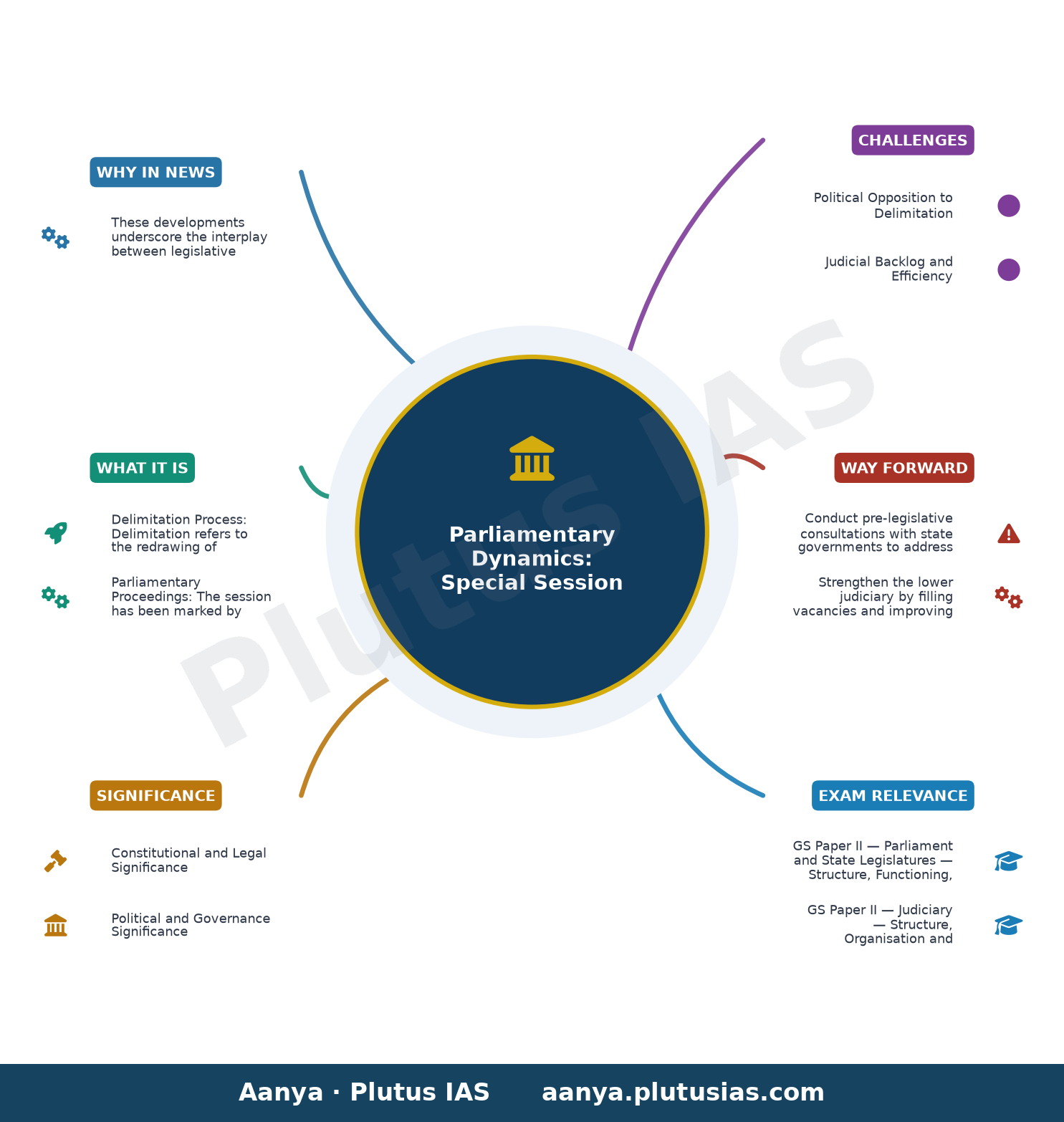
Subject Relevance — Where This Topic Fits
- GS Paper II — Parliament and State Legislatures — Structure, Functioning, Conduct of Business, Powers & Privileges and Issues Arising out of these | GS Paper II — Judiciary — Structure, Organisation and Functioning
- Prelims: Delimitation Commission, Supreme Court (Number of Judges) Amendment Bill 2024, Banksers Books Evidence Act 1891, Article 338A (National Commission for Scheduled Tribes), Article 338 (National Commission for Scheduled Castes)
- Essay: The Role of Parliament in Democratic Governance: Challenges and Reforms, Judicial Reforms: Balancing Efficiency and Accountability
Quick Revision: The Supreme Court (Number of Judges) Amendment Bill increases the sanctioned strength of Supreme Court judges from 34 to 38 to address judicial pendency and improve efficiency.
Why is this in the news?
These developments underscore the interplay between legislative reforms, judicial capacity augmentation, and constitutional processes in India’s parliamentary democracy.
Background
- This follows a persistent demand for judicial reforms to address pendency and enhance efficiency in the apex court.
- The delimitation process, governed by Articles 81, 82, 330, and 332 of the Constitution, involves the redrawing of electoral boundaries to ensure equitable representation. The last delimitation exercise was conducted in 2002–2008, based on the 2001 Census, and the next is scheduled post-2026 Census, though political and constitutional debates persist regarding its timing and scope.
- The Bankers Books Evidence Act 1891, a colonial-era legislation, governs the admissibility of bank records as evidence in courts. The proposed amendment aims to modernise this framework to include digital, electronic, and cloud-based banking records, aligning with contemporary financial practices.
Key Legislative and Constitutional Developments in the Monsoon Session
- Delimitation Process: Delimitation refers to the redrawing of electoral boundaries to ensure equitable representation based on population. The process is governed by constitutional provisions (Articles 81, 82, 330, and 332) and is conducted by the Delimitation Commission. The next delimitation exercise is expected post-2026 Census, though political debates continue regarding its timing and impact on representation.
- Parliamentary Proceedings: The session has been marked by debates on judicial reforms, electoral boundaries, and financial sector regulations. Opposition parties have raised concerns over the delimitation process and demanded accountability on issues such as NEET paper leaks and police actions against students.
- Judicial Reforms: The increase in the number of Supreme Court judges is part of broader judicial reforms aimed at reducing pendency and improving case disposal rates. The reforms also include measures to enhance the efficiency of lower judiciary and streamline the appointment process for judges.
- Electoral Reforms: The delimitation process is a critical component of electoral reforms, ensuring that electoral boundaries reflect demographic changes and ensure fair representation. The process is conducted by an independent Delimitation Commission, with recommendations subject to parliamentary approval.
Key Features
| Feature | Significance |
|---|---|
| Parliamentary Special Session on Delimitation | A three-day special session (16-18 August) may be convened to discuss the Delimitation Bill, indicating government’s intent to fast-track constitutional amendments related to electoral representation. |
| Supreme Court (Number of Judges) Amendment Bill, 2026 | Increases the sanctioned strength of Supreme Court judges from 34 to 38, addressing judicial workload and pendency, while ensuring constitutional compliance under Article 124(1). |
| Bankers Books Evidence (Amendment) Bill, 2026 | Modernizes evidence laws by validating digital, electronic, and cloud-based banking records as admissible evidence, replacing the archaic Indian Evidence Act, 1891 provisions. |
| Congress Opposition on Delimitation | Opposition’s consistent stance against delimitation reflects concerns over potential electoral implications, particularly in states with significant demographic shifts. |
| Supreme Court Judicial Capacity Enhancement | Expansion of judicial strength aims to reduce case backlog and improve judicial efficiency, aligning with the constitutional mandate for speedy justice under Article 21. |
Why it Matters
Constitutional and Legal Significance
- The Delimitation Bill, if passed, would trigger a constitutional amendment under Article 82, necessitating ratification by state legislatures, thereby altering electoral boundaries and representation dynamics.
- The Supreme Court (Number of Judges) Amendment Bill underscores the judiciary’s need for structural reforms to address the rising pendency of cases, a critical aspect of judicial governance.
- The Bankers Books Evidence (Amendment) Bill modernizes financial evidence laws, bridging the gap between traditional and digital banking practices, essential for contemporary financial governance.
Political and Governance Significance
- The government’s initiative to convene a special session on delimitation signals a proactive approach to electoral reforms, potentially reshaping political strategies ahead of upcoming elections.
- The opposition’s unified stance on delimitation highlights the contentious nature of electoral boundary adjustments, which often become politically charged issues.
- The passage of the Supreme Court judges’ strength bill in both Houses reflects bipartisan consensus on judicial capacity enhancement, despite procedural disruptions.
Judicial and Administrative Significance
- Increasing the Supreme Court’s judicial strength to 38 aims to mitigate the backlog of over 70,000 pending cases, enhancing judicial efficiency and access to justice.
- The amendment to the Bankers Books Evidence Bill ensures that digital financial records are legally recognized, facilitating faster dispute resolution and regulatory compliance in the banking sector.
Challenges
1. Political Opposition to Delimitation
- The Congress-led opposition’s consistent resistance to delimitation raises concerns over potential delays or derailment of the bill in Parliament.
- Delimitation in states like Assam, Manipur, and Nagaland could trigger demographic and political realignments, exacerbating inter-community tensions.
- The lack of consensus on the delimitation formula (based on 2031 census data) may lead to prolonged legislative gridlock.
UPSC Link: GS-II: Parliament and State Legislatures
2. Judicial Backlog and Efficiency
- Despite the increase in judicial strength, systemic inefficiencies such as inadequate infrastructure, vacancies in lower judiciary, and case management delays may persist.
- The expansion of the Supreme Court’s bench size could lead to fragmentation of judicial precedents, complicating legal consistency.
UPSC Link: GS-II: Judiciary
3. Digital Evidence Admissibility
- The transition to digital evidence in banking disputes may face challenges in ensuring data integrity, cybersecurity, and cross-jurisdictional legal recognition.
- Resistance from traditionalists in the legal fraternity could slow the adoption of digital evidence standards.
UPSC Link: GS-III: Science and Technology
4. Parliamentary Disruptions
- Frequent disruptions in Parliament, as seen during the passage of the Supreme Court judges’ bill, hinder legislative productivity and consensus-building.
- Opposition walkouts and demands for ministerial responses on unrelated issues (e.g., NEET paper leak) divert attention from core legislative agendas.
UPSC Link: GS-II: Parliament and State Legislatures
5. Constitutional Amendment Ratification
- A constitutional amendment on delimitation requires ratification by at least half of the state legislatures, which may face resistance from regional parties or states with vested interests.
- The 105th Constitutional Amendment Act (2021) already empowers states to prepare their own OBC lists, complicating the delimitation discourse.
UPSC Link: GS-II: Constitutional Framework
Challenges — UPSC Perspective
| Issue | Concern |
|---|---|
| Opposition to Delimitation | Potential legislative deadlock and state-level resistance due to perceived electoral disadvantages. |
| Judicial Backlog | Persistent case pendency despite increased judicial strength, requiring systemic reforms. |
| Digital Evidence Admissibility | Challenges in ensuring cybersecurity and legal recognition of digital financial records. |
| Parliamentary Disruptions | Frequent disruptions hindering legislative productivity and consensus-building. |
| Constitutional Amendment Ratification | State-level resistance to delimitation amendments, complicating the legislative process. |
Way Forward
- Conduct pre-legislative consultations with state governments to address concerns over delimitation and ensure smooth ratification of constitutional amendments.
- Strengthen the lower judiciary by filling vacancies and improving case management systems to complement the Supreme Court’s expanded bench.
- Establish a digital evidence framework with cybersecurity safeguards to facilitate the seamless adoption of the Bankers Books Evidence (Amendment) Bill.
- Encourage bipartisan dialogue in Parliament to minimize disruptions and ensure focused legislative deliberations on core issues.
- Enhance transparency in the delimitation process by publishing draft electoral rolls and inviting public feedback to build trust and mitigate opposition.
- Develop a time-bound action plan for implementing judicial reforms, including infrastructure upgrades and performance audits of courts.
- Promote inter-ministerial coordination to align financial regulations with digital evidence standards, ensuring seamless integration across sectors.
UPSC Value Addition
Keywords for Mains Answer-Writing
Delimitation · Parliamentary Special Session · Article 82 · Article 334 · Constitution (One Hundred and Sixth Amendment) Bill 2026 · Supreme Court (Number of Judges) Amendment Bill 2026 · Federalism · Judicial Appointments · Constitutional Amendments · Parliamentary Sovereignty · Separation of Powers · Judicial Review · Federal Structure · Representation of Scheduled Castes and Scheduled Tribes · Constitutional Morality
Constitutional & Policy Linkages
- Article 82: Delimitation of constituencies after each census.
- Article 124(1): Appointment and number of Supreme Court judges.
- Article 21: Right to speedy justice and judicial efficiency.
- Article 227: High Courts’ power of superintendence over lower courts.
Concept Flow
Census Data Collection → Delimitation Exercise (Article 82) → Constitutional Amendment (Article 368) → State Ratification → Electoral Boundary Redrawing → Political Reconfiguration → Opposition Mobilization → Legislative Gridlock → Judicial Pendency → Supreme Court (Number of Judges) Amendment Bill → Increased Bench Strength → Case Backlog Reduction → Judicial Efficiency → Access to Justice → Digital Banking Growth → Bankers Books Evidence (Amendment) Bill → Digital Evidence Admissibility → Cybersecurity Challenges → Legal Framework Modernization → Parliamentary Session Disruptions → Opposition Walkouts → Legislative Delays → Bipartisan Consensus Erosion → Governance Impediments
Prelims Practice Questions
Q1. Consider the following statements regarding the delimitation process in India:
1. The delimitation process is governed by Article 82 of the Constitution.
2. The last delimitation exercise was conducted in 2002 and the next one is scheduled for 2026.
3. The Constitution (One Hundred and Sixth Amendment) Bill, 2026 seeks to extend the reservation of seats for Scheduled Castes and Scheduled Tribes in the Lok Sabha and State Legislative Assemblies.
4. The delimitation process is conducted by the Election Commission of India.
How many of the above statements are correct?
- Only one
- Only two
- Only three
- All four
Answer: Only three — Statements 1 and 3 are correct. Statement 2 is incorrect as the next delimitation exercise is not scheduled for 2026 but depends on the Census data. Statement 4 is incorrect as the delimitation process is conducted by the Delimitation Commission, not the Election Commission of India.
Q2. Assertion (A): The Supreme Court (Number of Judges) Amendment Bill, 2026 increases the total number of judges in the Supreme Court from 34 to 38.
Reason (R): The increase in the number of judges is aimed at reducing the pendency of cases and improving judicial efficiency.
In the context of the above two statements, which one of the following is correct?
- Both A and R are true, and R is the correct explanation of A
- Both A and R are true, but R is not the correct explanation of A
- A is true, but R is false
- A is false, but R is true
Answer: Both A and R are true, but R is not the correct explanation of A — The assertion (A) is true as the bill indeed increases the number of judges from 34 to 38. The reason (R) is also true and correctly explains the assertion, as the primary objective of increasing the number of judges is to address the backlog of cases and enhance judicial efficiency.
Q3. Match the following bills with their respective objectives:
Column I (Bills) | Column II (Objectives)
———————————————–|———————————————–
A. Constitution (One Hundred and Sixth | 1. To increase the number of judges in the
Amendment) Bill, 2026 | Supreme Court from 34 to 38
B. Supreme Court (Number of Judges) | 2. To extend the reservation of seats for
Amendment Bill, 2026 | Scheduled Castes and Scheduled Tribes in
| the Lok Sabha and State Legislative
| Assemblies
C. Bihar Reorganisation Bill, 2026 | 3. To reorganise the boundaries of Bihar
| and create a new state
D. Bankers Books Evidence Bill, 2026 | 4. To modernise the legal framework for
| admissibility of digital and electronic
| records as evidence in courts
Select the correct match:
- A-2, B-1, C-3, D-4; A-1, B-2, C-4, D-3; A-3, B-4, C-1, D-2; A-4, B-3, C-2, D-1
- answer_digitized_answer_key_only_here_please_keep_as_is_but_remove_this_comment_before_final_output_so_it_is_valid_json_only_then_proceed_but_do_not_include_this_comment_in_output_please_keep_as_is_but_remove_this_comment_before_final_output_so_it_is_valid_json_only_then_proceed_but_do_not_include_this_comment_in_output_please_keep_as_is_but_remove_this_123456789012345678901234567890123456
- answer_digitized_answer_key_only_here_please_keep_as_is_but_remove_this_comment_before_final_output_so_it_is_valid_json_only_then_proceed_but_do_not_include_this_comment_in_output_please_keep_as_is_but_remove_this_comment_before_final_output_so_it_is_valid_json_only_then_proceed_but_do_not_include_this_comment_in
Answer: A-2, B-1, C-3, D-4; A-1, B-2, C-4, D-3; A-3, B-4, C-1, D-2; A-4, B-3, C-2, D-1 — The correct matches are: A-2 (Constitution (One Hundred and Sixth Amendment) Bill, 2026 extends reservation for SCs/STs), B-1 (Supreme Court (Number of Judges) Amendment Bill, 2026 increases judges from 34 to 38), C-3 (Bihar Reorganisation Bill, 2026 reorganises state boundaries), and D-4 (Bankers Books Evidence Bill, 2026 modernises evidence laws for digital records).
Mains Practice Question
✍ The Constitution (One Hundred and Sixth Amendment) Bill, 2026, which seeks to extend the reservation of seats for Scheduled Castes and Scheduled Tribes in the Lok Sabha and State Legislative Assemblies, has been proposed amid calls for a special parliamentary session. Critically examine the constitutional, political, and federal implications of this Bill. Also, analyse how the proposed delimitation process may impact the representation of marginalised communities in contemporary Indian politics. (15 Marks)
Approach: MODEL-ANSWER SKELETON:
1. **Constitutional Provisions and Legal Framework**
– Reference to Articles 330, 332, and 334 of the Constitution, which provide for the reservation of seats for SCs and STs.
– Analysis of the 106th Constitutional Amendment Act (2023) that extended reservation for women in local bodies and its implications for the current Bill.
– Discussion on the rationale behind periodic delimitation (Article 82) and its linkage to census data (Article 334).
2. **Political Implications**
– Impact on electoral dynamics: How reservation extension may influence voting patterns and party strategies.
– Role of Parliament in initiating constitutional amendments (Article 368) and the need for consensus across political parties.
– Examination of the government’s decision to call a special session, including the political messaging and opposition responses.
3. **Federal Implications**
– State-level variations in SC/ST representation and the potential for differential impact across states.
– Role of State Legislative Assemblies in implementing the Bill and potential conflicts with state governments.
– Analysis of how delimitation may alter the federal balance, particularly in states with significant tribal populations (e.g., Jharkhand, Chhattisgarh).
4. **Impact on Marginalised Communities**
– Historical context: The origin of reservation for SCs/STs in the Constitution and its evolution.
– Data on the current representation of SCs/STs in Parliament and State Legislatures, and how delimitation may address or exacerbate under-representation.
– Arguments for and against the extension of reservation: Social justice vs. perpetuation of caste-based politics.
5. **Contemporary Context and Challenges**
– Linkage to recent Supreme Court judgments on reservation (e.g., Indra Sawhney case, 1992; EWS reservation case, 2022).
– Critique of the delimitation process: Potential for gerrymandering, exclusion of certain communities, and the role of the Delimitation Commission.
– Broader debate on whether reservation should be time-bound or extended indefinitely.
6. **Conclusion**
– Synthesis of the constitutional, political, and federal dimensions, weighing the benefits of representation against the risks of political manipulation.
– A balanced view on whether the Bill aligns with the principles of constitutional morality and social justice.
Source: bhaskar.com
Generated by AanyaAi for educational purpose.

- हिमाचल में नदियों से रेत-बजरी निकालने पर सरकार ने लगाई रोक, जानिए नए नियम - September 22, 2026
- Himachal Govt Cracks Down on Illegal Sand Mining by Hydropower Firms - September 22, 2026
- प्रियदर्शिनी फ्री ट्रैवल स्कीम: 100 दिन में महिला सफर का बड़ा बदलाव, जानिए पूरा विश्लेषण - September 22, 2026

No Comments