


22 Sep Himachal Govt Cracks Down on Illegal Sand Mining by Hydropower Firms
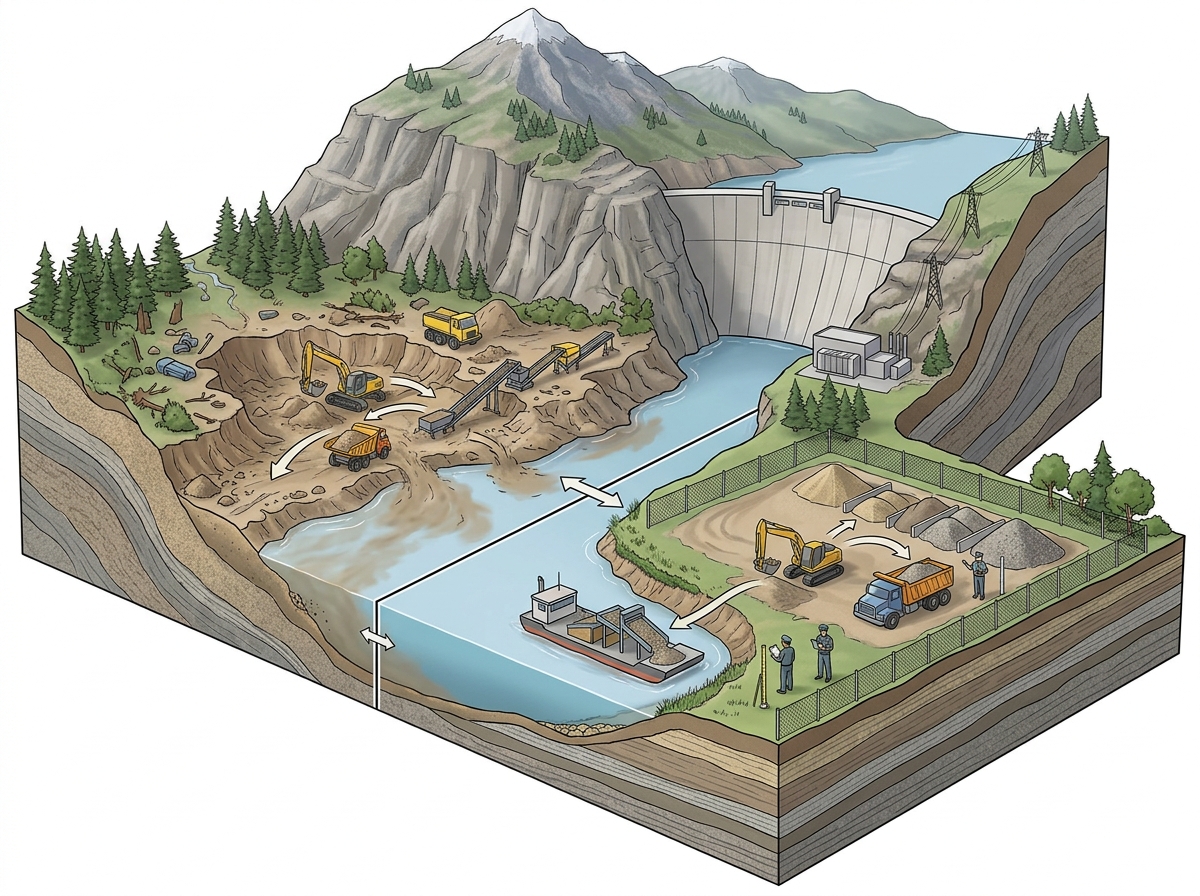
✎ The Himachal Pradesh government has proposed stringent regulatory measures to curb unregulated sand and gravel extraction from riverbeds by hydropower project operators.
Subject Relevance — Where This Topic Fits
- GS Paper II — Governance, Transparency and Accountability | GS Paper III — Environment and Sustainable Development
- Prelims: Environment Protection Act, 1986, Riverbed Mining Policy, National Green Tribunal (NGT), Forest Conservation Act, 1980, Public Trust Doctrine, Sand Mining Guidelines 2020, Himachal Pradesh Minor Minerals Concession Rules, 2013
- Essay: Sustainable management of natural resources: Balancing development and ecological conservation, Role of judiciary in environmental governance: A case study of riverbed mining
Why is this in the news?
The Himachal Pradesh government has proposed stringent regulatory measures to curb unregulated sand and gravel extraction from riverbeds by hydropower project operators. The move aims to assert state control over minor mineral resources, ensuring that extraction activities are conducted only under government-approved tendering processes, thereby preventing arbitrary and environmentally damaging mining practices by private entities operating within hydropower project areas.
Background
- The state hosts several large hydropower projects such as Nathpa Jhakri (1500 MW), Koldam (800 MW), and Parbati Stage-III (520 MW), along with numerous smaller projects.
- Riverbed mining for sand and gravel has historically been a lucrative but unregulated activity, often leading to ecological degradation, riverbank erosion, and conflicts with local communities.
- The Constitution of India places minor minerals, including sand and gravel, under the purview of state governments under Entry 23 of the State List (Seventh Schedule).
- The National Green Tribunal (NGT) has repeatedly highlighted the environmental hazards of unregulated riverbed mining and directed states to enforce strict compliance with the Sustainable Sand Mining Management Guidelines, 2020.
- The Himachal Pradesh Minor Minerals Concession Rules, 2013, regulate the grant of mining leases for minor minerals but have been inconsistently enforced in hydropower project areas.
What are the proposed regulatory changes and their legal basis?
- The government proposes to prohibit hydropower project operators from issuing tenders for sand-gravel extraction independently; all such activities must be conducted under state-authorised tendering processes.
- The move aligns with the Public Trust Doctrine, which mandates that the state acts as a trustee of natural resources for the benefit of the public, ensuring sustainable and equitable utilisation.
- [‘The National Green Tribunal (NGT) has, in multiple orders, directed states to ensure that riverbed mining activities are conducted only after obtaining environmental clearances and in compliance with the Sustainable Sand Mining Management Guidelines, 2020.’, ‘The Himachal Pradesh Minor Minerals Concession Rules, 2013, provide the statutory framework for regulating minor mineral extraction, including the grant of mining leases and the imposition of environmental safeguards.’, “The state government’s assertion of control over minor minerals is consistent with the constitutional principle that natural resources vest in the state for the welfare of the people, as interpreted by the Supreme Court in various judgments (e.g., *State of West Bengal v. Kesoram Industries Ltd.*).”, ‘The proposed measures also aim to address the ecological impact of unregulated mining, such as riverbank destabilisation, loss of biodiversity, and disruption of sediment flow, which can affect downstream areas and hydropower infrastructure.’]
Key Features
| Feature | Significance |
|---|---|
| Mandatory government approval for sand-gravel extraction | Ensures state control over extraction from riverbeds within hydropower project areas, preventing unilateral decisions by private operators. |
| Centralised tendering process for extraction | Shifts authority from project operators to state agencies, ensuring transparency and equitable resource distribution. |
| Prohibition on self-initiated tenders by operators | Eliminates arbitrary extraction practices, aligning with constitutional provisions on natural resource governance. |
| Emphasis on state’s sovereign rights over riverbed minerals | Reinforces the principle that riverbed resources are public property, not automatically vested with project developers. |
| Regulatory oversight of hydropower project operations | Bridges governance gaps in resource extraction within project concessions, ensuring compliance with environmental and legal norms. |
Why it Matters
Economic
- Prevents revenue leakage by ensuring state-led monetisation of riverbed minerals extracted within hydropower project concessions.
- Enhances fiscal federalism by centralising resource control under state authorities rather than delegating to private entities.
- Supports sustainable revenue generation for state exchequer from natural resources, particularly in hydro-rich regions like Himachal Pradesh.
Environmental
- Mitigates ecological degradation from unregulated sand-gravel extraction, which disrupts river ecosystems and sediment flow.
- Aligns with the ‘Polluter Pays’ principle by subjecting extraction activities to state-approved environmental safeguards.
- Supports compliance with the National Green Tribunal’s directives on sustainable riverbed mining practices.
Legal-Governance
- Clarifies the legal distinction between land rights granted to hydropower projects and sovereign rights over riverbed minerals.
- Strengthens the implementation of the Mines and Minerals (Development and Regulation) Act, 1957, and state-specific mining policies.
- Ensures adherence to the constitutional mandate under Article 297, which vests ownership of natural resources in the state.
Strategic
- Bolsters state capacity in regulating resource extraction within infrastructure projects, preventing monopolistic practices by private operators.
- Supports long-term hydropower sustainability by integrating environmental and economic considerations into project operations.
- Enhances inter-state coordination in transboundary river basins (e.g., Sutlej, Chenab) where extraction impacts multiple jurisdictions.
Challenges
1. Regulatory Arbitrage by Project Operators
- Historical tendency of private hydropower operators to bypass state oversight by self-initiating extraction tenders.
- Lack of uniform enforcement mechanisms across river basins, leading to inconsistent compliance with extraction norms.
- Potential resistance from project developers accustomed to operational autonomy in resource utilisation.
UPSC Link: Mines and Minerals (Development and Regulation) Act, 1957
2. Ecological Risks of Unregulated Extraction
- Riverbed mining disrupts sediment balance, increasing downstream erosion and flood risks in vulnerable regions like Himachal Pradesh.
- Threat to biodiversity, particularly in ecologically sensitive zones such as the Himalayan river basins.
- Long-term degradation of riverine ecosystems, undermining the ecological services provided by these water bodies.
UPSC Link: Environmental Impact Assessment (EIA) Notification, 2006
3. Inter-Jurisdictional Conflicts
- Overlap between state-level extraction regulations and centralised environmental clearances under the EIA framework.
- Potential disputes with neighbouring states in transboundary river basins (e.g., Sutlej, Chenab) over resource utilisation rights.
- Coordination challenges between state agencies (e.g., Energy Department, Geology Department) and hydropower project authorities.
UPSC Link: Inter-State River Water Disputes Act, 1956
4. Operational Bottlenecks in Implementation
- Delays in state-led tendering processes due to bureaucratic hurdles and resource constraints.
- Need for capacity building among state agencies to enforce extraction norms effectively.
- Risk of corruption in centralised tendering mechanisms, necessitating robust transparency measures.
UPSC Link: Prevention of Corruption Act, 1988
5. Legal Ambiguities in Resource Ownership
- Unclear demarcation between land rights granted to hydropower projects and sovereign rights over riverbed minerals.
- Potential conflicts with the constitutional provisions under Article 297, which vest ownership of natural resources in the state.
- Need for judicial clarity on the applicability of mining laws to riverbed resources within project concessions.
UPSC Link: Article 297 of the Constitution of India
Challenges — UPSC Perspective
| Issue | Concern |
|---|---|
| Historical autonomy of project operators | Operators may resist state-led oversight, citing operational convenience or contractual rights. |
| Ecological fragility of Himalayan river basins | Unregulated extraction exacerbates erosion, landslides, and biodiversity loss in fragile ecosystems. |
| Inter-state disputes over transboundary rivers | Extraction in shared basins (e.g., Sutlej, Chenab) may trigger conflicts with neighbouring states. |
| Bureaucratic delays in tendering processes | State-led centralisation may introduce inefficiencies, delaying project timelines. |
| Corruption risks in resource allocation | Centralised tendering requires stringent anti-corruption measures to ensure fairness and transparency. |
| Legal ambiguities in resource ownership | Unclear demarcation between land rights and mineral rights may lead to litigation and regulatory uncertainty. |
Way Forward
- Establish a dedicated state-level authority to oversee sand-gravel extraction within hydropower project areas, ensuring compliance with environmental and legal norms.
- Develop a transparent and time-bound tendering process for extraction, with mandatory environmental impact assessments and public consultations.
- Strengthen inter-departmental coordination between the Energy Department, Geology Department, and State Pollution Control Board to enforce extraction norms.
- Conduct capacity-building programmes for state officials to enhance their understanding of mining laws, environmental regulations, and constitutional provisions.
- Implement real-time monitoring systems (e.g., drones, satellite imagery) to track extraction activities and prevent illegal mining.
- Formulate a state-specific policy on riverbed mining, aligning it with the National Mineral Policy 2019 and the Sustainable Development Goals.
- Engage with hydropower project operators to sensitise them about the new regulatory framework and the rationale behind state-led oversight.
- Collaborate with neighbouring states in transboundary river basins to harmonise extraction norms and prevent inter-state disputes.
UPSC Value Addition
Keywords for Mains Answer-Writing
Himachal Pradesh · River sand mining · Hydropower projects · Natural resource governance · State autonomy over minerals · Environmental regulation · Sand and gravel extraction · Public procurement process · Sukhvinder Singh Sukhu · National Green Tribunal · Environmental Impact Assessment · Sustainable development · Inter-state river basins · Sutlej Basin hydropower projects · Chinab Basin hydropower projects · Sand mining policy · State authority over minor minerals · Environmental degradation · Regulatory oversight · Sustainable resource management
Constitutional & Policy Linkages
- [‘Article 297’, ‘Vests ownership of natural resources in the state.’]
- [‘Article 262’, ‘Empowers Parliament to adjudicate inter-state river water disputes.’]
- [‘Seventh Schedule’, ‘Distributes legislative powers between the Union and States on mining and water resources.’]
Concept Flow
Hydropower project operators historically extract sand-gravel from riverbeds within their concessions without state oversight. → This practice leads to unregulated extraction, ecological degradation, and revenue leakage for the state. → The state government introduces a regulatory framework requiring government approval for extraction and centralising tendering processes. → The new framework aligns with constitutional provisions (e.g., Article 297) and mining laws, ensuring state sovereignty over riverbed minerals. → Implementation requires inter-departmental coordination, capacity building, and real-time monitoring to enforce compliance. → Long-term outcomes include sustainable resource utilisation, ecological preservation, and equitable revenue generation for the state.
Prelims Practice Questions
Q1. Consider the following statements regarding the regulation of sand and gravel mining in India:
1. The regulation of minor minerals such as sand and gravel is primarily vested with the State Governments under the Mines and Minerals (Development and Regulation) Act, 1957.
2. The National Green Tribunal (NGT) has no jurisdiction over disputes related to sand mining.
3. The Environmental Impact Assessment (EIA) Notification, 2006, mandates prior environmental clearance for river sand mining in certain cases.
How many of the above statements are correct?
- Only one
- Only two
- All three
- None
Answer: Only two — Statement 1 is correct: The regulation of minor minerals like sand and gravel is indeed vested with State Governments under the MMDR Act, 1957. Statement 2 is incorrect: The NGT has jurisdiction over environmental disputes, including those related to sand mining. Statement 3 is correct: The EIA Notification, 2006, mandates prior environmental clearance for river sand mining in certain cases, particularly where the mining area exceeds a specified threshold.
Q2. Assertion (A): The Government of Himachal Pradesh has recently amended its policy to require prior state approval for sand and gravel extraction by hydropower project operators.
Reason (R): The amendment aims to assert state authority over natural resources and prevent arbitrary extraction that could lead to environmental degradation.
In the context of the above statements, which of the following is correct?
- Both A and R are true, and R is the correct explanation of A
- Both A and R are true, but R is not the correct explanation of A
- A is true, but R is false
- A is false, but R is true
Answer: Both A and R are true, and R is the correct explanation of A — Both Assertion (A) and Reason (R) are true. The amendment in Himachal Pradesh indeed requires prior state approval for sand and gravel extraction by hydropower project operators to assert state authority and prevent environmental degradation. The Reason (R) correctly explains the Assertion (A).
Q3. Match the following river basins with their associated hydropower projects in Himachal Pradesh:
Column I (River Basin) | Column II (Hydropower Project)
— | —
A. Sutlej Basin | 1. Nathpa Jhakri
B. Chinab Basin | 2. Dul Hasti
C. Beas Basin | 3. Parbati Stage-III
D. Ravi Basin | 4. Chamera
Select the correct match:
- A-1, B-2, C-3, D-4
- A-2, B-1, C-4, D-3
- A-1, B-2, C-4, D-3
- A-3, B-1, C-2, D-4
Answer: A-1, B-2, C-3, D-4 — The correct matches are: A-1 (Sutlej Basin – Nathpa Jhakri), B-2 (Chinab Basin – Dul Hasti), C-3 (Beas Basin – Parbati Stage-III), and D-4 (Ravi Basin – Chamera).
Mains Practice Question
✍ The Government of Himachal Pradesh has recently introduced stricter regulations governing the extraction of sand and gravel from river beds by hydropower project operators. Critically examine the constitutional and statutory basis for state authority over minor minerals, with particular reference to the Mines and Minerals (Development and Regulation) Act, 1957, and the environmental governance framework. Also, analyse the implications of such regulations for sustainable development and inter-state river basin management. (15 Marks)
Approach: MODEL-ANSWER SKELETON:
1. **Constitutional and Statutory Basis for State Authority over Minor Minerals:**
– Article 246(3) of the Constitution of India read with the State List (List II, Entry 23) vests the regulation of minor minerals with State Governments.
– The Mines and Minerals (Development and Regulation) Act, 1957 (MMDR Act) empowers State Governments to frame rules for the grant of mineral concessions for minor minerals.
– The Supreme Court in *Deepak Kumar v. State of Haryana* (2012) and *State of Tamil Nadu v. SEIAA* (2018) has upheld the exclusive authority of State Governments over minor minerals.
2. **Environmental Governance Framework:**
– The Environmental Impact Assessment (EIA) Notification, 2006, mandates prior environmental clearance for river sand mining in ecologically sensitive areas or where the mining area exceeds 5 hectares.
– The National Green Tribunal (NGT) has jurisdiction over disputes related to environmental degradation, including illegal sand mining (e.g., *Foundation for Restoration of Wildlife and Environment v. Union of India*, 2021).
– The National Mineral Policy, 2019, and Sustainable Sand Mining Management Guidelines, 2016, emphasize sustainable extraction and ecological balance.
3. **Implications for Sustainable Development:**
– Stringent regulation ensures ecological balance, prevents riverbed erosion, and protects aquatic biodiversity.
– It aligns with the Sustainable Development Goals (SDG 12: Responsible Consumption and Production, SDG 14: Life Below Water).
– However, over-regulation may lead to delays in hydropower projects, impacting energy security and economic growth.
4. **Inter-State River Basin Management:**
– Rivers like Sutlej and Chinab are inter-state rivers, requiring coordination with neighboring states (e.g., Punjab, Jammu & Kashmir) under the Inter-State Water Disputes Act, 1956.
– The National Water Policy, 2012, and River Basin Management frameworks emphasize integrated and sustainable water resource management.
5. **Balancing Development and Environmental Protection:**
– The Himachal Pradesh government’s move reflects a shift towards sustainable resource governance, balancing hydropower development with environmental conservation.
– The policy must ensure transparency in the public procurement process for sand and gravel extraction to prevent corruption and arbitrariness.
6. **Conclusion:**
– The regulations are legally sound and environmentally justified, but their success depends on effective implementation, inter-state cooperation, and stakeholder engagement.
Source: amarujala.com
Himachal Pradesh PCS (HPPSC (HAS)) — State PCS Practice
Prelims: As per recent Himachal Pradesh government directives, which authority has been empowered to regulate the extraction of sand and gravel from rivers to prevent arbitrary practices by electricity project companies?
- Himachal Pradesh State Pollution Control Board (HPPCB)
- Himachal Pradesh State Electricity Regulatory Commission (HPERC)
- Himachal Pradesh State Environment Impact Assessment Authority (SEIAA)
- Himachal Pradesh State Pollution Control Board (HPPCB) in coordination with the Irrigation and Public Health Department
Answer: Himachal Pradesh State Pollution Control Board (HPPCB) in coordination with the Irrigation and Public Health Department — The directive mandates coordination between HPPCB and the Irrigation and Public Health Department to regulate riverbed material extraction.
Mains: Discuss the environmental and socio-economic implications of unregulated sand and gravel extraction from riverbeds in Himachal Pradesh, particularly in the context of hydropower projects. Suggest measures to ensure sustainable extraction while balancing developmental needs.
Generated by AanyaAi for educational purpose.
Related guides on our sites
- Current affairs for upsc 2026
- Best PSIR optional coaching for upsc
- Best PSIR optional teacher for upsc
- Best teacher of PSIR optional for upsc

- Himachal Govt Cracks Down on Illegal Sand Mining by Hydropower Firms - September 22, 2026
- प्रियदर्शिनी फ्री ट्रैवल स्कीम: 100 दिन में महिला सफर का बड़ा बदलाव, जानिए पूरा विश्लेषण - September 22, 2026
- Kerala’s Priyadarshini Scheme: 100 Days of Free Travel & Its Impact on Polity - September 22, 2026

No Comments