


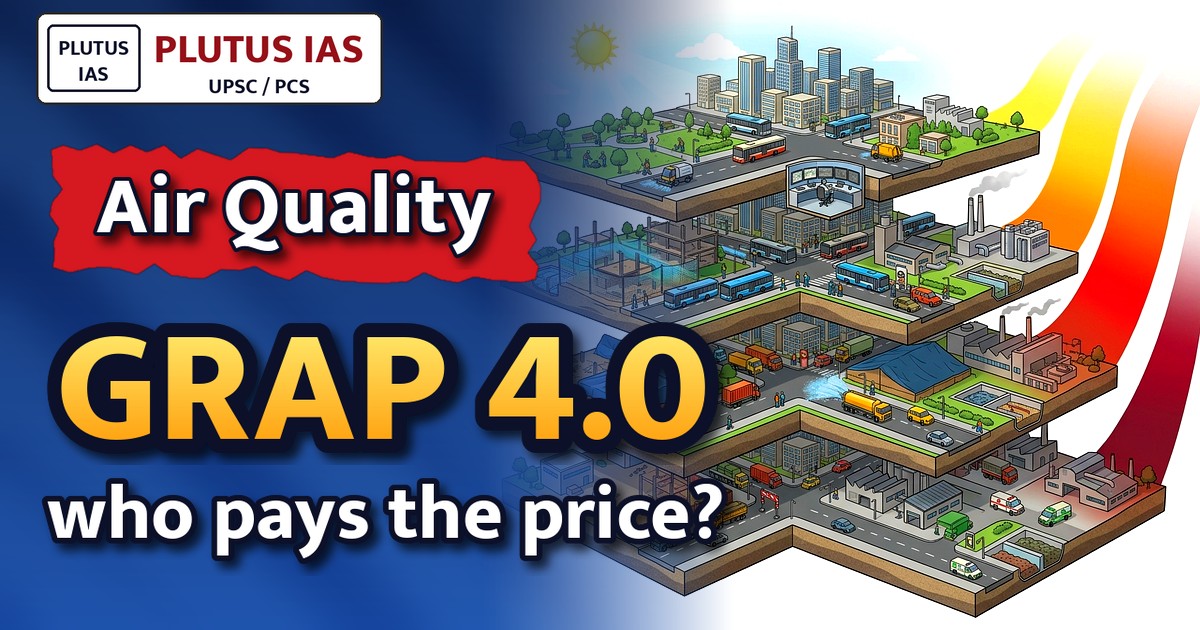
29 Sep सीएक्यूएम Approves Stricter GRAP Measures for NCR Air Quality
✎ GRAP is a statutory, four-stage action plan enforced by CAQM in the NCR, with measures escalating from Stage I to Stage IV, integrating vehicular, dust, and waste management controls.
Subject Relevance — Where This Topic Fits
- GS Paper III — Environment and Pollution Control
- Prelims: GRAP, AQI, NCR, CPCB, air quality management, BS norms, dust control, construction activity regulation
- Essay: Environmental governance and sustainable urban development
Quick Revision: GRAP is a statutory, four-stage action plan enforced by CAQM in the NCR, with measures escalating from Stage I to Stage IV, integrating vehicular, dust, and waste management controls.
Why is this in the news?
The Commission for Air Quality Management in NCR and Adjoining Areas (CAQM) approved amendments to the Graded Response Action Plan (GRAP) on 28 September 2026, intensifying measures for vehicle emissions, dust control, and waste management to mitigate air pollution in the National Capital Region (NCR). The revisions aim to enhance enforcement, expand coverage, and integrate citizen-centric actions under a revised four-stage framework.
Background
- GRAP operates through a four-stage response mechanism triggered by the Air Quality Index (AQI), with progressively stringent measures from Stage I (moderate air quality) to Stage IV (severe air quality).
- The NCR includes Delhi and parts of Haryana, Rajasthan, and Uttar Pradesh.
What is the Graded Response Action Plan (GRAP)?
- GRAP is a statutory, graded action plan to address air pollution in the National Capital Region (NCR) based on real-time Air Quality Index (AQI) levels.
- It operates through four stages with progressively stricter measures to reduce emissions and particulate matter.
- The plan includes sector-specific actions such as restrictions on vehicular movement, dust control measures at construction sites, waste management protocols, and industrial emission controls.
- GRAP integrates enforcement mechanisms through the CAQM, with a dedicated Enforcement Task Force (ETF) to monitor compliance.
- The 2026 amendments expand the scope of Stage I to include consolidated dust control, municipal solid waste (MSW) management, and transport-related actions, previously distributed across stages.
- The revised GRAP also clarifies restrictions on BS-III and BS-IV vehicles, extending prohibitions to additional districts in Haryana (e.g., Sonipat) and tightening entry norms for commercial vehicles from adjoining states.
- A citizen charter has been incorporated into each stage of GRAP, outlining do’s and don’ts for public participation in pollution mitigation efforts.
- The CAQM has also strengthened web-based monitoring of dust control measures at construction and demolition (C&D) sites, extending coverage to urban areas, controlled zones, and industrial corridors beyond municipal limits.
Key Features
| Feature | Significance |
|---|---|
| Consolidation of Dust Control Measures in Stage-I | Integrates dust control, municipal solid waste management, and transport actions into the earliest response phase, enabling proactive mitigation of particulate matter (PM) emissions. |
| Advancement of BS-IV and Below Vehicle Restrictions to Stage-I | Shifts restrictions on older diesel generators and BS-IV or lower buses from Stage-II to Stage-I, aligning with the principle of graduated escalation in pollution response. |
| Expansion of Vehicle Emission Norms to New Districts | Extends BS-III petrol and BS-IV diesel vehicle bans to Sonipat, beyond existing High Vehicle Density (HVD) districts in NCR, enhancing uniformity in enforcement. |
| Web-Portal Based Monitoring of C&D Sites | Strengthens real-time tracking of construction and demolition activities across urban, industrial, and highway corridor zones in NCR, ensuring compliance with dust suppression norms. |
| Citizen Charter Enhancement in GRAP Stages | Adds 48 specific ‘dos and don’ts’ measures across all GRAP stages, improving public awareness and participatory enforcement of air quality protocols. |
Why it Matters
Environmental Governance
- Demonstrates a structured, phased approach to air quality management under the GRAP framework, integrating emission norms, dust control, and waste management into a single regulatory instrument.
- Enhances the enforceability of pollution control measures by aligning them with real-time monitoring and citizen engagement, reducing discretionary delays in implementation.
- Reflects the Commission’s (CAQM) role in harmonising multi-state actions within the NCR, ensuring that pollution control is not fragmented across administrative boundaries.
Public Health
- Prioritises the reduction of PM2.5 and PM10 concentrations by targeting high-emission sources such as older vehicles, diesel generators, and construction dust, which are directly linked to respiratory and cardiovascular diseases.
- Incorporates seasonal considerations (e.g., November-December sports events) to mitigate acute exposure risks for vulnerable populations, including students and the elderly.
- Expands the geographical scope of emission restrictions to include emerging urban centres like Sonipat, addressing the spatial spread of pollution beyond traditional high-density zones.
Institutional Strengthening
- Augments CAQM’s technical capacity through the appointment of two full-time members, enabling evidence-based decision-making and sustained enforcement of pollution control directives.
- Institutionalises real-time monitoring of construction activities via a web portal, reducing manual oversight and improving compliance rates through digital transparency.
- Strengthens the Enforcement Task Force (ETF) by providing updated data on compliance status, enabling targeted interventions and reducing systemic delays in enforcement actions.
Challenges
1. Inter-State Coordination
- Ensuring uniform implementation of GRAP measures across NCR states (Delhi, Haryana, Uttar Pradesh, Rajasthan) remains a challenge due to varying administrative capacities and political priorities.
- Coordination with neighbouring states for enforcement of vehicle restrictions and construction norms requires sustained inter-governmental dialogue and shared enforcement mechanisms.
UPSC Link: GS-II: Federalism and Centre-State Relations
2. Enforcement Bottlenecks
- Delays in penalising non-compliant units (e.g., 352 out of 1,831 closed units remain unresolved) highlight systemic challenges in prosecution and compliance verification.
- High vehicle density and informal transport sectors (e.g., older BS-III/IV vehicles) pose difficulties in phasing out emission norms without adequate replacement infrastructure.
UPSC Link: GS-III: Environmental Pollution and Degradation
3. Public Compliance and Awareness
- Low awareness among citizens and stakeholders about GRAP stages and their roles in enforcement (e.g., citizen charters) may limit the effectiveness of participatory measures.
- Resistance from local industries and transport operators to stricter norms could undermine compliance, necessitating robust awareness campaigns and incentives for transition.
UPSC Link: GS-III: Environmental Impact Assessment
4. Technological and Data Gaps
- Reliance on web-portal monitoring for construction activities may exclude smaller or remote sites, requiring supplementary ground-level verification mechanisms.
- Absence of real-time air quality data integration with GRAP stages could limit adaptive responses to sudden pollution spikes.
UPSC Link: GS-III: Science and Technology in Governance
Challenges — UPSC Perspective
| Issue | Concern |
|---|---|
| Variation in State-Level Implementation | Lack of uniformity in enforcement across NCR states may lead to pollution hotspots persisting in less stringent jurisdictions. |
| Inadequate Infrastructure for Vehicle Phase-Out | Limited availability of BS-VI compliant public transport and charging stations for electric vehicles hampers the transition from older emission norms. |
| Informal Sector Resistance | Unorganised transport and construction sectors may evade compliance due to weak regulatory oversight and economic incentives to retain older vehicles/equipment. |
| Data Accuracy in Monitoring Systems | Web-portal based systems may face inaccuracies in reporting, particularly for small-scale or temporary construction sites. |
| Seasonal Pollution Peaks | November-December events (e.g., sports competitions) coincide with worsening air quality, requiring pre-emptive measures to avoid acute health risks. |
Way Forward
- Strengthen inter-state coordination mechanisms under CAQM to ensure uniform enforcement of GRAP measures across all NCR states, including joint inspection teams and shared monitoring protocols.
- Accelerate the phase-out of BS-III/IV vehicles by expanding public transport electrification and providing subsidies for vehicle upgrades in high-density zones.
- Enhance public awareness campaigns through multi-lingual outreach, involving local governments, schools, and civil society to improve citizen participation in pollution control.
- Invest in real-time air quality monitoring networks and integrate them with GRAP stages to enable dynamic adjustments in pollution control measures based on live data.
- Mandate third-party audits for construction and demolition sites to supplement web-portal monitoring, ensuring accuracy and reducing evasion of dust control norms.
- Establish a grievance redressal mechanism for industries and transport operators to address compliance challenges, offering phased penalties and technical support for transition.
- Develop contingency plans for seasonal pollution peaks (e.g., November-December) by pre-emptively rescheduling outdoor events and deploying additional enforcement teams.
- Promote research on low-cost emission control technologies for small-scale industries and informal sectors to facilitate compliance without disproportionate economic burden.
UPSC Value Addition
Keywords for Mains Answer-Writing
Graded Response Action Plan (GRAP) · Commission for Air Quality Management (CAQM) · Bharat Stage (BS) emission norms · National Capital Region (NCR) air quality · Construction and Demolition (C&D) dust control · Web-based monitoring of pollution sources · Environmental governance in NCR · Vehicular emission standards · Air quality management frameworks · Pollution control measures in urban areas
Concept Flow
Urbanisation and Industrialisation → Increase in Vehicular Emissions and Construction Dust → Rise in PM2.5/PM10 Levels → Public Health Risks (Respiratory Diseases) → CAQM Constituted under EPCA (1998) → GRAP Formulated as a Graded Response Plan → Phased Implementation (Stages I-IV) → Enhanced Monitoring and Enforcement (Web-Portal, ETF) → Revised GRAP with Stricter Measures → Improved Air Quality and Health Outcomes.
Prelims Practice Questions
Q1. Consider the following statements regarding the Graded Response Action Plan (GRAP) in the National Capital Region (NCR):
1. GRAP is implemented by the Commission for Air Quality Management (CAQM).
2. The revised GRAP schedule includes 48 measures across four stages.
3. Under GRAP, restrictions on BS-III petrol and BS-IV diesel vehicles are limited to Delhi only.
4. The revised GRAP schedule mandates web-based monitoring of Construction and Demolition (C&D) sites across all urban areas in NCR.
How many of the above statements are correct?
- Only one
- Only two
- Only three
- All
Answer: Only three — Statements 1 and 2 are correct. Statement 3 is incorrect as restrictions on BS-III petrol and BS-IV diesel vehicles extend to Gurugram, Faridabad, Ghaziabad, Gautam Buddh Nagar, and Sonipat. Statement 4 is incorrect as web-based monitoring is limited to eligible C&D projects as defined by statutory/planning frameworks, not all urban areas.
Q2. Assertion (A): The Commission for Air Quality Management (CAQM) has been vested with the power to issue directions for the closure of non-compliant industrial units in the National Capital Region (NCR).
Reason (R): The CAQM was established under the Commission for Air Quality Management in National Capital Region and Adjoining Areas Act, 2021, to ensure implementation of the Graded Response Action Plan (GRAP).
Options:
A. Both A and R are true, and R is the correct explanation of A.
B. Both A and R are true, but R is not the correct explanation of A.
C. A is true, but R is false.
D. A is false, but R is true.
Answer: ? — Both Assertion (A) and Reason (R) are true. The CAQM, established under the 2021 Act, is empowered to issue directions for closure of non-compliant units as part of its enforcement mandate under GRAP. R correctly explains A.
Q3. Match the following vehicular emission norms with their corresponding Bharat Stage (BS) standards:
Column I (Vehicle Type) Column II (BS Standard)
a. Light Motor Vehicles (Petrol) 1. BS-IV
b. Light Motor Vehicles (Diesel) 2. BS-III
c. Medium Goods Vehicles (Diesel) 3. BS-VI
d. Heavy Goods Vehicles (Diesel) 4. BS-II
Options:
A. a-1, b-2, c-3, d-4
B. a-2, b-1, c-4, d-3
C. a-2, b-1, c-3, d-4
D. a-1, b-2, c-4, d-3
Answer: ? — The correct matches are: a (Light Motor Vehicles – Petrol) with BS-III, b (Light Motor Vehicles – Diesel) with BS-IV, c (Medium Goods Vehicles – Diesel) with BS-IV, and d (Heavy Goods Vehicles – Diesel) with BS-IV. Hence, option C is correct.
Mains Practice Question
✍ The Commission for Air Quality Management (CAQM) has recently approved a revised Graded Response Action Plan (GRAP) schedule for the National Capital Region (NCR), introducing stricter measures across four stages to combat air pollution. In this context, critically examine the efficacy of GRAP as a regulatory framework for air quality management in urban agglomerations. Also, discuss the challenges in its implementation and suggest measures to enhance its effectiveness. (15 Marks)
Approach: MODEL-ANSWER SKELETON:
1. **Introduction (2 Marks)**
– Define GRAP: A graded, proactive, and preventive action plan to combat air pollution in NCR, notified under the Air (Prevention and Control of Pollution) Act, 1981, and the Environment (Protection) Act, 1986.
– Institutional framework: Role of CAQM (established under the Commission for Air Quality Management in National Capital Region and Adjoining Areas Act, 2021) in enforcing GRAP.
2. **Efficacy of GRAP as a Regulatory Framework (5 Marks)**
– **Strengths:**
– **Graded Response:** Phased implementation (Stages I-IV) allows for proportional responses based on air quality severity.
– **Comprehensive Measures:** Covers vehicular emissions (BS norms), dust control (C&D sites), industrial emissions, and waste management.
– **Web-based Monitoring:** Enhanced transparency and real-time tracking of compliance (e.g., C&D site monitoring via portal).
– **Legal Backing:** Empowers CAQM to issue directions, impose penalties, and enforce closures of non-compliant units.
– **Limitations:**
– **Jurisdictional Challenges:** Overlapping mandates of state pollution control boards (SPCBs), municipal bodies, and CAQM can lead to coordination gaps.
– **Enforcement Gaps:** Despite 1,831 closure orders, only 1,479 units were reopened post-compliance, indicating persistent non-compliance.
– **Vehicular Emissions:** Restrictions on older vehicles (BS-III/BS-IV) face enforcement challenges due to exemptions and inter-state movement.
– **Stakeholder Resistance:** Industrial and construction sectors often resist stricter norms due to cost implications.
3. **Challenges in Implementation (4 Marks)**
– **Institutional:** Fragmented governance between CAQM, SPCBs, and local bodies; lack of unified data-sharing mechanisms.
– **Technical:** Limited real-time air quality monitoring infrastructure in peri-urban and rural areas of NCR.
– **Economic:** High compliance costs for industries and construction sectors, leading to circumvention of norms.
– **Social:** Public resistance to restrictions on vehicular movement or construction activities during peak seasons.
– **Political Economy:** Balancing economic growth with environmental sustainability in a rapidly urbanizing region.
4. **Measures to Enhance Effectiveness (4 Marks)**
– **Institutional Reforms:** Strengthen inter-state coordination via the CAQM; empower SPCBs with stricter penalties for non-compliance.
– **Technological Interventions:** Expand real-time air quality monitoring networks; leverage AI/ML for predictive modeling of pollution episodes.
– **Economic Incentives:** Subsidies for adoption of cleaner technologies (e.g., BS-VI vehicles, dust suppression systems); carbon credits for compliant industries.
– **Public Awareness:** Mass campaigns to sensitize citizens on individual contributions (e.g., vehicle maintenance, waste segregation).
– **Legal Reforms:** Amend the Air Act to include stricter timelines for compliance; introduce citizen suits for enforcement.
– **Inter-sectoral Integration:** Align GRAP with urban planning policies (e.g., green belts, public transport expansion) to reduce long-term pollution.
5. **Conclusion (2 Marks)**
– GRAP is a robust framework but faces implementation challenges due to institutional, technical, and socio-economic constraints.
– Its success hinges on multi-stakeholder collaboration, technological upgradation, and a balance between growth and environmental sustainability.
– Future reforms should focus on decentralization of enforcement, data-driven policymaking, and public participation.
Source: PIB (Press Information Bureau)
Generated by AanyaAi for educational purpose.
Related guides on our sites
- Best geography optional coaching
- Best geography optional coaching
- Best geography optional teacher
- Best geography optional teacher

- DEPwAM partners MSME’s MSTC for E-waste Auction under Swachh Campaign 6.0 - September 30, 2026
- हिमाचल में लेक्चररों से अतिरिक्त भत्तों की वसूली: सुप्रीम कोर्ट के फैसले का असर - September 30, 2026
- India’s IIP June 2026: Net Claims Rise by $16.5 Billion - September 30, 2026

No Comments