


09 Aug ₹4,597 Crore Tax Devolution Boosts Andhra Pradesh’s Economy: UPSC Insights
✎ Tax devolution in India, governed by the Finance Commission under Article 280, is a formula-based, non-conditional transfer of Union tax revenues to states, enabling fiscal autonomy and addressing regional developmental…
Subject Relevance — Where This Topic Fits
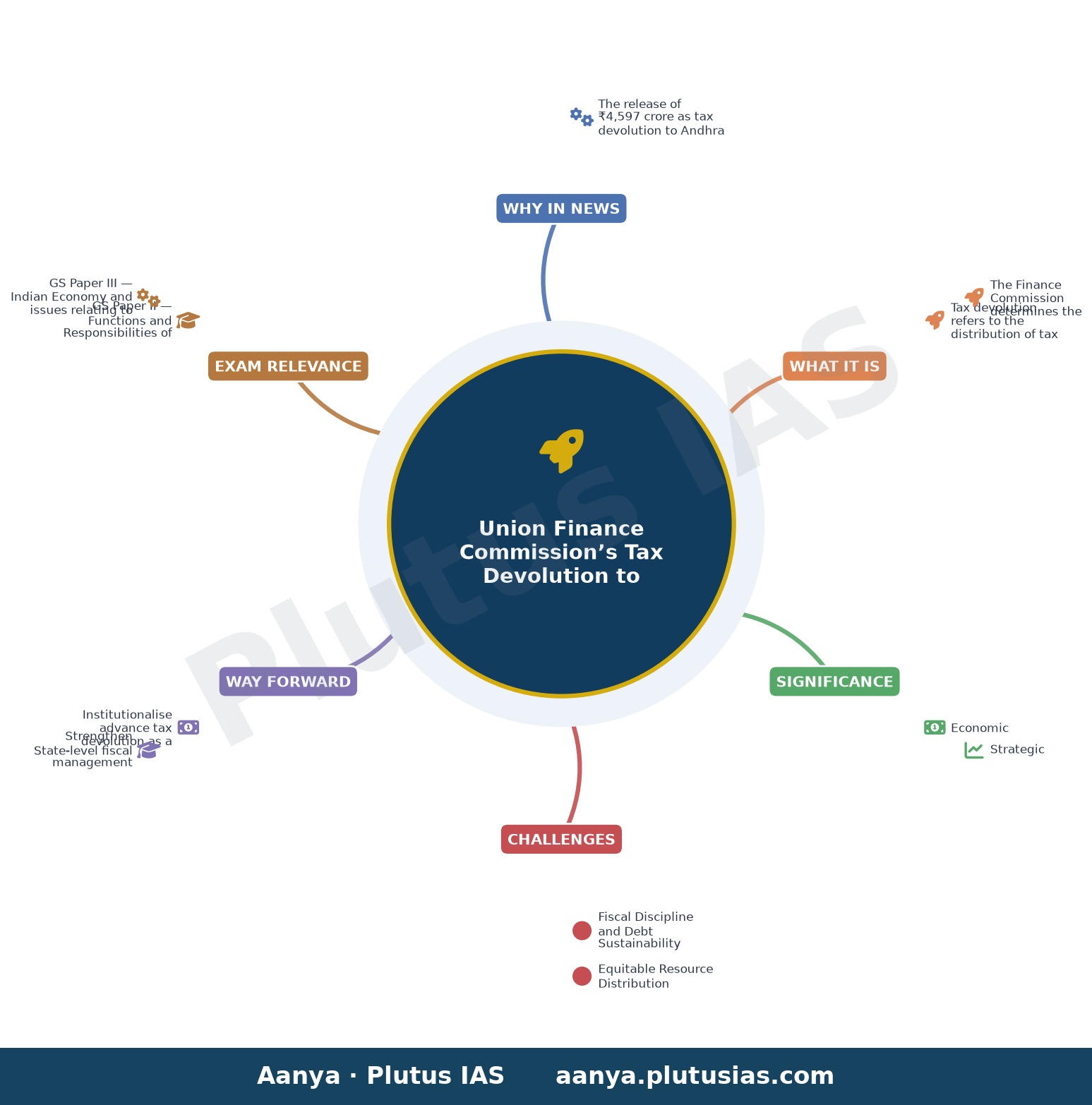
- GS Paper II — Functions and Responsibilities of the Union and the States, Issues and Challenges Pertaining to the Federal Structure, Devolution of Powers and Finances up to Local Levels and Challenges Therein | GS Paper III — Indian Economy and issues relating to Planning, Mobilisation of Resources, Growth, Development and Employment
- Prelims: Tax Devolution, Finance Commission, Article 280, Cooperative Federalism, GST Compensation Cess, Vertical and Horizontal Devolution, Fiscal Deficit, Centrally Sponsored Schemes, Public Accounts of India
- Essay: The Imperative of Fiscal Federalism in India’s Development Trajectory, Balancing Centralisation and Decentralisation: A Case for Cooperative Governance
Quick Revision: Tax devolution in India, governed by the Finance Commission under Article 280, is a formula-based, non-conditional transfer of Union tax revenues to states, enabling fiscal autonomy and addressing regional developmental disparities.
Why is this in the news?
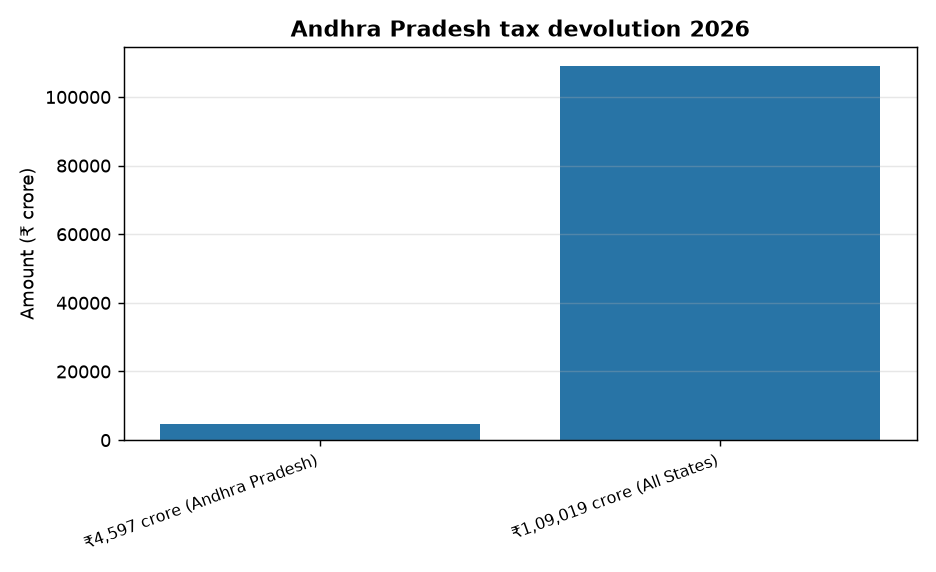
The release of ₹4,597 crore as tax devolution to Andhra Pradesh, acknowledged by Deputy Chief Minister K. Pawan Kalyan, underscores the Centre’s proactive fiscal federalism through advance devolution of tax revenues to states. This timely financial infusion, part of a broader advance release of ₹1,09,019 crore to states, aligns with the Centre’s strategy to accelerate infrastructure development, welfare delivery, and economic growth, particularly in the context of India’s Viksit Bharat vision. The development highlights the operational dynamics of India’s fiscal federalism and its role in addressing regional developmental disparities.
Background
- The Finance Commission, a constitutional body established under Article 280 of the Constitution, is tasked with recommending the distribution of tax revenues between the Union and the States, as well as among the States themselves.
- Tax devolution forms a critical component of fiscal federalism in India, enabling states to access resources for developmental expenditure while maintaining fiscal autonomy.
- The Goods and Services Tax (GST) regime, implemented in 2017, subsumed multiple indirect taxes and introduced a compensation mechanism to states for revenue losses, ensuring fiscal stability during the transition.
- The Union Government, in recent years, has prioritised advance releases of tax devolution to states to provide timely financial resources, particularly ahead of the Budget cycle, to support capital expenditure and welfare schemes.
- Andhra Pradesh, a state with significant developmental needs, has historically relied on central transfers to bridge fiscal gaps, particularly in infrastructure, agriculture, and social sectors.
- The release of ₹4,597 crore to Andhra Pradesh is part of a larger advance devolution of ₹1,09,019 crore to all states, aimed at accelerating economic growth and addressing regional imbalances.
What is Tax Devolution in India’s Fiscal Federalism?
- Tax devolution refers to the distribution of tax revenues collected by the Union Government to the States, as recommended by the Finance Commission under Article 280 of the Constitution.
- The Finance Commission determines the vertical devolution (share of states in the Union’s tax pool) and horizontal devolution (distribution among states based on criteria such as population, income distance, and area).
- Tax devolution is distinct from grants-in-aid, which are discretionary transfers for specific purposes, and forms a non-conditional, formula-based fiscal transfer mechanism.
- The 15th Finance Commission recommended a vertical devolution of 41% of the Union’s divisible tax pool to states, with adjustments for certain Union Territories and cess funds.
- Advance devolution of tax revenues, as seen in the release of ₹1,09,019 crore, is a proactive measure to provide states with early access to funds, enabling timely expenditure on capital projects and welfare schemes.
- Tax devolution plays a pivotal role in addressing fiscal imbalances between states, particularly in supporting less developed regions and promoting inclusive growth.
- The Union Government’s decision to release advance devolution aligns with the principles of cooperative federalism, fostering a collaborative framework for national development.
Key Features
| Feature | Significance |
|---|---|
| Advance tax devolution of ₹1,09,019 crore to States | Provides States with early fiscal resources to accelerate capital expenditure and infrastructure development ahead of the usual schedule. |
| Release of ₹4,597 crore to Andhra Pradesh | Enhances State’s fiscal capacity to expand infrastructure, improve connectivity, and strengthen social sectors like education and healthcare. |
| Timely financial resource provision | Reduces liquidity constraints for States, enabling faster implementation of development projects and welfare schemes. |
| Catalytic role in economic growth | Stimulates employment generation, investment attraction, and rural-urban transformation through increased public expenditure. |
| Commitment to cooperative federalism | Demonstrates Centre-State fiscal coordination, ensuring equitable resource distribution and reducing inter-State disparities. |
Why it Matters
Economic
- Boosts State-level capital expenditure, critical for achieving the Viksit Bharat 2047 vision through accelerated infrastructure development.
- Enhances fiscal federalism by ensuring predictable and timely resource flows to States, reducing budgetary uncertainties.
- Stimulates multiplier effects in the economy via increased public spending on infrastructure, agriculture, and social sectors.
- Supports employment generation through labour-intensive infrastructure projects and allied economic activities.
Strategic
- Demonstrates Centre’s commitment to cooperative federalism, fostering trust and collaboration between the Union and State governments.
- Strengthens fiscal decentralisation, enabling States to address local developmental priorities with greater autonomy.
- Acts as a counter-cyclical measure, providing fiscal stimulus during periods of economic slowdown or reduced private investment.
Social
- Facilitates targeted spending in education and healthcare, improving human development outcomes and reducing regional disparities.
- Supports agricultural and irrigation projects, enhancing food security and rural livelihoods in States like Andhra Pradesh.
- Enables States to implement welfare schemes more effectively, improving quality of life and reducing poverty.
Challenges
1. Fiscal Discipline and Debt Sustainability
- Risk of excessive State borrowing to match increased capital expenditure, potentially leading to debt traps.
- Need for robust fiscal consolidation frameworks to balance developmental spending with debt management.
- Ensuring that advance devolution does not create a precedent for unsustainable fiscal practices.
UPSC Link: GS-II: Centre-State financial relations
2. Equitable Resource Distribution
- Challenge of ensuring that advance devolution does not disproportionately benefit fiscally stronger States.
- Addressing historical revenue gaps and special category status issues for States like Andhra Pradesh.
- Balancing the needs of resource-rich and resource-poor States to prevent inter-State fiscal imbalances.
UPSC Link: GS-II: Finance Commission recommendations
3. Implementation Bottlenecks
- Delays in project execution due to administrative inefficiencies, land acquisition hurdles, or environmental clearances.
- Risk of funds remaining unutilised if States lack capacity to absorb and deploy resources efficiently.
- Need for strong monitoring and evaluation mechanisms to track the utilisation and impact of devolved funds.
UPSC Link: GS-II: Public expenditure management
4. Political Economy Challenges
- Potential for politicisation of fund utilisation, leading to suboptimal allocation based on electoral considerations.
- Risk of States diverting funds away from developmental priorities to meet revenue expenditure commitments.
- Ensuring transparency and accountability in the utilisation of devolved funds to prevent leakages and corruption.
UPSC Link: GS-II: Cooperative federalism
Challenges — UPSC Perspective
| Issue | Concern |
|---|---|
| Fiscal Discipline | Risk of increased State debt and unsustainable borrowing to match expenditure. |
| Equitable Distribution | Ensuring fair allocation of funds across States with varying fiscal capacities. |
| Implementation Gaps | Delays in project execution due to administrative or regulatory bottlenecks. |
| Political Economy | Risk of funds being diverted for non-developmental purposes or politicised allocations. |
| Monitoring and Evaluation | Need for robust systems to track utilisation and impact of devolved funds. |
| Capacity Building | States with weaker institutional capacity may struggle to utilise funds effectively. |
Way Forward
- Institutionalise advance tax devolution as a regular feature in the Union Budget, subject to fiscal consolidation targets.
- Strengthen State-level fiscal management frameworks, including debt ceilings and expenditure prioritisation.
- Enhance inter-State resource distribution mechanisms, ensuring special provisions for historically disadvantaged States.
- Accelerate administrative reforms to reduce project execution delays, including land acquisition and environmental clearances.
- Establish transparent and independent monitoring bodies to track fund utilisation and assess developmental outcomes.
- Promote capacity-building initiatives for State governments to improve financial management and project implementation.
- Encourage States to align devolved funds with national priorities like Gati Shakti, PM Gati Shakti, and Viksit Bharat 2047.
- Foster public-private partnerships to leverage devolved funds for accelerated infrastructure development.
UPSC Value Addition
Keywords for Mains Answer-Writing
Cooperative federalism · Tax devolution to States · Finance Commission · Union-State financial relations · Advance release of tax devolution · Fiscal federalism in India · Infrastructure development funding · NITI Aayog’s role in fiscal transfers · Constitutional provisions on Centre-State financial relations · Viksit Bharat vision and fiscal federalism · Intergovernmental fiscal transfers · Centre-State fiscal imbalance
Constitutional & Policy Linkages
- {‘Article 270’: ‘Distribution of taxes between Centre and States’}
- {‘Article 275’: ‘Grants-in-aid to States from the Consolidated Fund of India’}
- {‘Article 280’: “Finance Commission’s role in tax devolution and grants”}
- {‘Article 282’: ‘Grants for public purposes from the Union to States’}
Concept Flow
Constitutional framework (Articles 270, 275, 280, 282) → Tax devolution mechanism → Advance release of funds → Enhanced State fiscal capacity → Accelerated capital expenditure → Infrastructure development and social sector spending → Economic growth and employment generation → Viksit Bharat 2047 vision.
Prelims Practice Questions
Q1. Consider the following statements regarding tax devolution in India:
1. Tax devolution to States is determined by the Finance Commission under Article 280 of the Constitution.
2. The Finance Commission is a constitutional body with a fixed tenure of five years.
3. The 15th Finance Commission (2021-26) recommended a horizontal devolution of 41% of the divisible pool of taxes to States.
4. The advance release of tax devolution is a discretionary power of the Union Government and not mandated by the Constitution.
How many of the above statements are correct?
- Only one
- Only two
- Only three
- All four
Answer: All four — Statements 1, 2, and 3 are correct. Statement 4 is incorrect as the advance release of tax devolution is not a constitutional mandate but a policy decision by the Union Government.
Q2. Assertion (A): The Union Government can release tax devolution to States in advance of the normal schedule.
Reason (R): The advance release of tax devolution is aimed at accelerating capital expenditure and infrastructure development in States.
Options:
A. Both A and R are true, and R is the correct explanation of A.
B. Both A and R are true, but R is not the correct explanation of A.
C. A is true, but R is false.
D. A is false, but R is true.
Answer: ? — Both Assertion (A) and Reason (R) are true, and Reason (R) correctly explains Assertion (A). The Union Government has the discretion to release tax devolution in advance to support State-level development initiatives.
Q3. Match the following Finance Commissions with their respective chairpersons:
Column I (Finance Commission) | Column II (Chairperson)
1. 12th Finance Commission | A. Dr. C. Rangarajan
2. 13th Finance Commission | B. Dr. Y.V. Reddy
3. 14th Finance Commission | C. Dr. Vijay L. Kelkar
4. 15th Finance Commission | D. N.K. Singh
Options:
A. 1-A, 2-B, 3-C, 4-D
B. 1-B, 2-A, 3-D, 4-C
C. 1-C, 2-D, 3-A, 4-B
D. 1-D, 2-C, 3-B, 4-A
- A
- B
- C
- D
Answer: A — 1-C (12th FC: Dr. Vijay L. Kelkar), 2-D (13th FC: N.K. Singh), 3-A (14th FC: Dr. Y.V. Reddy), 4-B (15th FC: Dr. N.K. Singh).
Mains Practice Question
✍ The advance release of tax devolution to States ahead of the normal schedule represents a significant shift in India’s fiscal federalism. Critically examine this policy in the context of cooperative federalism and the Union Government’s role in accelerating infrastructure development. Also, discuss the constitutional and institutional framework governing tax devolution in India. (15 Marks)
Approach: MODEL-ANSWER SKELETON:
1. **Constitutional and Institutional Framework**:
– Article 279 and 280: Role of the Finance Commission in determining tax devolution.
– Horizontal vs. vertical devolution: Principles guiding the 15th Finance Commission (2021-26) recommendations (41% of divisible pool).
– NITI Aayog’s role in fostering cooperative federalism and fiscal transfers.
2. **Advance Release of Tax Devolution as a Policy Instrument**:
– Nature of the policy: Discretionary power of the Union Government (not constitutional mandate).
– Objectives: Accelerate capital expenditure, infrastructure development, and welfare delivery.
– Recent examples: Advance release of ₹1,09,019 crore in August 2026 (as reported in the news).
3. **Cooperative Federalism and Centre-State Relations**:
– Definition and principles of cooperative federalism: Shared responsibility, mutual trust, and financial autonomy.
– Role of the Prime Minister and Finance Minister in facilitating timely fiscal transfers (as highlighted in the news).
– Critique: Potential for Centre’s discretion to undermine State autonomy or create fiscal dependency.
4. **Challenges and Criticisms**:
– Fiscal imbalance: Persistent vertical and horizontal imbalances in Centre-State financial relations.
– Conditionalities: Whether advance releases come with implicit or explicit conditions.
– Impact on State-level planning: Potential distortion of State priorities due to centrally-driven fiscal transfers.
5. **Conclusion**:
– Balance between Centre’s developmental goals and State fiscal autonomy.
– Need for institutional safeguards to ensure transparency and predictability in tax devolution.
Source: The Hindu
Generated by AanyaAi for educational purpose.

- विधायकों की चुप्पी को न्यायालय कैसे मान सकता है शून्य? मद्रास हाईकोर्ट का महत्वपूर्ण फैसला - September 23, 2026
- वायुसेना को मिला बड़ा हथियार: ₹811 करोड़ के 160 स्मार्ट एंटी-एयरफील्ड वेपन समझौता - September 23, 2026
- UPSC Exam Alert: Defence Ministry signs ₹811 Crore SAT-SAAW deal for IAF - September 23, 2026

No Comments