


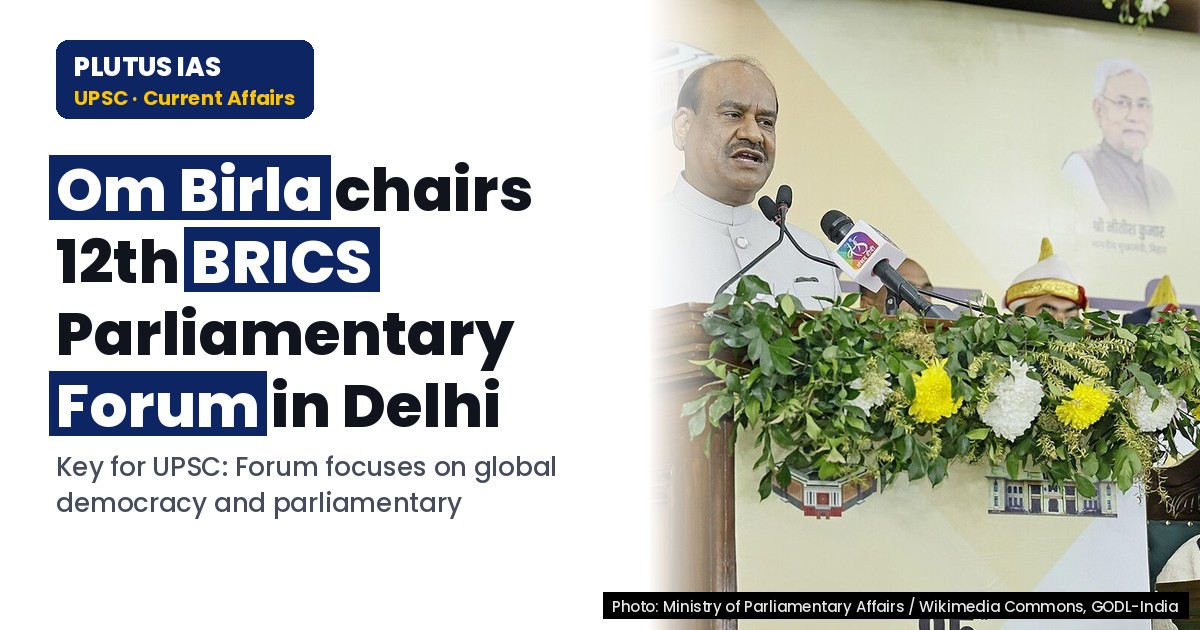
26 Oct 12th BRICS Parliamentary Forum Kicks Off in Delhi: Key Highlights for UPSC
✎ The BRICS Parliamentary Forum is a platform for parliamentary leaders of BRICS member states to institutionalise dialogue, share legislative best practices, and amplify collective positions on global governance through democratic…
Subject Relevance — Where This Topic Fits
- GS Paper II — International Relations: Bilateral, Regional and Global Groupings and Agreements involving India and/or affecting India’s interests | GS Paper II — International Organisations: Role, Structure and Functioning of the United Nations and other International Organisations | GS Paper II — Parliament and State Legislatures: Structure, Functioning, Conduct of Business, Powers & Privileges and Issues Arising out of these
- Prelims: BRICS Parliamentary Forum, Om Birla, Central Hall of Parliament, Presiding Officers, Joint Statement, Parliamentary diplomacy, Multilateralism, BRICS Summit 2026
- Essay: The Role of Parliamentary Diplomacy in Shaping Global Governance, Multilateralism in the 21st Century: Challenges and Opportunities for Developing Nations
Quick Revision: The BRICS Parliamentary Forum is a platform for parliamentary leaders of BRICS member states to institutionalise dialogue, share legislative best practices, and amplify collective positions on global governance through democratic multilateralism.
Why is this in the news?
The 12th BRICS Parliamentary Forum, inaugurated in New Delhi on 26 October 2026, marks a significant milestone in institutionalising parliamentary engagement among the BRICS member states. This forum, coinciding with India’s chairmanship of the BRICS in 2026, underscores the evolving role of parliamentary diplomacy in addressing global challenges, promoting democratic values, and fostering people-centric development across diverse geopolitical contexts.
Background
- The BRICS bloc, comprising Brazil, Russia, India, China, and South Africa, was established in 2009 as a platform for political and economic cooperation among major emerging economies.
- The 20th anniversary of the BRICS Parliamentary Forum in 2026 reflects its growing institutional maturity and expanding mandate beyond mere diplomatic symbolism.
- India’s chairmanship of BRICS in 2026 aligns with its broader diplomatic strategy of leveraging multilateral platforms to address global governance gaps, particularly in areas such as sustainable development, digital governance, and climate action.
- The forum’s location in New Delhi, within the Central Hall of Parliament, symbolises the centrality of democratic institutions in shaping global policy discourse.
What is the BRICS Parliamentary Forum?
- The BRICS Parliamentary Forum is a platform established to facilitate dialogue among the Presiding Officers and parliamentary leaders of the BRICS member states (Brazil, Russia, India, China, and South Africa) and partner countries.
- The forum aims to strengthen parliamentary diplomacy by promoting mutual understanding, sharing legislative best practices, and fostering cooperation on global challenges such as sustainable development, climate change, and digital governance.
- The forum’s deliberations are guided by the principles of sovereign equality, mutual respect, and non-interference in domestic affairs, as enshrined in the BRICS founding documents.
- The forum provides a structured platform for parliamentary leaders to engage with international organisations, civil society, and the private sector on issues of mutual interest, thereby enhancing the democratic legitimacy of multilateral decision-making.
- The 2026 edition marks the 20th anniversary of the forum, reflecting its evolution from a symbolic gathering to a substantive platform for policy coordination and legislative collaboration.
- The forum’s outcomes, including joint statements and declarations, are intended to influence global governance by articulating shared positions on key international issues.
- The forum operates in tandem with the BRICS Summit, ensuring alignment between political and parliamentary engagements to amplify the bloc’s collective voice on the global stage.
Key Features
| Feature | Significance |
|---|---|
| Inaugural Session in Central Hall of Samvidhan Sadan | Hosting the event in the Parliament House complex underscores India’s constitutional and democratic credentials, providing a symbolic venue for inter-parliamentary dialogue among BRICS nations. |
| 20th Anniversary of BRICS Parliamentary Forum | Marks two decades of institutionalised parliamentary cooperation, reflecting the forum’s evolution from a consultative platform to a significant actor in global parliamentary diplomacy. |
| Unanimous Adoption of Joint Statement at BRICS Summit 2026 | Demonstrates the forum’s capacity to generate consensus on shared priorities, reinforcing BRICS as a platform for coordinated policy positions in multilateral forums. |
| Participation of Union Ministers, State Legislatures, and MPs | Ensures multi-tiered representation, bridging national and sub-national governance, and facilitating exchange of best practices in legislative processes across BRICS nations. |
| Focus on People-Centric Development | Aligns with the forum’s mandate to translate parliamentary cooperation into tangible outcomes for citizens, particularly in areas of sustainable development and inclusive growth. |
Why it Matters
Economic and Strategic
- BRICS nations collectively account for nearly 42% of the global population and 23% of global GDP, making the forum a critical platform for shaping economic policies that influence global trade and investment flows.
- The forum’s emphasis on parliamentary cooperation can facilitate trade agreements, investment facilitation, and regulatory harmonisation among member states, enhancing economic integration within the bloc.
- India’s chairmanship of the BRICS Summit 2026 and hosting of the Parliamentary Forum positions the country as a key interlocutor in South-South cooperation, particularly in areas like technology transfer and climate finance.
Institutional and Diplomatic
- The BRICS Parliamentary Forum serves as a parallel track to the BRICS Summit, enabling legislatures to endorse and implement decisions taken at the executive level, thereby strengthening the bloc’s institutional coherence.
- The forum’s expansion into partner countries (e.g., Egypt, Ethiopia, Iran, Saudi Arabia, UAE) reflects its growing role as a bridge between emerging economies and global governance structures.
- Parliamentary diplomacy through such forums can mitigate geopolitical tensions by fostering dialogue and mutual understanding, even amid divergences in foreign policy stances.
Democratic Governance and Institutional Strengthening
- The forum reinforces the principles of democratic pluralism, rule of law, and participatory governance, which are central to the BRICS’ stated commitment to democratic values.
- Exchange of legislative best practices among BRICS parliaments can enhance the quality of governance, particularly in areas like budgetary oversight, anti-corruption measures, and citizen engagement.
- The inclusion of State Legislatures and MPs ensures that sub-national governance perspectives are integrated into the forum’s deliberations, promoting federalism and decentralised policy-making.
Global South Leadership
- The BRICS Parliamentary Forum amplifies the voice of the Global South in international forums, particularly on issues like climate justice, debt relief, and equitable access to global commons.
- By focusing on people-centric development, the forum aligns with the Sustainable Development Goals (SDGs), positioning BRICS as a champion of inclusive growth and poverty alleviation.
- The forum’s emphasis on mutual respect and non-interference in domestic affairs resonates with the Global South’s preference for sovereignty in international relations.
Challenges
1. Heterogeneity in Governance Systems
- Divergent political systems, levels of democratic consolidation, and governance priorities among BRICS members may hinder consensus-building on critical issues like human rights or electoral integrity.
- Variations in parliamentary procedures, legislative capacity, and institutional strength across member states can limit the effective implementation of forum resolutions.
UPSC Link: GS-II: Global Groupings
2. Balancing Sovereignty and Collective Action
- The tension between national sovereignty and the need for collective action on global challenges (e.g., climate change, pandemics) poses a persistent challenge for BRICS parliamentary cooperation.
- Member states may prioritise national interests over bloc-wide commitments, particularly in areas like trade protectionism or security alliances, complicating consensus formation.
UPSC Link: GS-II: International Organisations
3. Inclusivity and Representation Gaps
- The expansion of the forum to include partner countries raises questions about the criteria for inclusion and the potential dilution of the bloc’s original mandate focused on emerging economies.
- Underrepresentation of certain regions (e.g., Latin America, Africa) within the BRICS grouping may limit the forum’s legitimacy as a truly representative platform for the Global South.
UPSC Link: GS-II: Regional Groupings
4. Implementation and Follow-Up Mechanisms
- The forum’s deliberations often lack binding outcomes, raising concerns about the translation of resolutions into actionable policies at the national level.
- Weak institutional mechanisms for monitoring and evaluating the implementation of forum resolutions may undermine its credibility and effectiveness over time.
UPSC Link: GS-II: International Treaties
5. Geopolitical Rivalries and External Pressures
- The forum operates in a geopolitical landscape marked by rivalries among member states (e.g., India-China border tensions, Russia-West relations), which can spill over into parliamentary deliberations.
- External pressures from major powers (e.g., US, EU) to align with their strategic priorities may influence the forum’s agenda and limit its autonomy.
UPSC Link: GS-II: Bilateral Relations
Challenges — UPSC Perspective
| Issue | Concern |
|---|---|
| Divergent Political Systems | Limited consensus on governance norms and human rights standards may impede collective action. |
| Sovereignty vs. Collective Action | National interests may override bloc-wide commitments, complicating policy coordination. |
| Inclusivity Gaps | Expansion to partner countries may dilute the forum’s original focus and reduce representativeness. |
| Implementation Deficits | Lack of binding outcomes and weak follow-up mechanisms may render resolutions ineffective. |
| Geopolitical Spillovers | External rivalries among member states may hinder constructive dialogue and consensus-building. |
| Resource Constraints | Limited institutional capacity and funding may restrict the forum’s ability to execute its mandate effectively. |
Way Forward
- Facilitate structured working groups within the forum to address specific thematic areas (e.g., climate finance, digital governance) and ensure continuity between sessions.
- Establish a dedicated secretariat or coordination mechanism to monitor the implementation of forum resolutions and report progress to member parliaments annually.
- Promote peer learning and capacity-building initiatives among BRICS parliaments, particularly in areas like legislative drafting, oversight mechanisms, and citizen engagement.
- Develop a framework for regular inter-parliamentary exchanges at the sub-national level to deepen grassroots-level cooperation and policy alignment.
- Strengthen the forum’s engagement with civil society organisations and think tanks to provide evidence-based inputs and enhance the quality of deliberations.
- Explore the possibility of converting the forum into a more formalised inter-parliamentary union with a permanent secretariat, similar to the Inter-Parliamentary Union (IPU).
- Encourage member states to align domestic legislative reforms with forum resolutions, particularly in areas like anti-corruption, gender equality, and environmental sustainability.
- Leverage digital platforms to enhance transparency, facilitate remote participation, and ensure broader stakeholder engagement in the forum’s proceedings.
UPSC Value Addition
Keywords for Mains Answer-Writing
BRICS Parliamentary Forum · parliamentary diplomacy · multilateral parliamentary cooperation · people-centric development · democratic values · BRICS Summit 2026 · Joint Statement of BRICS · Lok Sabha Speaker · parliamentary institutions · global governance · BRICS member nations · International parliamentary engagement
Concept Flow
BRICS nations’ shared demographic and economic weight → Establishment of BRICS Parliamentary Forum as a platform for inter-parliamentary dialogue → Hosting of the 12th Forum in India under its 2026 chairmanship → Deliberations on people-centric development and democratic governance → Adoption of Joint Statement reflecting consensus on key priorities → Implementation of resolutions at national and sub-national levels through legislative and executive action → Monitoring and evaluation of outcomes by member parliaments → Feedback loop to inform future forum agendas and strengthen institutional coherence.
Prelims Practice Questions
Q1. Consider the following statements regarding the BRICS Parliamentary Forum:
1. The 12th BRICS Parliamentary Forum was held in the Central Hall of Samvidhan Sadan, New Delhi.
2. The Forum is marking its 20th anniversary in 2026.
3. The Forum is attended exclusively by the heads of state of BRICS member nations.
4. The Lok Sabha Speaker chairs the meeting.
How many of the above statements are correct?
- Only one
- Only two
- Only three
- All
Answer: Only three — Statements 1, 2, and 4 are correct. Statement 3 is incorrect as the Forum is attended by parliamentary leaders, not exclusively heads of state.
Q2. Assertion (A): The BRICS Parliamentary Forum aims to promote parliamentary cooperation and people-centric development.
Reason (R): The BRICS nations collectively represent nearly half of the world’s population and one-third of the global landmass.
Codes:
A. Both A and R are true, and R is the correct explanation of A.
B. Both A and R are true, but R is not the correct explanation of A.
C. A is true, but R is false.
D. A is false, but R is true.
- A
- B
- C
- D
Answer: B — Both A and R are true. The Forum’s stated aim is to promote parliamentary cooperation and people-centric development (A). The demographic and geographic significance of BRICS (R) is a factual statement that supports the assertion but does not directly explain the Forum’s purpose.
Q3. Match the following columns:
Column I (BRICS Member Nations)
A. Brazil
B. Russia
C. India
D. China
Column II (Capital Cities)
1. Moscow
2. Beijing
3. Brasília
4. New Delhi
Choose the correct match:
- A-3, B-1, C-4, D-2
- A-1, B-3, C-4, D-2
- A-3, B-1, C-2, D-4
- A-2, B-1, C-4, D-3
Answer: A-3, B-1, C-4, D-2 — The correct matches are: Brazil (A) – Brasília (3), Russia (B) – Moscow (1), India (C) – New Delhi (4), China (D) – Beijing (2).
Mains Practice Question
✍ The BRICS Parliamentary Forum serves as a platform for parliamentary diplomacy to foster multilateral cooperation among member nations. Critically examine the role of such forums in promoting democratic values and people-centric development in the contemporary global governance architecture. (15 Marks)
Approach: MODEL-ANSWER SKELETON:
1. **Introduction** (2 marks): Define parliamentary diplomacy and BRICS Parliamentary Forum; state its objectives (e.g., strengthening parliamentary cooperation, promoting people-centric development).
2. **Role in Promoting Democratic Values** (5 marks):
– **Institutional Mechanisms**: Highlight the role of parliamentary institutions in BRICS nations (e.g., Lok Sabha, Duma) in upholding democratic principles (e.g., separation of powers, accountability).
– **Shared Commitments**: Reference the BRICS Joint Statement (2026) and its emphasis on democratic values, mutual respect, and consensus-building.
– **Comparative Perspective**: Contrast with other multilateral forums (e.g., UN, G20) to show how parliamentary engagement adds a democratic dimension.
3. **Role in People-Centric Development** (5 marks):
– **Policy Priorities**: Discuss how parliamentary forums address developmental challenges (e.g., poverty, healthcare, climate change) through joint declarations and collaborative frameworks.
– **Inclusivity**: Highlight mechanisms for citizen participation (e.g., public consultations, digital platforms) in BRICS nations.
– **Case Study**: Cite a recent BRICS initiative (e.g., BRICS Innovation Cooperation Action Plan) to illustrate developmental cooperation.
4. **Challenges and Criticisms** (3 marks):
– **Implementation Gaps**: Note the lack of binding commitments in parliamentary forums compared to inter-governmental bodies.
– **Geopolitical Constraints**: Discuss how divergent national interests may limit the Forum’s effectiveness.
– **Accountability**: Address the challenge of ensuring follow-up on commitments made during the Forum.
5. **Conclusion** (2 marks): Summarize the significance of parliamentary diplomacy in BRICS while acknowledging its limitations. Suggest measures to enhance its impact (e.g., stronger institutional linkages, citizen engagement).
Source: orissapost.com
Generated by AanyaAi for educational purpose.
Related guides on our sites
- Best PSIR optional coaching in delhi for UPSC
- Best PSIR optional coaching for upsc
- Best PSIR optional teacher for upsc
- Best teacher of PSIR optional for upsc

- NAMASTE Scheme: Enhancing Sanitation Workers’ Livelihoods & Safety - November 14, 2026
- एमएसएमई का विशेष अभियान 6.0: स्वच्छता और लंबित मामलों का निपटारा - November 14, 2026
- Sea Vigil-26: Coastal Defence Drills Off Visakhapatnam - November 14, 2026

No Comments