


28 Jul 13 Indians Stranded in Ukraine Port Amid Drone, Missile Attacks: FSUI Appeal
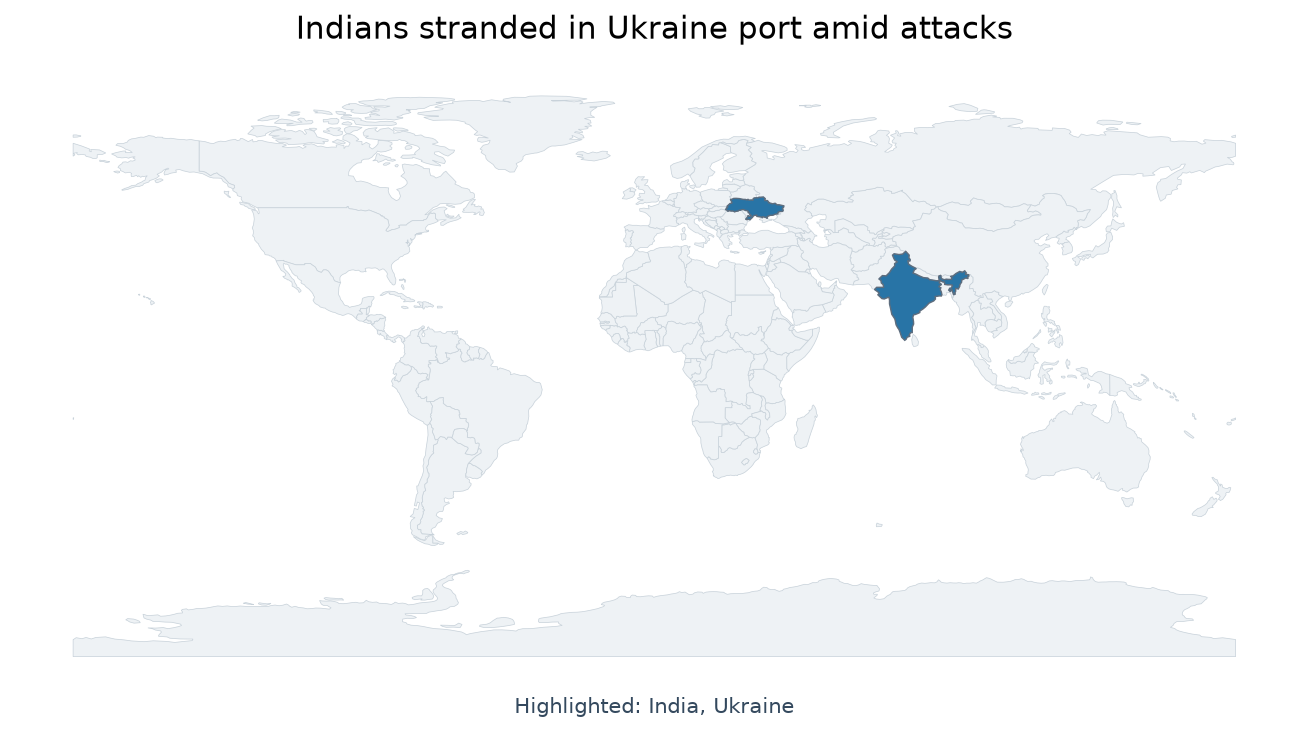
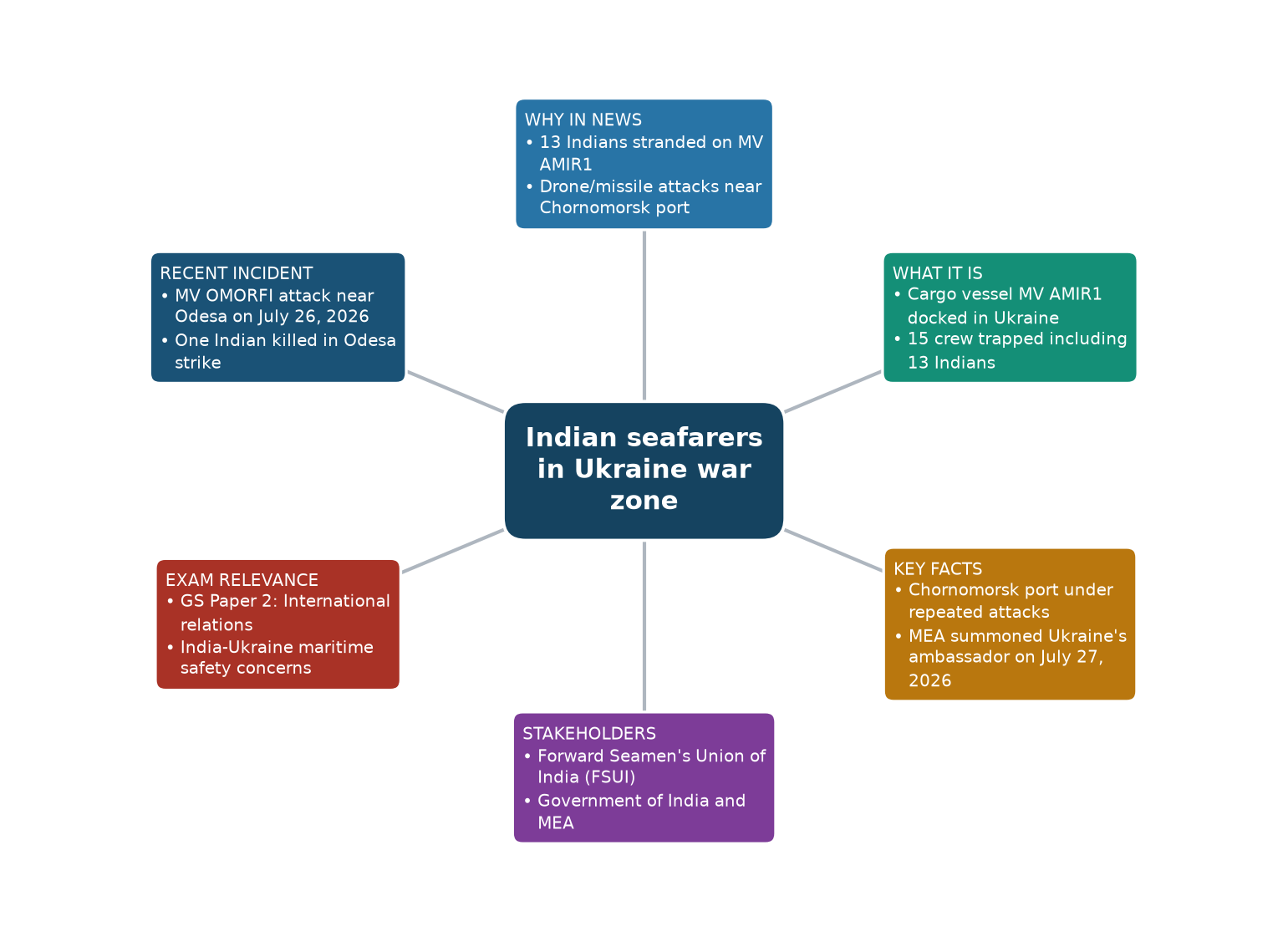
Map & concept mind-map: Indians stranded in Ukraine port amid attacks
Subject Relevance — Where This Topic Fits
- GS Paper II — International Relations (Maritime Security, Conflict Zones) | GS Paper III — Economy (Maritime Trade, Shipping Industry)
- Prelims: Chornomorsk port, Black Sea, Forward Seamen’s Union of India (FSUI), Maritime Safety Committee (MSC), UNCLOS (United Nations Convention on the Law of the Sea), Flag State Jurisdiction, Maritime Security Threats, Commercial Shipping Vulnerabilities
- Essay: Maritime Security: A Critical Imperative for Global Trade, Diplomacy in Crisis: Protecting Citizens in War Zones
Quick Revision: Indian seafarers stranded in conflict zones highlight the intersection of maritime law, diplomatic interventions, and the operational challenges of ensuring safety in high-risk regions like the Black Sea.
Why is this in the news?
Thirteen Indian seafarers are stranded aboard the cargo vessel MV AMIR1 at Ukraine’s Chornomorsk port, trapped amid escalating drone and missile attacks. The Forward Seamen’s Union of India (FSUI) has issued an urgent appeal for evacuation, highlighting the life-threatening conditions faced by the crew. This incident follows a recent attack on the merchant vessel MV OMORFI near Odesa, which resulted in the death of an Indian national, underscoring the escalating risks to maritime safety in the Black Sea conflict zone.
Background
- The Black Sea has emerged as a high-risk maritime region due to the ongoing Russia-Ukraine conflict, which has intensified since 2022, disrupting global shipping lanes and commercial operations.
- Chornomorsk and Odesa are critical Ukrainian ports for grain and commodity exports, historically accounting for a significant share of global wheat and corn trade, which has been severely disrupted by the conflict.
- India is a major contributor to the global seafaring workforce, with over 2.5 lakh Indian seafarers employed in international shipping, making their safety a critical diplomatic and economic concern.
- The International Maritime Organization (IMO) and maritime conventions such as UNCLOS (1982) mandate the protection of civilian seafarers and commercial vessels in conflict zones, though enforcement remains challenging.
- The Forward Seamen’s Union of India (FSUI) is a representative body for Indian seafarers, advocating for their rights and safety, particularly in high-risk regions.
- The Indian Ministry of External Affairs (MEA) has previously condemned attacks on commercial vessels, emphasizing the need for adherence to international maritime law and the protection of civilian lives.
What is the legal and operational framework governing the safety of seafarers in conflict zones?
- UNCLOS (United Nations Convention on the Law of the Sea, 1982) establishes the legal framework for maritime zones, including the right of innocent passage through territorial waters and the obligation of coastal states to ensure the safety of vessels in their jurisdiction.
- The International Maritime Organization (IMO) enforces the International Convention for the Safety of Life at Sea (SOLAS, 1974), which mandates safety measures for vessels, including emergency evacuation protocols and crew protection.
- Flag State Jurisdiction: The country under whose flag a vessel is registered (e.g., Panama, Liberia, or India) bears primary responsibility for the safety and welfare of its crew, including in conflict zones.
- The Maritime Safety Committee (MSC) of the IMO provides guidelines for navigating high-risk areas, including the Black Sea, and advises on the use of convoy systems or alternative routes to mitigate risks.
- The principle of ‘due regard’ under UNCLOS requires coastal states to avoid actions that could jeopardize the safety of foreign vessels, including commercial shipping, in their territorial waters.
- The International Labour Organization (ILO) Maritime Labour Convention (MLC, 2006) guarantees seafarers’ rights to safe working conditions, repatriation, and protection from exploitation, including in conflict zones.
- Private maritime security companies (PMSCs) and armed guards are sometimes deployed on vessels transiting high-risk areas, though their use is regulated by international conventions and flag state laws.
- Diplomatic interventions, such as the MEA’s summoning of Ukraine’s ambassador, are critical in resolving such crises, as they leverage bilateral relations to secure the safety of stranded nationals.
Key Features
| Feature | Significance |
|---|---|
| Stranding of 13 Indian seafarers on MV AMIR1 at Chornomorsk port | Exposes vulnerability of civilian maritime assets in conflict zones, highlighting the human cost of geopolitical instability. |
| Repeated drone and missile attacks in proximity to the vessel | Demonstrates the escalation of asymmetric warfare tactics in the Black Sea, posing direct threats to commercial shipping and maritime safety. |
| Involvement of the Forward Seamen’s Union of India (FSUI) | Showcases the role of maritime labour unions in advocating for the rights and safety of Indian seafarers in high-risk regions. |
| Ministry of External Affairs (MEA) engagement with Ukraine | Illustrates India’s diplomatic intervention to secure the safety of its nationals in conflict-affected areas, aligning with India’s consular protection obligations. |
| Death of an Indian national in the MV OMORFI attack | Underscores the lethal consequences of targeting commercial vessels, reinforcing the need for adherence to international maritime law. |
Why it Matters
Economic
- Disruption of maritime trade routes in the Black Sea due to conflict-related risks, potentially increasing freight costs and delays in global supply chains dependent on Ukrainian grain and other commodities.
- India’s reliance on seafarers for maritime workforce—with over 200,000 Indian seafarers employed globally—faces reputational and operational risks if their safety in conflict zones is compromised.
Strategic
- The incident highlights the geopolitical volatility in the Black Sea region, where Russia’s military actions have repeatedly targeted civilian infrastructure, including ports critical for global trade.
- India’s diplomatic engagement with Ukraine amid the conflict reflects its balancing act in maintaining relations with both conflict parties while prioritising citizen safety.
Legal/Regulatory
- Violations of international maritime conventions, including the United Nations Convention on the Law of the Sea (UNCLOS), which guarantees freedom of navigation and protection of civilian vessels in international waters.
- The MEA’s condemnation of attacks on commercial shipping underscores India’s stance on upholding maritime safety norms, even in conflict zones.
Humanitarian
- The stranded seafarers face psychological trauma and physical danger due to prolonged exposure to conflict-related threats, raising ethical concerns about their abandonment in a war zone.
- The FSUI’s appeal for repatriation reflects the moral responsibility of states to protect their citizens, especially in high-risk professions like seafaring.
Challenges
1. Safety of Indian Seafarers in Conflict Zones
- Direct exposure to drone and missile attacks while docked or transiting through conflict-affected waters, with no guaranteed protection under international humanitarian law for civilian vessels.
- Lack of enforceable mechanisms to ensure safe evacuation of seafarers from war zones, as commercial shipping operations are not prioritised in conflict de-escalation negotiations.
- Psychological and physical toll on seafarers, including stress, injury, or fatality, with long-term career and family impacts.
UPSC Link: GS-II: Consular services and protection of Indian citizens abroad
2. Diplomatic and Consular Constraints
- Limited leverage of the Indian government to compel conflict parties to cease attacks on civilian vessels, especially when commercial shipping is not a primary military target.
- Coordination challenges with multiple stakeholders (shipowners, flag states, host country authorities) to secure safe passage or evacuation.
- Risk of diplomatic friction if India’s interventions are perceived as favouring one conflict party over another.
UPSC Link: GS-II: India’s foreign policy and diplomatic engagements
3. Maritime Security Governance
- Inadequacy of existing international frameworks to protect civilian maritime assets in asymmetric warfare scenarios, where non-state actors and state forces employ drones and missiles indiscriminately.
- Failure of flag states and port authorities to enforce safety protocols in high-risk regions, leaving seafarers and vessels vulnerable.
- Need for India to strengthen bilateral and multilateral agreements to safeguard its maritime workforce in conflict zones.
UPSC Link: GS-III: Maritime security and piracy
4. Economic Disruptions
- Potential long-term impact on India’s maritime trade and shipping industry if conflict-related risks deter Indian seafarers from serving in high-risk regions.
- Increased insurance premiums for vessels operating in conflict zones, raising operational costs for Indian shipping companies.
- Supply chain disruptions for critical imports/exports routed through the Black Sea, affecting India’s trade balance and inflation.
UPSC Link: GS-III: Effects of conflicts on global supply chains
5. Legal and Ethical Dilemmas
- Ambiguity in the application of international humanitarian law to commercial vessels in conflict zones, particularly when vessels are not directly involved in hostilities.
- Ethical responsibility of shipowners and flag states to prioritise crew safety over commercial interests, especially in war zones.
- Moral obligation of the Indian government to intervene diplomatically or militarily to protect its citizens, balancing sovereignty with practical constraints.
UPSC Link: GS-II: International humanitarian law and human rights
Challenges — UPSC Perspective
| Issue | Concern |
|---|---|
| Indiscriminate targeting of civilian vessels | Violation of maritime safety norms and UNCLOS, endangering lives and disrupting global trade. |
| Lack of enforceable safety protocols | Commercial vessels remain vulnerable due to gaps in international and national regulations. |
| Diplomatic limitations in conflict zones | India’s ability to secure its citizens is constrained by geopolitical realities and lack of leverage. |
| Psychological and physical trauma to seafarers | Prolonged exposure to conflict increases stress, injury, and fatality risks. |
| Economic fallout for Indian shipping industry | Rising insurance costs and reputational damage may deter seafarers from high-risk regions. |
| Coordination failures among stakeholders | Shipowners, flag states, and host countries often fail to align on safety and evacuation plans. |
Way Forward
- The Government of India must initiate high-level diplomatic negotiations with Ukraine and Russia to secure safe passage or evacuation corridors for stranded seafarers, leveraging India’s neutral stance in the conflict.
- The Ministry of External Affairs (MEA) should establish a dedicated crisis management cell for Indian seafarers in conflict zones, with real-time monitoring and rapid response protocols.
- India should advocate for the inclusion of civilian maritime assets in international humanitarian law frameworks, ensuring explicit protections for commercial vessels and their crews in conflict zones.
- The Forward Seamen’s Union of India (FSUI) and maritime labour unions must collaborate with the government to develop standard operating procedures (SOPs) for repatriation and compensation of seafarers affected by conflicts.
- The Directorate General of Shipping (DGS) should mandate pre-deployment training for Indian seafarers on conflict zone navigation, including emergency protocols and psychological support measures.
- India should strengthen bilateral agreements with conflict-affected states to facilitate the safe evacuation of its nationals, including seafarers, during crises.
- The Indian Navy and Coast Guard should be prepared to conduct evacuation operations in high-risk maritime regions, in coordination with international partners like the International Maritime Organization (IMO).
- Shipowners and flag states must be held accountable for ensuring the safety of their crews, with penalties for negligence in high-risk regions.
UPSC Value Addition
Keywords for Mains Answer-Writing
Chornomorsk port · Black Sea maritime security · Indian seafarers in conflict zones · maritime safety under IMO · freedom of navigation · UNCLOS provisions on non-combatant vessels · Indian diaspora in crisis zones · MEA crisis management protocols · commercial shipping in war zones · flag state responsibilities · Forward Seamen’s Union of India · maritime evacuation protocols
Concept Flow
Escalation of Russia-Ukraine conflict → Increased use of drones and missiles in Black Sea region → Targeting of civilian maritime assets (e.g., MV AMIR1, MV OMORFI) → Stranding of 13 Indian seafarers and death of one Indian national → FSUI and MEA intervention → Diplomatic and consular challenges for India → Broader implications for maritime safety and global trade.
Prelims Practice Questions
Q1. Consider the following statements regarding the legal framework governing maritime safety during armed conflicts: 1. The United Nations Convention on the Law of the Sea (UNCLOS) explicitly prohibits attacks on civilian vessels in conflict zones. 2. The International Maritime Organization (IMO) mandates that flag states must ensure the safety of their vessels operating in war-affected areas. 3. The Geneva Conventions directly apply to civilian seafarers stranded in conflict zones. Which of the statements given above is/are correct?
- 1 only
- 1 and 2 only
- 2 and 3 only
- 1, 2 and 3
Answer: 1 and 2 only — Statement 1 is correct under UNCLOS Part VII, which protects non-combatant vessels. Statement 2 is correct as per IMO Resolution A.955(23) on maritime security. Statement 3 is incorrect; the Geneva Conventions primarily protect combatants and prisoners of war, not civilian seafarers.
Q2. Which of the following bodies is primarily responsible for the evacuation and repatriation of Indian seafarers stranded in foreign ports during geopolitical crises?
- Ministry of External Affairs (MEA)
- Directorate General of Shipping (DGS)
- Ministry of Ports, Shipping and Waterways
- National Disaster Management Authority (NDMA)
Answer: Ministry of External Affairs (MEA) — The Ministry of External Affairs (MEA) is the nodal agency for crisis management involving Indian citizens abroad, including seafarers, as per its mandate under the Crisis Management Plan.
Mains Practice Question
✍ Analyse the geopolitical and legal challenges faced by Indian seafarers stranded in conflict zones, such as Ukraine. In your answer, discuss the role of international maritime law, the responsibilities of flag states, and the measures the Government of India can undertake to ensure their safety and repatriation.
Approach: Begin by contextualising the crisis with reference to the UN Convention on the Law of the Sea (UNCLOS) and the International Maritime Organization (IMO) guidelines on maritime safety in conflict zones. Examine the obligations of the flag state (Panama, in this case) and the host state (Ukraine) under international law. Assess the Government of India’s crisis management protocols, including diplomatic interventions, evacuation logistics, and coordination with maritime unions. Conclude by evaluating the efficacy of existing frameworks and suggesting policy reforms to enhance the protection of Indian seafarers in high-risk maritime regions.
Source: Times of India
Generated by AanyaAi for educational purpose.

- महाराष्ट्र में त्योहार जुलूसों पर बॉम्बे हाईकोर्ट का बड़ा फैसला: पटाखे, लेजर और संगीत पर रोक - September 24, 2026
- Bombay HC Bans Firecrackers, Music in Maharashtra Processions: Key UPSC Analysis - September 24, 2026
- तमिलनाडु में महिला कर्मचारियों के लिए सवैतनिक माहवारी अवकाश नीति पर HC का आदेश - September 24, 2026

No Comments