


20 Aug 13th BRICS Education Meet in Odisha: Key Priorities & India’s Role Explained
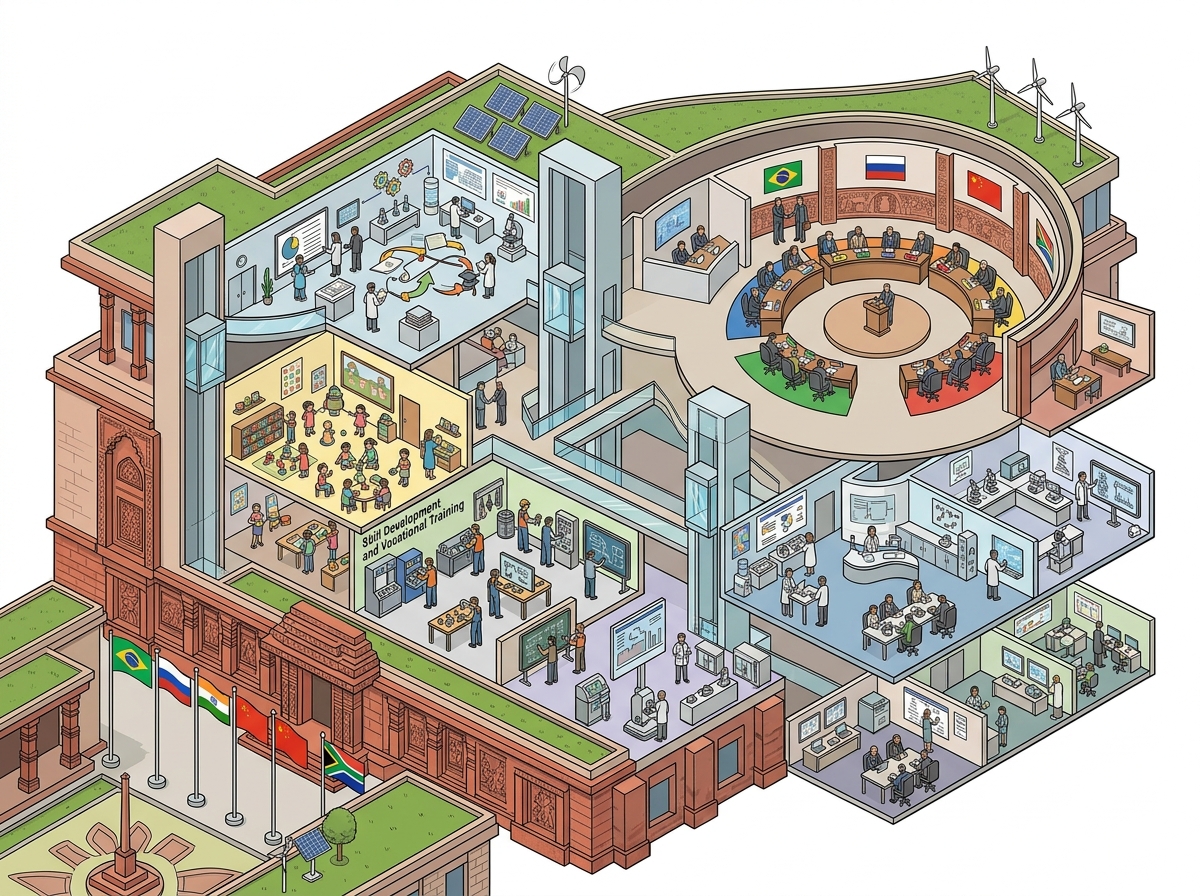
Education MinistersECCE FrameworkSkill DevelopmentResearch Innovation✎ The BRICS Education Track is a structured mechanism for educational cooperation among BRICS member countries, focusing on ECCE, TVET, research collaboration, and mutual recognition of qualifications, with the BRICS Education…
Subject Relevance — Where This Topic Fits
- GS Paper II — International Relations — Regional Groupings and Agreements involving India and/or affecting India’s interests | GS Paper II — International Organisations — Role, Structure and Functions
- Prelims: BRICS, BRICS Education Track, Early Childhood Care and Education (ECCE), Technical and Vocational Education and Training (TVET), Mutual Recognition of Qualifications, Academic Leadership
- Essay: Global Education Governance: Challenges and Opportunities in the 21st Century
Quick Revision: The BRICS Education Track is a structured mechanism for educational cooperation among BRICS member countries, focusing on ECCE, TVET, research collaboration, and mutual recognition of qualifications, with the BRICS Education Ministers’ Declaration serving as a key policy document.
Why is this in the news?
The 13th BRICS Education Ministers’ Meeting, held in Bhubaneswar, Odisha, on August 7, 2026, under India’s BRICS Chairship, deliberated on critical priorities such as early childhood care and education (ECCE), skill development, research and innovation, and mutual recognition of qualifications. This meeting, preceded by the 3rd BRICS Senior Officials Meeting on August 5, 2026, underscored the bloc’s commitment to strengthening institutional mechanisms and fostering inclusive, resilient, and future-ready education systems through enhanced cooperation among member countries.
Background
- BRICS (Brazil, Russia, India, China, South Africa) was established in 2006 as a platform for political and economic cooperation among major emerging economies.
- The BRICS Education Track was formalised to promote educational cooperation, including policy dialogue, capacity-building, and collaborative research among member countries.
- India assumed the BRICS Chairship for 2026, with a thematic focus on ‘Inclusive and Resilient Education Systems for Sustainable Development’.
- The BRICS Education Ministers’ Declaration is a key outcome document that outlines shared commitments and actionable priorities for educational cooperation.
What is the BRICS Education Track?
- The BRICS Education Track is a thematic pillar under the BRICS framework that focuses on enhancing educational cooperation, policy alignment, and institutional capacity among member countries.
- It operates through a structured mechanism involving Senior Officials Meetings, Education Ministers’ Meetings, and thematic working groups on priority areas such as ECCE, TVET, and research collaboration.
- The Track aims to promote the exchange of best practices, facilitate mutual recognition of qualifications, and strengthen academic leadership across BRICS nations.
- The Track also emphasises the integration of traditional and indigenous knowledge systems into educational frameworks, as outlined in the BRICS Guiding Principles on the subject.
- The BRICS Education Ministers’ Declaration serves as a policy document that reflects the collective aspirations of member countries and provides a roadmap for future cooperation.
- The Track’s activities are aligned with the United Nations Sustainable Development Goal 4 (SDG 4), which seeks to ensure inclusive and equitable quality education and promote lifelong learning opportunities for all.
Key Features
| Feature | Significance |
|---|---|
| Early Childhood Care and Education (ECCE) | Lays the foundation for cognitive, social, and emotional development, ensuring equitable access to foundational learning for children aged 0-8 years across BRICS nations. |
| Technical and Vocational Education and Training (TVET) | Enhances employability by aligning education with industry demands, fostering skill mobility and reducing youth unemployment through standardized vocational training frameworks. |
| Mutual Recognition of Qualifications | Facilitates academic mobility and professional opportunities by establishing standardized protocols for the recognition of degrees and certifications among BRICS member states. |
| Research and Innovation Collaboration | Promotes joint research initiatives, knowledge exchange, and innovation ecosystems to address global challenges such as climate change, public health, and sustainable development. |
| Guiding Principles on Traditional and Indigenous Knowledge Systems | Preserves cultural heritage by integrating traditional knowledge into formal education systems, ensuring intergenerational transmission and ethical utilization. |
Why it Matters
Economic Integration
- Strengthens labour market integration by harmonising skill standards and qualifications, thereby enhancing cross-border employment opportunities within the BRICS bloc.
- Fosters innovation-led economic growth through collaborative research in emerging technologies, such as artificial intelligence, renewable energy, and biotechnology.
- Promotes trade in educational services by reducing regulatory barriers, thereby expanding market access for institutions and students across member countries.
Geopolitical Cooperation
- Reinforces BRICS as a platform for South-South cooperation, countering the dominance of Western-led education frameworks and fostering a multipolar knowledge ecosystem.
- Enhances soft power by positioning BRICS as a credible alternative in global education governance, particularly in areas like ECCE and indigenous knowledge systems.
- Supports the broader BRICS agenda of de-dollarisation and financial sovereignty by building institutional linkages in non-economic sectors.
Educational Equity and Inclusion
- Advances the Sustainable Development Goal 4 (Quality Education) by prioritising inclusive and equitable access to education, particularly for marginalised communities.
- Promotes gender parity in STEM education through targeted initiatives in TVET and research collaboration, addressing structural barriers to participation.
- Ensures equitable access to early childhood education by advocating for policy frameworks that reduce disparities in foundational learning outcomes.
Institutional Capacity Building
- Strengthens national education systems by facilitating the exchange of best practices in curriculum design, teacher training, and institutional governance.
- Enhances the quality of higher education institutions through joint accreditation mechanisms and collaborative research projects.
- Builds resilience in education systems by promoting digital transformation and adaptive learning models in response to global disruptions.
Challenges
1. DIVERGENT EDUCATION SYSTEMS
- Variations in curriculum standards, assessment frameworks, and certification processes across BRICS nations complicate mutual recognition of qualifications.
- Differences in governance models (federal vs. unitary) and regulatory autonomy hinder the harmonisation of educational policies.
- Linguistic and cultural barriers impede seamless academic mobility and collaboration among institutions.
UPSC Link: GS2: Education systems in India and the world
2. INEQUITIES IN ACCESS AND QUALITY
- Disparities in infrastructure, funding, and teacher training between urban and rural areas within BRICS countries limit the reach of inclusive education initiatives.
- Socioeconomic barriers, such as poverty and gender discrimination, disproportionately affect access to ECCE and higher education.
- Digital divide exacerbates inequities, particularly in remote regions, where internet connectivity and device access remain limited.
UPSC Link: GS1: Social empowerment and inclusion
3. POLITICAL AND GEOPOLITICAL TENSIONS
- Divergent national priorities and strategic interests among BRICS members may lead to delays in consensus-building on shared education policies.
- Bilateral disputes or historical tensions between member states can spill over into multilateral cooperation, affecting trust and collaboration.
- External geopolitical pressures may influence the prioritisation of certain education initiatives over others, skewing the bloc’s collective agenda.
UPSC Link: GS2: International groupings and agreements
4. RESOURCE CONSTRAINTS
- Limited public funding for education in some BRICS countries constrains the implementation of ambitious cooperation frameworks.
- High costs associated with research collaboration, faculty exchange, and joint infrastructure projects pose financial challenges.
- Brain drain and the outflow of skilled professionals to developed nations undermine capacity-building efforts within the bloc.
UPSC Link: GS3: Resource mobilisation and utilisation
5. STANDARDISATION AND COMPLIANCE
- Lack of a unified regulatory body for education in BRICS complicates the enforcement of mutual recognition agreements.
- Differences in accreditation standards and quality assurance mechanisms undermine the credibility of collaborative initiatives.
- Slow bureaucratic processes and administrative delays hinder the timely implementation of agreed-upon education policies.
UPSC Link: GS2: Government policies and interventions
Challenges — UPSC Perspective
| Issue | Concern |
|---|---|
| Curriculum Alignment | Differences in educational standards and learning outcomes hinder comparability of qualifications. |
| Teacher Mobility | Variations in teacher training and certification processes limit cross-border academic exchanges. |
| Digital Infrastructure | Uneven access to technology and internet connectivity restricts participation in virtual collaborations. |
| Funding Disparities | Varying levels of public expenditure on education affect the feasibility of joint initiatives. |
| Policy Coordination | Divergent national priorities delay consensus on shared education agendas. |
| Cultural Sensitivity | Linguistic and cultural differences complicate the integration of traditional knowledge systems. |
Way Forward
- Establish a BRICS Education Secretariat to streamline policy coordination and monitor the implementation of agreed-upon initiatives.
- Develop a common framework for mutual recognition of qualifications, incorporating digital credentials and blockchain-based verification.
- Launch joint capacity-building programmes in TVET and ECCE, leveraging India’s expertise in digital learning and skill development.
- Create a BRICS Education Innovation Fund to finance collaborative research projects and institutional partnerships.
- Promote academic mobility through scholarship programmes, faculty exchange schemes, and joint degree initiatives.
- Strengthen digital infrastructure in under-resourced regions to ensure equitable participation in virtual collaborations.
- Adopt a phased approach to standardise accreditation processes, starting with flagship institutions in each member country.
- Facilitate public-private partnerships to mobilise additional resources for education infrastructure and research.
UPSC Value Addition
Keywords for Mains Answer-Writing
BRICS Education Ministers’ Meeting 2026 · Early Childhood Care and Education (ECCE) · Technical and Vocational Education and Training (TVET) · Mutual Recognition of Qualifications · BRICS Education Track · Academic Leadership in Higher Education · Research and Innovation Cooperation · Traditional and Indigenous Knowledge Systems · Inclusive and Resilient Education Systems · Capacity-Building Initiatives in Education · Bhubaneswar Declaration on Education · India’s BRICS Chairship 2026 · Global South Cooperation in Education · Skill Development and Employability · Higher Education Governance and Policy
Concept Flow
BRICS member states identify shared education priorities through multilateral consultations. → Senior officials negotiate policy frameworks and draft the BRICS Education Ministers’ Declaration. → Ministers adopt the declaration, outlining commitments to ECCE, TVET, and mutual recognition. → Member countries integrate BRICS priorities into national education policies and regulatory frameworks. → Institutions implement collaborative programmes, such as joint research and faculty exchanges. → Monitoring mechanisms assess progress and address implementation challenges. → Outcomes feed into broader BRICS cooperation agendas, reinforcing economic and geopolitical integration.
Prelims Practice Questions
Q1. Consider the following statements regarding the 13th BRICS Education Ministers’ meeting held in Bhubaneswar, 2026:
1. The meeting focused exclusively on higher education reforms within BRICS member countries.
2. Mutual recognition of qualifications was identified as a key priority area.
3. The BRICS Guiding Principles on Traditional and Indigenous Knowledge Systems were discussed.
4. The meeting was chaired by the Union Minister of Education, India.
How many of the above statements are correct?
- Only one
- Only two
- Only three
- All four
Answer: Only three — Statements 2 and 3 are correct as they align with the priorities outlined in the meeting. Statement 1 is incorrect because the meeting deliberated on ECCE, TVET, and academic leadership alongside higher education. Statement 4 is incorrect as the meeting was chaired by the Union Education Minister of India, but the statement does not specify the role of the Minister as chair.
Q2. Assertion (A): The 13th BRICS Education Ministers’ meeting emphasized the importance of capacity-building initiatives among member countries.
Reason (R): The meeting concluded that strengthening institutional mechanisms and facilitating exchange of best practices were essential for advancing inclusive education systems.
In the context of the above two statements, which one of the following is correct?
- Both A and R are true, and R is the correct explanation of A.
- Both A and R are true, but R is not the correct explanation of A.
- A is true, but R is false.
- A is false, but R is true.
Answer: Both A and R are true, and R is the correct explanation of A. — Both Assertion (A) and Reason (R) are true, and Reason (R) correctly explains Assertion (A). The meeting explicitly highlighted capacity-building and institutional strengthening as key outcomes.
Q3. Match the following priority areas discussed in the 13th BRICS Education Ministers’ meeting with their respective descriptions:
Column I (Priority Areas)
A. Early Childhood Care and Education (ECCE)
B. Technical and Vocational Education and Training (TVET)
C. Mutual Recognition of Qualifications
D. Academic Leadership
Column II (Descriptions)
1. Focuses on foundational learning and holistic development in the initial years of schooling.
2. Aims to harmonize educational credentials across BRICS member countries to facilitate mobility.
3. Emphasizes the development of vocational skills aligned with industry needs.
4. Highlights the role of leadership in higher education institutions to drive institutional excellence.
Select the correct match:
- A-1, B-3, C-2, D-4; A-2, B-1, C-3, D-4; A-3, B-2, C-1, D-4; A-4, B-3, C-2, D-1
- answer_match_indexes_to_options_indexes_above
- explain_match_pairs
- format_match
Answer: A-1, B-3, C-2, D-4; A-2, B-1, C-3, D-4; A-3, B-2, C-1, D-4; A-4, B-3, C-2, D-1 — The correct matches are: A-1 (ECCE focuses on foundational learning), B-3 (TVET emphasizes vocational skills), C-2 (Mutual recognition of qualifications aims to harmonize credentials), and D-4 (Academic leadership highlights institutional leadership).
Mains Practice Question
✍ The 13th BRICS Education Ministers’ meeting in Bhubaneswar, 2026, underscored the need for enhanced cooperation in education among BRICS member countries. Critically examine the significance of this multilateral initiative for India’s educational policy and global engagement. (15 Marks)
Approach: MODEL-ANSWER SKELETON:
1. **Introduction**: Briefly outline the context of the 13th BRICS Education Ministers’ meeting and its alignment with India’s BRICS Chairship 2026.
2. **Key Priorities and Their Relevance to India**:
– Early Childhood Care and Education (ECCE): Link to India’s National Education Policy (NEP) 2020 and the foundational literacy mission.
– Technical and Vocational Education and Training (TVET): Discuss India’s Skill India Mission and the role of TVET in employability.
– Mutual Recognition of Qualifications: Explain how this facilitates student and faculty mobility, referencing India’s participation in global education frameworks.
– Research and Innovation: Highlight India’s initiatives like the National Research Foundation (NRF) and collaborations under BRICS.
3. **Academic Leadership and Governance**: Discuss the role of leadership in higher education institutions and India’s efforts to strengthen institutional autonomy (e.g., Higher Education Commission of India).
4. **Traditional and Indigenous Knowledge Systems**: Examine India’s initiatives like the National Education Policy’s emphasis on local knowledge and how BRICS collaboration can preserve and promote these systems.
5. **Global South Cooperation**: Critically assess how this initiative strengthens South-South cooperation, particularly in addressing shared challenges like access, equity, and quality in education.
6. **Challenges and Limitations**:
– Diverse educational systems and standards among BRICS members.
– Political and economic disparities affecting implementation.
– Need for sustained funding and institutional capacity.
7. **Conclusion**: Summarize the strategic importance of BRICS education cooperation for India’s soft power, economic diplomacy, and long-term educational reforms.
Source: The Hindu
Generated by AanyaAi for educational purpose.

- आरबीआई ने सरकारी प्रतिभूतियों की ओएमओ बिक्री की घोषणा, जानिए पूरा विवरण - September 23, 2026
- RBI to Sell ₹25,000 Crore Govt Securities via OMO on Sept 28, 2026 - September 23, 2026
- भारत-श्रीलंका नौसैनिक अभ्यास ‘स्लाईनेक्स-26’: विशाखापत्तनम में संपन्न, जानें प्रमुख बिंदु - September 23, 2026

No Comments