


06 Aug 13th BRICS Education Meet in Odisha: Key Priorities & India’s Role Explained
✎ The BRICS Education Track, under India’s 2026 Chairship, prioritises ECCE, TVET, mutual recognition of qualifications, and research collaboration to foster inclusive and resilient education systems.
Subject Relevance — Where This Topic Fits
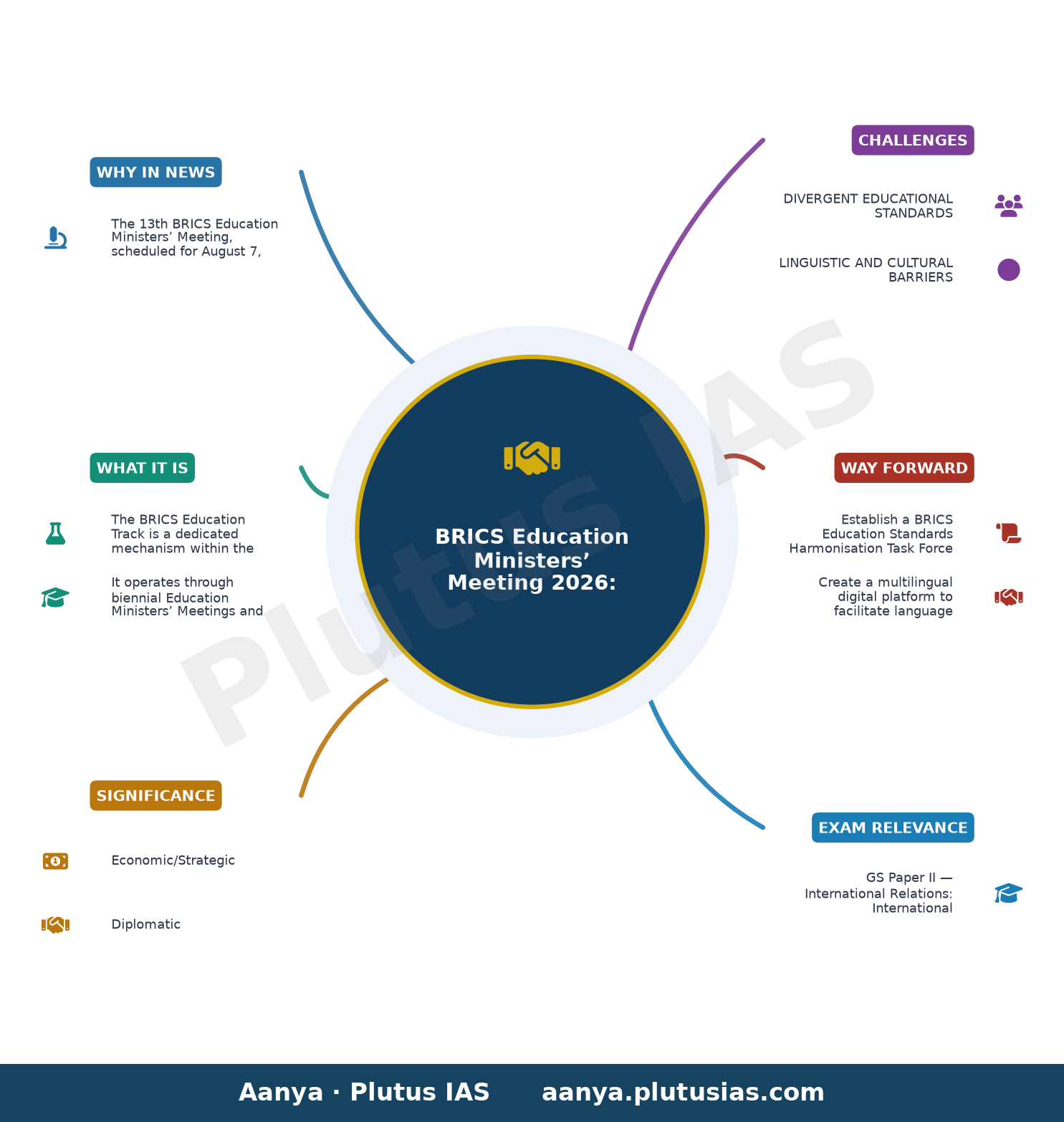
- GS Paper II — International Relations: International Organisations and Groupings (BRICS)
- Prelims: BRICS, ECCE, TVET, mutual recognition of qualifications, academic leadership, Guiding Principles on Traditional and Indigenous Knowledge Systems
- Essay: Globalisation and the role of multilateral groupings in shaping educational equity and innovation
Quick Revision: The BRICS Education Track, under India’s 2026 Chairship, prioritises ECCE, TVET, mutual recognition of qualifications, and research collaboration to foster inclusive and resilient education systems.
Why is this in the news?
The 13th BRICS Education Ministers’ Meeting, scheduled for August 7, 2026, in Bhubaneswar, Odisha, under India’s 2026 BRICS Chairship, is significant as it convenes education ministers and senior officials from BRICS member states and key observer nations to deliberate on foundational priorities such as early childhood care and education (ECCE), skill development, research collaboration, and the mutual recognition of academic qualifications. This meeting follows the 3rd BRICS Senior Officials Meeting held on August 5, 2026, and is pivotal for advancing institutional mechanisms that reinforce inclusive, resilient, and future-ready education systems within the bloc.
Background
- The BRICS bloc, comprising Brazil, Russia, China, South Africa, Indonesia, Iran, Ethiopia and United Arab Emirates, has progressively expanded its thematic engagement beyond economic cooperation to include education through the BRICS Education Track, established to foster multilateral collaboration in human capital development.
- India assumed the BRICS Chairship for 2026, with education cooperation identified as a strategic priority under its thematic focus on ‘Inclusive Growth and Shared Future’.
- The BRICS Education Track operates through ministerial and senior official meetings, working groups, and thematic consultations to align educational policies, standards, and practices across member states.
- The inclusion of observer countries such as Indonesia, Iran, Ethiopia, and the United Arab Emirates in BRICS education deliberations reflects the bloc’s evolving outreach and recognition of shared educational challenges in the Global South.
- The BRICS Education Ministers’ Declaration serves as a normative instrument to guide collective action, institutionalise cooperation, and promote convergence in education governance among member states.
- India’s leadership in the BRICS Education Track aligns with its broader diplomatic and developmental objectives, including the promotion of South-South cooperation and the advancement of the Sustainable Development Goal 4 (SDG 4) agenda.
What is the BRICS Education Track and its significance?
- The BRICS Education Track is a dedicated mechanism within the BRICS framework established to facilitate multilateral cooperation in education, research, and skill development among member states.
- It operates through biennial Education Ministers’ Meetings and intersessional Senior Officials Meetings, supported by thematic working groups and expert consultations.
- The Track addresses priority areas such as Early Childhood Care and Education (ECCE), Technical and Vocational Education and Training (TVET), research and innovation, mutual recognition of qualifications, and academic leadership.
- A key deliverable is the BRICS Education Ministers’ Declaration, which outlines collective commitments, guiding principles, and actionable recommendations for member states.
- The Track also promotes the exchange of best practices, capacity-building initiatives, and collaborative research projects to enhance educational quality and equity across BRICS nations.
- The inclusion of the ‘Guiding Principles on Traditional and Indigenous Knowledge Systems’ reflects the bloc’s commitment to integrating cultural heritage with modern education systems.
- The Track complements other BRICS initiatives, such as the BRICS Network University and the BRICS Skills Development Working Group, to create a cohesive ecosystem for educational transformation.
- Its work is aligned with global education agendas, including the United Nations Sustainable Development Goal 4 (SDG 4), which aims for inclusive and equitable quality education for all.
Key Features
| Feature | Significance |
|---|---|
| Early Childhood Care and Education (ECCE) | Addresses foundational learning gaps, aligns with SDG 4.2, and ensures cognitive and socio-emotional development of children aged 0-8 years. |
| Skill Development (TVET) | Enhances employability through vocational training, bridges industry-academia gaps, and supports BRICS’ goal of inclusive economic growth. |
| Research and Innovation | Promotes joint research initiatives, leverages diverse expertise across member nations, and accelerates technological advancements in education. |
| Mutual Recognition of Qualifications | Facilitates academic mobility, harmonises educational standards, and strengthens labour market integration within BRICS nations. |
| Academic Leadership | Fosters institutional governance reforms, promotes best practices in higher education, and strengthens BRICS’ collective voice in global education discourse. |
Why it Matters
Economic/Strategic
- Strengthens BRICS as a bloc by fostering human capital development, which is critical for sustained economic growth and innovation.
- Enhances labour market integration through mutual recognition of qualifications, reducing barriers to cross-border employment.
- Promotes collaborative research and innovation, positioning BRICS as a counterbalance to Western-led educational and technological dominance.
Diplomatic
- Reinforces India’s leadership in BRICS during its 2026 chairship, enhancing its soft power and global standing.
- Demonstrates India’s commitment to multilateralism and South-South cooperation in education, aligning with its foreign policy priorities.
- Provides a platform for dialogue and consensus-building among diverse education systems, fostering mutual trust and cooperation.
Educational
- Addresses systemic gaps in education through shared best practices, particularly in ECCE and TVET, where disparities are most pronounced.
- Encourages peer learning and capacity-building initiatives, enabling member nations to adopt innovative solutions tailored to their contexts.
- Promotes the integration of traditional and indigenous knowledge systems into formal education, preserving cultural heritage while enhancing relevance.
Challenges
1. DIVERGENT EDUCATIONAL STANDARDS
- Variations in curriculum frameworks, assessment systems, and quality benchmarks across BRICS nations hinder seamless academic mobility.
- Differences in regulatory frameworks for TVET and higher education complicate mutual recognition of qualifications.
- Lack of standardised data on educational outcomes impedes effective benchmarking and policy alignment.
UPSC Link: GS2: International Organisations
2. LINGUISTIC AND CULTURAL BARRIERS
- Language differences among BRICS countries create communication challenges in collaborative research and academic exchanges.
- Cultural nuances in pedagogical approaches may lead to misalignment in teaching methods and learning outcomes.
- Limited proficiency in commonly used languages (e.g., English) among non-native speakers restricts participation in joint initiatives.
UPSC Link: GS2: Globalisation
3. FUNDING AND RESOURCE CONSTRAINTS
- Limited financial resources allocated to education in some BRICS nations reduce the scope for joint projects and capacity-building programmes.
- Inequitable distribution of research funding across member states limits equitable participation in collaborative ventures.
- Dependence on external funding sources may compromise the autonomy and sustainability of BRICS-led initiatives.
UPSC Link: GS3: Resource Mobilisation
4. POLITICAL AND GEOPOLITICAL TENSIONS
- Bilateral tensions between member states (e.g., China-India) may spill over into multilateral forums, complicating consensus-building.
- Divergent foreign policy priorities could lead to competing agendas within BRICS, diluting the focus on education.
- Sanctions or trade restrictions imposed by one member on another may hinder educational and research collaborations.
UPSC Link: GS2: International Relations
Challenges — UPSC Perspective
| Issue | Concern |
|---|---|
| Divergent Educational Standards | Hampers academic mobility and recognition of qualifications across BRICS nations. |
| Linguistic Barriers | Restricts participation in collaborative research and academic exchanges due to language differences. |
| Resource Constraints | Limits the scope for joint projects and capacity-building initiatives due to inadequate funding. |
| Geopolitical Tensions | Undermines consensus-building and cooperation within BRICS due to bilateral disputes. |
Way Forward
- Establish a BRICS Education Standards Harmonisation Task Force to develop common frameworks for curriculum, assessment, and quality assurance.
- Create a multilingual digital platform to facilitate language translation and cultural exchange in educational collaborations.
- Launch a BRICS Education Innovation Fund to pool resources and finance joint research, TVET, and capacity-building programmes.
- Develop a BRICS Academic Mobility Programme to streamline student and faculty exchanges, including scholarships and credit transfer mechanisms.
- Promote the integration of traditional knowledge systems into formal education through pilot projects and curriculum reforms.
- Strengthen BRICS’ engagement with UNESCO and other multilateral bodies to align its initiatives with global education goals.
- Conduct periodic reviews of the BRICS Education Ministers’ Declaration to assess progress and adapt priorities to emerging challenges.
UPSC Value Addition
Keywords for Mains Answer-Writing
BRICS Education Ministers’ Meeting 2026 · Early Childhood Care and Education (ECCE) · Technical and Vocational Education and Training (TVET) · Mutual Recognition of Qualifications · BRICS Education Track · Bhubaneswar Declaration · Academic Leadership in BRICS · Research and Innovation in Education · India’s BRICS Chairship 2026 · Traditional and Indigenous Knowledge Systems · Inclusive and Resilient Education Systems · Capacity-Building Initiatives in Education
Concept Flow
BRICS nations face divergent educational standards and resource constraints → Identify key priorities (ECCE, TVET, research, mutual recognition) → Host senior officials meeting to draft declaration → Finalise BRICS Education Ministers’ Declaration → Strengthen institutional mechanisms and academic collaborations → Enhance inclusive, resilient, and future-ready education systems.
Prelims Practice Questions
Q1. Consider the following statements regarding the 13th BRICS Education Ministers’ meeting held in Bhubaneswar, August 2026:
1. The meeting deliberated on Early Childhood Care and Education (ECCE) as a key priority.
2. Mutual recognition of qualifications among BRICS member countries was excluded from the agenda.
3. The BRICS Education Track includes collaboration on Technical and Vocational Education and Training (TVET).
4. The meeting concluded with the adoption of the Bhubaneswar Declaration, which was finalised during the 3rd BRICS Senior Officials Meeting.
How many of the above statements are correct?
- Only one
- Only two
- Only three
- All four
Answer: Only three — Statements 1 and 3 are correct as ECCE and TVET are explicitly mentioned as priorities. Statement 2 is incorrect because mutual recognition of qualifications was included. Statement 4 is incorrect because the declaration was finalised during the Education Ministers’ meeting, not the Senior Officials Meeting.
Q2. Assertion (A): The BRICS Education Ministers’ meeting in Bhubaneswar, 2026, emphasised the strengthening of institutional mechanisms for academic and research collaborations.
Reason (R): The meeting aimed to enhance capacity-building initiatives and facilitate the exchange of best practices among BRICS countries.
- Both A and R are true, and R is the correct explanation of A.
- Both A and R are true, but R is not the correct explanation of A.
- A is true, but R is false.
- A is false, but R is true.
Answer: Both A and R are true, and R is the correct explanation of A. — Both the Assertion (A) and Reason (R) are true, and R correctly explains A, as the emphasis on strengthening institutional mechanisms is directly linked to enhancing capacity-building and exchange of best practices.
Q3. Match the following priority areas discussed at the 13th BRICS Education Ministers’ meeting with their respective descriptions:
Column I (Priority Area)
A. Early Childhood Care and Education (ECCE)
B. Technical and Vocational Education and Training (TVET)
C. Mutual Recognition of Qualifications
D. Academic Leadership
Column II (Description)
1. Ensuring that educational qualifications obtained in one BRICS country are recognised in others.
2. Fostering the development of leadership skills among educators and administrators.
3. Providing foundational learning opportunities for children aged 0-8 years.
4. Equipping individuals with practical skills and competencies for employment.
Select the correct match:
- A-3, B-4, C-1, D-2
- A-1, B-2, C-3, D-4
- A-4, B-3, C-2, D-1
- A-2, B-1, C-4, D-3
Answer: A-3, B-4, C-1, D-2 — The correct matches are: A (ECCE) with 3, B (TVET) with 4, C (Mutual Recognition of Qualifications) with 1, and D (Academic Leadership) with 2.
Mains Practice Question
✍ The 13th BRICS Education Ministers’ meeting in Bhubaneswar, 2026, underscored the need for inclusive, resilient, and future-ready education systems through enhanced cooperation among member countries. Critically examine the significance of this meeting for India’s diplomatic and educational objectives, with reference to the key priorities identified. (15 Marks)
Approach: MODEL-ANSWER SKELETON:
1. **Introduction (2 marks)**: Briefly contextualise the BRICS Education Track within India’s broader BRICS Chairship 2026 and its diplomatic priorities, highlighting the global emphasis on multilateral cooperation in education.
2. **Key Priorities and Their Significance (5 marks)**:
– **Early Childhood Care and Education (ECCE)**: Link to India’s National Education Policy (NEP) 2020 and the global Sustainable Development Goal 4 (SDG 4). Discuss how ECCE lays the foundation for lifelong learning and addresses equity gaps.
– **Technical and Vocational Education and Training (TVET)**: Highlight India’s Skill India Mission and the role of TVET in bridging the skills gap and promoting employability, particularly in the context of Industry 4.0.
– **Mutual Recognition of Qualifications**: Explain its role in facilitating academic mobility, reducing barriers to professional recognition, and fostering trust among BRICS nations.
– **Research and Innovation**: Emphasise the importance of collaborative research in addressing global challenges (e.g., climate change, public health) and India’s position as a hub for innovation.
3. **Academic Leadership and Indigenous Knowledge Systems (3 marks)**:
– **Academic Leadership**: Discuss the need for developing leadership competencies in education systems to drive systemic reforms and innovation.
– **Traditional and Indigenous Knowledge Systems**: Link to India’s commitment to preserving and integrating indigenous knowledge, as reflected in the NEP 2020 and global best practices.
4. **Challenges and Way Forward (3 marks)**:
– **Challenges**: Highlight potential obstacles such as differing educational standards, bureaucratic hurdles, and geopolitical tensions.
– **Way Forward**: Propose measures such as establishing a BRICS Education Council, leveraging digital platforms for collaboration, and aligning national policies with BRICS frameworks.
5. **Conclusion (2 marks)**: Summarise the strategic importance of the BRICS Education Ministers’ meeting for India’s soft power diplomacy and its role in shaping a resilient global education ecosystem.
Source: The Hindu
Generated by AanyaAi for educational purpose.

- विकलांग सैन्य कैडेटों को पेंशन देने से रोक रही सरकार की नीति: केंद्र ने सुप्रीम कोर्ट में बताया - September 23, 2026
- Centre Tells SC: Policy Blocks Disability Pension for Outboarded Cadets - September 23, 2026
- यूपीएससी तैयारी: स्कूलों में स्वच्छता सुविधाओं की कमी, 5 करोड़ बच्चे प्रभावित - September 23, 2026

No Comments