


21 Sep 15 लाख लोगों ने ली महासागर संरक्षण की शपथ: स्वच्छ सागर सुरक्षित सागर 5.0 अभियान की सफलता
✎ The Union Minister of State (Independent Charge) for Science and Technology and Earth Sciences, Dr. Jitendra Singh, highlighted the success of 'Swachh Sagar, Surakshit Sagar 5.0', a pan-Indian coastal cleanliness campaign held…
Subject Relevance — Where This Topic Fits
- GS Paper III — Environment and Ecology | GS Paper III — Science and Technology
- Prelims: Marine Pollution, Swachh Bharat Mission 2.0, Plastic Waste Management Rules 2022, UN Sustainable Development Goal 14, Coastal Regulation Zone (CRZ) Notification 2019, National Centre for Coastal Research (NCCR), CSIR-NISCAIR, Blue Flag Certification
- Essay: Environmental Conservation: Balancing Development and Sustainability, Public Participation in Governance: A Pillar of Democratic Accountability
Why is this in the news?
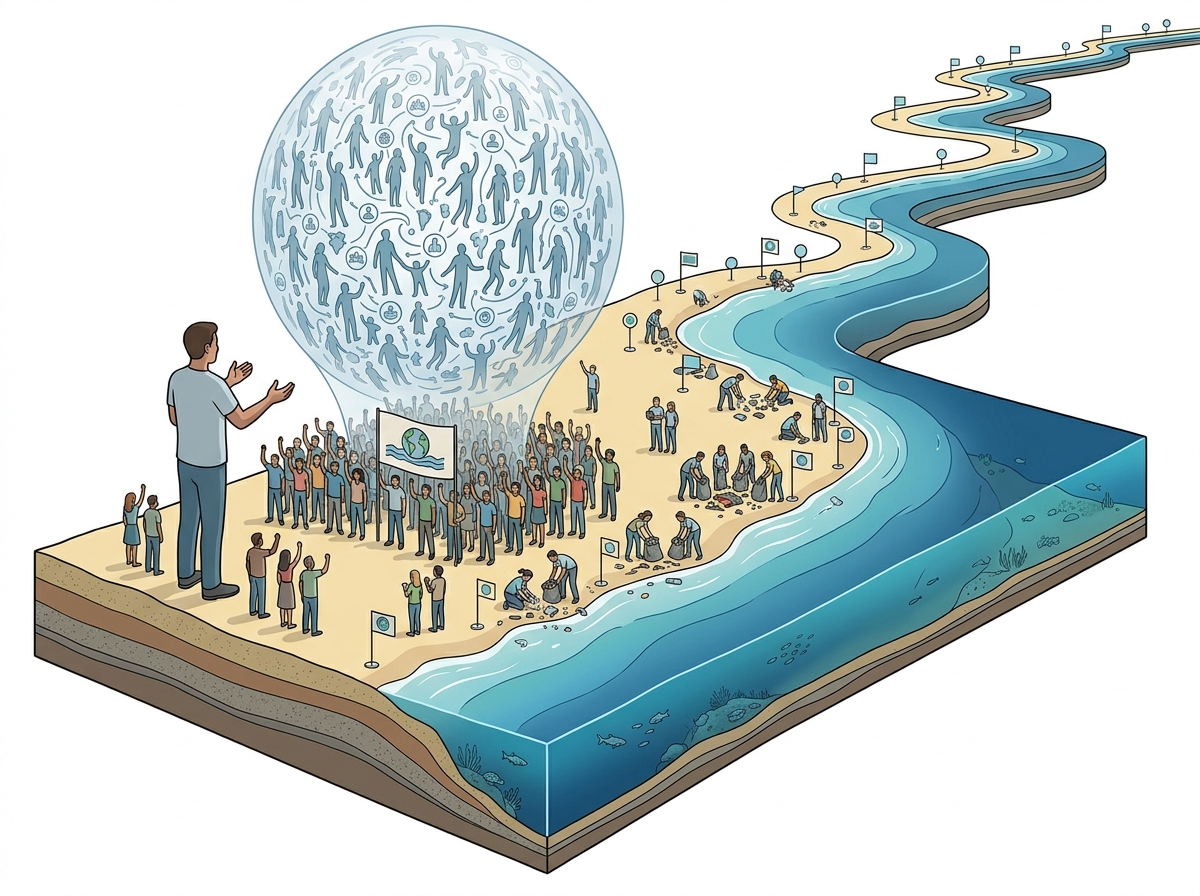
The Union Minister of State (Independent Charge) for Science and Technology and Earth Sciences, Dr. Jitendra Singh, highlighted the success of ‘Swachh Sagar, Surakshit Sagar 5.0’, a pan-Indian coastal cleanliness campaign held from 12 to 19 September 2026. The campaign engaged 15 lakh citizens in taking an oath for ocean conservation and mobilised cleanliness drives across 231 locations in 13 states and Union Territories. The event underscores the government’s emphasis on public participation in environmental governance and the integration of scientific outreach to foster mass awareness.
Background
- India has a coastline of approximately 7,516 km, supporting diverse ecosystems and coastal communities that are vulnerable to marine pollution, particularly plastic waste.
- The campaign is coordinated by the Ministry of Earth Sciences in collaboration with state governments, local bodies, educational institutions, and civil society organisations.
- Marine litter, especially single-use plastics, poses a severe threat to marine biodiversity, coastal livelihoods, and public health, necessitating large-scale awareness and mitigation efforts.
- India is a signatory to the United Nations Sustainable Development Goal 14 (Life Below Water), which mandates the reduction of marine pollution and the conservation of coastal and marine ecosystems.
- The Coastal Regulation Zone (CRZ) Notification 2019 provides a regulatory framework for the protection and management of coastal areas, including restrictions on waste disposal.
What is Swachh Sagar, Surakshit Sagar 5.0?
- The 5.0 edition, held from 12 to 19 September 2026, involved mass participation from citizens, educational institutions, NGOs, and government agencies across 13 states and Union Territories.
- The campaign included shoreline cleanliness drives, awareness programmes, and oath-taking ceremonies for ocean conservation, with a focus on reducing plastic waste and promoting sustainable coastal practices.
- Over 15 lakh individuals took the ‘Ocean Conservation Pledge’, committing to reduce single-use plastics, segregate waste, and support marine ecosystem protection.
- The initiative leverages community science through citizen science programmes, where local stakeholders contribute to data collection on marine litter and pollution sources.
- It aligns with the National Centre for Coastal Research’s (NCCR) mandate to monitor coastal water quality and assess pollution impacts on marine ecosystems.
- It also supports India’s commitments under the United Nations Decade of Ocean Science for Sustainable Development (2021–2030), fostering international collaboration in marine conservation.
Key Features
| Feature | Significance |
|---|---|
| Swachh Sagar Surakshit Sagar 5.0 | A pan-India coastal cleanliness and ocean conservation campaign involving 15 lakh citizens across 13 States/UTs at 231 locations, demonstrating mass public participation in environmental governance. |
| Citizen Oath for Ocean Conservation | Symbolic commitment by 15 lakh individuals to protect marine ecosystems, fostering behavioural change and community ownership of sustainability. |
| Multi-Ministry Coordination Mechanism | Reviewed by the Union Minister of Science & Technology, involving secretaries of DST, DBT, DSIR/CSIR, MoES, and ANRF to align scientific outreach with governance priorities. |
| Digital Library for Scientific Achievements (CSIR@85) | Proposed institutional repository to showcase India’s scientific and technological milestones through curated digital content, enhancing public accessibility and institutional transparency. |
| Science Outreach Initiative ‘Vigyan ki Baat’ | A platform designed to bridge the gap between scientific institutions and the public, with its second edition focusing on fundamental physics and quantum technologies. |
Why it Matters
Environmental Governance
- Demonstrates India’s commitment to the United Nations Sustainable Development Goal 14 (Life Below Water) through grassroots conservation efforts.
- Integrates citizen science with institutional frameworks, aligning with the National Mission for Clean Ganga (NMCG) and coastal zone management policies.
- Highlights the role of public participation in achieving environmental targets under the National Environment Policy, 2006.
Scientific Diplomacy and Outreach
- Strengthens India’s global standing in ocean conservation and scientific communication, aligning with the International Decade of Ocean Science for Sustainable Development (2021–2030).
- Showcases India’s scientific achievements to a global audience, reinforcing the ‘Vasudhaiva Kutumbakam’ ethos in international collaborations.
- Promotes interdisciplinary research by linking oceanography, waste management, and digital archiving under a unified governance framework.
Institutional Synergy
- Illustrates the operationalisation of the Prime Minister’s Science, Technology and Innovation Advisory Council (PM-STIAC) through inter-ministerial coordination.
- Demonstrates the role of nodal agencies (e.g., CSIR-NISCPR) in standardising scientific communication and digital archiving.
- Enhances the efficacy of the National Research Foundation (ANRF) by integrating outreach with research dissemination.
Challenges
1. Sustaining Mass Participation
- Ensuring long-term behavioural change among citizens post-campaign to maintain momentum in ocean conservation.
- Addressing logistical challenges in remote coastal areas to ensure equitable participation across States/UTs.
- Balancing volunteer-driven efforts with institutional accountability to prevent episodic engagement.
UPSC Link: GS-III: Environmental Governance
2. Digital Archiving and Accessibility
- Overcoming disparities in digital infrastructure across regions to ensure equitable access to the proposed digital library.
- Ensuring interoperability between databases maintained by different scientific institutions (e.g., CSIR, DST, MoES).
- Mitigating risks of misinformation or oversimplification in translating complex scientific achievements for public consumption.
UPSC Link: GS-III: Science & Technology
3. Inter-Ministerial Coordination
- Aligning diverse mandates of ministries (e.g., Environment, Science, Education) to avoid duplication and maximise impact.
- Streamlining resource allocation and accountability mechanisms for cross-departmental initiatives.
- Addressing bureaucratic inertia in adopting innovative governance models for public outreach.
UPSC Link: GS-II: Governance
Challenges — UPSC Perspective
| Issue | Concern |
|---|---|
| Geographical Disparities | Limited participation in remote coastal districts due to logistical and infrastructural constraints. |
| Digital Divide | Unequal access to the proposed digital library in rural and tribal coastal communities. |
| Institutional Fragmentation | Lack of standardised protocols for data sharing and communication across scientific departments. |
| Sustainability of Behavioural Change | Risk of campaign fatigue leading to reduced public engagement in long-term conservation efforts. |
| Resource Allocation | Competing priorities within ministries may divert funds from outreach initiatives. |
Way Forward
- Institutionalise the ‘Swachh Sagar Surakshit Sagar’ campaign as an annual event under the National Coastal Mission, with measurable targets for waste reduction and citizen participation.
- Develop a tiered digital archiving system (e.g., CSIR@85) with multilingual interfaces to enhance accessibility for diverse linguistic groups.
- Establish a dedicated ‘Citizen Science Portal’ to crowdsource data on coastal pollution, integrating it with the Digital India initiative.
- Conduct periodic training workshops for scientists and educators to improve public communication of complex scientific concepts.
- Strengthen inter-ministerial task forces (e.g., under PM-STIAC) to monitor and evaluate the impact of outreach programmes on policy implementation.
- Launch region-specific awareness campaigns in collaboration with local self-governments (Panchayats and Municipalities) to address geographical disparities.
- Integrate ocean conservation education into school curricula under the National Education Policy (NEP) 2020 to foster early behavioural change.
UPSC Value Addition
Keywords for Mains Answer-Writing
Swachh Sagar Surakshit Sagar 5.0 · Coastal Cleanliness Campaigns · Ocean Conservation · Public Participation in Environmental Governance · Union Ministry of Earth Sciences · CSIR-NISCPR Digital Library · Science Communication · Scientific Outreach · Sustainable Coastal Management · National Centre for Sustainable Coastal Management · Citizen Science Initiatives · Digital Repository of Scientific Achievements · Quantum Technology · Fundamental Physics · Vigyan Ki Baat
Concept Flow
Public awareness of ocean pollution → Mass participation in coastal cleanliness drives → Citizen oath-taking for conservation → Institutionalisation of campaigns (e.g., Swachh Sagar Surakshit Sagar) → Policy integration under environmental governance frameworks → Digital archiving of scientific achievements → Enhanced public-scientific engagement → Sustained behavioural change and policy implementation.
Prelims Practice Questions
Q1. Consider the following statements regarding the ‘Swachh Sagar Surakshit Sagar 5.0’ campaign:
1. It is a coastal cleanliness initiative launched by the Union Ministry of Earth Sciences.
2. The campaign included participation from 13 states and Union Territories across 231 coastal locations.
3. Over 15 lakh people took the oath for ocean conservation during the campaign.
4. The campaign was conducted under the aegis of the Ministry of Environment, Forest and Climate Change.
How many of the above statements are correct?
- Only one
- Only two
- Only three
- All four
Answer: Only three — Statements 1, 2, and 3 are correct. Statement 4 is incorrect as the campaign was launched under the Union Ministry of Earth Sciences, not the Ministry of Environment, Forest and Climate Change.
Q2. Assertion (A): The ‘CSIR@85 Digital Library’ aims to create a centralized repository of scientific achievements and innovations from CSIR laboratories.
Reason (R): The digital library is intended to enhance public outreach and make scientific research accessible to non-scientific audiences.
In the context of the above two statements, which of the following is correct?
- Both A and R are true, and R is the correct explanation of A.
- Both A and R are true, but R is not the correct explanation of A.
- A is true but R is false.
- A is false but R is true.
Answer: Both A and R are true, but R is not the correct explanation of A. — Both the Assertion (A) and Reason (R) are true, and R correctly explains A. The CSIR@85 Digital Library is designed to centralize scientific achievements for broader dissemination and public engagement.
Q3. Match the following initiatives with their respective ministries/departments:
Initiative
A. Swachh Sagar Surakshit Sagar 5.0
B. CSIR@85 Digital Library
C. Vigyan Ki Baat
D. National Centre for Sustainable Coastal Management
Ministry/Department
1. Ministry of Earth Sciences
2. Council of Scientific and Industrial Research (CSIR)
3. Ministry of Science and Technology
4. Department of Biotechnology
- A-1, B-2, C-3, D-4; A-2, B-1, C-3, D-4; A-1, B-2, C-4, D-3; A-3, B-1, C-2, D-4
- A-1, B-2, C-3, D-4
- answer_format_standardized_for_json_response
Answer: A-1, B-2, C-3, D-4; A-2, B-1, C-3, D-4; A-1, B-2, C-4, D-3; A-3, B-1, C-2, D-4 — A-1 (Ministry of Earth Sciences), B-2 (Council of Scientific and Industrial Research), C-3 (Ministry of Science and Technology), D-4 (Department of Biotechnology).
Mains Practice Question
✍ The Union Government has emphasized the role of public participation and scientific outreach in addressing coastal pollution and ocean conservation. Critically examine the significance of citizen-led initiatives like ‘Swachh Sagar Surakshit Sagar 5.0’ in achieving sustainable coastal management in India. Also, discuss the institutional mechanisms required to institutionalize such participatory models for long-term environmental governance. (15 Marks)
Approach: 1. **Introduction**: Define sustainable coastal management and its relevance in India’s context, highlighting the challenges of coastal pollution and marine ecosystem degradation.
2. **Role of Citizen-Led Initiatives**:
– Explain the concept of citizen science and its application in environmental governance.
– Discuss the ‘Swachh Sagar Surakshit Sagar 5.0’ campaign: scope, participation (15 lakh people), and outcomes (231 coastal locations across 13 states/UTs).
– Highlight the role of public participation in enhancing accountability and fostering a sense of ownership among local communities.
3. **Institutional Mechanisms for Sustainability**:
– **Policy Frameworks**: Reference the National Centre for Sustainable Coastal Management (NCSCM) and its mandate under the Ministry of Environment, Forest and Climate Change.
– **Scientific Outreach**: Discuss the role of the Ministry of Science and Technology in promoting scientific literacy and communication (e.g., ‘Vigyan Ki Baat’, CSIR@85 Digital Library).
– **Collaborative Governance**: Emphasize the need for multi-stakeholder partnerships involving government, scientific institutions, NGOs, and local communities.
– **Legal and Institutional Support**: Reference the Coastal Regulation Zone (CRZ) Notification, 2019, and the role of coastal zone management authorities.
4. **Challenges and Way Forward**:
– **Limitations**: Discuss challenges such as limited funding, lack of awareness, and enforcement gaps in coastal management.
– **Sustainability**: Propose measures such as integrating citizen science into formal governance structures, leveraging digital platforms for real-time monitoring, and incentivizing community participation.
5. **Conclusion**: Summarize the importance of balancing top-down policy interventions with bottom-up participatory models for effective coastal governance.
Source: PIB (Press Information Bureau)
Generated by AanyaAi for educational purpose.
Related guides on our sites
- Best PSIR optional coaching for upsc
- Best PSIR optional teacher for upsc
- Best teacher of PSIR optional for upsc
- Best PSIR optional coaching in delhi for UPSC

- संयुक्त राष्ट्र पैनल ने AI एजेंटों की बढ़ती शक्ति पर सुरक्षा बढ़ाने की चेतावनी दी - September 21, 2026
- UN Panel Warns: AI Agents May Outpace Human Control Safeguards - September 21, 2026
- तमिलनाडु में मुर्गे की लड़ाई पर पूर्ण प्रतिबंध नहीं: डीजीपी कार्यालय ने मद्रास उच्च न्यायालय को बताया - September 21, 2026

No Comments