


04 Aug 15th Finance Commission Conditional Grants: Key Insights for UPSC & State PCS
✎ The Press Information Bureau (PIB) released a detailed report on 4 August 2026 highlighting the utilisation of conditional grants provided under the Fifteenth Finance Commission (XV-FC) for rural water supply and sanitation in…
Subject Relevance — Where This Topic Fits
- GS Paper II — Constitutional, Statutory, Regulatory and various Quasi-judicial Bodies | GS Paper III — Environment, Disaster Management and Developmental Issues | GS Paper III — Government Budgeting and Fiscal Policy
- Prelims: Fifteenth Finance Commission (XV-FC), Conditional Grants (Tied Grants), Rural Local Bodies (RLBs), Open Defecation Free (ODF) status, Panchayati Raj Institutions (PRIs), Jal Jeevan Mission (JJM), Swachh Bharat Mission (SBM), Sixteenth Finance Commission
- Essay: The Role of Finance Commissions in India’s Fiscal Federalism, Water Security and Sanitation: A Prerequisite for Sustainable Development
Why is this in the news?
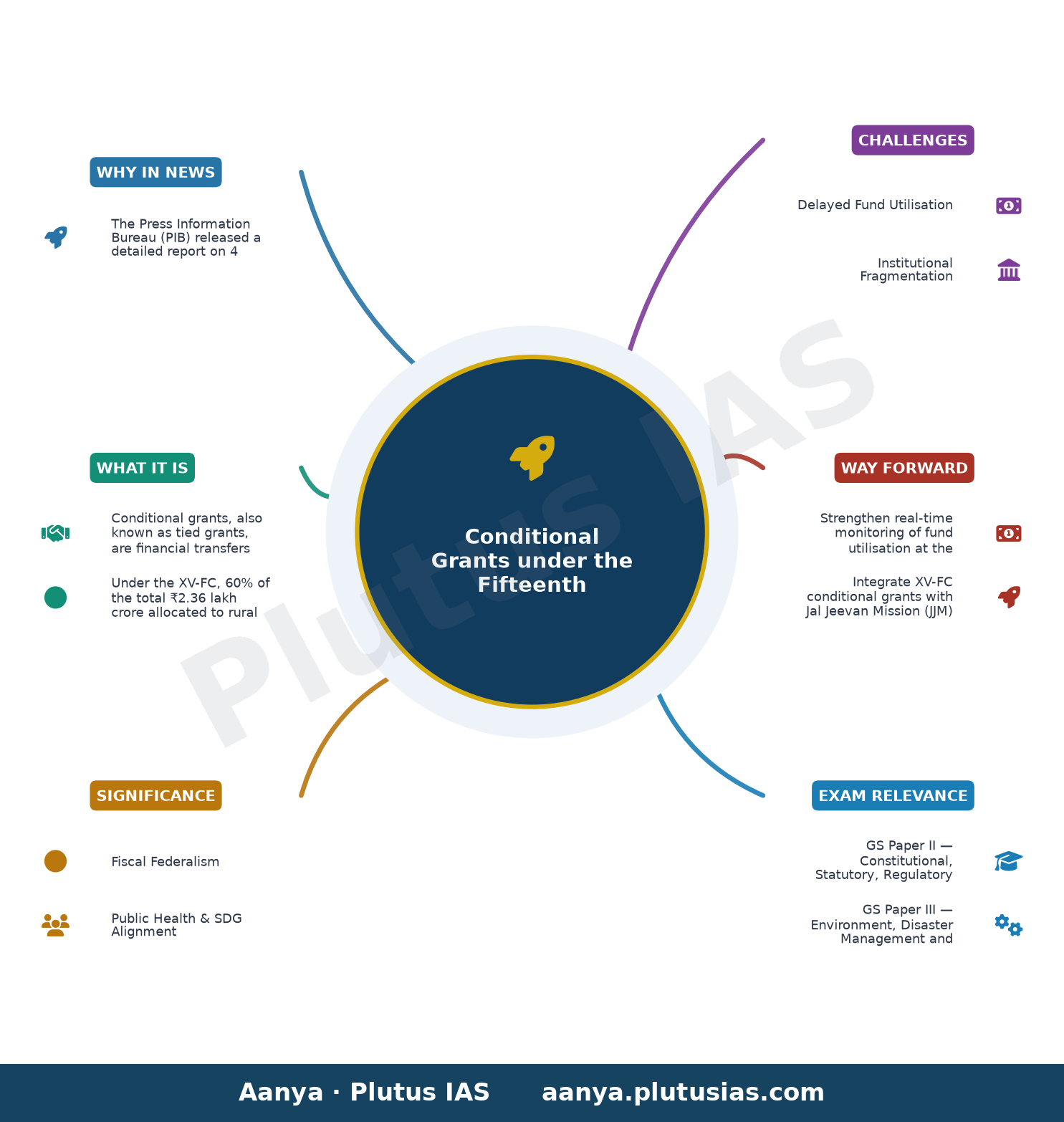
The Press Information Bureau (PIB) released a detailed report on 4 August 2026 highlighting the utilisation of conditional grants provided under the Fifteenth Finance Commission (XV-FC) for rural water supply and sanitation in the state of Andhra Pradesh. This development is significant as it reflects the culmination of the XV-FC’s recommendations and the transition to the Sixteenth Finance Commission, which will continue to shape fiscal transfers for rural development.
Background
- The Fifteenth Finance Commission (XV-FC) submitted its report in two phases: an interim report for FY 2020-21 and a final report for the award period 2021-26.
- The XV-FC recommended ₹2.36 lakh crore for rural local bodies (RLBs) across 28 states, including Andhra Pradesh, with 60% (₹1.42 lakh crore) allocated as conditional (tied) grants for water supply, sanitation, and ODF maintenance.
- Conditional grants are tied to specific purposes and must be utilised strictly for water and sanitation-related activities as per the guidelines issued by the Department of Drinking Water and Sanitation (DDWS), Ministry of Jal Shakti.
- The nodal department for the implementation of these grants is the Department of Drinking Water and Sanitation.
- The XV-FC period concluded on 31 March 2026, and any pending grants under this commission lapsed, necessitating a transition to the Sixteenth Finance Commission for continued funding.
- The XVI-FC is expected to build on the XV-FC’s framework, with a renewed focus on sustainable water and sanitation infrastructure in rural areas.
What are Conditional Grants under the Fifteenth Finance Commission?
- Conditional grants, also known as tied grants, are financial transfers from the Union Government to states with specific conditions attached to their utilisation. These grants are designed to ensure targeted outcomes in priority sectors such as water supply and sanitation.
- Under the XV-FC, 60% of the total ₹2.36 lakh crore allocated to rural local bodies was designated as conditional grants, which amounts to ₹1.42 lakh crore. This amount was for two objectives, with ‘each component’ receiving ₹0.71 lakh crore.
- The allocation of conditional grants to states is based on pre-defined criteria outlined in the operational guidelines for the implementation of XV-FC recommendations for rural local bodies.
- States are required to transfer the conditional grants to rural local bodies (RLBs) or exempted areas (e.g., Fifth and Sixth Schedule areas) for utilisation in water and sanitation projects.
- Information regarding district-wise unspent funds, delays in fund utilisation, or implementation deficiencies under conditional grants in the state is not maintained centrally by the Department of Drinking Water and Sanitation.
- The XV-FC’s conditional grants were a critical component of India’s efforts to achieve universal access to safe drinking water and sanitation, aligning with the objectives of the Jal Jeevan Mission (JJM) and Swachh Bharat Mission (SBM).
- The transition to the Sixteenth Finance Commission necessitates a review of the XV-FC’s utilisation patterns to inform future fiscal transfers and policy interventions.
- Conditional grants are distinct from untied (unconditional) grants, which provide states with greater flexibility in utilisation but lack the targeted focus of tied grants.
Key Features
| Feature | Significance |
|---|---|
| Conditional Grants under XV-FC | Allocates ₹1.42 lakh crore (60% of ₹2.36 lakh crore) for rural local bodies in 28 states, earmarked exclusively for potable water supply, rainwater harvesting, water recycling, sanitation, and ODF maintenance. |
| Nodal Ministry: Department of Drinking Water and Sanitation (DDWS) | Ensures technical oversight and compliance with conditional grant utilisation guidelines, acting as the central repository for fund disbursement and monitoring. |
| State-wise Allocation Mechanism | Funds are released to states based on XV-FC’s operational guidelines, which prioritise compliance with prescribed criteria for rural local body utilisation. |
| Year-wise Disbursement to Andhra Pradesh | Demonstrates systematic fund release (₹1,312.50 crore in 2020-21 to ₹1,259.40 crore in 2025-26), ensuring predictable resource flow for long-term water and sanitation projects. |
| Lapse of Unutilised Funds | Unspent conditional grants under XV-FC lapsed on 31.03.2026, highlighting the need for timely utilisation to avoid wastage of fiscal resources. |
Why it Matters
Fiscal Federalism
- Enhances fiscal autonomy of rural local bodies by earmarking untied funds for critical water and sanitation infrastructure, reducing dependency on state budgets.
- Demonstrates the XV-FC’s role in bridging Centre-State fiscal gaps through targeted conditional transfers, aligning with the principles of cooperative federalism enshrined in the Constitution.
Public Health & SDG Alignment
- Directly contributes to Sustainable Development Goal 6 (Clean Water and Sanitation) by funding potable water supply, sanitation, and ODF maintenance, thereby reducing water-borne diseases and improving rural health outcomes.
- Supports the Swachh Bharat Mission (Gramin) objectives by ensuring sustained funding for sanitation infrastructure beyond the initial ODF declaration phase.
Institutional Capacity Building
- Strengthens the institutional framework of Panchayati Raj Institutions (PRIs) by providing dedicated funds for capacity-building in water resource management and sanitation planning.
- Encourages participatory governance through localised fund utilisation, fostering accountability and transparency in rural governance.
Resource Optimisation
- Promotes efficient use of water resources via rainwater harvesting and recycling, addressing both scarcity and sustainability challenges in rural areas.
- Ensures long-term viability of water and sanitation projects by linking fund disbursement to measurable outcomes, such as ODF status maintenance and water quality improvements.
Challenges
1. Delayed Fund Utilisation
- State-level delays in transferring funds to rural local bodies (RLBs) hinder timely project execution, particularly in resource-constrained regions.
- Lack of real-time tracking of fund utilisation at the district/panchayat level complicates monitoring and corrective action.
UPSC Link: 7th Schedule, Article 246
2. Institutional Fragmentation
- Overlap between multiple schemes (e.g., Jal Jeevan Mission, SBM-G) and conditional grants creates administrative confusion and duplication of efforts.
- Weak inter-departmental coordination between DDWS, Ministry of Panchayati Raj, and state agencies leads to inefficiencies in fund disbursement and utilisation.
UPSC Link: 7th Schedule, State List
3. Technical and Skilled Manpower Gaps
- Shortage of trained personnel in rural local bodies for planning, implementing, and maintaining water and sanitation infrastructure.
- Limited awareness among rural communities about fund utilisation guidelines and project benefits, reducing community ownership.
UPSC Link: Panchayati Raj, 73rd Amendment
4. Geographical Disparities
- Hilly, tribal, and remote regions face higher implementation costs and logistical challenges, leading to uneven fund absorption.
- Climate variability (e.g., droughts, floods) disrupts project timelines, particularly for water harvesting and recycling initiatives.
UPSC Link: 5th and 6th Schedule Areas
5. Accountability and Compliance Issues
- Absence of a centralised monitoring system for district/panchayat-level expenditure undermines transparency and accountability.
- Lack of penalties for non-compliance with utilisation guidelines encourages suboptimal fund utilisation.
UPSC Link: Article 282 (Grants-in-Aid)
Challenges — UPSC Perspective
| Issue | Concern |
|---|---|
| Fund Transfer Delays | States often delay releasing funds to RLBs, causing project interruptions and cost overruns. |
| Multi-Scheme Overlap | Competition for funds between XV-FC conditional grants, JJM, and SBM-G leads to inefficiencies and diluted impact. |
| Monitoring Gaps | No centralised tracking of district/panchayat-level expenditure hampers performance assessment and corrective action. |
| Technical Capacity Deficit | RLBs lack expertise in water infrastructure planning, leading to poorly designed or unsustainable projects. |
| Climate Vulnerability | Extreme weather events disrupt water and sanitation projects, particularly in ecologically fragile regions. |
| Community Engagement Deficit | Low awareness among rural populations reduces demand for and utilisation of funded facilities. |
Way Forward
- Strengthen real-time monitoring of fund utilisation at the district and panchayat levels through digital platforms (e.g., PRIASoft, e-Gram Swaraj) to ensure transparency and accountability.
- Integrate XV-FC conditional grants with Jal Jeevan Mission (JJM) and Swachh Bharat Mission (Gramin) to eliminate duplication and leverage synergies in water and sanitation infrastructure development.
- Conduct capacity-building programmes for PRI members and rural engineers on water resource management, sanitation planning, and fund utilisation guidelines to bridge skill gaps.
- Establish a dedicated grievance redressal mechanism for RLBs to address delays in fund disbursement and utilisation, with fixed timelines for resolution.
- Prioritise fund allocation to hilly, tribal, and remote regions through targeted interventions, such as climate-resilient water infrastructure and decentralised wastewater treatment systems.
- Enhance community participation by organising awareness campaigns on the benefits of funded projects and the importance of ODF maintenance, leveraging SHGs and local leaders.
- Introduce performance-based incentives for states to ensure timely utilisation of conditional grants, with penalties for non-compliance or underutilisation.
- Develop a centralised dashboard for tracking district/panchayat-level expenditure and outcomes, enabling data-driven policy adjustments and corrective measures.
UPSC Value Addition
Keywords for Mains Answer-Writing
Fifteenth Finance Commission (XV-FC) · Conditional Grants (Tied Grants) · Panchayati Raj Institutions (PRIs) · Rural Local Bodies (RLBs) · Grants for Water Supply and Sanitation · Open Defecation Free (ODF) Maintenance · Sixteenth Finance Commission · Devolution of Funds to States · Local Governance and Fiscal Federalism · Sustainable Water Resource Management
Constitutional & Policy Linkages
- 7th Schedule, State List (water supply and sanitation)
- Article 243G (Functions of Panchayats)
- Article 243W (Powers and Responsibilities of Municipalities, applicable mutatis mutandis to Panchayats)
- 5th Schedule (Scheduled Areas and Tribal Areas)
Concept Flow
XV-FC recommends conditional grants → Funds earmarked for water and sanitation → States receive allocations based on XV-FC guidelines → Funds released to RLBs → Projects implemented (e.g., water harvesting, sanitation) → Outcomes monitored (ODF status, water quality) → Lapse of unutilised funds on XV-FC cycle closure → Transition to XVI-FC with refined utilisation strategies.
Prelims Practice Questions
Q1. Consider the following statements regarding the Fifteenth Finance Commission (XV-FC) and its conditional grants:
1. The XV-FC recommended ₹2.36 lakh crore for rural local bodies in 28 states for the period 2021-26.
2. 60% of the conditional grants were earmarked for water supply, rainwater harvesting, and sanitation.
3. The nodal department for the implementation of conditional grants under XV-FC is the Department of Drinking Water and Sanitation, Ministry of Jal Shakti.
4. The conditional grants can be utilised for any developmental activity by the Panchayati Raj Institutions (PRIs).
How many of the above statements are correct?
- Only one
- Only two
- Only three
- All four
Answer: Only three — Statements 1, 2, and 3 are correct. Statement 4 is incorrect as conditional grants under XV-FC are strictly for water supply, sanitation, and ODF maintenance activities.
Q2. Assertion (A): The Fifteenth Finance Commission (XV-FC) allocated conditional grants only to those states with Panchayati Raj Institutions (PRIs) established under the Constitution.
Reason (R): The XV-FC’s conditional grants were designed to cover all rural local bodies, including areas under the Fifth and Sixth Schedules and excluded areas where PRIs are not mandatory.
In the context of the above statements, which of the following is correct?
- Both A and R are true, and R is the correct explanation of A.
- Both A and R are true, but R is not the correct explanation of A.
- A is true, but R is false.
- A is false, but R is true.
Answer: ? — Assertion (A) is false because XV-FC’s conditional grants were allocated to all rural local bodies, including areas where PRIs are not mandatory (e.g., Fifth and Sixth Schedule areas). Reason (R) is true as it correctly states the inclusivity of the grants.
Q3. Match the following pairs regarding the Fifteenth Finance Commission (XV-FC) and its conditional grants:
Column I (State) Column II (Conditional Grant Allocated for 2021-22)
A. Andhra Pradesh 1. ₹1,163.40 crore
B. Bihar 2. ₹2,225.40 crore
C. Gujarat 3. ₹1,417.20 crore
D. Assam 4. ₹711.60 crore
Select the correct match:
- A-1, B-2, C-3, D-4
- A-4, B-3, C-2, D-1
- A-2, B-1, C-4, D-3
- A-3, B-4, C-1, D-2
Answer: A-1, B-2, C-3, D-4 — The correct matches are: A-1 (Andhra Pradesh: ₹1,163.40 crore), B-2 (Bihar: ₹2,225.40 crore), C-3 (Gujarat: ₹1,417.20 crore), D-4 (Assam: ₹711.60 crore).
Mains Practice Question
✍ The Fifteenth Finance Commission (XV-FC) recommended conditional grants for rural local bodies primarily to address water supply and sanitation deficits. Critically examine the institutional mechanisms and fiscal federalism principles underlying this recommendation. Also, analyse the challenges in ensuring effective utilisation of these grants at the grassroots level. (15 Marks)
Approach: MODEL-ANSWER SKELETON:
1. **Institutional Mechanisms**:
– Role of the Department of Drinking Water and Sanitation as the nodal agency.
– Devolution of funds from the Union to states, and states to rural local bodies (RLBs).
– Operational guidelines issued by the XV-FC for conditional grant utilisation.
– Monitoring mechanisms: Expenditure Department’s role in fund release and state-level tracking.
2. **Fiscal Federalism Principles**:
– Vertical imbalance: Addressing the gap between revenue-raising capacity and expenditure responsibilities of local bodies.
– Horizontal equity: Ensuring equitable distribution of grants across states, including special provisions for Fifth and Sixth Schedule areas.
– Principle of conditional grants: Earmarking funds for specific purposes (water supply, sanitation) to address public goods provision.
3. **Challenges in Utilisation**:
– **Institutional Capacity**: Limited technical and administrative capacity of PRIs, especially in tribal and remote areas.
– **Bureaucratic Delays**: Multi-layered fund transfer mechanisms leading to delays in utilisation.
– **Accountability Gaps**: Lack of real-time monitoring of fund utilisation at the district/gram panchayat level.
– **Political Economy Factors**: Local elite capture, corruption, and prioritisation of visible projects over sustainable water and sanitation infrastructure.
– **Technical Constraints**: Inadequate planning for water resource management (e.g., rainwater harvesting, groundwater recharge) due to lack of expertise.
4. **Comparative Perspective**:
– Contrast with unconditional grants under Article 282 of the Constitution and their utilisation patterns.
– Lessons from the Swachh Bharat Mission (SBM) in achieving ODF status and its post-ODF sustainability challenges.
5. **Way Forward**:
– Strengthening PRI capacity through training and technical support.
– Leveraging digital platforms (e.g., PRAGATI, e-Gram Swaraj) for real-time monitoring.
– Encouraging community participation in planning and monitoring (e.g., Social Audit under MGNREGA).
– Aligning XV-FC recommendations with the Sixteenth Finance Commission’s priorities for water and sanitation.
Source: PIB (Press Information Bureau)
Generated by AanyaAi for educational purpose.

- केरल में एंटीमाइक्रोबियल रेजिस्टेंस: सरकारी रिपोर्ट में चौंकाने वाले आँकड़े सामने - September 23, 2026
- Kerala’s AMR Crisis: Rising Drug Resistance Threatens Public Health in 2025 - September 23, 2026
- सुप्रीम कोर्ट ने दवाओं की ऊंची कीमतों को ‘लूट’ बताया, सरकार से पूछा- क्या है कानून? - September 23, 2026

No Comments