


08 Oct 16th Finance Commission’s One-Time Grant for Urban Local Bodies: Key Details for UPSC & State PCS
✎ The 16th Finance Commission’s urbanisation premium grant incentivises ULBs to integrate peri-urban villages by linking financial transfers to audited fiscal transparency, minimum revenue growth (5%), and utilisation of prior…
Subject Relevance — Where This Topic Fits
- GS Paper II — Functions and Responsibilities of the Union and the States, Devolution of Powers and Finances | GS Paper III — Urbanisation, Problems and their Remedies
- Prelims: Finance Commission, Urban Local Bodies (ULBs), Peri-urban Villages, Performance Grants, 16th Finance Commission, 74th Constitutional Amendment Act, City Action Plan, Audited Financial Statements, Revenue Growth Criterion
- Essay: Urbanisation and Governance: Balancing Growth and Equity in India’s Spatial Transformation
Quick Revision: The 16th Finance Commission’s urbanisation premium grant incentivises ULBs to integrate peri-urban villages by linking financial transfers to audited fiscal transparency, minimum revenue growth (5%), and utilisation of prior allocations, ensuring sustainable and accountable urban expansion.
Why is this in the news?
The 16th Finance Commission has recommended a one-time performance-linked grant to eligible Urban Local Bodies (ULBs) with populations exceeding one lakh, specifically to incentivise the integration of peri-urban villages. This recommendation, announced on 8 October 2026, introduces conditionalities such as audited financial transparency, minimum revenue growth, and utilisation of prior allocations, underscoring the Commission’s emphasis on fiscal discipline, accountability, and sustainable urban expansion.
Background
- The 16th Finance Commission, constituted under Article 280 of the Constitution, operates in the interregnum between the 15th (2020-21 to 2024-25) and 16th Finance Commissions, with its recommendations applicable for the period 2026-27 to 2030-31.
- Urbanisation in India has accelerated, with peri-urban areas—transitional zones between rural and urban—experiencing rapid demographic and economic changes, necessitating structured governance and infrastructure integration.
- The 74th Constitutional Amendment Act (1992) mandates the establishment of Urban Local Bodies (ULBs) as institutions of local self-government, devolving functions such as urban planning, public health, and infrastructure development.
- Prior Finance Commissions have allocated untied and tied grants to ULBs; however, the 16th Commission introduces performance-based conditionalities to ensure fiscal prudence and measurable outcomes.
- Kerala, despite its advanced urbanisation, has not been selected for a special infrastructure grant for comprehensive wastewater management under the 16th Finance Commission’s framework.
- The recommendation aligns with the broader policy thrust on ‘Clean India Mission’ and ‘Smart Cities Mission’, emphasising sanitation, solid waste management, and water infrastructure in urban centres.
What is the 16th Finance Commission’s Urbanisation Premium Grant?
- The grant is a one-time performance-linked financial incentive designed to encourage ULBs with populations exceeding one lakh to integrate peri-urban villages, thereby formalising urban expansion and improving service delivery.
- The ‘urbanisation premium’ component is distinct from general devolution and is contingent on meeting predefined fiscal and administrative criteria, including audited financial disclosures and revenue growth benchmarks.
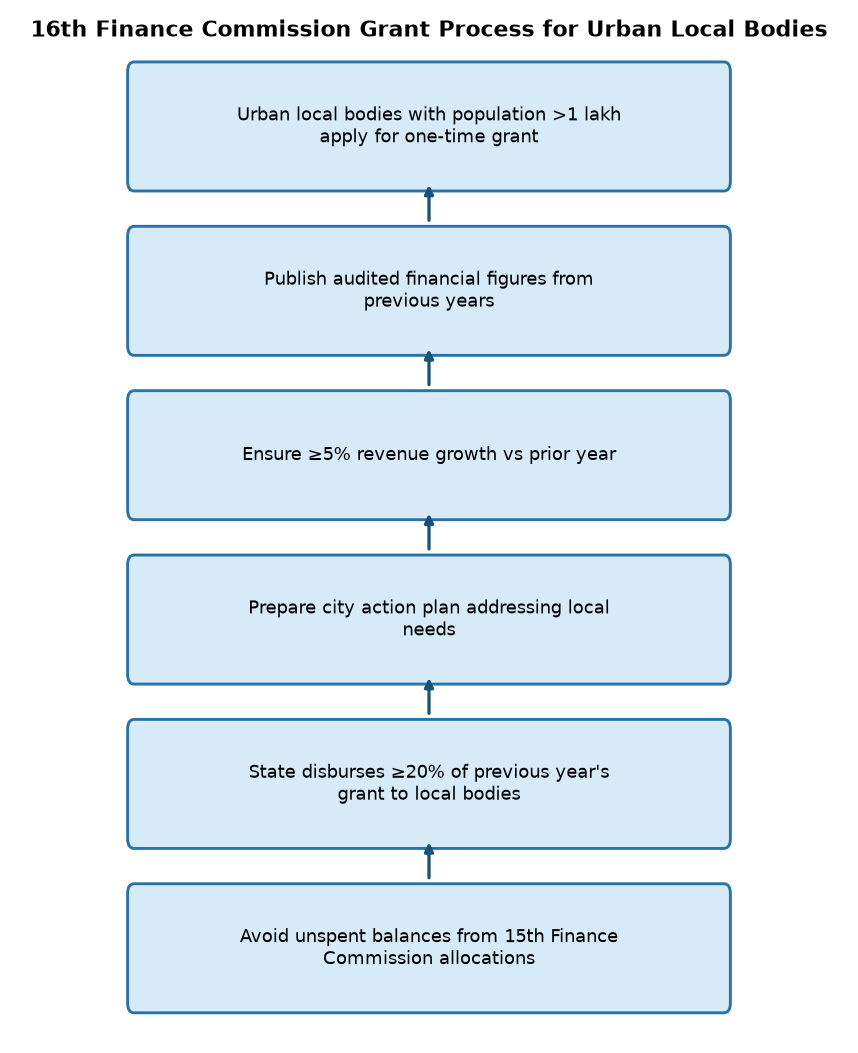
- Eligibility for the grant requires ULBs to publish audited financial statements from the previous financial year, ensuring transparency and accountability in fiscal management.
- A key condition for disbursement is a minimum 5% year-on-year revenue growth in the preceding financial year compared to the year prior, incentivising efficient revenue mobilisation and economic dynamism.
- States must disburse at least 20% of the grant recommended by the 16th Finance Commission to local bodies in the previous year to qualify for the State performance component, reinforcing intergovernmental fiscal discipline.
- The grant is disbursed in instalments, with the first tranche conditional on ULBs not holding unspent amounts from the 15th Finance Commission allocations.
- ULBs are required to prepare a City Action Plan that addresses local needs, including infrastructure, sanitation, and solid waste management, to qualify for the grant, aligning with national urban development priorities.
- The 16th Finance Commission’s framework prioritises cleanliness, solid waste processing, and water management, reflecting a shift towards outcome-based fiscal transfers in urban governance.
Key Features
| Feature | Significance |
|---|---|
| One-time grant for urban local bodies (ULBs) | Provides targeted financial support to ULBs with population above one lakh to incentivise the integration of peri-urban villages into urban governance structures. |
| Urbanisation premium component | Recognises the additional fiscal burden on ULBs due to rapid urbanisation and peri-urban expansion, ensuring equitable resource allocation. |
| Performance-based grant conditions | Links grant disbursement to measurable criteria such as revenue growth (minimum 5% YoY) and utilisation of previous allocations, promoting fiscal discipline. |
| City action plan requirement | Mandates ULBs to prepare a comprehensive plan addressing local needs, ensuring alignment of grants with developmental priorities. |
| State performance component | Ties a portion of the grant to the State’s disbursement of at least 20% of the 16th Finance Commission’s recommended grants to ULBs in the prior year. |
Why it Matters
Fiscal Federalism
- Enhances the fiscal autonomy of urban local bodies by providing untied grants, thereby strengthening the third tier of governance as envisaged in the 74th Constitutional Amendment Act, 1992.
- Introduces performance-linked conditionalities, ensuring that grants are utilised efficiently and in accordance with developmental objectives.
- Bridges the urban-rural fiscal divide by incentivising the integration of peri-urban areas into urban governance structures, promoting inclusive urbanisation.
Urban Governance
- Facilitates the merger of peri-urban villages into urban local bodies, addressing governance fragmentation and improving service delivery in rapidly expanding urban agglomerations.
- Encourages long-term planning through the requirement of city action plans, ensuring that infrastructure and services are developed in a coordinated manner.
- Promotes accountability and transparency by mandating the publication of audited financial statements and utilisation reports.
Sustainable Development
- Prioritises cleanliness, solid waste processing, and water management in the grant framework, aligning with the Sustainable Development Goals (SDG 6 and SDG 11) on clean water, sanitation, and sustainable cities.
- Supports the development of wastewater management infrastructure, addressing critical urban challenges such as pollution and public health risks.
Economic Growth
- Stimulates economic activity in peri-urban areas by integrating them into urban economies, potentially increasing land values, employment opportunities, and local tax revenues.
- Encourages efficient utilisation of public funds through performance-based disbursement, reducing fiscal inefficiencies in urban development.
Challenges
1. Implementation Gaps in Urban Local Bodies
- Many ULBs lack the administrative and technical capacity to prepare city action plans or utilise grants efficiently, necessitating capacity-building initiatives.
- Delays in auditing and financial reporting may hinder timely disbursement of grants, requiring streamlined processes and digital governance solutions.
UPSC Link: 74th CAA, Part IXA
2. Fiscal Constraints of States
- States may face difficulties in meeting the 20% disbursement condition for the State performance component, particularly in fiscally stressed regions.
- The requirement to utilise only up to 20% of untied grants for road construction may limit flexibility in addressing pressing infrastructure needs.
UPSC Link: Article 280
3. Peri-Urban Integration Challenges
- Legal and administrative hurdles in merging peri-urban villages into ULBs, including disputes over land ownership, local governance structures, and service provision responsibilities.
- Resistance from local communities due to concerns over loss of autonomy, displacement, or changes in land use regulations.
UPSC Link: 74th CAA, Schedule XII
4. Monitoring and Evaluation
- Ensuring compliance with utilisation conditions (e.g., 50% utilisation of previous allocations) requires robust monitoring mechanisms, which may be lacking in some ULBs.
- The absence of a standardised framework for measuring revenue growth and fiscal performance across ULBs complicates the assessment of grant eligibility.
UPSC Link: Article 280(3)
Challenges — UPSC Perspective
| Issue | Concern |
|---|---|
| Capacity deficits in ULBs | Inadequate technical and administrative expertise to prepare action plans or manage grants effectively. |
| Delayed financial reporting | Audited figures not published on time, leading to delays in grant disbursement. |
| State fiscal constraints | Difficulty in meeting the 20% disbursement condition for State performance grants. |
| Community resistance | Local opposition to merging peri-urban villages into ULBs due to perceived loss of autonomy. |
| Infrastructure prioritisation | Limited flexibility in utilising untied grants, potentially constraining urgent infrastructure needs. |
Way Forward
- Strengthen institutional capacity of ULBs through targeted training programmes on financial management, planning, and grant utilisation.
- Digitise financial reporting and auditing processes to ensure timely publication of audited statements and improve transparency.
- Establish a standardised framework for measuring revenue growth and fiscal performance across ULBs to ensure equitable grant allocation.
- Develop community engagement strategies to address resistance to peri-urban integration, including awareness campaigns and participatory planning.
- Create a dedicated monitoring mechanism to track utilisation of grants and enforce compliance with performance conditions.
- Encourage States to allocate additional resources to meet the 20% disbursement condition for State performance grants.
- Promote inter-departmental coordination between urban development, environment, and revenue departments to streamline peri-urban integration.
UPSC Value Addition
Keywords for Mains Answer-Writing
16th Finance Commission · Urban Local Bodies (ULBs) · Peri-urban villages · Urbanisation premium · Performance grants · Solid waste management · Wastewater management · City action plan · Audited financial statements · Urban governance · Fiscal federalism · Local body revenue growth · Untied grants · Urban infrastructure · 74th Constitutional Amendment Act · JNNURM · Swachh Bharat Mission · Urban sanitation · Resource mobilisation by ULBs
Constitutional & Policy Linkages
- Article 280: Finance Commission and distribution of grants-in-aid to States.
- 74th Constitutional Amendment Act, 1992: Empowerment of urban local bodies and devolution of functions.
- Part IXA: Constitutional provisions for urban governance and local bodies.
Concept Flow
Rapid urbanisation and peri-urban expansion → Increased fiscal burden on ULBs → 16th Finance Commission identifies need for targeted grants → Recommendation of one-time urbanisation premium grant → Conditions for grant disbursement (revenue growth, utilisation of prior allocations) → ULBs prepare city action plans → State performance component ensures fiscal discipline → Integration of peri-urban villages into urban governance structures → Improved service delivery and sustainable urban development.
Prelims Practice Questions
Q1. Consider the following statements regarding the 16th Finance Commission’s recommendations for urban local bodies (ULBs):
1. The Commission recommends a one-time grant to ULBs with a population above one lakh for merging peri-urban villages.
2. ULBs must demonstrate a minimum 5% revenue growth in the previous financial year to qualify for the performance grant.
3. The grant can be used entirely for road construction or maintenance works without any restrictions.
4. ULBs are required to publish audited financial statements from previous years to qualify for the grant.
How many of the above statements are correct?
- Only one
- Only two
- Only three
- All four
Answer: Only three — Statements 1, 2, and 4 are correct. Statement 3 is incorrect as the 16th Finance Commission restricts the use of untied grants for road construction or maintenance to a maximum of 20%.
Q2. Assertion (A): The 16th Finance Commission emphasizes cleanliness, solid waste processing, and water management as key focus areas for urban local bodies from 2026-27 to 2030-31.
Reason (R): The Commission has recommended a special infrastructure grant for comprehensive wastewater management programmes in selected urban growth centres.
In the context of the above two statements, which of the following is correct?
- Both A and R are true, and R is the correct explanation of A.
- Both A and R are true, but R is not the correct explanation of A.
- A is true, but R is false.
- A is false, but R is true.
Answer: A is true, but R is false. — Both statements are true. The 16th Finance Commission focuses on cleanliness, solid waste processing, and water management (A). It also recommends a special infrastructure grant for wastewater management programmes (R). However, R is not the sole explanation for A, as the focus areas are broader.
Q3. Match the following components of the 16th Finance Commission’s grant recommendations for urban local bodies with their respective conditions:
Column I (Component) | Column II (Condition)
———————————————–|—————————————
A. Urbanisation premium component | 1. At least 20% of the grant must be disbursed to ULBs in the previous year
B. Performance grant | 2. Revenue growth of at least 5% in the previous year
C. State performance component | 3. Population above one lakh
D. Special infrastructure grant | 4. Comprehensive wastewater management programmes
- A-3, B-2, C-1, D-4
- A-1, B-2, C-3, D-4
- A-2, B-3, C-1, D-4
- A-4, B-1, C-2, D-3
Answer: A-3, B-2, C-1, D-4 — The correct match is: A (Urbanisation premium component) with 3 (Population above one lakh), B (Performance grant) with 2 (Revenue growth of at least 5%), C (State performance component) with 1 (At least 20% of the grant must be disbursed to ULBs in the previous year), and D (Special infrastructure grant) with 4 (Comprehensive wastewater management programmes).
Mains Practice Question
✍ The 16th Finance Commission’s recommendations for urban local bodies (ULBs) reflect a paradigm shift towards incentivising fiscal discipline, urban governance reforms, and sustainable urbanisation. Critically examine this assertion with reference to the Commission’s grant mechanisms, performance conditions, and institutional frameworks outlined in the 74th Constitutional Amendment Act, 1992. Also, analyse the potential challenges in the implementation of these recommendations. (15 Marks)
Approach: A top-tier answer must structure the response into the following dimensions:
1. **Contextual Framework** (2 marks):
– Briefly outline the constitutional mandate under the 74th Constitutional Amendment Act (CAA), 1992, for empowering ULBs in urban planning, governance, and resource mobilisation.
– Highlight the persistent challenges in urban governance: fragmented ULBs, inadequate revenue base, poor service delivery, and lack of fiscal autonomy.
2. **16th Finance Commission’s Grant Mechanisms** (4 marks):
– **Urbanisation Premium Component**: Explain the rationale for a one-time grant to ULBs with population >1 lakh for merging peri-urban villages. Link to the objective of promoting sustainable urbanisation and reducing urban sprawl.
– **Performance Grant**: Discuss the conditions—5% revenue growth, utilisation of 50% of previous allocations, and no unspent amounts from the 15th Finance Commission—to incentivise fiscal responsibility and efficient resource use.
– **State Performance Component**: Analyse the requirement for states to disburse at least 20% of the grant to ULBs, ensuring equitable distribution and accountability.
– **Special Infrastructure Grant**: Explain the focus on cleanliness, solid waste processing, and wastewater management, aligning with national missions like Swachh Bharat Mission 2.0.
3. **Institutional Frameworks and Governance Reforms** (4 marks):
– **City Action Plans**: Emphasise the need for ULBs to prepare comprehensive city action plans, integrating local needs, audited financial statements, and transparent governance.
– **Fiscal Federalism**: Discuss how the recommendations reinforce cooperative federalism by linking grants to performance, ensuring ULBs and states are incentivised to improve governance.
– **Role of State Governments**: Highlight the state’s responsibility in disbursing grants and ensuring ULBs meet conditions, reflecting the principle of subsidiarity.
4. **Potential Challenges in Implementation** (3 marks):
– **Fiscal Constraints**: ULBs in economically weaker states may struggle to meet the 5% revenue growth condition due to limited tax bases or administrative inefficiencies.
– **Administrative Bottlenecks**: Delays in auditing financial statements, bureaucratic hurdles in merging peri-urban villages, and lack of technical capacity in ULBs.
– **Equity Concerns**: Risk of grants being disproportionately availed by larger ULBs, exacerbating regional disparities.
– **Political Economy Factors**: Potential resistance from state governments or local political elites in implementing reforms or disbursing grants transparently.
5. **Conclusion** (2 marks):
– Summarise the significance of the 16th Finance Commission’s recommendations in transforming ULBs into effective instruments of urban governance.
– Highlight the need for concurrent reforms in property tax regimes, user charges, and capacity-building of ULBs to sustain the momentum generated by these grants.
Source: The Hindu
Generated by AanyaAi for educational purpose.
Related guides on our sites
- Best economics optional coaching for upsc
- Best economics optional teacher for upsc
- How to prepare for GS paper 1 for UPSC CSE mains exam
- Best UPSC coaching for IFOS exam


No Comments