


19 Sep 180+ Scientists Warn of ‘Super’ El Nino Threat to India: UPSC Exam Analysis
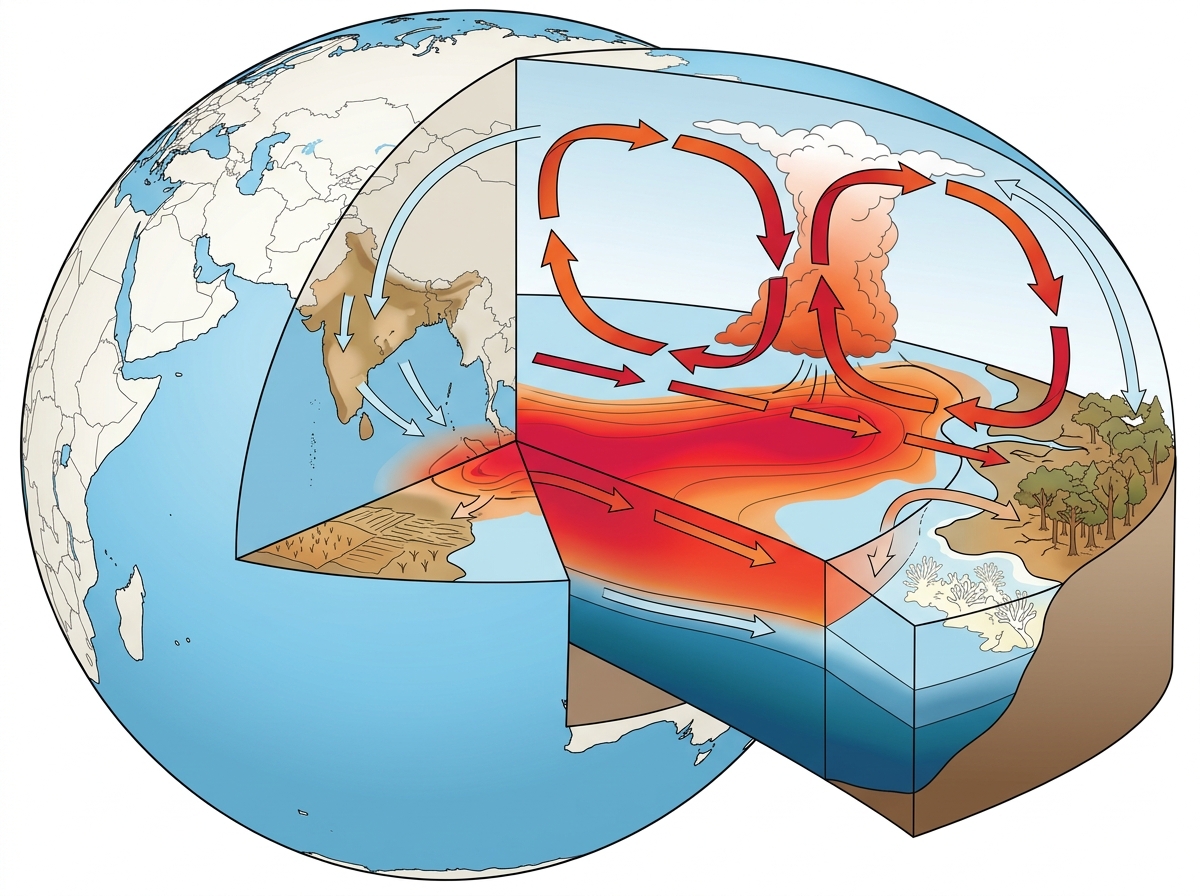
✎ El Niño is a phase of the ENSO cycle marked by abnormal warming of the tropical Pacific Ocean, disrupting global weather patterns and posing severe risks to India’s monsoon-dependent agriculture, ecosystems, and water security.
Subject Relevance — Where This Topic Fits
- GS Paper I — Geography (Physical Geography, Climate and Weather Systems) | GS Paper III — Environment and Disaster Management
- Prelims: El Niño, Southern Oscillation (ENSO), Indian Ocean Dipole (IOD), Coral bleaching, Wildfires, Drought, Heatwaves, Indian Institute of Tropical Meteorology (IITM), World Meteorological Organisation (WMO), Tropical Pacific Ocean, Oceanic Niño Index (ONI)
- Essay: Climate change and its cascading impacts on natural ecosystems and human societies, The interplay between scientific research and policy in mitigating climate-induced disasters
Quick Revision: El Niño is a phase of the ENSO cycle marked by abnormal warming of the tropical Pacific Ocean, disrupting global weather patterns and posing severe risks to India’s monsoon-dependent agriculture, ecosystems, and water security.
Why is this in the news?
In September 2026, over 180 Indian scientists and ecologists issued a joint appeal urging immediate and coordinated action to study and mitigate the anticipated impacts of an impending ‘super’ El Niño event. The World Meteorological Organisation (WMO) had earlier projected that the current El Niño conditions would intensify into a very strong event, persisting through February 2027, with potential sea-surface temperature anomalies exceeding 4°C—levels unprecedented in the past millennium. The appeal underscores the severe ecological and socio-economic risks posed to India’s natural systems, including coral reefs, rainforests, and agricultural landscapes, necessitating urgent scientific documentation and adaptive governance measures.
Background
- El Niño is a phase of the El Niño-Southern Oscillation (ENSO) cycle, characterised by the abnormal warming of surface waters in the central and eastern tropical Pacific Ocean, disrupting global weather patterns.
- Historical records indicate that strong El Niño events have been associated with severe droughts in India, particularly during the monsoon season, leading to significant agricultural losses and water scarcity.
- The Indian Institute of Tropical Meteorology (IITM), Pune, serves as a nodal agency for climate research in India, providing critical data and forecasts on ENSO and its regional impacts.
What is El Niño and its associated mechanisms?
- El Niño is a climate phenomenon arising from the El Niño-Southern Oscillation (ENSO) cycle, which alternates between warm (El Niño), cold (La Niña), and neutral phases.
- The event is triggered by the weakening or reversal of trade winds over the tropical Pacific, reducing upwelling of cold, nutrient-rich waters and leading to abnormal warming of surface waters.
- The Oceanic Niño Index (ONI), based on sea-surface temperature anomalies in the Niño 3.4 region, is the standard metric used to classify El Niño events as weak, moderate, or strong.
- El Niño disrupts global weather patterns by altering the Walker Circulation, a large-scale atmospheric loop that redistributes heat and moisture across the tropics.
- In India, El Niño is typically associated with suppressed monsoon rainfall, prolonged dry spells, and elevated temperatures, particularly in central and southern regions.
- The phenomenon also influences global climate systems, including the Atlantic hurricane season, Australian droughts, and South American floods.
- The term ‘super El Niño’ refers to exceptionally strong events with sea-surface temperature anomalies exceeding 2°C, often linked to extreme weather events and ecological disruptions.
- Scientific monitoring of El Niño relies on satellite data, ocean buoys, and climate models to track sea-surface temperatures, trade wind patterns, and atmospheric pressure gradients.
Key Features
| Feature | Significance |
|---|---|
| El Niño phenomenon | A periodic warming of tropical Pacific Ocean surface waters disrupting global weather patterns, with severe implications for monsoon-dependent economies like India. |
| Sea Surface Temperature (SST) anomalies | Current projections indicate anomalies exceeding 4°C, the highest in a millennium, amplifying climate extremes globally. |
| World Meteorological Organisation (WMO) assessment | WMO’s forecast of a ‘very strong’ El Niño event persisting till February 2027 underscores the need for anticipatory governance. |
| Ecological impacts in India | Threatens coral bleaching, rainforest die-offs, wildfires, and shifts in phenology (e.g., delayed fruiting) with cascading effects on biodiversity. |
| Agricultural vulnerability | Droughts and extreme heat linked to El Niño threaten crop yields, livestock health, and livelihoods of smallholder farmers and pastoralists. |
Why it Matters
Climate Science & Research
- El Niño events are critical case studies for understanding non-linear climate feedbacks, particularly in the Indian Ocean dipole and monsoon dynamics.
- India’s scientific community (e.g., IITM, MoES) plays a pivotal role in monitoring and modelling such events, necessitating sustained funding for climate research.
- Long-term ecological documentation during such events provides empirical data to refine climate projections and adaptation strategies.
Economic Implications
- Agricultural output fluctuations due to El Niño can disrupt food security, inflation trajectories, and rural incomes, impacting GDP growth.
- Fisheries and coastal ecosystems face collapse risks, threatening livelihoods of millions dependent on marine resources.
- Energy demand surges during heatwaves (linked to El Niño) strain power grids, necessitating grid resilience and renewable integration.
Environmental Governance
- Extreme climate events expose weaknesses in India’s disaster risk reduction frameworks, particularly in drought-prone and heat-vulnerable regions.
- Ecosystem-based adaptation (e.g., mangrove restoration, agroforestry) emerges as a cost-effective strategy to buffer against climate shocks.
- Cross-sectoral coordination between meteorological agencies, forest departments, and agricultural ministries is essential for integrated response.
Global Context
- El Niño events are part of the broader ENSO cycle, with teleconnections affecting global precipitation patterns, including South America and Australia.
- International collaboration (e.g., via WMO, IPCC) enhances early warning systems and knowledge-sharing for transboundary climate risks.
- India’s proactive engagement in climate diplomacy (e.g., COP processes) can leverage global resources for domestic resilience-building.
Challenges
1. Climate Data Gaps & Monitoring
- Inadequate high-resolution climate models for sub-regional El Niño impacts, particularly in the Bay of Bengal and Himalayan foothills.
- Limited real-time ecological monitoring networks to track cascading effects (e.g., coral bleaching, phenological shifts).
- Fragmented data-sharing protocols between central agencies (e.g., IMD, ISRO) and state-level institutions hinder granular risk assessment.
UPSC Link: GS Paper 3: Disaster Management (NDMA guidelines)
2. Agricultural Adaptation Deficits
- Low adoption of climate-resilient crop varieties (e.g., drought-tolerant seeds) due to high costs and limited extension services.
- Insufficient insurance penetration for smallholder farmers to mitigate El Niño-induced crop losses.
- Delayed policy responses (e.g., crop diversification incentives) exacerbate vulnerability during extreme events.
UPSC Link: GS Paper 3: Agriculture (National Mission on Sustainable Agriculture)
3. Ecosystem Degradation
- Coastal and forest ecosystems face cumulative stress from anthropogenic pressures (e.g., deforestation, pollution) alongside El Niño impacts.
- Lack of integrated coastal zone management plans to address coral reef degradation and mangrove loss.
- Inadequate legal frameworks for protecting critical habitats during climate emergencies.
UPSC Link: GS Paper 3: Environment (Wildlife Protection Act, 1972)
4. Public Health Risks
- Heatwaves linked to El Niño increase mortality risks, particularly among vulnerable populations (e.g., elderly, outdoor workers).
- Vector-borne disease outbreaks (e.g., dengue, malaria) surge due to altered monsoon patterns and stagnant water accumulation.
- Health infrastructure (e.g., PHCs, district hospitals) lacks capacity for mass casualty events during climate extremes.
UPSC Link: GS Paper 2: Health (National Health Mission)
5. Governance & Institutional Coordination
- Silos between meteorological, agricultural, and disaster management agencies delay response timelines.
- State-level climate action plans often lack alignment with national strategies, leading to fragmented implementation.
- Limited fiscal devolution to local bodies (e.g., panchayats) for community-led resilience initiatives.
UPSC Link: GS Paper 2: Federalism (73rd/74th Constitutional Amendments)
Challenges — UPSC Perspective
| Issue | Concern |
|---|---|
| Sub-regional climate modelling | Inability to predict El Niño impacts at district/block level, leading to poor localised preparedness. |
| Agricultural insurance coverage | Only 20% of smallholder farmers are covered under PMFBY, leaving majority exposed to El Niño-induced losses. |
| Coral reef monitoring | India’s reefs (e.g., Andamans, Lakshadweep) lack dedicated monitoring networks for bleaching events. |
| Heatwave early warning systems | Urban areas (e.g., Delhi, Ahmedabad) lack heat action plans with real-time heat index tracking. |
| Cross-state water sharing | El Niño-induced droughts exacerbate inter-state water disputes (e.g., Cauvery, Krishna basins). |
| Public awareness campaigns | Limited outreach on El Niño risks among rural communities, reducing adaptive capacity. |
Way Forward
- Enhance sub-regional climate modelling by investing in high-performance computing (HPC) and AI-driven forecasting tools at institutions like IITM and IMD.
- Expand real-time ecological monitoring networks (e.g., coral reefs, mangroves) through partnerships with CSIR, MoEFCC, and state forest departments.
- Scale up climate-resilient agriculture via subsidies for drought-tolerant seeds, micro-irrigation, and weather-indexed crop insurance.
- Strengthen heatwave preparedness in urban and rural areas by mandating heat action plans under the National Disaster Management Guidelines.
- Integrate El Niño risk assessments into state action plans on climate change (SAPCCs) with dedicated budgetary allocations.
- Promote ecosystem-based adaptation (EbA) through afforestation, mangrove restoration, and agroforestry programs in vulnerable regions.
- Foster inter-ministerial coordination via a dedicated El Niño Task Force under the National Disaster Management Authority (NDMA).
- Launch public awareness campaigns in regional languages, targeting farmers, fishermen, and pastoralists, using community radio and digital platforms.
UPSC Value Addition
Keywords for Mains Answer-Writing
El Niño Southern Oscillation (ENSO) · El Niño · La Niña · Indian Ocean Dipole (IOD) · tropical Pacific Ocean · global climate variability · climate change impacts on agriculture · monsoon variability in India · World Meteorological Organisation (WMO) · climate resilience · ecosystem degradation · coral bleaching · wildfire frequency · drought risk management · climate adaptation strategies
Concept Flow
El Niño formation → Warming of tropical Pacific SSTs → Disruption of Walker circulation → Weakening of Indian Summer Monsoon (ISM) → Weak ISM → Reduced rainfall → Agricultural drought → Crop yield decline and rural distress → Increased surface temperatures → Heatwaves → Public health emergencies and energy demand spikes → Altered ocean-atmosphere interactions → Coral bleaching and marine ecosystem collapse → Extreme weather events → Wildfires and forest die-offs → Biodiversity loss and carbon cycle feedbacks → Cascading socio-economic impacts → Food insecurity, inflation, and migration pressures → Policy response → Early warning systems, adaptation strategies, and resilience-building measures
Prelims Practice Questions
Q1. Consider the following statements regarding El Niño and its impacts on India:
1. El Niño is characterised by the unusual warming of surface waters in the tropical Pacific Ocean.
2. El Niño events are associated with above-normal monsoon rainfall in India.
3. El Niño can lead to increased frequency of wildfires and coral bleaching.
4. The World Meteorological Organisation (WMO) has categorised the current El Niño event as a “super” El Niño.
How many of the above statements are correct?
- Only one
- Only two
- Only three
- All four
Answer: Only three — Statements 1 and 3 are correct. Statement 2 is incorrect as El Niño is linked to below-normal monsoon rainfall in India. Statement 4 is incorrect as the WMO has not officially categorised the current event as a ‘super’ El Niño; it has only indicated a very strong El Niño event.
Q2. Assertion (A): El Niño events are driven by the weakening of trade winds over the tropical Pacific Ocean.
Reason (R): The weakening of trade winds reduces the upwelling of cold water, leading to warming of surface waters in the eastern Pacific.
Options:
A. Both A and R are true, and R is the correct explanation of A.
B. Both A and R are true, but R is NOT the correct explanation of A.
C. A is true, but R is false.
D. A is false, but R is true.
Answer: ? — Both the assertion and reason are correct, and the reason accurately explains the assertion. The weakening of trade winds disrupts the Walker circulation, reducing upwelling and causing surface warming in the eastern Pacific, which defines El Niño.
Q3. Match the following climate phenomena with their characteristic features:
Column I (Phenomenon)
A. El Niño
B. La Niña
C. Indian Ocean Dipole (IOD)
Column II (Feature)
1. Unusual warming of surface waters in the tropical Pacific Ocean
2. Unusual cooling of surface waters in the tropical Pacific Ocean
3. Positive IOD phase characterised by warmer western Indian Ocean and cooler eastern Indian Ocean
4. Negative IOD phase characterised by cooler western Indian Ocean and warmer eastern Indian Ocean
Options:
A. A-1, B-2, C-3
B. A-2, B-1, C-4
C. A-1, B-2, C-4
D. A-3, B-4, C-1
Answer: ? — El Niño is associated with unusual warming in the tropical Pacific (A-1). La Niña is associated with unusual cooling in the tropical Pacific (B-2). The positive phase of the Indian Ocean Dipole (IOD) features warmer western Indian Ocean and cooler eastern Indian Ocean (C-3).
Mains Practice Question
✍ ‘The El Niño Southern Oscillation (ENSO) phenomenon is a critical driver of climate variability in India, with far-reaching consequences for agriculture, water resources, and ecosystem stability.’ Critically examine this statement with reference to the mechanisms of ENSO, its impacts on the Indian monsoon, and the associated socio-economic challenges. Also, outline the institutional frameworks in India for monitoring and mitigating ENSO-related risks. (15 Marks)
Approach: MODEL-ANSWER SKELETON:
1. **Introduction (2 marks)**
– Define ENSO: El Niño (warming phase), La Niña (cooling phase), and Southern Oscillation (atmospheric component).
– Brief on the Walker circulation and its disruption during El Niño.
2. **Mechanisms of ENSO (3 marks)**
– Trade winds, upwelling, and sea surface temperature (SST) anomalies in the tropical Pacific.
– Teleconnections: How ENSO influences global weather patterns, including the Indian monsoon.
– Role of the Indian Ocean Dipole (IOD) as a modulating factor in ENSO impacts on India.
3. **Impacts on India (5 marks)**
– **Monsoon variability**: Correlation between El Niño and deficient monsoon rainfall (e.g., 2015, 2018).
– **Agricultural consequences**: Droughts, reduced kharif crop yields, and farmer distress.
– **Water resources**: Depletion of reservoirs, groundwater stress, and urban water shortages.
– **Ecosystem degradation**: Coral bleaching in the Andaman and Nicobar Islands, increased wildfire frequency in the Himalayas and Western Ghats.
– **Socio-economic challenges**: Migration, food security risks, and economic losses in rainfed agriculture.
4. **Institutional Frameworks (3 marks)**
– **Monitoring**: India Meteorological Department (IMD), Indian Institute of Tropical Meteorology (IITM), and WMO collaborations.
– **Early warning systems**: Seasonal forecasts, ENSO bulletins, and district-level advisories.
– **Mitigation**: National Action Plan on Climate Change (NAPCC), National Mission for Sustainable Agriculture (NMSA), and Pradhan Mantri Fasal Bima Yojana (PMFBY).
– **Research**: Role of institutions like CSIR, IITs, and state agricultural universities in climate-resilient practices.
5. **Critical Analysis (2 marks)**
– Limitations of current forecasting models in predicting ENSO impacts at sub-regional scales.
– Challenges in translating early warnings into actionable policies for vulnerable communities.
– Need for integrating traditional knowledge with modern science for climate resilience.
Source: orissapost.com
Generated by AanyaAi for educational purpose.
Related guides on our sites
- How to prepare for GS paper 1 for UPSC CSE mains exam
- Best UPSC coaching for IFOS exam
- Best agriculture optional coaching
- Best geography optional coaching

- UPSC Civil Services (Main) Examination 2026 — Sanskrit Literature Paper II: Question Paper | Plutus IAS - September 21, 2026
- चीनी राष्ट्रपति शी जिनपिंग अमेरिका दौरे पर, ट्रंप से मिलेंगे वार्ता हेतु - September 21, 2026
- Xi Jinping’s US Visit: Key Takeaways for UPSC & State PCS Aspirants - September 21, 2026

No Comments