


26 Sep 24 Minor Pregnancies in Odisha Tribal Hostels: UPSC Exam Analysis of Governance Gaps
✎ Minor pregnancies in tribal school hostels violate the POCSO Act, 2012, and the Juvenile Justice Act, 2015, and necessitate immediate action under the Integrated Child Protection Scheme (ICPS) to ensure child safety and…
Subject Relevance — Where This Topic Fits
- GS Paper I — Social Issues and Vulnerable Sections | GS Paper II — Governance, Transparency and Accountability | GS Paper III — Issues Relating to Development and Management of Social Sector/Services relating to Health, Education, Human Resources
- Prelims: Child Marriage Prohibition Act, 2006, Protection of Children from Sexual Offences (POCSO) Act, 2012, Integrated Child Protection Scheme (ICPS), National Commission for Protection of Child Rights (NCPCR), Sarva Shiksha Abhiyan (SSA), Tribal Sub-Plan (TSP), Juvenile Justice (Care and Protection of Children) Act, 2015, Rashtriya Madhyamik Shiksha Abhiyan (RMSA), Odisha Tribal Empowerment and Livelihoods Programme (OTELP)
- Essay: Safeguarding the Vulnerable: The State’s Duty to Protect Children in Institutional Care, Education and Social Justice: Balancing Access with Safety in Tribal Communities
Quick Revision: Minor pregnancies in tribal school hostels violate the POCSO Act, 2012, and the Juvenile Justice Act, 2015, and necessitate immediate action under the Integrated Child Protection Scheme (ICPS) to ensure child safety and institutional accountability.
Why is this in the news?
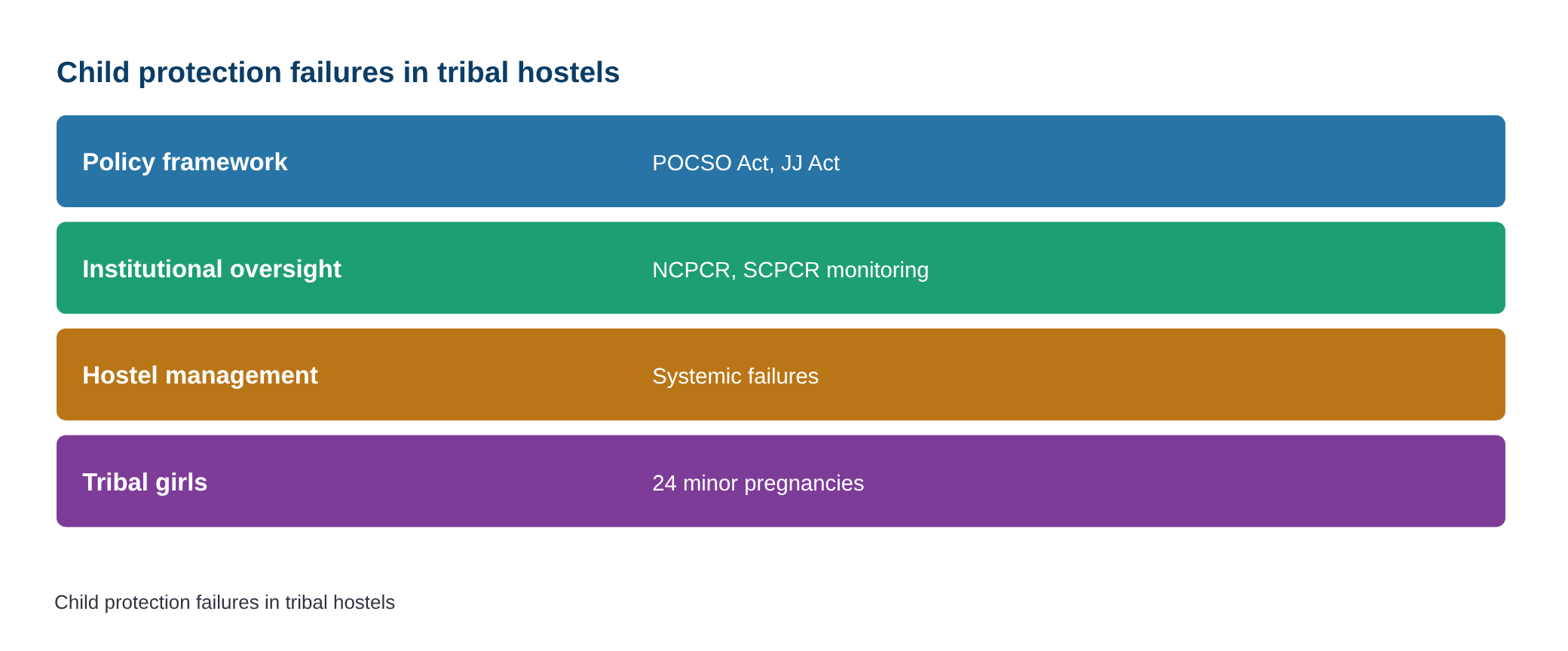
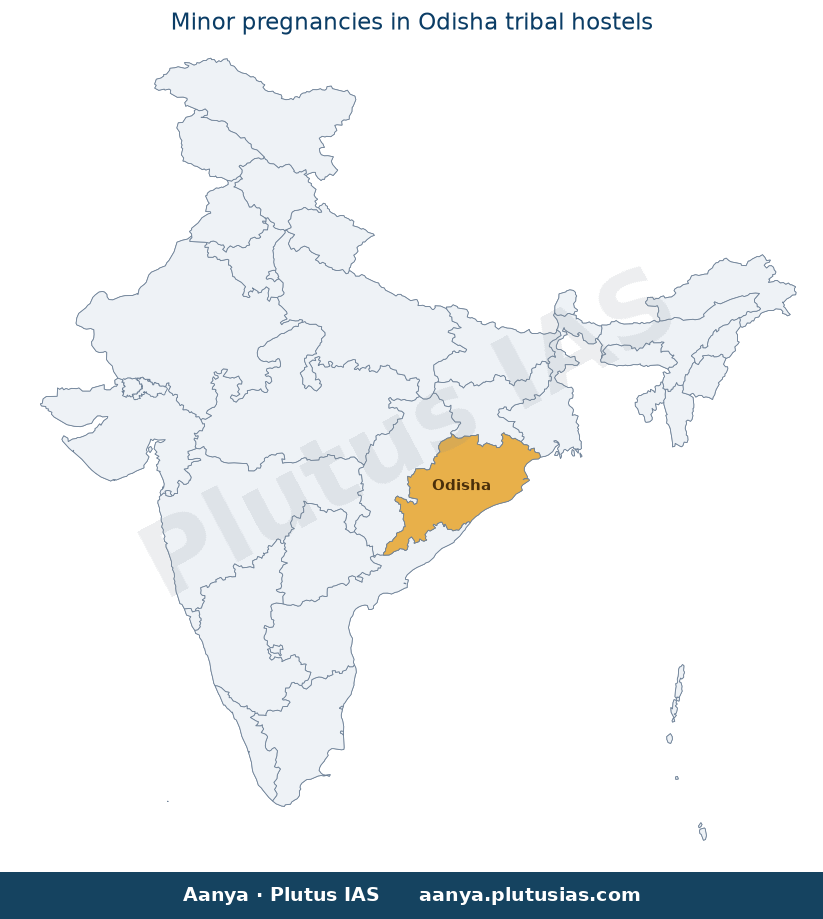
The revelation of 24 cases of minor pregnancies in government-run tribal school hostels in Odisha over two academic years underscores systemic failures in child protection within residential educational institutions, particularly for tribal girls. This incident necessitates an examination of the legal framework, institutional mechanisms, and socio-economic factors that contribute to such vulnerabilities, as well as the policy responses required to address them. The disclosure in the Odisha Legislative Assembly highlights the need for rigorous implementation of child protection laws and hostel management protocols in tribal education settings.
Background
- The Government of Odisha operates a network of tribal residential schools under schemes such as the Tribal Sub-Plan (TSP) and the Integrated Tribal Development Programme (ITDP), aimed at providing quality education to tribal children in remote areas.
- The Protection of Children from Sexual Offences (POCSO) Act, 2012, and the Juvenile Justice (Care and Protection of Children) Act, 2015, mandate the state to ensure the safety and well-being of children in institutional care, including hostels.
- The National Commission for Protection of Child Rights (NCPCR) and the State Commission for Protection of Child Rights (SCPCR) are empowered to monitor compliance with child protection norms in such institutions.
- Odisha has a significant tribal population, with Scheduled Tribes constituting approximately 22.85% of the state’s total population, as per the 2011 Census.
- The state has faced challenges in ensuring the safety of tribal girls in residential institutions, with reports of child labour, trafficking, and early marriages in tribal communities.
Minor Pregnancies in Tribal School Hostels: Legal, Social, and Institutional Dimensions
- The POCSO Act, 2012, defines a child as any person below the age of 18 years and criminalises sexual offences against minors, including statutory rape, with stringent penalties for offenders.
- The Juvenile Justice (Care and Protection of Children) Act, 2015, mandates the establishment of Child Welfare Committees (CWCs) and Juvenile Justice Boards (JJBs) to address the protection and rehabilitation of children in need of care and protection, including those affected by sexual abuse or exploitation.
- The Integrated Child Protection Scheme (ICPS), launched in 2009, provides a framework for the establishment of child protection structures at the district, state, and national levels, including the creation of Child Protection Units (CPUs) and Specialized Adoption Agencies (SAAs).
- The National Commission for Protection of Child Rights (NCPCR) and State Commissions for Protection of Child Rights (SCPCRs) are statutory bodies tasked with monitoring the implementation of child rights laws and investigating complaints of violations.
- Tribal school hostels in Odisha are required to comply with the Guidelines for Hostels for Children under the Juvenile Justice Act, which mandate regular inspections, grievance redressal mechanisms, and the appointment of child protection officers.
- The issue of minor pregnancies in hostels may stem from a combination of factors, including lack of adequate supervision, inadequate staff training on child protection protocols, socio-economic vulnerabilities in tribal communities, and gaps in the implementation of hostel management guidelines.
- The state government’s disclosure of 24 cases over two years suggests a systemic failure in the enforcement of child protection norms, necessitating a review of hostel management practices, staff recruitment and training, and the role of local authorities in ensuring compliance with statutory obligations.
- The incident highlights the intersection of education policy, child rights, and socio-economic development, particularly in tribal communities where access to education is often linked to institutional care.
UPSC Value Addition
Keywords for Mains Answer-Writing
Tribal welfare policy · Minor pregnancy in hostels · Child protection under POCSO Act · Government-run tribal residential schools · Socio-educational vulnerabilities of Scheduled Tribes · Institutional safeguards for tribal minors · Odisha Tribal Hostels (Food and Accommodation) Rules · UN Convention on the Rights of the Child (UNCRC) · Juvenile Justice (Care and Protection of Children) Act, 2015 · Multi-stakeholder governance for tribal minors · Sustainable Development Goals (SDG) 4 and 5 · Cultural relativism vs. child rights
Prelims Practice Questions
Q1. Consider the following statements regarding the protection of minors in residential institutions in India: 1. The Protection of Children from Sexual Offences (POCSO) Act, 2012 applies to all minors below the age of 18 years. 2. The Juvenile Justice (Care and Protection of Children) Act, 2015 mandates the establishment of Child Welfare Committees in every district. 3. The Odisha Tribal Hostels (Food and Accommodation) Rules, 2022 are framed under the Scheduled Castes and Scheduled Tribes (Prevention of Atrocities) Act, 1989. How many of the above statements are correct?
- Only one
- Only two
- All three
- None
Answer: Only two — Statement 1 is correct as POCSO Act protects all minors below 18. Statement 2 is correct as the JJ Act mandates Child Welfare Committees. Statement 3 is incorrect as the Odisha Tribal Hostels Rules are framed under the Tribal Sub-Plan and not the Atrocities Act.
Q2. Assertion (A): The Government of India has ratified the United Nations Convention on the Rights of the Child (UNCRC). Reason (R): UNCRC obligates state parties to ensure that children in institutional care are protected from all forms of abuse and exploitation.
- Both A and R are true, and R is the correct explanation of A
- Both A and R are true, but R is not the correct explanation of A
- A is true but R is false
- A is false but R is true
Answer: Both A and R are true, but R is not the correct explanation of A — India ratified UNCRC in 1992 (A is true). R correctly states the obligations under UNCRC (R is true). However, R is not the explanation for A as the ratification preceded the convention’s enforcement mechanisms.
Q3. Which of the following constitutional provisions directly empowers the Parliament to legislate on matters related to the welfare of Scheduled Tribes?
- Article 244
- Article 338
- Article 342
- Article 246 read with List V (State List) and List VI (Concurrent List)
Answer: Article 246 read with List V (State List) and List VI (Concurrent List) — Article 342 empowers the President to specify Scheduled Tribes. However, Parliament’s legislative competence on tribal welfare is derived from Article 246 read with List V (State List) and List VI (Concurrent List), particularly Entry 20 (Social Security and Social Insurance) and Entry 25 (Education).
Mains Practice Question
✍ The reported occurrence of 24 minor pregnancies in tribal school hostels in Odisha over two academic years raises critical questions about the adequacy of institutional safeguards for vulnerable tribal minors. Critically examine the legal, administrative, and socio-cultural dimensions of this issue. Also, outline the constitutional and statutory framework that governs the protection of tribal minors in residential institutions. (15 Marks)
Approach: MODEL-ANSWER SKELETON:
1. **Legal Framework**:
– POCSO Act, 2012: Define ‘child’ (Section 2(d)), mandatory reporting (Section 19), and institutional responsibilities (Section 28).
– Juvenile Justice (Care and Protection of Children) Act, 2015: Role of Child Welfare Committees (Section 27), Special Juvenile Police Units (Section 107), and rehabilitation mechanisms (Section 40).
– Odisha Tribal Hostels (Food and Accommodation) Rules, 2022: Provisions for safety audits, grievance redressal, and monitoring (Rule 12).
– UN Convention on the Rights of the Child (UNCRC): Articles 3, 19, 20, and 34 on best interests, protection from abuse, and institutional care.
2. **Administrative Gaps**:
– Failure of hostel authorities to implement mandatory POCSO compliance (e.g., lack of CCTV, unsupervised movement, delayed reporting).
– Weaknesses in the Juvenile Justice system: Understaffed Child Welfare Committees, delays in FIR registration, and inadequate rehabilitation.
– Odisha’s Tribal Sub-Plan (TSP) and Van Mitra schemes: Need for convergence with child protection mechanisms.
3. **Socio-Cultural Dimensions**:
– Tribal communities’ patriarchal norms and early marriage practices (e.g., Gond tribe’s customary practices).
– Stigma and underreporting in tribal societies due to cultural taboos.
– Intersectionality: Tribal minors face dual vulnerabilities—gender and tribal identity.
4. **Constitutional Safeguards**:
– Article 15(3): Special provisions for women and children.
– Article 21: Right to life and personal liberty (including protection from exploitation).
– Article 46: Promotion of educational and economic interests of Scheduled Tribes.
– Directive Principles of State Policy (Articles 38, 39, 45): State’s obligation to ensure welfare.
5. **Comparative Perspective**:
– Lessons from other states (e.g., Rajasthan’s Udaipur model for tribal hostel safety).
– Role of civil society and NGOs in monitoring hostels (e.g., UNICEF’s child protection initiatives).
6. **Way Forward**:
– Strengthening multi-stakeholder governance: Tribal departments, education departments, police, and child rights bodies.
– Mandatory third-party audits of hostels, grievance portals, and real-time monitoring.
– Sensitisation programmes for tribal communities on child rights and legal recourse.
– Data-driven policy: Annual reports on minor pregnancies in hostels, disaggregated by tribe and district.
Balance of views: Acknowledge tribal autonomy concerns while prioritising child rights. Cite recent judicial precedents (e.g., Supreme Court’s directives in *In Re: Alarming Rise in POCSO Cases*).
Source: Hindustan Times
Odisha PCS (OPSC (OAS)) — State PCS Practice
Prelims: As per recent reports, which tribal community in Odisha has witnessed 24 minor pregnancy cases in school hostels over the past two years?
- A. Gond
- B. Kondh
- C. Saora
- D. Juang
Answer: A. Gond — The Gond tribal community in Odisha has reported 24 minor pregnancy cases in school hostels over the past two years, highlighting issues of child protection and education access.
Mains: Discuss the socio-economic and administrative challenges in addressing minor pregnancies in tribal school hostels of Odisha, with special reference to the Gond community. Suggest measures for effective intervention and prevention.
Generated by AanyaAi for educational purpose.
Related guides on our sites
- Current affairs for upsc 2026
- Best PSIR optional coaching for upsc
- Best economics optional coaching for upsc
- Best PSIR optional teacher for upsc

- यूक्रेन का रोबोट सेना अभियान: युद्ध में मानव हानि कम करने की रणनीति - September 27, 2026
- Ukraine’s ‘Army of Robots’: A Game-Changer for UPSC Mains 2026 Polity & Governance - September 27, 2026
- रूस ने भारत-ब्राजील को दिया UNSC स्थायी सदस्यता का समर्थन, जर्मनी-जापान विरोध में - September 27, 2026

No Comments