


05 Sep 37,500 करोड़ रुपये की सतही कोयला गैसीकरण योजना: आवेदन प्रक्रिया और स्थिति
✎ The Surface Coal/Lignite Gasification Promotion Scheme, approved in May 2026 with a ₹37,500 crore outlay, seeks to convert domestic fossil fuels into high-value industrial products, reducing import dependence and strengthening…
Subject Relevance — Where This Topic Fits
- GS Paper II — Government Policies and Interventions for Development | GS Paper III — Energy, Infrastructure, and Industrial Policy
- Prelims: Coal Gasification, Lignite Gasification, Syn-gas, Methanol, Urea, Energy Security, Import Substitution, Coal Ministry, Cabinet Approval
- Essay: India’s Energy Transition: Balancing Domestic Resources and Import Dependence, Industrial Policy and Technological Self-Reliance in the 21st Century
Quick Revision: The Surface Coal/Lignite Gasification Promotion Scheme, approved in May 2026 with a ₹37,500 crore outlay, seeks to convert domestic fossil fuels into high-value industrial products, reducing import dependence and strengthening energy security.
Why is this in the news?
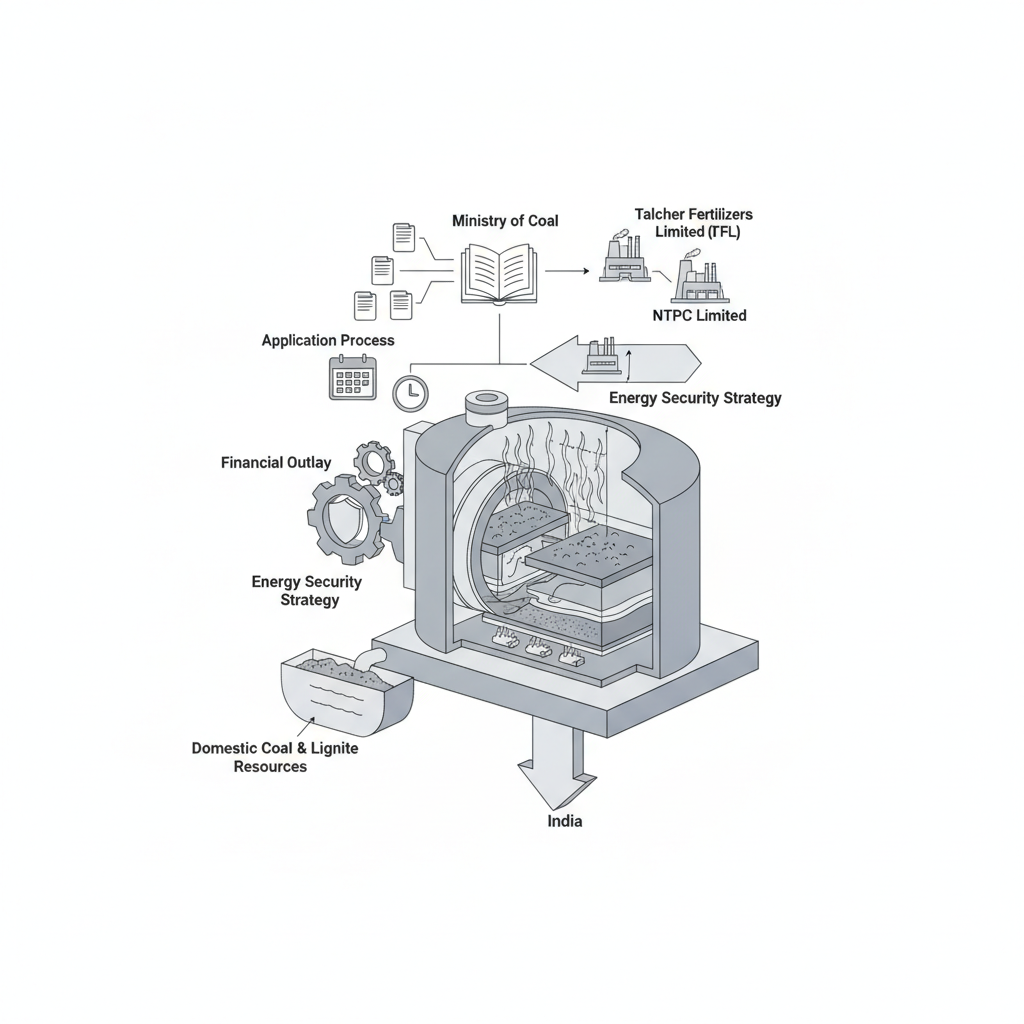
The Ministry of Coal has issued a clarification regarding media reports suggesting the absence of applications for the Surface Coal/Lignite Gasification Promotion Scheme, which was approved by the Union Cabinet on 13 May 2026 with a financial outlay of ₹37,500 crore. The Ministry has highlighted that the application process remains ongoing, with the first submission window closing on 7 September 2026, and has confirmed the receipt of applications from entities such as Talcher Fertilizers Limited (TFL) and NTPC Limited. This clarification underscores the procedural and institutional dynamics of large-scale energy transition policies in India.
Background
- India’s energy security strategy prioritises the utilisation of domestic coal and lignite resources to reduce import dependence, particularly for critical chemicals and fertilisers.
- Coal and lignite gasification converts solid fossil fuels into synthesis gas (syngas), which can be further processed into methanol, ammonia, and urea—key industrial feedstocks.
- The scheme is part of India’s broader industrial policy to enhance value addition in the coal sector, reduce reliance on imported urea and methanol, and support the Make in India initiative.
- The Ministry of Coal has conducted stakeholder engagement through roadshows in New Delhi (28 May 2026), Hyderabad (11 June 2026), and Mumbai (18 June 2026) to facilitate industry participation.
What is the Surface Coal/Lignite Gasification Promotion Scheme?
- Objective: To accelerate the development of coal and lignite gasification projects in India, transforming domestic fossil resources into high-value industrial products such as syngas, methanol, ammonia, and urea.
- Financial Outlay: ₹37,500 crore, approved by the Union Cabinet on 13 May 2026, with provisions for viability gap funding and incentives.
- Policy Instruments: The scheme provides financial incentives, regulatory support, and facilitation mechanisms to reduce the capital and operational risks associated with gasification projects.
- Eligibility Criteria: Open to public and private sector entities, including state-owned enterprises (e.g., NTPC, TFL), with a focus on projects utilising domestic coal and lignite reserves.
- Application Process: The first window closing on 7 September 2026. Applications are submitted via an online portal managed by the Ministry of Coal.
- Stakeholder Engagement: The Ministry has organised pre-application conferences (e.g., 20 July 2026) to address queries and ensure clarity on eligibility, technical requirements, and financial modalities.
- Project Scale and Complexity: Gasification projects are capital-intensive and require extensive preparatory work, including pre-feasibility studies, technology assessments, and raw material sourcing arrangements.
- Outcome Expectations: The scheme aims to reduce India’s import dependence for urea and methanol, enhance energy security, and promote technological self-reliance in the coal sector.
Key Features
| Feature | Significance |
|---|---|
| Financial Outlay | A total outlay of ₹37,500 crore to incentivise surface coal/lignite gasification projects, aiming to reduce import dependency and enhance domestic value addition. |
| Eligible Products | Promotes conversion of coal/lignite into synthesis gas, methanol, ammonia, and urea, aligning with industrial and agricultural requirements. |
| Application Process | Multi-stage application process with continuous rolling windows, allowing staggered submissions and revisions for stakeholders. |
| Stakeholder Engagement | Proactive outreach through roadshows, pre-application conferences, and direct consultations with public/private entities to ensure participation. |
| Timeline | First application window closes on 7 September 2026, followed by subsequent two-month windows to accommodate project preparation timelines. |
Why it Matters
Economic Security
- Reduces reliance on imported feedstock (e.g., methanol, ammonia) by leveraging domestic coal/lignite resources, thereby improving trade balance.
- Enhances value addition in the coal sector, transitioning from raw fuel to high-value industrial intermediates with broader economic multipliers.
Energy Transition
- Supports the development of coal gasification as a cleaner alternative to traditional coal combustion, aligning with long-term decarbonisation goals.
- Facilitates the integration of coal-based synthesis gas into existing petrochemical and fertiliser value chains, reducing carbon intensity per unit of output.
Industrial Competitiveness
- Provides a structured incentive framework to attract investment in coal gasification, fostering innovation and technological upgradation in the sector.
- Strengthens backward linkages for industries dependent on methanol, ammonia, and urea, such as chemicals, fertilisers, and transportation fuels.
Policy Continuity
- Demonstrates the government’s commitment to sector-specific interventions, complementing broader energy and industrial policies.
- Ensures policy predictability through rolling application windows, reducing uncertainty for potential investors and project developers.
Challenges
1. Technological Maturity
- Coal/lignite gasification requires advanced technological capabilities, including gasification reactors, syngas purification, and downstream conversion processes.
- Limited domestic expertise in large-scale gasification plants may necessitate technology transfer or joint ventures with international partners.
UPSC Link: GS-III: Energy, Science & Tech
2. Economic Viability
- High capital expenditure and operational costs for gasification plants may deter private investment without sustained policy support.
- Volatility in global energy prices can impact the competitiveness of domestically produced synthesis gas relative to imported alternatives.
UPSC Link: GS-III: Investment Models
3. Resource Availability
- Surface coal/lignite reserves are geographically concentrated, requiring robust logistics and infrastructure for transportation and utilisation.
- Competition for coal/lignite resources between power generation and gasification projects may arise, necessitating prioritisation frameworks.
UPSC Link: GS-III: Mineral & Energy Resources
4. Environmental Concerns
- Gasification processes, while cleaner than combustion, still emit CO₂ and other pollutants, requiring stringent emission controls and carbon capture measures.
- Mining of surface coal/lignite can lead to land degradation and water stress, necessitating sustainable mining practices and rehabilitation plans.
UPSC Link: GS-III: Environmental Pollution
5. Regulatory Framework
- Complexity in obtaining environmental clearances, land acquisition, and fuel supply agreements may delay project implementation.
- Need for harmonised policies across central and state governments to streamline approvals and ensure consistency in incentives.
UPSC Link: GS-II: Governance
Challenges — UPSC Perspective
| Issue | Concern |
|---|---|
| Capital Intensity | High upfront costs deter private participation without risk-sharing mechanisms or subsidies. |
| Technology Gap | Limited domestic expertise in gasification necessitates foreign collaboration, raising cost and dependency concerns. |
| Infrastructure Bottlenecks | Inadequate transport and storage facilities for surface coal/lignite hamper project scalability. |
| Market Competition | Synthesis gas from gasification must compete with cheaper imported methanol/urea, requiring protective measures. |
| Environmental Safeguards | Stringent emission norms and carbon pricing could increase operational costs, reducing profitability. |
| Policy Coherence | Overlapping regulations between coal, environment, and energy ministries may create compliance challenges. |
Way Forward
- Establish a dedicated nodal agency to coordinate approvals, clearances, and stakeholder consultations for gasification projects.
- Develop a technology upgradation fund to support R&D in coal gasification, including pilot plants and demonstration projects.
- Create a risk-sharing mechanism (e.g., viability gap funding) to offset high capital costs and attract private investment.
- Strengthen logistics infrastructure, including dedicated rail/road corridors for transporting surface coal/lignite to gasification hubs.
- Formulate a carbon credit framework to incentivise cleaner gasification processes and offset emissions.
- Conduct periodic reviews of the incentive structure to ensure alignment with market dynamics and technological advancements.
- Enhance skill development programmes in gasification technology through partnerships with IITs, NITs, and industry associations.
- Promote public-private partnerships (PPPs) to leverage government resources for large-scale gasification projects.
UPSC Value Addition
Keywords for Mains Answer-Writing
Coal Gasification Mission · Lignite Gasification Scheme · Energy Security in India · Domestic Coal Utilisation · Synthetic Gas Production · Methanol and Ammonia Production · Coal Beneficiation Policy · Circular Economy in Energy · Import Substitution Strategy · Coal Gasification Technology · Union Cabinet Approval · Ministry of Coal Initiatives · Surface Coal Gasification Projects · Energy Transition in India · Resource Efficiency in Energy Sector · Public-Private Partnership in Energy
Concept Flow
Coal/lignite extraction from surface mines → Transport to gasification hubs → Conversion to synthesis gas via gasification → Purification and downstream processing → Production of methanol, ammonia, urea → Industrial/agricultural utilisation or export → Policy announcement of ₹37,500 crore incentive scheme → Stakeholder engagement and roadshows → Application window opening → Submission of proposals by entities (e.g., TFL, NTPC) → Evaluation and approval of projects → Implementation and monitoring → Domestic gasification projects reduce import dependency → Lower trade deficit and improve energy security → Enhanced industrial competitiveness → Economic growth and job creation → High capital costs and technological gaps → Need for policy incentives and risk-sharing mechanisms → Attract private investment → Accelerate project implementation → Environmental concerns (emissions, land degradation) → Regulatory safeguards and carbon pricing → Sustainable project design → Long-term viability of gasification
Prelims Practice Questions
Q1. Consider the following statements regarding the Surface Coal/Lignite Gasification Promotion Scheme in India:
1. The scheme was approved by the Union Cabinet on 13 May 2026.
2. The total financial outlay of the scheme is ₹37,500 crore.
3. The scheme aims to reduce dependence on imported urea and ammonia by promoting domestic coal gasification.
4. The scheme mandates that all applications must be submitted within 30 days of its announcement.
How many of the above statements are correct?
- Only one
- Only two
- Only three
- All four
Answer: Only three — Statements 1, 2, and 3 are correct. Statement 4 is incorrect as the application window is not restricted to 30 days; the first phase closes on 7 September 2026, and subsequent phases will follow.
Q2. Assertion (A): The Surface Coal/Lignite Gasification Promotion Scheme is designed to enhance India’s energy security by reducing reliance on imported raw materials.
Reason (R): The scheme encourages the conversion of domestic coal and lignite into high-value products such as syngas, methanol, and ammonia, thereby substituting imports.
In the context of the above two statements, which one of the following is correct?
- Both A and R are true, and R is the correct explanation of A.
- Both A and R are true, but R is not the correct explanation of A.
- A is true, but R is false.
- A is false, but R is true.
Answer: Both A and R are true, and R is the correct explanation of A. — Both the Assertion (A) and Reason (R) are true, and the Reason (R) correctly explains the Assertion (A). The scheme’s primary objective is to convert domestic coal and lignite into high-value products to reduce import dependence and enhance energy security.
Mains Practice Question
✍ Critically examine the strategic significance of the Surface Coal/Lignite Gasification Promotion Scheme for India’s energy security and economic sustainability. Also, analyse the challenges in its implementation and suggest measures to enhance its effectiveness. (15 Marks)
Approach: MODEL-ANSWER SKELETON:
1. **Strategic Significance (6 points)**
– **Energy Security**: Reduces import dependence on urea, ammonia, and methanol by leveraging domestic coal/lignite resources.
– **Resource Efficiency**: Promotes circular economy by utilising low-grade coal and lignite, aligning with the National Coal Logistics Policy and Atmanirbhar Bharat.
– **Economic Sustainability**: Enhances value addition in the coal sector, creating employment and reducing subsidies on fertiliser imports.
– **Technology Modernisation**: Encourages adoption of advanced gasification technologies (e.g., U-GAS, KBR Transport Reactor) for cleaner energy production.
– **Policy Alignment**: Supports the National Mission on Coal Bed Methane (CBM) and the Hydrogen Energy Mission by providing a feedstock for syngas.
– **Climate Considerations**: While gasification is cleaner than direct coal combustion, its lifecycle emissions must be balanced with India’s NDC commitments under the Paris Agreement.
2. **Implementation Challenges (5 points)**
– **Technological Barriers**: High capital costs and operational complexities in gasification plants, particularly for lignite.
– **Environmental Concerns**: Potential air and water pollution if not regulated under the Environmental Protection Act, 1986 and the National Green Tribunal’s guidelines.
– **Market Dynamics**: Volatility in prices of methanol, ammonia, and urea may affect the economic viability of projects.
– **Infrastructure Gaps**: Inadequate transportation and storage facilities for synthetic gas and its derivatives.
– **Stakeholder Coordination**: Requires seamless collaboration between the Ministry of Coal, state governments, public-sector undertakings (e.g., NTPC, CIL), and private investors.
3. **Measures for Effectiveness (4 points)**
– **Financial Incentives**: Extend Production-Linked Incentive (PLI) schemes to gasification projects, similar to the ₹19,500 crore PLI for high-efficiency solar modules.
– **Regulatory Framework**: Strengthen the Coal Mines (Special Provisions) Act, 2015, and introduce a dedicated ‘Coal Gasification Regulatory Authority’ to streamline clearances.
– **R&D Collaboration**: Partner with institutions like CSIR-CIMFR and IITs to develop indigenous gasification technologies and reduce reliance on foreign patents.
– **Public Awareness**: Conduct capacity-building programmes for state governments and local bodies to address NIMBY (Not In My Backyard) sentiments and ensure smooth project execution.
4. **Balanced View (2 points)**
– **Pros**: Long-term energy independence, job creation, and alignment with India’s net-zero targets by 2070.
– **Cons**: Short-term financial burden on exchequer, potential environmental trade-offs, and competition with renewable energy transitions.
Source: PIB (Press Information Bureau)
Generated by AanyaAi for educational purpose.
Related guides on our sites
- Best PSIR optional coaching for upsc
- Best PSIR optional teacher for upsc
- Best teacher of PSIR optional for upsc
- Best PSIR optional coaching in delhi for UPSC

- स्ट्रेट ऑफ होर्मुज में भारतीयों से भरे तेल टैंकर पर प्रक्षेपास्त्र हमला, चालक दल सुरक्षित - October 22, 2026
- Rajya Sabha Bypoll on November 12: Key Dates & Process Explained - October 22, 2026
- सिम्बेक्स-2026: भारत-सिंगापुर नौसैनिक अभ्यास विशाखापत्तनम में शुरू, जानिए महत्वपूर्ण बिंदु - October 22, 2026

No Comments