


11 Aug 392वीं संसदीय रिपोर्ट: बस परिवहन में सुधार हेतु प्रमुख सिफारिशें
✎ The 392nd Report advocates for a National Bus Digital Grid with real-time tracking and integrated booking, a National Bus Terminal Authority for standardised infrastructure, and a Fleet Transition Compact to accelerate electric…
Subject Relevance — Where This Topic Fits
- GS Paper II — Government Policies and Interventions for Development in various sectors | GS Paper III — Infrastructure: Energy, Ports, Roads, Airports and Railways
- Prelims: Parliamentary Standing Committee, Bus Transport Policy, Public-Private Partnership (PPP), Fleet Transition Compact, National Bus Digital Grid, All-India Passenger Permit
- Essay: Sustainable Urban Mobility: Balancing Efficiency and Equity, Role of Technology in Public Service Delivery
Quick Revision: The 392nd Report advocates for a National Bus Digital Grid with real-time tracking and integrated booking, a National Bus Terminal Authority for standardised infrastructure, and a Fleet Transition Compact to accelerate electric bus adoption through scrapping incentives and regional manufacturing clusters.
Why is this in the news?
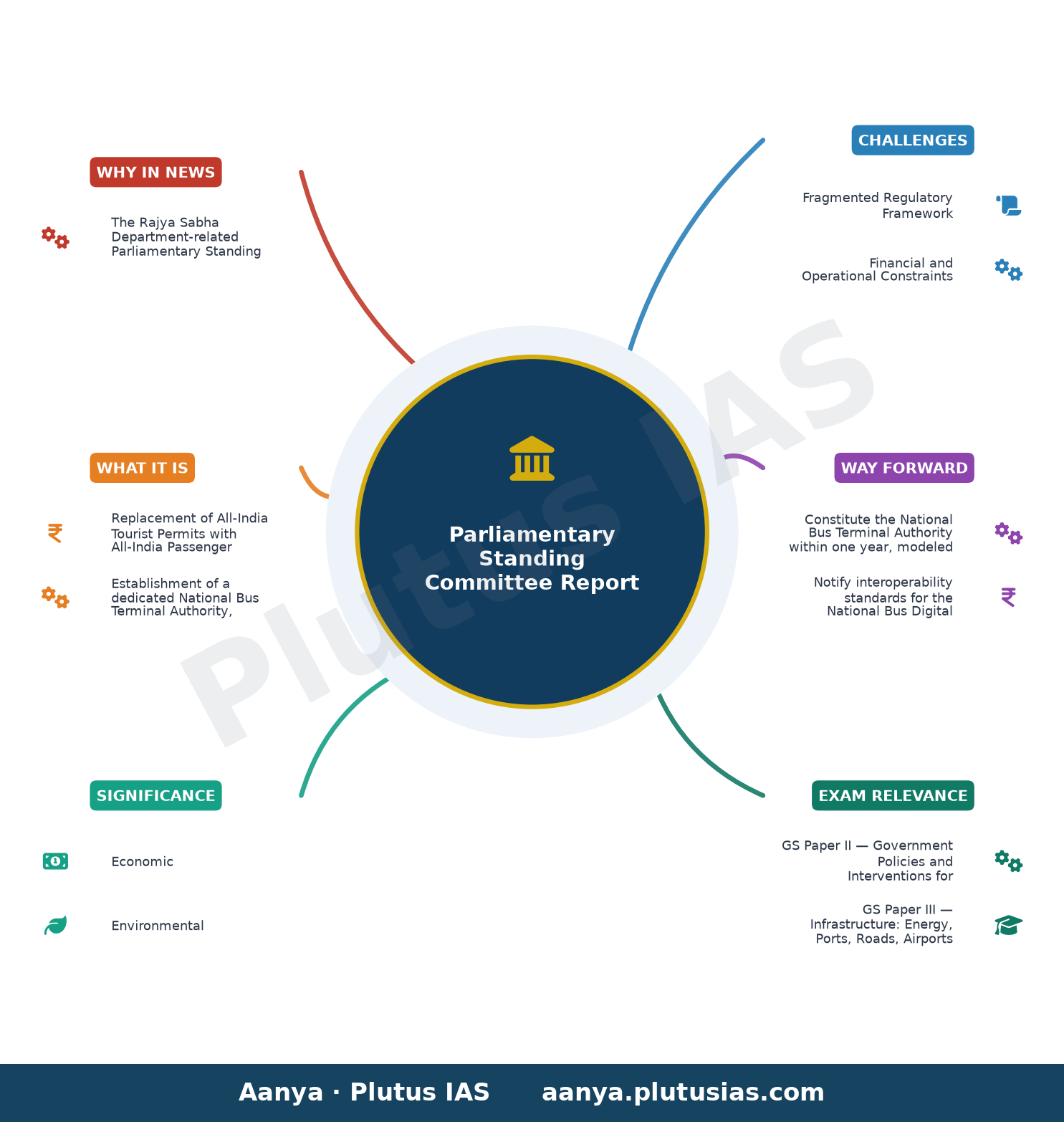
The Rajya Sabha Department-related Parliamentary Standing Committee on Transport, Tourism and Culture presented its 392nd report on 11 August 2026, titled ‘Enabling Inclusive, Digital and Sustainable Bus Transport: Policy, Regulation and Public-Private Partnership for Next-Generation Mobility’. The report, adopted on 6 August 2026, outlines critical recommendations to modernise India’s bus transport ecosystem through digital integration, regulatory reforms, safety enhancements, and gender-inclusive service delivery. This initiative aligns with broader national objectives of sustainable mobility, decarbonisation, and equitable access.
Background
- Bus transport constitutes a vital segment of India’s public transport infrastructure, catering to approximately 60% of the country’s passenger traffic, particularly in urban and semi-urban areas.
- The sector faces challenges such as fragmented regulatory frameworks, lack of standardised infrastructure, safety concerns, and limited digital integration across operators and terminals.
- The Ministry of Road Transport and Highways has previously highlighted the need for a unified approach to bus operations, including the adoption of digital tracking, standardised terminals, and safety audits.
- The COVID-19 pandemic exacerbated vulnerabilities in public transport, necessitating reforms to enhance resilience, hygiene, and digital payment systems.
- The report builds on earlier recommendations, including the 392nd Report of the Parliamentary Standing Committee on Transport, Tourism and Culture, which emphasised the need for policy coherence and multi-stakeholder collaboration.
- Global best practices, such as Singapore’s bus terminal management and Malaysia’s bus stop funding model (MPLADS), are referenced to inform India’s institutional and regulatory reforms.
Key Recommendations of the 392nd Report on Bus Transport Modernisation
- Replacement of All-India Tourist Permits with All-India Passenger Permits within one year, ensuring electronic issuance, monitoring through control centres, and seamless insurance claim settlement for injured passengers.
- Establishment of a dedicated National Bus Terminal Authority, modelled on the Airports Authority of India, to separate terminal ownership from bus operations and ensure non-discriminatory access frameworks.
- Creation of a National Bus Digital Grid within one year, featuring interoperable standards, real-time tracking, integrated booking systems, and a crowd-sourced rating mechanism linked to permit databases.
- Implementation of operator-centric safety reforms, including automated fitness testing stations, mandatory verification of fire safety and emergency equipment, and the phased deployment of emergency warning systems.
- Introduction of a Fleet Transition Compact to facilitate the adoption of electric buses through registered scrapping facilities and bulk procurement mechanisms.
- Development of a GIS-based network atlas to monitor fleet performance, predict risks, and publish time-bound metrics for transparency and accountability in bus operations.
- Mandatory participation of commercial permit holders in digital reporting systems, with measurable benchmarks to be achieved within six months of implementation.
Key Features
| Feature | Significance |
|---|---|
| All-India Passenger Permit | Replaces fragmented state-specific tourist permits with a unified, electronically monitored permit system to enhance interstate bus operations and passenger safety. |
| National Bus Terminal Authority | Establishes a dedicated authority for bus terminal management, modeled on airport authorities, to ensure non-discriminatory access and standardized infrastructure across India. |
| National Bus Digital Grid | Creates an interoperable digital platform for real-time tracking, integrated booking, and crowd-sourced safety ratings to improve service transparency and efficiency. |
| Operator-Centric Safety Framework | Mandates automated fitness testing, fire safety compliance, and emergency warning systems to ensure uniform safety standards for all bus operators. |
| Fleet Transition Compact | Facilitates the phased transition to electric buses through bulk procurement, scrappage incentives, and localized charging infrastructure to meet decarbonisation goals. |
Why it Matters
Economic
- Enhances interstate connectivity and reduces logistics costs by standardising bus permits and terminal operations.
- Stimulates investment in bus manufacturing and maintenance through bulk procurement of electric buses and scrappage incentives.
- Boosts employment in the transport sector, particularly for women drivers and staff, through targeted capacity-building programs.
Environmental
- Accelerates the adoption of electric buses and scrappage of older, polluting vehicles to reduce vehicular emissions.
- Promotes the use of standardized charging infrastructure aligned with regional renewable energy potential.
Technological
- Establishes a digital ecosystem for real-time tracking, integrated booking, and safety monitoring to improve service reliability.
- Ensures interoperability standards for seamless data exchange between public and private bus operators.
Social
- Improves passenger safety and comfort through standardized bus designs, CCTV monitoring, and emergency systems.
- Enhances inclusivity by mandating accessible bus designs and services for women and marginalised groups.
Challenges
1. Fragmented Regulatory Framework
- Lack of uniform standards across states for bus permits, terminal operations, and safety protocols hampers seamless interstate travel.
- Inconsistent enforcement of safety norms and fitness testing leads to varied service quality.
- Resistance to digital integration due to legacy systems and data privacy concerns among operators.
UPSC Link: GS-II: Transport Infrastructure
2. Financial and Operational Constraints
- High capital expenditure for electric bus adoption and charging infrastructure poses a burden on state transport undertakings.
- Limited fiscal space for scrappage incentives and retrofitting programs in resource-constrained states.
- Dependence on public-private partnerships (PPPs) for terminal management and digital platforms may lead to inequitable access.
UPSC Link: GS-III: Infrastructure Financing
3. Technological and Data Governance Challenges
- Ensuring real-time data accuracy and interoperability across multiple stakeholders (operators, terminals, regulators).
- Addressing cybersecurity risks in digital tracking and payment systems to prevent data breaches.
- Standardising safety ratings and emergency response protocols for universal applicability.
UPSC Link: GS-III: Science & Technology
4. Social and Institutional Barriers
- Low participation of women in bus operations due to cultural and safety concerns, despite targeted programs.
- Resistance from traditional operators to adopt electric buses and digital systems due to high transition costs.
- Lack of awareness among passengers about safety features and digital tools for grievance redressal.
UPSC Link: GS-II: Social Justice
Challenges — UPSC Perspective
| Issue | Concern |
|---|---|
| Permit Fragmentation | Multiple state-level permits create administrative hurdles and increase operational costs for interstate bus services. |
| Terminal Management | Lack of standardized terminal operations leads to inefficiencies in passenger handling and vehicle turnaround times. |
| Safety Compliance | Inconsistent enforcement of safety norms results in accidents and reduces public trust in bus services. |
| Digital Divide | Limited digital literacy among operators and passengers hinders the adoption of real-time tracking and booking systems. |
| Electric Bus Adoption | High upfront costs and limited charging infrastructure delay the transition from fossil-fuel buses. |
Way Forward
- Constitute the National Bus Terminal Authority within one year, modeled on the Airport Authority of India, to standardise terminal operations and accessibility.
- Notify interoperability standards for the National Bus Digital Grid within six months to enable seamless data exchange between operators and regulators.
- Develop a phased transition plan for electric buses, including bulk procurement targets, scrappage incentives, and localized charging infrastructure, within one year.
- Establish automated fitness testing stations at the district level within six months to ensure uniform safety compliance across all bus operators.
- Launch a national awareness campaign to educate passengers and operators about digital tools, safety features, and grievance redressal mechanisms.
- Conduct a gender-inclusive recruitment drive for bus drivers and staff, with mandatory training programs and safe working conditions.
- Strengthen cybersecurity protocols for the National Bus Digital Grid to protect passenger data and prevent fraud in digital transactions.
- Monitor progress through quarterly reviews by the Parliamentary Standing Committee to ensure accountability and timely implementation.
UPSC Value Addition
Keywords for Mains Answer-Writing
Parliamentary Standing Committee on Transport, Tourism and Culture · Inclusive, Digital and Sustainable Bus Transport · All India Passenger Permit · National Bus Terminal Authority · National Bus Digital Grid · Operator-Centric Safety · Fleet Transition Compact · Women-operated Bus Services · Public-Private Partnership in Transport · Digital Governance in Mobility · Electrification of Bus Fleets · Safety and Compliance in Public Transport · Interoperability Standards in Transport · Geospatial Tracking and GIS-based Network Atlas · Standardisation of Bus Stops and Terminals
Constitutional & Policy Linkages
- Article 246: Division of Legislative Powers (Transport as Concurrent List subject).
- Article 248: Residuary Powers of Parliament (Digital governance of transport systems).
- Seventh Schedule: Concurrent List (Transport infrastructure and services).
Concept Flow
Fragmented state-level permits → Inter-state travel inefficiencies → Proposal for All-India Passenger Permit → Electronic monitoring and standardised enforcement. → Lack of terminal standards → Inconsistent service quality → National Bus Terminal Authority → Standardised terminal operations and accessibility. → Digital integration gaps → Poor real-time tracking and safety monitoring → National Bus Digital Grid → Interoperable platform for tracking, booking, and ratings. → Safety compliance gaps → High accident rates → Operator-Centric Safety Framework → Automated testing, emergency systems, and retrofitting mandates. → High carbon emissions → Pollution and climate impact → Fleet Transition Compact → Phased adoption of electric buses and scrappage incentives. → Low women participation → Gender disparity in transport sector → Women-led bus services → Targeted recruitment and safety programs.
Prelims Practice Questions
Q1. Consider the following statements regarding the 392nd Report of the Parliamentary Standing Committee on Transport, Tourism and Culture:
1. The report recommends replacing the All India Tourist Permit with an All India Passenger Permit issued by the state of first registration.
2. It proposes the establishment of a dedicated National Bus Terminal Authority modeled on the Airport Authority of India.
3. The report advocates for the mandatory scrapping of all old buses within five years.
4. It suggests the implementation of a GIS-based network atlas for real-time tracking of buses and terminals.
How many of the above statements are correct?
- Only one
- Only two
- Only three
- All
Answer: Only three — Statements 1, 2, and 4 are correct as per the report. Statement 3 is incorrect as the report does not mandate scrapping within five years but proposes a phased transition to electric buses and scrapping facilities.
Q2. Assertion (A): The 392nd Report of the Parliamentary Standing Committee on Transport, Tourism and Culture recommends the creation of a National Bus Digital Grid to ensure interoperability and real-time tracking of buses.
Reason (R): The report emphasizes the need for electronic monitoring of vehicle permits, FAS Tag data, and vehicle location data to enhance transparency and accountability in bus operations.
In the context of the above two statements, which one of the following is correct?
- Both A and R are true, and R is the correct explanation of A
- Both A and R are true, but R is not the correct explanation of A
- A is true, but R is false
- A is false, but R is true
Answer: Both A and R are true, but R is not the correct explanation of A — Both the assertion and reason are correct. The National Bus Digital Grid is proposed to integrate real-time tracking, interoperability, and permit databases, and the reason correctly explains the necessity of electronic monitoring for this purpose.
Q3. Match the following recommendations of the 392nd Report with their respective focus areas:
Column I (Recommendation)
A. All India Passenger Permit
B. National Bus Terminal Authority
C. Operator-Centric Safety
D. Fleet Transition Compact
Column II (Focus Area)
1. Standardisation of bus terminals and ownership separation
2. Phased transition to electric buses and scrapping incentives
3. Electronic monitoring and dispute resolution for passenger claims
4. Safety audits, retrofitting, and emergency alert systems
Select the correct match:
- A-1, B-2, C-3, D-4
- A-3, B-1, C-4, D-2
- A-2, B-3, C-1, D-4
- A-4, B-2, C-3, D-1
Answer: A-3, B-1, C-4, D-2 — A matches with 3 (electronic monitoring and dispute resolution for passenger claims), B with 1 (standardisation of bus terminals), C with 4 (safety audits and emergency systems), and D with 2 (phased transition to electric buses).
Mains Practice Question
✍ The 392nd Report of the Parliamentary Standing Committee on Transport, Tourism and Culture underscores the need for a transformative shift towards ‘Inclusive, Digital and Sustainable Bus Transport’ in India. Critically analyse the key recommendations of the report, with particular reference to the proposed institutional mechanisms, digital governance frameworks, and safety standards. Also, assess the feasibility of these recommendations in the context of India’s federal structure and the challenges of inter-state coordination. (15 Marks)
Approach: MODEL-ANSWER SKELETON:
1. Introduction (2 marks):
– Context: The report titled ‘Enabling Inclusive, Digital and Sustainable Bus Transport: Policy, Regulation and PPP’ was submitted on 11 August 2026 by the Parliamentary Standing Committee on Transport, Tourism and Culture.
– Objective: To modernise India’s bus transport sector through inclusivity, digitalisation, sustainability, and safety.
2. Key Recommendations and Their Significance (6 marks):
– All India Passenger Permit: Replace the All India Tourist Permit with a state-issued All India Passenger Permit, incorporating electronic monitoring (FAS Tag, vehicle location data) and dispute resolution mechanisms for passenger claims. Cite the need for transparency and inter-state operability.
– National Bus Terminal Authority: Propose a dedicated authority modeled on the Airport Authority of India to standardise bus terminals, separate ownership from operations, and ensure non-discriminatory access frameworks. Reference the Kshatri Gate model and the need for a national code for bus terminals.
– National Bus Digital Grid: Recommend a digital infrastructure for real-time tracking, integrated booking, permit database linkage, and a GIS-based network atlas for predictive analytics. Highlight the role of interoperability standards and public-private participation.
– Operator-Centric Safety: Advocate for automated testing stations, retrofitting of sleeper and school buses, publication of operator safety ratings, and mandatory emergency alert systems. Emphasise the need for compliance with life-safety standards.
– Fleet Transition Compact: Propose a phased transition to electric buses through registered scrapping facilities, bulk procurement, and regional manufacturing clusters. Discuss the role of incentives and regulatory frameworks.
3. Institutional and Federal Challenges (4 marks):
– Federal Structure: Analyse the challenges of inter-state coordination in implementing uniform permits, digital grids, and safety standards. Reference the concurrent nature of transport under the Constitution (Entry 20, List III) and the need for cooperative federalism.
– Institutional Capacity: Discuss the feasibility of establishing a National Bus Terminal Authority and the National Bus Digital Grid, including resource allocation, technical expertise, and stakeholder consultations.
– Stakeholder Engagement: Highlight the role of public-private partnerships (PPPs) and the need for consensus among state governments, bus operators, and technology providers.
4. Conclusion and Way Forward (3 marks):
– Summarise the transformative potential of the recommendations for India’s bus transport sector.
– Suggest measures such as pilot projects in model states (e.g., Gurugram, Katra), capacity-building for state transport undertakings, and phased rollout of digital and safety frameworks.
– Conclude with the need for political will, inter-ministerial coordination (e.g., Ministry of Road Transport and Highways, Ministry of Housing and Urban Affairs), and long-term funding mechanisms.
Source: PIB (Press Information Bureau)
Generated by AanyaAi for educational purpose.

- Tamil Nadu’s Rising Drought Crisis: UPSC Geography Current Affairs 2024 - September 26, 2026
- ट्रम्प ने ईरान के होर्मुज स्ट्रेट खोलने के प्रस्ताव को किया खारिज, जानिए क्यों है महत्वपूर्ण - September 26, 2026
- Trump Rejects Iran’s Strait of Hormuz Reopening Proposal: UPSC Geography Insights - September 26, 2026

No Comments