


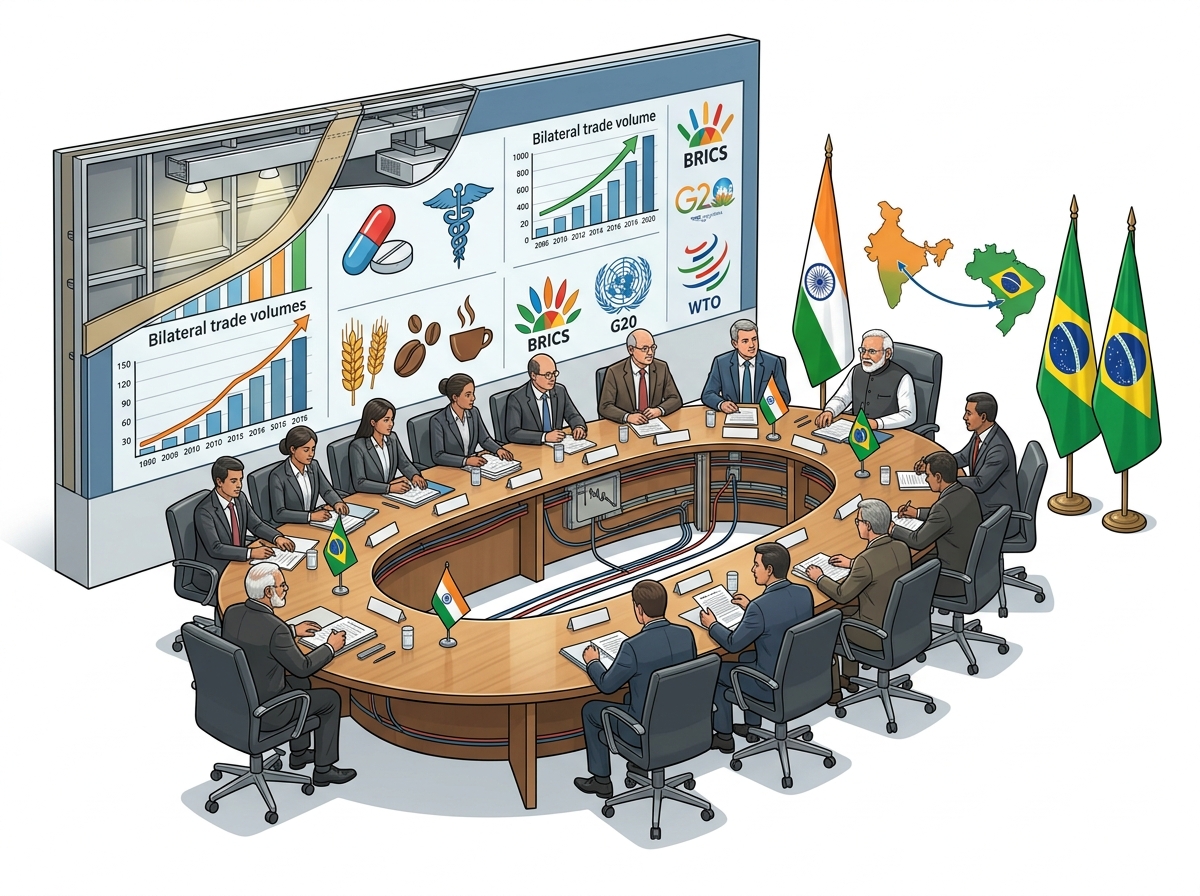
31 Aug 8th India-Brazil Trade Monitoring Mechanism Meeting: Key Outcomes for UPSC
✎ The India-Brazil Trade Monitoring Mechanism (TMM) is a structured bilateral platform to review trade barriers, monitor flows, and align sectoral cooperation—key to achieving the 2030 trade target of USD 30 billion.
Subject Relevance — Where This Topic Fits
- GS Paper II — International Relations (Bilateral Relations, Regional Groupings) | GS Paper III — Economy (International Trade, Trade Agreements, WTO, Multilateralism)
- Prelims: Trade Monitoring Mechanism (TMM), India-MERCOSUR Preferential Trade Agreement (PTA), CDSCO-ANVISA MoU, BRICS Economic Partnership Strategy 2030, GVC Action Plan 2026-2030
- Essay: The evolving architecture of South-South cooperation in the 21st century, The role of institutional frameworks in deepening global trade partnerships
Quick Revision: The India-Brazil Trade Monitoring Mechanism (TMM) is a structured bilateral platform to review trade barriers, monitor flows, and align sectoral cooperation—key to achieving the 2030 trade target of USD 30 billion.
Why is this in the news?
Co-chaired by India’s Commerce Secretary and Brazil’s Foreign Trade Secretary, the meeting reviewed progress toward the 2030 bilateral trade target of USD 30 billion, examined market access issues—particularly for pharmaceuticals and agriculture—and reaffirmed commitments to strengthen cooperation within BRICS, G20, and WTO frameworks. The discussions reflect a structured approach to trade facilitation, regulatory alignment, and multilateral coordination, aligning with India’s broader foreign trade policy objectives.
Background
- India and Brazil are strategic partners with historical ties in the Global South, formalised through the 2007 Strategic Partnership Agreement.
- Bilateral trade has grown from USD 5.2 billion in 2010 to USD 15.07 billion in 2025-26, driven by pharmaceuticals, chemicals, engineering goods, and machinery.
- The India-MERCOSUR Preferential Trade Agreement (PTA), operational since 2009, provides a framework for preferential tariffs on select goods, with ongoing negotiations to expand its scope and modernise its architecture.
- The India-Brazil Trade Monitoring Mechanism (TMM) was established in 2016 as a joint institutional platform to review trade barriers, monitor trade flows, and propose policy interventions to enhance bilateral commerce.
- The TMM operates under the aegis of the India-Brazil Joint Commission, which serves as the apex body for reviewing and guiding bilateral economic cooperation.
- Both countries are active participants in BRICS, G20, and WTO, leveraging these platforms to advocate for reforms in global trade governance, including agriculture subsidies, intellectual property rights, and dispute settlement mechanisms.
What is the India-Brazil Trade Monitoring Mechanism (TMM)?
- The India-Brazil Trade Monitoring Mechanism (TMM) is a bilateral institutional framework established to systematically review and address trade-related issues between India and Brazil.
- It was launched in 2016 under the India-Brazil Joint Commission on Economic and Technical Cooperation to enhance trade facilitation, reduce non-tariff barriers, and monitor progress toward bilateral trade targets.
- Key functions of the TMM include: (i) reviewing bilateral trade data and identifying trade imbalances; (ii) assessing non-tariff barriers such as sanitary and phytosanitary (SPS) measures, technical regulations, and customs procedures; (iii) facilitating market access negotiations for priority sectors like pharmaceuticals, agriculture, and engineering goods; and (iv) coordinating positions on multilateral trade issues within BRICS, G20, and WTO.
- The TMM works closely with sectoral working groups, including those on pharmaceuticals (via the CDSCO-ANVISA MoU), agriculture (SPS issues), and MSMEs (trade facilitation and e-certificates), to implement targeted interventions.
- Progress under the TMM is periodically reviewed by the India-Brazil Joint Commission, which provides strategic direction to bilateral economic engagement.
- The mechanism exemplifies India’s approach to deepening South-South cooperation through structured, outcome-oriented institutional partnerships rather than ad-hoc engagements.
Key Features
| Feature | Significance |
|---|---|
| 8th India-Brazil Trade Monitoring Mechanism (TMM) Meeting | Institutionalizes regular bilateral dialogue to monitor and enhance trade relations, ensuring sustained engagement beyond ad-hoc summits. |
| Target of USD 30 billion bilateral trade by 2030 | Demonstrates long-term strategic commitment to deepen economic ties, particularly in pharmaceuticals, chemicals, and engineering goods. |
| Review of India-MERCOSUR Reference Terms | Accelerates negotiations to modernize the Preferential Trade Agreement (PTA), addressing tariff and non-tariff barriers for expanded market access. |
| CDSCO-ANVISA MoU (February 2026) | Facilitates regulatory harmonization in pharmaceuticals, enabling faster approvals and market entry for Indian generic drugs in Brazil. |
| Electronic Certificate of Origin (e-CoO) Mutual Recognition | Reduces trade costs and procedural delays by digitalizing origin certification, aligning with WTO Trade Facilitation Agreement (TFA) principles. |
Why it Matters
Economic Diplomacy
- Reinforces India’s engagement with Latin America through structured bilateral mechanisms, counterbalancing over-reliance on traditional trade partners.
- Aligns with India’s Act East Policy and Brazil’s strategic pivot toward Asia, creating a complementary economic axis in the Global South.
- Demonstrates the role of trade monitoring mechanisms in preemptively addressing disputes and non-tariff barriers before they escalate.
Sectoral Cooperation
- Pharmaceuticals: India’s cost-effective generics can address Brazil’s public health priorities, while Brazilian regulatory reforms (via ANVISA) ensure quality compliance.
- Agriculture: Focus on sanitary and phytosanitary (SPS) measures and mutual recognition of standards to boost agri-exports, particularly for basmati rice, spices, and marine products.
- MSMEs & Startups: Leverages Brazil’s innovation ecosystem (e.g., BRICS Startup Knowledge Hub) to foster joint ventures in clean energy, biotechnology, and digital services.
Multilateral Alignment
- Strengthens coordination within BRICS, G20, and WTO to advocate for developing-country interests, such as reforming agricultural subsidies and intellectual property rules.
- Promotes supply chain resilience by integrating India-Brazil trade into Global Value Chains (GVCs), particularly in critical minerals and renewable energy technologies.
Institutional Capacity Building
- High-level trade facilitation events (e.g., Brasília business delegation) provide a platform for Indian exporters to engage directly with Brazilian importers and policymakers.
- Technical working groups on e-commerce, digital trade, and customs procedures enhance predictability and reduce transaction costs.
Challenges
1. Non-Tariff Barriers (NTBs)
- Brazil’s stringent sanitary and phytosanitary (SPS) norms for agricultural products often delay market access for Indian exporters.
- Pharmaceutical regulations, while harmonized via CDSCO-ANVISA MoU, still face delays in post-approval inspections and pricing controls.
- Local content requirements in Brazil’s procurement policies (e.g., ‘Compras Governamentais’) may disadvantage Indian firms in public sector contracts.
UPSC Link: Economic Survey 2023-24: Non-Tariff Barriers
2. Currency and Payment Risks
- Bilateral trade is increasingly denominated in USD, exposing Indian exporters to exchange rate volatility and higher hedging costs.
- Brazil’s capital controls and restrictions on foreign exchange transactions can create liquidity challenges for Indian MSMEs operating in the market.
UPSC Link: RBI Report on Trade Settlements
3. Logistics and Infrastructure Gaps
- Limited direct shipping routes between India and Brazil increase transit times and costs, particularly for perishable goods.
- Port inefficiencies in Brazil (e.g., Santos Port congestion) and India (e.g., Mumbai/JNPT delays) raise operational costs for traders.
UPSC Link: Logistics Performance Index (World Bank)
4. Regulatory Divergence in Services
- Brazil’s restrictive visa policies for skilled professionals (e.g., IT services, engineering consultants) hinder temporary labor mobility.
- Differences in data localization laws and digital taxation frameworks (e.g., Brazil’s ‘Marco Civil da Internet’) complicate cross-border e-commerce.
UPSC Link: WTO Trade in Services Agreement (TiSA)
5. Geopolitical Frictions
- Competing interests in Mercosur’s external trade policy (e.g., Brazil’s alignment with EU-Mercosur FTA negotiations) may delay India’s market access concessions.
- Brazil’s historical trade surplus with India creates asymmetry in negotiations, requiring calibrated concessions to balance reciprocity.
UPSC Link: India’s Foreign Trade Policy 2023
Challenges — UPSC Perspective
| Issue | Concern |
|---|---|
| Sanitary and Phytosanitary (SPS) Measures | Delays in approvals for Indian agricultural products due to Brazil’s stringent food safety norms. |
| Pharmaceutical Price Controls | Brazil’s ‘Câmara de Regulação do Mercado de Medicamentos’ (CMED) caps drug prices, impacting profitability of Indian generic manufacturers. |
| Local Content Requirements | Brazil’s ‘Lei de Informática’ mandates local manufacturing for IT hardware, limiting market access for Indian electronics exporters. |
| Currency Fluctuations | Volatility in USD/BRL exchange rates increases hedging costs for Indian exporters. |
| Port Congestion | Santos Port (Brazil) and JNPT (India) face delays, raising logistics costs for bilateral trade. |
Government Initiatives — Must-Memorise for Prelims
- CDSCO-ANVISA Memorandum of Understanding (MoU) on Pharmaceutical Cooperation (February 2026)
Way Forward
- Accelerate the finalization of India-MERCOSUR Reference Terms by addressing outstanding tariff lines in pharmaceuticals, chemicals, and engineering goods.
- Establish a joint task force to streamline SPS certification processes, including mutual recognition of laboratory testing standards.
- Develop a bilateral trade facilitation agreement to reduce documentary requirements and digitalize customs procedures (aligned with WTO TFA).
- Expand the CDSCO-ANVISA MoU to include joint inspections for pharmaceutical manufacturing facilities, reducing approval timelines.
- Promote direct shipping routes between Indian and Brazilian ports via public-private partnerships to cut logistics costs.
- Enhance MSME collaboration by linking Indian startups with Brazil’s innovation hubs (e.g., BRICS Startup Knowledge Hub) for joint R&D projects.
- Strengthen currency swap arrangements or local currency settlement mechanisms to mitigate exchange rate risks in bilateral trade.
UPSC Value Addition
Keywords for Mains Answer-Writing
India-Brazil Strategic Partnership · Trade Monitoring Mechanism (TMM) · Bilateral Trade Targets · India-MERCOSUR Preferential Trade Agreement · Pharmaceutical Market Access · Agricultural Market Access · BRICS Economic Partnership Strategy 2030 · Global Value Chains (GVC) Work Plan 2026-2030 · Electronic Certificate of Origin (CoO) · MSMEs and Entrepreneurship Cooperation · WTO Reforms · Multilateral Trade Governance
Concept Flow
Bilateral trade deficit and non-tariff barriers → Institutionalization of India-Brazil Trade Monitoring Mechanism (TMM) → Regular dialogue to identify and resolve trade frictions → Pharmaceutical sector challenges (approval delays) → CDSCO-ANVISA MoU (2026) → Regulatory harmonization and faster market access for generics → India’s Act East Policy → Strategic partnership with Brazil → Enhanced engagement in BRICS, G20, and Mercosur forums → Economic Survey 2023-24 highlights NTBs → Bilateral negotiations to modernize India-MERCOSUR PTA → Expanded market access for Indian exporters → Logistics inefficiencies (port congestion) → Joint task force for trade facilitation → Digitalization of customs and direct shipping routes → Currency risks in USD/BRL trade → Proposal for local currency settlement mechanisms → Reduced hedging costs for MSMEs
Prelims Practice Questions
Q1. Consider the following statements regarding the India-Brazil Trade Monitoring Mechanism (TMM):
1. The 8th meeting of the TMM was co-chaired by the Commerce Secretary of India and the Foreign Trade Secretary of Brazil.
2. The meeting was held in New Delhi.
3. The TMM aims to review the progress of the India-MERCOSUR Preferential Trade Agreement.
4. The TMM has set a bilateral trade target of USD 50 billion by 2030.
How many of the above statements are correct?
- Only one
- Only two
- Only three
- All
Answer: Only three — Statements 1 and 3 are correct. Statement 2 is incorrect as the meeting was held in Brasília. Statement 4 is incorrect as the bilateral trade target is USD 30 billion by 2030.
Q2. Assertion (A): The India-Brazil Trade Monitoring Mechanism (TMM) focuses on enhancing market access for pharmaceutical products.
Reason (R): The TMM aims to facilitate trade facilitation and reduce non-tariff barriers in bilateral trade.
Options:
A. Both A and R are true, and R is the correct explanation of A.
B. Both A and R are true, but R is not the correct explanation of A.
C. A is true, but R is false.
D. A is false, but R is true.
Answer: ? — Both the assertion and reason are true. The TMM indeed focuses on enhancing market access for pharmaceutical products, and this is part of its broader goal to facilitate trade and reduce non-tariff barriers.
Q3. Match the following initiatives with their respective objectives:
Column I (Initiative)
A. India-Brazil Trade Monitoring Mechanism (TMM)
B. India-MERCOSUR Preferential Trade Agreement
C. BRICS Economic Partnership Strategy 2030
D. Electronic Certificate of Origin (CoO)
Column II (Objective)
1. Facilitate trade facilitation and reduce non-tariff barriers
2. Expand and modernize preferential trade terms
3. Promote economic cooperation among BRICS nations
4. Provide a digital platform for verifying the origin of goods
Options:
A-1, B-2, C-3, D-4
A-2, B-1, C-3, D-4
A-4, B-2, C-1, D-3
A-3, B-1, C-2, D-4
- A-1, B-2, C-3, D-4
- A-2, B-1, C-3, D-4
- A-4, B-2, C-1, D-3
- A-3, B-1, C-2, D-4
Answer: A-1, B-2, C-3, D-4 — The correct match is: A-1 (TMM aims to facilitate trade facilitation), B-2 (MERCOSUR PTA aims to expand and modernize trade terms), C-3 (BRICS EPS 2030 promotes economic cooperation), D-4 (Electronic CoO provides a digital platform for origin verification).
Mains Practice Question
✍ India and Brazil have reiterated their commitment to strengthening bilateral trade and economic ties, including setting a target of USD 30 billion in bilateral trade by 2030. In this context, critically examine the role of the India-Brazil Trade Monitoring Mechanism (TMM) in facilitating trade facilitation and reducing non-tariff barriers. Also, analyze how the India-MERCOSUR Preferential Trade Agreement (PTA) can complement this bilateral trade framework. (15 Marks)
Approach: MODEL-ANSWER SKELETON:
1. **Introduction (2 Marks)**
– Briefly define the India-Brazil TMM and its objectives.
– Mention the bilateral trade target of USD 30 billion by 2030 and its significance.
2. **Role of TMM in Trade Facilitation (5 Marks)**
– **Institutional Framework**: Discuss the institutional setup of TMM, including its co-chairmanship by senior officials from both countries.
– **Trade Monitoring and Review**: Explain how TMM reviews progress on trade agreements, including the India-MERCOSUR PTA.
– **Non-Tariff Barriers (NTBs)**: Highlight specific NTBs addressed, such as sanitary and phytosanitary measures, technical barriers to trade, and regulatory hurdles in sectors like pharmaceuticals and agriculture.
– **Market Access**: Discuss initiatives like the MoU between CDSCO (India) and ANVISA (Brazil) to enhance market access for pharmaceutical products.
– **Digital Tools**: Mention the mutual recognition of electronic certificates of origin and their role in reducing trade barriers.
3. **India-MERCOSUR PTA and its Complementarity (5 Marks)**
– **Preferential Trade Terms**: Explain the existing India-MERCOSUR PTA and its potential for expansion and modernization.
– **Sectoral Coverage**: Discuss how the PTA can cover sectors like pharmaceuticals, chemicals, engineering goods, and machinery, aligning with the TMM’s goals.
– **Trade Diversification**: Analyze how the PTA can help diversify trade beyond traditional sectors and reduce dependence on specific markets.
– **Institutional Synergy**: Highlight how the TMM and PTA can work together to address common challenges, such as regulatory harmonization and dispute resolution.
4. **Challenges and Way Forward (3 Marks)**
– **Challenges**: Mention potential challenges, such as differing regulatory standards, non-tariff barriers, and geopolitical factors.
– **Way Forward**: Suggest measures like strengthening institutional cooperation, enhancing digital trade facilitation, and promoting MSME engagement to achieve the trade targets.
5. **Conclusion (1 Mark)**
– Summarize the importance of the TMM and PTA in achieving the bilateral trade target and fostering sustainable economic ties.
Source: PIB (Press Information Bureau)
Generated by AanyaAi for educational purpose.
Related guides on our sites
- Current affairs for upsc 2026
- Best PSIR optional coaching for upsc
- Best PSIR optional teacher for upsc
- Best teacher of PSIR optional for upsc


No Comments