


12 Nov 8th Pay Commission: Retirement, Arrears, and Pension Rules
✎ The Central Pay Commission is an administrative body constituted by the Government of India to review and recommend changes to the salary structure, allowances, and pension benefits for central government employees and pensioners.
Subject Relevance — Where This Topic Fits
- GS Paper II — Governance, Constitution, Polity, Social Justice and International Relations | GS Paper III — Economy, Science and Technology, Environment, Security and Disaster Management
- Prelims: Central Pay Commission, Eighth Pay Commission, Terms of Reference, Arrears, Pension benefits, Effective date of implementation, Government employees, Pensioners
- Essay: The role of expert committees in public policy formulation and implementation in India., Ensuring social security and economic welfare for government employees and pensioners: A critical analysis.
Quick Revision: The Central Pay Commission is an administrative body constituted by the Government of India to review and recommend changes to the salary structure, allowances, and pension benefits for central government employees and pensioners.
Why is this in the news?
The Eighth Central Pay Commission (CPC) is currently in the process of formulating its recommendations, leading to discussions among central government employees and pensioners regarding the potential impact on their salaries and pensions. A key concern revolves around the eligibility for revised pay and arrears for employees who may retire before the official implementation of the Commission’s recommendations. The effective date of implementation, yet to be announced by the government, will be crucial in determining the scope of benefits for both serving and retired personnel.
Background
- Central Pay Commissions are administrative bodies constituted by the Government of India to review and recommend changes to the salary structure, allowances, and other benefits for central government employees and pensioners.
- These commissions are typically formed every ten years, with their recommendations often having a significant impact on the financial well-being of a large segment of the population.
- The Seventh Central Pay Commission, constituted in February 2014, submitted its report in November 2015, with its recommendations implemented from January 1, 2016.
- The Eighth Central Pay Commission was announced in January 2025, with its Terms of Reference (ToR) approved in October 2025, and the commission formally constituted in November 2025.
- The Commission is chaired by a retired Supreme Court judge, Ranjana Prakash Desai, and includes other expert members.
- The Commission has been given 18 months to submit its recommendations, with January 1, 2026, being a widely discussed potential effective date for the new pay structure, although this is yet to be officially confirmed by the government.
What is the Central Pay Commission?
- The Central Pay Commission (CPC) is an ad-hoc body established by the Government of India to examine and recommend changes to the emoluments, allowances, and service conditions of central government employees, including those in the All India Services, Union Territories, and the Indian Audit and Accounts Department.
- Its primary objective is to ensure that the pay structure of government employees remains competitive and fair, reflecting economic realities and the cost of living.
- The recommendations of the CPC cover various aspects, including basic pay, dearness allowance, house rent allowance, transport allowance, and other special allowances.
- The Commission also reviews and suggests modifications to the pension and related benefits for retired central government employees.
- Upon submission of its report, the government reviews the recommendations and, after due consideration, implements them, often with modifications.
- The implementation typically involves a prospective effective date, but arrears may be paid for the period between the effective date and the actual disbursement of revised salaries.
- The decisions of the CPC have far-reaching implications for fiscal policy, government expenditure, and the overall economy due to the large number of employees and pensioners affected.
Key Features
| Feature | Significance |
|---|---|
| 8th Central Pay Commission (CPC) | A body constituted by the Central Government to review and recommend changes to the salary structure, allowances, and pension benefits for central government employees and pensioners. |
| Terms of Reference (ToR) | Defines the scope, objectives, and specific areas that the Pay Commission is mandated to examine and provide recommendations on. |
| Effective Date of Implementation | The date from which the recommendations of the Pay Commission, once accepted by the government, become legally binding and financially applicable. This date determines eligibility for revised salaries and arrears. |
| Arrears | The difference between the revised salary/pension and the old salary/pension for the period between the effective date of implementation and the actual date of disbursement of the revised amounts. |
| Pension Revision | The process of adjusting pension benefits for retired employees in accordance with the new pay structure recommended by the Pay Commission, ensuring parity with serving employees. |
Why it Matters
Governance and Public Administration
- The establishment of a Pay Commission is a standard administrative mechanism for periodic review and rationalisation of remuneration structures for government employees, ensuring fair compensation and maintaining morale within the civil services.
- The recommendations impact the financial well-being of a large segment of the population, including serving and retired central government personnel, influencing their economic stability and purchasing power.
Fiscal Implications
- Implementation of Pay Commission recommendations entails significant financial outlays for the government, impacting the Union Budget through increased expenditure on salaries, allowances, and pensions.
- The timing and extent of arrears payment can influence government cash flows and fiscal deficit targets, necessitating careful financial planning and resource allocation.
Socio-Economic Impact
- Revised pay scales and pensions can stimulate demand in the economy, as increased disposable income for employees and pensioners may lead to higher consumption and investment.
- Ensuring equitable and timely revision of pensions addresses concerns of retired personnel, contributing to social security and welfare for a vulnerable demographic.
Challenges
1. Fiscal Burden
- Implementing the recommendations of a Pay Commission typically involves substantial financial expenditure, potentially straining government finances and impacting fiscal deficit targets.
- Balancing the need for competitive remuneration with fiscal prudence remains a persistent challenge for the government.
UPSC Link: Government Budgeting; Fiscal Policy
2. Timely Implementation
- Delays in the constitution of the commission, submission of recommendations, or government approval can lead to uncertainty among employees and pensioners regarding their revised emoluments.
- Ensuring a streamlined process from commission formation to implementation is crucial for maintaining employee morale and administrative efficiency.
UPSC Link: Public Administration; Policy Implementation
3. Arrears Management
- The calculation and disbursement of arrears for a large number of employees and pensioners, especially when the effective date is retrospective, present significant administrative and logistical challenges.
- Clear guidelines are required to address eligibility for arrears for those who retire before the formal implementation date but within the retrospective period.
UPSC Link: Financial Administration; Public Grievances
4. Pension Parity
- Ensuring that pension revisions adequately address the concerns of existing pensioners and maintain parity with the revised pay scales for serving employees is a complex task.
- Different categories of pensioners may have varying expectations and requirements, necessitating a nuanced approach to pension reform.
UPSC Link: Social Justice; Welfare Schemes
Challenges — UPSC Perspective
| Issue | Concern |
|---|---|
| Retirement before implementation | Uncertainty among employees regarding eligibility for revised pay and arrears if they retire between the effective date and the actual implementation date. |
| Determination of effective date | The government’s decision on the retrospective or prospective application of recommendations significantly impacts financial benefits and administrative workload. |
| Calculation of arrears | Complexity in accurately calculating and disbursing arrears for a diverse workforce, including those who have retired, resigned, or passed away. |
| Pension revision for existing pensioners | Ensuring that pension benefits for those already retired are appropriately adjusted to reflect the new pay structure and maintain inter-generational equity. |
| Fiscal impact of recommendations | The substantial financial implications of pay and pension revisions on the national exchequer, requiring careful budgetary management. |
Way Forward
- Expeditious constitution and functioning of Pay Commissions to ensure timely submission of recommendations.
- Clear communication from the government regarding the terms of reference, timelines, and the eventual effective date of implementation to mitigate uncertainty.
- Development of robust administrative mechanisms for accurate and timely calculation and disbursement of revised salaries, allowances, and arrears.
- Formulation of explicit guidelines addressing the eligibility and calculation of benefits for employees retiring between the effective date and the actual implementation date.
- Prioritising fiscal sustainability while considering the legitimate demands for fair remuneration and pension benefits for government employees and pensioners.
- Leveraging technology for efficient processing of pay and pension revisions, reducing administrative burden and errors.
- Conducting comprehensive impact assessments of proposed recommendations on various sectors and demographics to ensure equitable outcomes.
UPSC Value Addition
Keywords for Mains Answer-Writing
Central Pay Commission · Eighth Pay Commission · Pay revision · Pension benefits · Arrears · Retirement benefits · Government employees · Fiscal implications · Terms of Reference · Economic impact · Social security · Public finance
Concept Flow
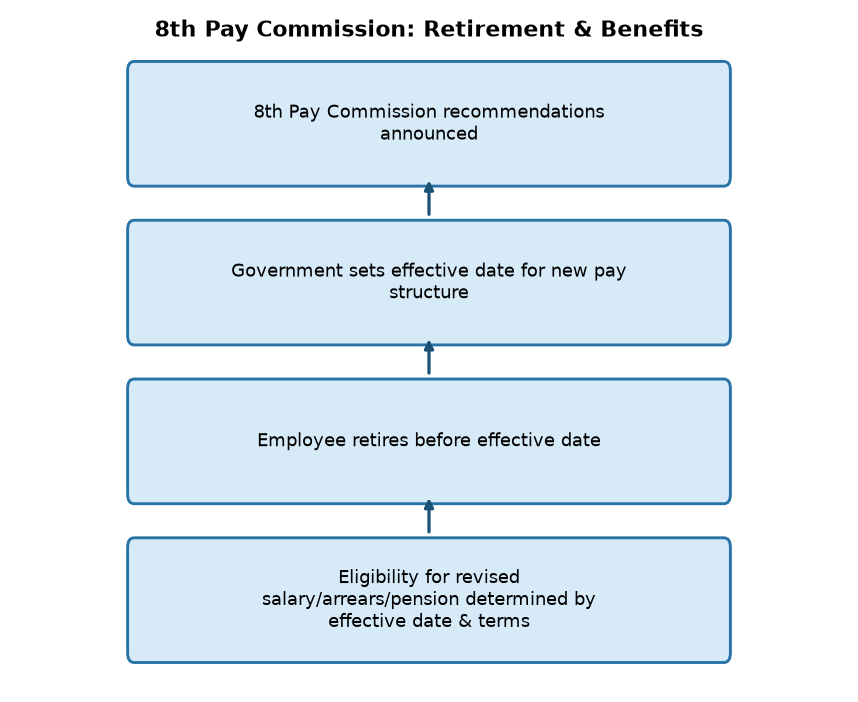
Central Government constitutes Pay Commission. → Pay Commission submits recommendations on pay, allowances, and pensions. → Government reviews and approves recommendations, setting an effective date. → Revised pay scales and benefits are implemented from the effective date. → Employees and pensioners receive revised emoluments and eligible arrears.
Prelims Practice Questions
Q1. Consider the following statements regarding the Central Pay Commission in India:
1. The Central Pay Commission is a statutory body constituted by the Ministry of Finance.
2. Its recommendations are binding on the Central Government.
3. The primary objective of the Pay Commission is to review and recommend changes to the salary structure of central government employees and pensioners.
How many of the above statements are correct?
- Only one
- Only two
- Only three
- None
Answer: Only one — Statement 1 is incorrect: The Central Pay Commission is an administrative body, not a statutory one, constituted by the Union Cabinet. Statement 2 is incorrect: Its recommendations are advisory in nature and not binding on the government, which may accept, reject, or modify them. Statement 3 is correct: The primary objective is indeed to review and recommend changes to the emoluments, allowances, and pension structure for central government employees and pensioners.
Q2. Assertion (A): The effective date of implementation of the Central Pay Commission’s recommendations is crucial for determining the eligibility of retired employees for revised benefits.
Reason (R): Pay Commission recommendations often include provisions for retrospective application, entitling employees who retired before the official notification date but after the effective date to arrears and revised pension.
- Both A and R are individually true and R is the correct explanation of A.
- Both A and R are individually true but R is not the correct explanation of A.
- A is true but R is false.
- A is false but R is true.
Answer: Both A and R are individually true and R is the correct explanation of A. — Assertion (A) is true: The effective date (e.g., January 1, 2026, for the 8th CPC) determines the period for which revised pay and pension are applicable, impacting those who retire between this date and the actual implementation. Reason (R) is true: Pay Commissions frequently recommend retrospective application, meaning benefits like arrears and revised pension are calculated from an earlier ‘effective date’ even if the official order comes later, thus benefiting those who retired in the interim period. R is the correct explanation of A because the retrospective nature of recommendations directly links the effective date to the eligibility of retired employees for revised benefits.
Mains Practice Question
✍ Examine the role and significance of the Central Pay Commission in India’s public administration. Discuss the potential challenges associated with the implementation of its recommendations, particularly concerning fiscal implications and employee expectations. (15 Marks)
Approach: Introduction: Briefly define the Central Pay Commission (CPC) as an administrative body constituted by the Union Government to review and recommend changes to the pay, allowances, and pension structure of its employees.
Role and Significance:
1. Ensuring fair remuneration: Mechanism for periodic review to maintain parity with market rates and address inflation.
2. Promoting efficiency and morale: Aims to motivate government employees and attract talent.
3. Standardization across government: Ensures uniformity in pay scales and service conditions.
4. Impact on public finance: Recommendations have significant budgetary implications, affecting fiscal policy.
5. Social security for pensioners: Addresses the welfare of retired personnel through pension revisions.
Challenges in Implementation:
1. Fiscal burden: Substantial increase in government expenditure, potentially impacting fiscal deficit and macroeconomic stability.
2. Inflationary pressure: Increased disposable income for a large segment of the population can contribute to demand-pull inflation.
3. Inter-service disparities: Addressing grievances regarding perceived inequities among different cadres or services.
4. State government implications: Often leads to similar demands from state government employees, creating pressure on state finances.
5. Employee expectations vs. government capacity: Balancing employee demands for higher pay with the government’s financial constraints and economic realities.
6. Retrospective application complexities: Issues related to calculation and disbursement of arrears for retired employees.
Conclusion: Summarize the dual role of CPC in enhancing employee welfare and ensuring administrative efficiency, while acknowledging the need for a balanced approach to manage fiscal prudence and economic stability during implementation.
Source: aajtak.in
Generated by AanyaAi for educational purpose.
Related guides on our sites
- Best PSIR optional coaching for upsc
- Best PSIR optional teacher for upsc
- Best teacher of PSIR optional for upsc
- Best PSIR optional coaching in delhi for UPSC

- NAMASTE Scheme: Enhancing Sanitation Workers’ Livelihoods & Safety - November 14, 2026
- एमएसएमई का विशेष अभियान 6.0: स्वच्छता और लंबित मामलों का निपटारा - November 14, 2026
- Sea Vigil-26: Coastal Defence Drills Off Visakhapatnam - November 14, 2026

No Comments