


08 Aug 90% J&K industrial units post-2019 set up by locals: Parliamentary Panel Report
✎ The New Central Sector Scheme-2021 (NCSS-2021) is a ₹28,400-crore incentive programme aimed at fostering industrial development in Jammu and Kashmir by providing financial assistance, capital subsidies, and employment-linked…
Subject Relevance — Where This Topic Fits
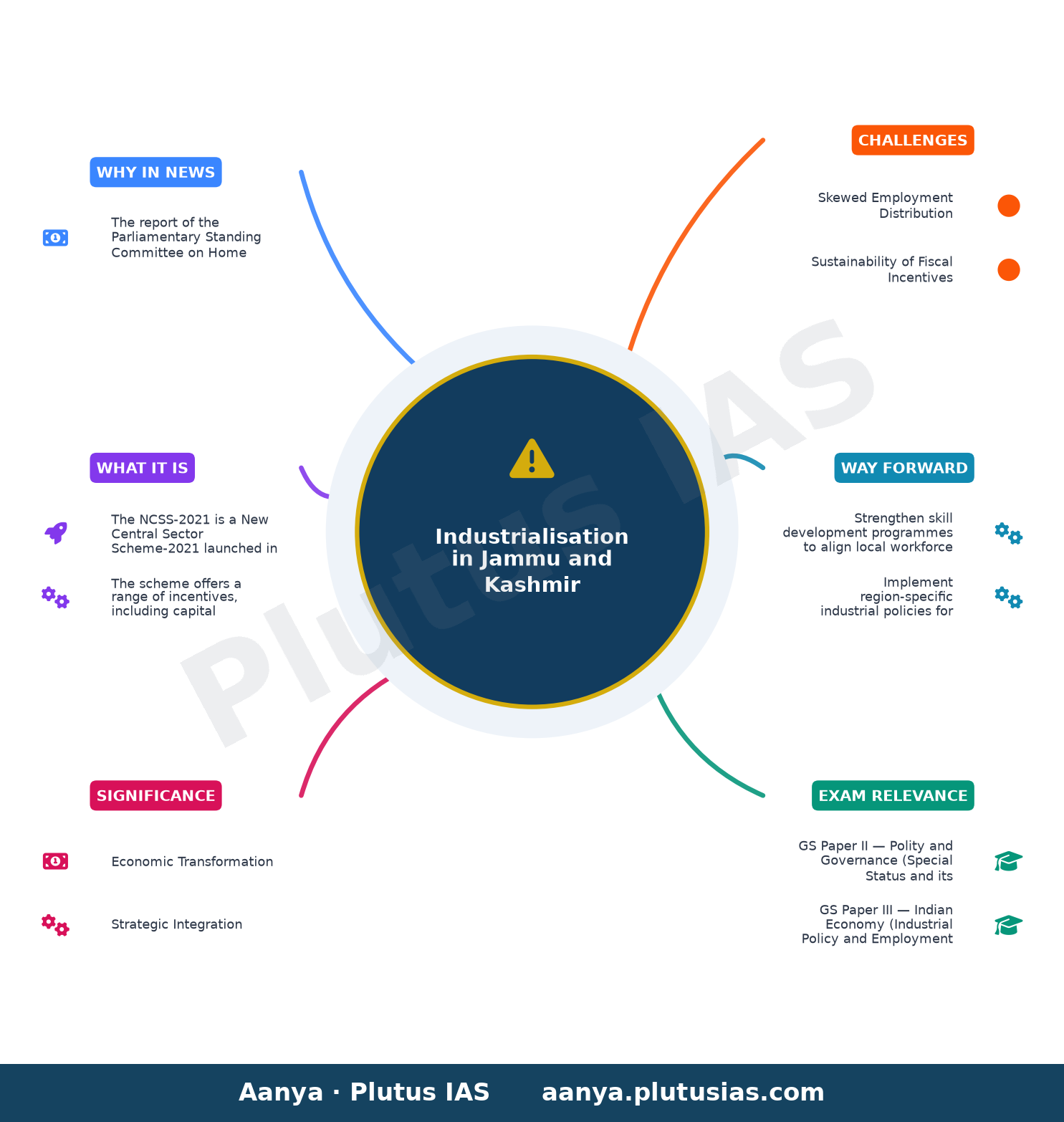
- GS Paper II — Polity and Governance (Special Status and its Abrogation) | GS Paper III — Indian Economy (Industrial Policy and Employment Generation)
- Prelims: Article 370 abrogation, Union Territory status, New Central Sector Scheme-2021 (NCSS-2021), Total Fertility Rate (TFR), Parliamentary Standing Committee on Home Affairs
- Essay: Economic Development and Inclusive Growth in Post-Special Status Jammu and Kashmir, The Role of Policy Interventions in Transforming Conflict-Affected Regions
Quick Revision: The New Central Sector Scheme-2021 (NCSS-2021) is a ₹28,400-crore incentive programme aimed at fostering industrial development in Jammu and Kashmir by providing financial assistance, capital subsidies, and employment-linked incentives to local and non-local entrepreneurs.
Why is this in the news?
The report of the Parliamentary Standing Committee on Home Affairs, tabled in Parliament on August 8, 2026, highlights that 90% of industrial units established in Jammu and Kashmir since 2019 were set up by local entrepreneurs. This data, presented in the context of post-Article 370 abrogation industrialisation, underscores the role of policy interventions such as the New Central Sector Scheme-2021 (NCSS-2021) in driving economic growth and employment generation in the Union Territory.
Background
- The abrogation of Article 370 of the Constitution on August 5, 2019, revoked the special status of Jammu and Kashmir, converting it into a Union Territory (UT) with bifurcation into two UTs: Jammu & Kashmir and Ladakh.
- Post-abrogation, the central government introduced several policy measures, including the New Central Sector Scheme-2021 (NCSS-2021), to stimulate industrial development and attract investments in the region.
- The NCSS-2021, notified by the Department for Promotion of Industry and Internal Trade (DPIIT), is a ₹28,400-crore incentive programme aimed at fostering industrial growth and employment generation in Jammu and Kashmir.
- The parliamentary panel’s report assesses the impact of these policies over the period from 2019-20 to 2025-26, covering the establishment of 2,279 industrial units with investments worth ₹16,598.97 crore and generating 75,848 jobs.
- The industrialisation drive is seen as a critical component of the UT’s broader development strategy, aligning with the central government’s vision of integrating Jammu and Kashmir into the national mainstream.
What is the New Central Sector Scheme-2021 (NCSS-2021)?
- The NCSS-2021 is a New Central Sector Scheme-2021 launched in 2021 to promote industrial development in Jammu and Kashmir by providing financial assistance and incentives to entrepreneurs.
- The scheme offers a range of incentives, including capital investment subsidies, interest subsidies on loans, and support for infrastructure development, to attract investments and foster entrepreneurship.
- Under the scheme, enterprises are eligible for incentives based on their investment size, employment generation, and sector-specific priorities, such as manufacturing, services, and tourism.
- The NCSS-2021 is designed to address the unique challenges faced by Jammu and Kashmir, including geographical constraints, limited industrial base, and the need for employment generation in a post-conflict scenario.
- The scheme is implemented in collaboration with the UT administration, industry associations, and financial institutions to ensure effective disbursement of incentives and monitoring of progress.
- As of the report’s findings, 971 units were registered under the NCSS-2021, with 754 units established by locals and 217 by non-locals, reflecting a balanced participation of both groups.
- The scheme has approved 3,338 incentive claims worth ₹951 crore, with ₹814.68 crore already disbursed, indicating significant financial outlay and administrative efficiency.
- The NCSS-2021 is part of a broader policy framework that includes infrastructure development, skill enhancement, and ease of doing business reforms to create a conducive environment for industrial growth.
Key Features
| Feature | Significance |
|---|---|
| Local entrepreneurship dominance (90%) | Demonstrates indigenous economic agency post-Article 370 abrogation, reducing reliance on external capital. |
| Investment inflow (₹16,598.97 crore) | Signifies tangible capital infusion into J&K’s industrial sector, aligning with Centre’s developmental objectives. |
| Employment generation (75,848 jobs) | Highlights direct socio-economic impact through formal sector job creation in a region historically marked by unemployment. |
| NCSS-2021 linkage (₹28,400 crore scheme) | Central government’s flagship incentive programme driving industrialisation via fiscal support and regulatory simplification. |
| Fertility rate (TFR 1.5) | Indicates demographic transition, potentially reducing pressure on employment markets while signalling improved socio-economic conditions. |
Why it Matters
Economic Transformation
- Industrialisation post-2019 marks a structural shift from conflict-driven economy to formal sector growth, with local ownership as a stabilising factor.
- Concentration of investments in micro, small, and medium enterprises (MSMEs) suggests inclusive growth, though larger non-local units may indicate capital-intensive sectors.
- Fiscal incentives under NCSS-2021 have catalysed private sector participation, reducing dependence on public expenditure alone.
Strategic Integration
- Enhanced industrial activity strengthens J&K’s integration with national supply chains, reducing logistical vulnerabilities in the erstwhile state.
- Local entrepreneurship mitigates risks of external economic dominance, aligning with Centre’s policy of ‘Nation First’ in resource utilisation.
- Job creation in formal sectors may reduce insurgency triggers by addressing youth unemployment, a historically volatile issue.
Policy Governance
- Parliamentary oversight via Standing Committee reports ensures transparency in fund utilisation and outcome assessment.
- Central sector schemes (NCSS-2021) demonstrate Union Territory administration’s reliance on centrally sponsored programmes for development.
- Data-driven policymaking is evident, with employment and investment metrics serving as performance benchmarks.
Challenges
1. Skewed Employment Distribution
- Non-local units generate 41% of jobs despite comprising only 10% of units, indicating capital-intensive sectors with lower employment elasticity.
- Risk of ‘jobless growth’ if large-scale units dominate, necessitating skill development programmes tailored to local workforce.
UPSC Link: GS3: Employment & Inclusive Growth
2. Sustainability of Fiscal Incentives
- NCSS-2021’s ₹28,400 crore outlay raises questions about long-term fiscal viability, especially if industrialisation does not achieve self-sufficiency.
- Dependence on central funds may create fiscal imbalances if revenue generation lags behind expenditure.
UPSC Link: GS3: Fiscal Federalism
3. Regional Disparities
- Concentration of units in specific districts (e.g., Jammu/Srinagar) may exacerbate intra-UT inequalities, requiring targeted regional policies.
- Kashmir Valley’s industrial ecosystem remains underdeveloped compared to Jammu, necessitating balanced development strategies.
UPSC Link: GS2: Federalism & Local Governance
4. Environmental Externalities
- Industrialisation may lead to unregulated pollution in fragile Himalayan ecosystems, requiring strict environmental compliance mechanisms.
- Lack of robust EIA (Environmental Impact Assessment) frameworks in UT could undermine sustainable growth.
UPSC Link: GS3: Environmental Governance
5. Political Economy Risks
- Over-reliance on local entrepreneurship may stifle innovation if risk-averse business culture persists in a post-conflict environment.
- Perception of ‘outsider’ exclusion could trigger socio-political tensions if non-local participation is perceived as disproportionate.
UPSC Link: GS2: Centre-State Relations
Challenges — UPSC Perspective
| Issue | Concern |
|---|---|
| Capital vs. Labour Intensity | Non-local units generate higher jobs per unit but may not align with local skill sets, risking structural unemployment. |
| Fiscal Sustainability | Long-term viability of ₹28,400 crore incentives depends on industrial output matching expenditure, currently unassured. |
| Regional Imbalances | Jammu’s industrial growth outpaces Kashmir Valley, potentially deepening socio-economic divides within UT. |
| Environmental Compliance | Rapid industrialisation may outpace regulatory frameworks, leading to pollution and resource degradation. |
| Policy Continuity | Future governments may alter incentives, creating uncertainty for investors and entrepreneurs. |
Government Initiatives — Must-Memorise for Prelims
- New Central Sector Scheme-2021 (NCSS-2021)
Way Forward
- Strengthen skill development programmes to align local workforce with capital-intensive industries, mitigating job-skill mismatches.
- Implement region-specific industrial policies for Kashmir Valley to bridge developmental disparities with Jammu region.
- Establish a dedicated Environmental Impact Assessment (EIA) authority for J&K to regulate industrial pollution and ensure sustainable growth.
- Diversify incentive structures under NCSS-2021 to include labour-intensive sectors, ensuring inclusive employment generation.
- Create a J&K Industrial Data Dashboard for real-time monitoring of investments, employment, and sectoral growth to aid evidence-based policymaking.
- Enhance ease of doing business by simplifying land acquisition and single-window clearance processes for MSMEs.
- Promote public-private partnerships (PPPs) in infrastructure to reduce logistical bottlenecks hindering industrial expansion.
- Conduct periodic parliamentary reviews of NCSS-2021 to assess fiscal sustainability and adjust incentives based on performance metrics.
UPSC Value Addition
Keywords for Mains Answer-Writing
Jammu and Kashmir industrial policy post-Article 370 abrogation · New Central Sector Scheme-2021 (NCSS-2021) · Parliamentary Standing Committee on Home Affairs report · Local entrepreneurship in J&K post-2019 · Industrialisation and employment generation in Union Territories · Investment incentives for MSMEs in J&K · Article 370 abrogation and economic development · Union Territory governance and economic policy · Demographic dividend and Total Fertility Rate (TFR) in J&K · Role of DPIIT in industrial promotion · Comparative analysis of local vs non-local industrial units · Policy continuity and economic reforms in post-special status regions
Constitutional & Policy Linkages
- [‘Article 370 (now abrogated)’, ‘Original special status enabling autonomy in industrial policy.’]
Concept Flow
Abrogation of Article 370 (2019) → Removal of special status → Centralisation of legislative powers → Enactment of NCSS-2021 → Fiscal incentives for industrialisation → Establishment of 2,279 units (2019-2026) → Local ownership (90%) and investment inflow (₹16,598.97 crore) → Job creation (75,848) → Socio-economic stabilisation.
Prelims Practice Questions
Q1. Consider the following statements regarding the New Central Sector Scheme-2021 (NCSS-2021) for Jammu and Kashmir:
1. The scheme offers incentives worth ₹28,400 crore.
2. Under the scheme, 971 units were registered, with 754 established by locals.
3. The scheme mandates that all industrial units must be owned by local entrepreneurs.
How many of the above statements are correct?
- Only one
- Only two
- All three
- None
Answer: Only two — Statement 1 is correct (₹28,400 crore incentives). Statement 2 is correct (971 units registered, 754 by locals). Statement 3 is incorrect as the scheme does not mandate local ownership exclusively.
Q2. Assertion (A): The abrogation of Article 370 in Jammu and Kashmir has led to significant industrial growth.
Reason (R): The New Central Sector Scheme-2021 (NCSS-2021) provides substantial financial incentives for industrial units in J&K.
Options:
A. Both A and R are true, and R is the correct explanation of A.
B. Both A and R are true, but R is not the correct explanation of A.
C. A is true but R is false.
D. A is false but R is true.
Answer: ? — A is true as the report highlights industrial growth post-2019. R is true and directly explains A, as NCSS-2021 incentivised industrial units, driving growth.
Q3. Which of the following best describes the primary objective of the New Central Sector Scheme-2021 (NCSS-2021) for Jammu and Kashmir?
- To provide financial incentives for industrial units and generate employment
- To exclusively promote units owned by non-local entrepreneurs
- To replace the erstwhile Article 370 with a new industrial policy
- To reduce the Total Fertility Rate (TFR) in J&K to below 1.5
Answer: To provide financial incentives for industrial units and generate employment — The NCSS-2021 aims to incentivise industrial units and generate employment, as evidenced by the report’s data on investments and job creation.
Mains Practice Question
✍ Critically examine the role of the New Central Sector Scheme-2021 (NCSS-2021) in catalysing industrialisation and employment generation in Jammu and Kashmir since 2019. Also, assess the extent to which local entrepreneurship has been fostered under the scheme. (15 Marks)
Approach: MODEL-ANSWER SKELETON:
1. **Introduction**: Briefly outline the abrogation of Article 370 (August 5, 2019) and the introduction of NCSS-2021 as a flagship policy to promote industrialisation in J&K. Cite the scheme’s financial outlay (₹28,400 crore) and its objectives.
2. **NCSS-2021: Key Features and Incentives**:
– Outline the scheme’s components: capital investment subsidy, interest subvention, GST reimbursement, and employment generation-linked incentives.
– Highlight the role of the Department for Promotion of Industry and Internal Trade (DPIIT) in implementation.
3. **Industrial Growth Metrics**:
– Present data from the Parliamentary Standing Committee report: 2,279 units, ₹16,598.97 crore investments, 75,848 jobs.
– Breakdown of units: 2,056 by locals (90%), 217 by non-locals (10%).
– Employment figures: Locals’ units proposed 20,629 jobs; non-locals’ units proposed 31,268 jobs (larger scale).
4. **Local Entrepreneurship and Policy Impact**:
– Analyse the dominance of local entrepreneurs (90% of units) and its implications for regional economic autonomy.
– Discuss the scheme’s success in fostering grassroots industrialisation, contrasting with pre-2019 limitations under Article 370.
– Note the committee’s observation on improving investor confidence and sustained policy support.
5. **Challenges and Criticisms**:
– Highlight disparities in job generation between local and non-local units (scale vs. inclusivity).
– Discuss potential issues: bureaucratic hurdles, access to credit, and infrastructure gaps in J&K.
– Mention the Total Fertility Rate (TFR) of 1.5 in J&K as a demographic dividend but also a challenge for future employment.
6. **Comparative Perspective**:
– Compare J&K’s industrial growth post-NCSS-2021 with other Union Territories or states with similar schemes (e.g., Gujarat’s industrial policy).
7. **Conclusion**:
– Summarise the scheme’s role in transforming J&K’s industrial landscape.
– Argue that while NCSS-2021 has been a catalyst, long-term success requires addressing structural challenges and ensuring equitable growth.
Source: The Hindu
Generated by AanyaAi for educational purpose.

- सुप्रीम कोर्ट का सीईसी नियुक्ति कानून पर विभाजित फैसला, संविधान पीठ को भेजने पर मतभेद - September 23, 2026
- Supreme Court Split Verdict on CEC, EC Appointment Law: Key UPSC Analysis - September 23, 2026
- यूके ने AI मानकों और फर्जी ख़बरों पर वैश्विक पहल की घोषणा, जानिए क्या है पूरा मामला - September 23, 2026

No Comments