


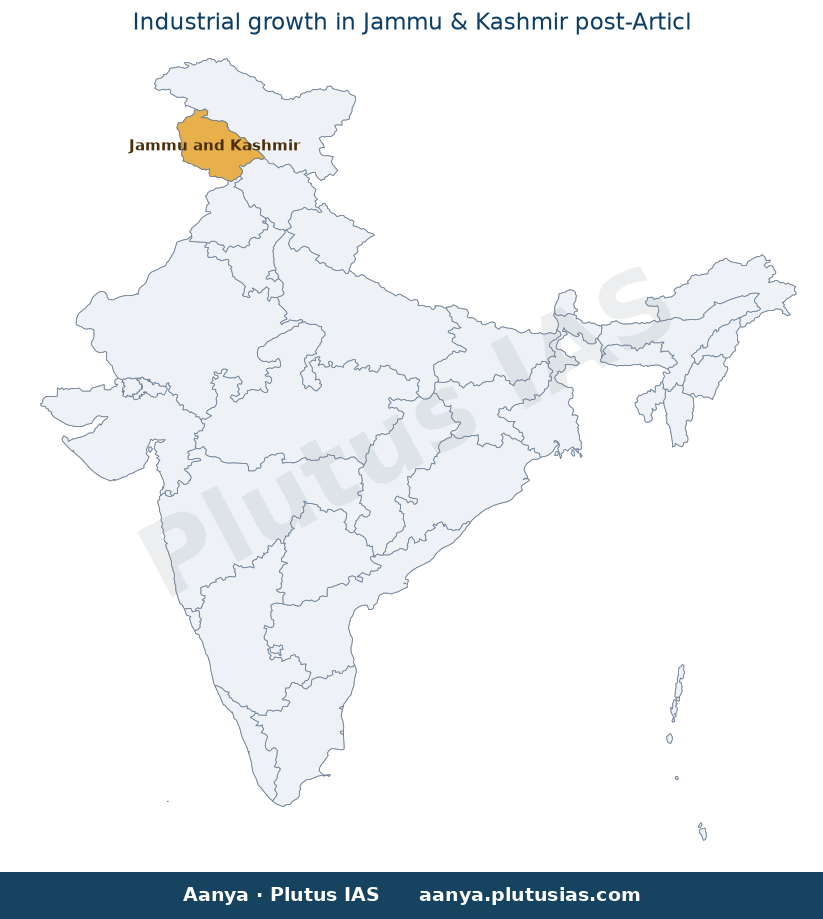
08 Aug 90% J&K industrial units post-2019 set up by locals: Parliamentary report
✎ The New Central Sector Scheme-2021 (NCSS-2021) is a ₹28,400-crore central sector incentive programme designed to catalyse industrial growth in J&K post-2019, with 90% of new units established by locals and ₹814.68 crore already…
Subject Relevance — Where This Topic Fits
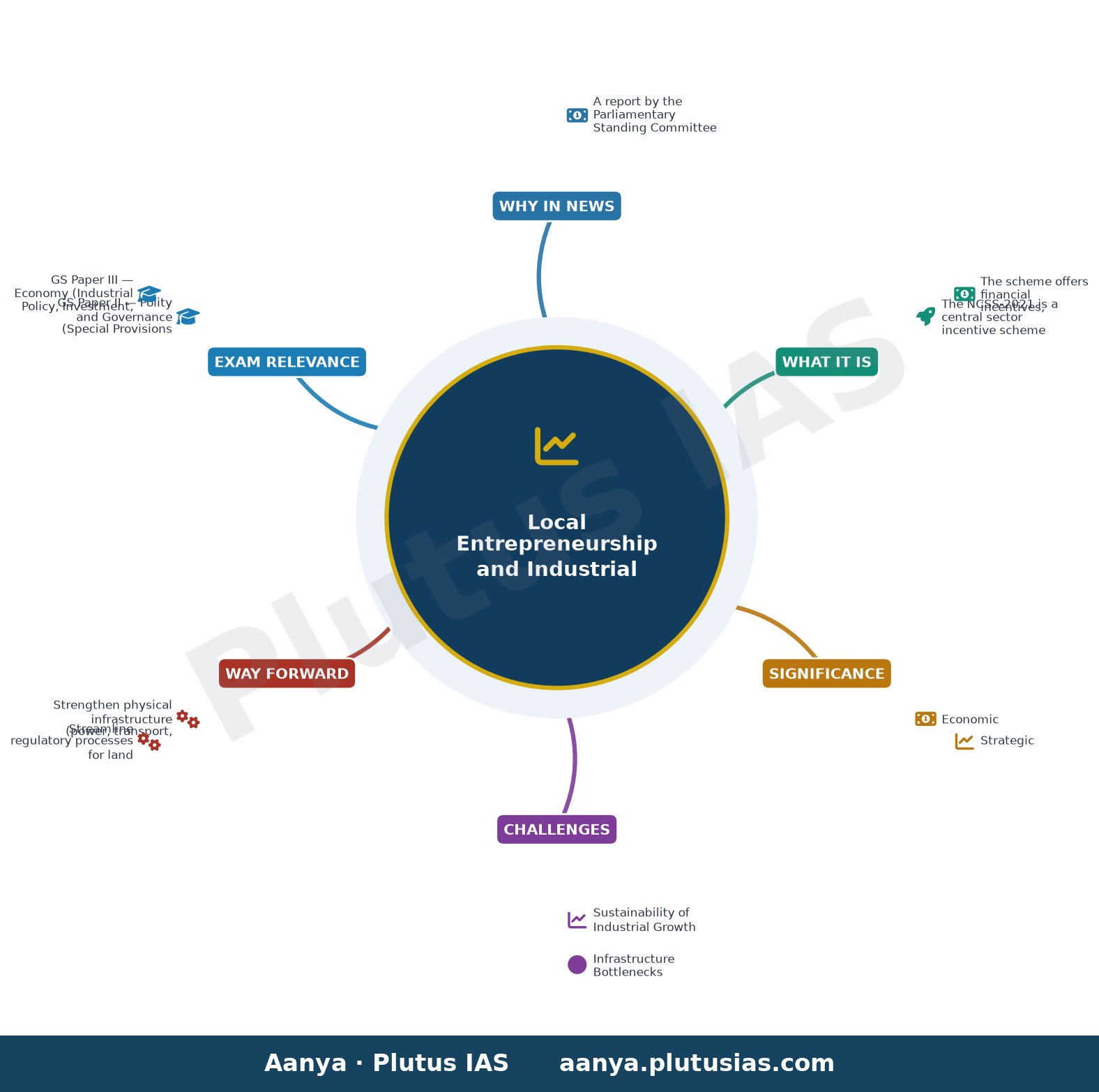
- GS Paper II — Polity and Governance (Special Provisions for J&K, Federalism) | GS Paper III — Economy (Industrial Policy, Investment, Employment Generation)
- Prelims: Article 370 abrogation, Jammu & Kashmir Reorganisation Act 2019, New Central Sector Scheme-2021 (NCSS-2021), Union Territory status, Total Fertility Rate (TFR), DPIIT, Parliamentary Standing Committee on Home Affairs
- Essay: The Role of Policy in Transforming Regional Economies: A Case Study of Jammu & Kashmir, Balancing Development and Identity: Post-Abolition Challenges in J&K
Quick Revision: The New Central Sector Scheme-2021 (NCSS-2021) is a ₹28,400-crore central sector incentive programme designed to catalyse industrial growth in J&K post-2019, with 90% of new units established by locals and ₹814.68 crore already disbursed in incentives.
Why is this in the news?
A report by the Parliamentary Standing Committee on Home Affairs, tabled in Parliament on August 8, 2026, highlights that 90% of industrial units established in Jammu & Kashmir since 2019 were set up by local entrepreneurs, demonstrating significant indigenous economic participation. The data, covering 2,279 units with investments worth ₹16,598.97 crore and 75,848 jobs, underscores the impact of post-2019 industrial policies, particularly the New Central Sector Scheme-2021 (NCSS-2021), on local and non-local investor confidence in the Union Territory.
Background
- The abrogation of Article 370 of the Constitution on August 5, 2019, and the reorganisation of Jammu & Kashmir into a Union Territory (UT) marked a paradigm shift in the region’s constitutional and administrative framework.
- Post-abolition, the Union Government introduced multiple central sector schemes to stimulate industrialisation, employment generation, and economic integration of J&K with the national mainstream.
- The New Central Sector Scheme-2021 (NCSS-2021), notified by the Department for Promotion of Industry and Internal Trade (DPIIT), allocated ₹28,400 crore in incentives to attract investments and promote entrepreneurship in J&K.
- J&K’s economic trajectory post-2019 has been closely monitored for its potential to address historical developmental disparities and integrate the region into India’s broader economic framework.
What is the New Central Sector Scheme-2021 (NCSS-2021)?
- The NCSS-2021 is a central sector incentive scheme launched by the Government of India to promote industrial development, employment generation, and investment in Jammu & Kashmir post the abrogation of Article 370.
- The scheme offers financial incentives, including capital investment subsidy, interest subvention, and GST reimbursement, to eligible industrial units established in J&K.
- It aims to attract both local and non-local entrepreneurs by providing a supportive policy environment, thereby fostering economic integration and reducing regional disparities.
- The 754 NCSS-linked units established by locals proposed 20,629 jobs, while the 217 units established by non-locals proposed 31,268 jobs.
- The scheme has disbursed ₹814.68 crore in incentives out of ₹951 crore approved claims, indicating robust utilisation of allocated funds.
- NCSS-2021 is part of a broader strategy to leverage J&K’s strategic location, skilled workforce, and policy incentives to position it as a competitive industrial hub in North India.
- The scheme’s design reflects a shift from the erstwhile special status regime to a performance-linked incentive model, aligning with the Centre’s ‘One Nation, One Policy’ approach.
- Parliamentary oversight, as evidenced by the Standing Committee’s report, ensures transparency and accountability in the scheme’s implementation and impact assessment.
Key Features
| Feature | Significance |
|---|---|
| Proportion of local-owned industrial units (90%) | Demonstrates indigenous entrepreneurship and reduced dependence on external investors, aligning with local aspirations for self-reliance in economic development. |
| Investment attracted (₹16,598.97 crore) | Significant capital infusion into the Union Territory’s economy, fostering industrial growth and employment generation. |
| Employment generated (75,848 jobs) | Direct impact on reducing unemployment and improving livelihoods, particularly in a region historically affected by socio-economic challenges. |
| New Central Sector Scheme-2021 (NCSS-2021) | A ₹28,400-crore incentive programme instrumental in catalysing industrialisation, with 971 units registered under it. |
| Total Fertility Rate (TFR) of 1.5 | Indicates demographic transition and potential long-term benefits for human resource development and economic planning. |
Why it Matters
Economic
- Demonstrates the success of post-Article 370 industrial policies in attracting investment and fostering local entrepreneurship, countering scepticism about the region’s economic viability.
- Highlights the role of central schemes (e.g., NCSS-2021) in bridging developmental gaps in a Union Territory with historically constrained industrial activity.
- Industrial growth contributes to Gross State Domestic Product (GSDP) expansion, reducing dependence on central grants and promoting fiscal self-sufficiency.
Strategic
- Enhanced industrial presence in J&K strengthens national integration by reducing economic disparities and fostering socio-economic stability in a strategically sensitive region.
- Local ownership of industries mitigates concerns about external control, aligning with national security imperatives in border territories.
Social
- Employment generation addresses youth unemployment, a critical socio-economic challenge in J&K, potentially reducing alienation and promoting social cohesion.
- Low Total Fertility Rate (TFR) reflects improved access to education and healthcare, indicating long-term demographic dividends for economic planning.
Policy
- The success of NCSS-2021 underscores the efficacy of centrally sponsored schemes in addressing regional imbalances and incentivising private sector participation.
- The report validates the policy shift post-Article 370, demonstrating tangible outcomes in industrialisation and economic revival.
Challenges
1. Sustainability of Industrial Growth
- Over-reliance on central schemes may create dependency, necessitating long-term structural reforms to ensure self-sustaining industrial ecosystems.
- Large-scale non-local investments (e.g., 217 units under NCSS-2021) may lead to concerns about resource exploitation or displacement of local labour, requiring balanced policy interventions.
UPSC Link: GS3: Industrial Policy
2. Infrastructure Bottlenecks
- Inadequate physical infrastructure (power, transport, logistics) remains a critical constraint, limiting the scalability of industrial units despite policy incentives.
- Regulatory hurdles, including land acquisition and environmental clearances, may deter further investment despite central support.
UPSC Link: GS3: Infrastructure Development
3. Demographic Dividend Utilisation
- While TFR is low, ensuring quality employment for the existing workforce remains a challenge, requiring alignment between industrial growth and skill development programmes.
- Brain drain and lack of high-value job opportunities may persist, necessitating targeted policies for talent retention.
UPSC Link: GS1: Population & Associated Issues
4. Security and Stability Concerns
- Persistent security challenges in certain districts may deter large-scale investments, despite overall improvements in industrial activity.
- Balancing development with counter-insurgency measures remains a delicate policy challenge.
UPSC Link: GS3: Security Challenges
5. Fiscal Constraints of UT
- J&K’s budget (₹1.12 lakh crore in 2025-26) may be insufficient to fully support industrial growth without sustained central assistance or revenue augmentation.
- Dependence on central grants risks fiscal fragility, necessitating efforts to expand the tax base and attract private investment.
UPSC Link: GS3: Fiscal Federalism
Challenges — UPSC Perspective
| Issue | Concern |
|---|---|
| Infrastructure Deficits | Limits scalability of industrial units despite policy incentives. |
| Regulatory Hurdles | Land acquisition, environmental clearances, and bureaucratic delays deter investment. |
| Security Challenges | Persistent instability in certain districts may deter large-scale investments. |
| Fiscal Constraints | UT’s budget may be insufficient for sustained industrial growth without central support. |
| Skill Mismatch | Industrial growth must align with workforce skill development to avoid structural unemployment. |
| Balancing Local vs Non-Local Interests | Ensuring equitable benefits to locals while attracting non-local investments. |
Government Initiatives — Must-Memorise for Prelims
- New Central Sector Scheme-2021 (NCSS-2021)
Way Forward
- Strengthen physical infrastructure (power, transport, logistics) to support industrial scaling and reduce operational costs.
- Streamline regulatory processes for land acquisition, environmental clearances, and labour compliance to expedite project implementation.
- Expand skill development programmes (e.g., PMKVY, ITIs) to align workforce capabilities with industrial demands, particularly in high-growth sectors.
- Design targeted incentives for local entrepreneurs in niche sectors (e.g., handicrafts, agro-processing) to ensure inclusive growth.
- Enhance security measures in vulnerable districts to boost investor confidence and reduce operational risks.
- Diversify industrial base beyond traditional sectors (e.g., tourism, IT) to reduce dependence on a few industries and mitigate economic volatility.
- Promote public-private partnerships (PPPs) for large-scale infrastructure projects to leverage private sector efficiency.
- Monitor and address concerns about non-local investments to ensure equitable benefits and prevent local alienation.
UPSC Value Addition
Keywords for Mains Answer-Writing
Jammu and Kashmir industrialisation post-Article 370 abrogation · Parliamentary Standing Committee on Home Affairs report 2026 · New Central Sector Scheme-2021 (NCSS-2021) for J&K · Local vs non-local entrepreneurship in J&K · Investment and employment generation in Union Territories · Union Territory status and economic development · Industrial policy incentives and employment generation · Total Fertility Rate (TFR) in Jammu and Kashmir · Union Territory administration and economic governance · Impact of abrogation of Article 370 on industrial growth
Constitutional & Policy Linkages
- [‘Article 370 (Abrogation)’, ‘Policy shift enabling industrialisation.’]
- [‘Article 239A’, ‘Special status of Union Territory.’]
Concept Flow
Abrogation of Article 370 (2019) → Policy shift enabling industrialisation in J&K → Launch of NCSS-2021 (₹28,400 crore) → Attraction of investments (₹16,598.97 crore) and establishment of 2,279 industrial units → Generation of 75,848 jobs → Local ownership (90%) and non-local participation (10%) → Employment generation disparities (larger units by non-locals) → Need for sustained policy support to maintain momentum.
Prelims Practice Questions
Q1. Consider the following statements regarding the New Central Sector Scheme-2021 (NCSS-2021) for Jammu and Kashmir:
1. NCSS-2021 is a ₹28,400-crore incentive programme notified by the Department for Promotion of Industry and Internal Trade.
2. Under NCSS-2021, 971 units were registered, including 754 established by locals and 217 by non-locals.
3. The scheme aims to attract investment primarily from non-local entrepreneurs to boost industrialisation in J&K.
How many of the above statements are correct?
- Only one
- Only two
- All three
- None
Answer: Only two — Statement 1 is correct as NCSS-2021 is a ₹28,400-crore incentive programme. Statement 2 is correct with 971 units registered. Statement 3 is incorrect as the scheme encourages participation from both local and non-local entrepreneurs.
Q2. Assertion (A): The abrogation of Article 370 in Jammu and Kashmir has led to significant industrial growth, with nearly 90% of industrial units established by locals since 2019.
Reason (R): The New Central Sector Scheme-2021 (NCSS-2021) provides substantial financial incentives to attract both local and non-local entrepreneurs to invest in J&K.
- Both A and R are true, and R is the correct explanation of A
- Both A and R are true, but R is not the correct explanation of A
- A is true, but R is false
- A is false, but R is true
Answer: Both A and R are true, but R is not the correct explanation of A — Assertion (A) is true as the report confirms 90% of industrial units were set up by locals. Reason (R) is also true as NCSS-2021 provides incentives, but it does not directly explain the dominance of local entrepreneurship.
Q3. Match the following columns related to industrial development in Jammu and Kashmir:
Column I (Data Point) | Column II (Value/Description)
— | —
A. Total industrial units established (2019-20 to 2025-26) | 1. ₹16,598.97 crore
B. Total investment attracted by industrial units | 2. 2,279 units
C. Total jobs generated by industrial units | 3. 75,848 jobs
D. Total Fertility Rate (TFR) in J&K | 4. 1.5
- A-2, B-1, C-3, D-4
- A-1, B-2, C-3, D-4
- A-3, B-4, C-1, D-2
- A-4, B-3, C-2, D-1
Answer: A-2, B-1, C-3, D-4 — A matches 2 (2,279 units), B matches 1 (₹16,598.97 crore), C matches 3 (75,848 jobs), and D matches 4 (TFR of 1.5).
Mains Practice Question
✍ Critically examine the role of the Union Territory status and policy incentives in accelerating industrialisation in Jammu and Kashmir since 2019. How far has the New Central Sector Scheme-2021 (NCSS-2021) contributed to this growth? Also, analyse the implications of local versus non-local entrepreneurship in the region’s economic development. (15 Marks)
Approach: MODEL-ANSWER SKELETON:
1. **Context and Background**
– Brief on abrogation of Article 370 (August 5, 2019) and transition to UT status.
– Objective: Accelerate development, attract investment, and generate employment.
2. **Industrial Growth Metrics**
– Data: 2,279 units, ₹16,598.97 crore investment, 75,848 jobs (2019-20 to 2025-26).
– Local vs non-local ownership: 90% by locals (2,056 units), 10% by non-locals (223 units).
3. **Role of NCSS-2021**
– Scheme details: ₹28,400 crore incentives, 971 units registered (754 locals, 217 non-locals).
– Employment distribution: Locals (20,629 jobs), non-locals (31,268 jobs) — larger projects by non-locals.
– Financial disbursement: ₹814.68 crore released, 3,338 claims approved worth ₹951 crore.
4. **Critical Analysis**
– **Strengths**: Significant local participation, employment generation, and investor confidence.
– **Weaknesses**: Non-local units generate larger employment but fewer in number; sustainability concerns.
– **Policy Gaps**: Need for sustained policy support, skill development, and infrastructure alignment.
5. **Local vs Non-Local Entrepreneurship**
– **Local Advantages**: Familiarity with terrain, community trust, and lower operational costs.
– **Non-Local Advantages**: Larger capital, advanced technology, and higher employment generation.
– **Implications**: Balancing local ownership with economic efficiency; avoiding resource drain.
6. **Broader Implications**
– TFR of 1.5 (below national average) reflects demographic dividend but also underscores need for job creation.
– UT administration’s role in policy implementation and monitoring.
7. **Conclusion**
– NCSS-2021 has been a catalyst, but long-term success depends on inclusive growth, infrastructure, and political stability. Critically, the dominance of local entrepreneurship must be leveraged without stifling larger investments.
Source: The Hindu
Generated by AanyaAi for educational purpose.

- सुप्रीम कोर्ट का सीईसी नियुक्ति कानून पर विभाजित फैसला, संविधान पीठ को भेजने पर मतभेद - September 23, 2026
- Supreme Court Split Verdict on CEC, EC Appointment Law: Key UPSC Analysis - September 23, 2026
- यूके ने AI मानकों और फर्जी ख़बरों पर वैश्विक पहल की घोषणा, जानिए क्या है पूरा मामला - September 23, 2026

No Comments