


08 Aug 90% J&K industrial units since 2019 set up by locals: Parliamentary panel report
✎ The New Central Sector Scheme (NCSS-2021) for Jammu and Kashmir, a ₹28,400-crore central sector scheme, has catalysed 90% of post-2019 industrial units in the UT, with 971 units registered and ₹814.68 crore disbursed…
Subject Relevance — Where This Topic Fits
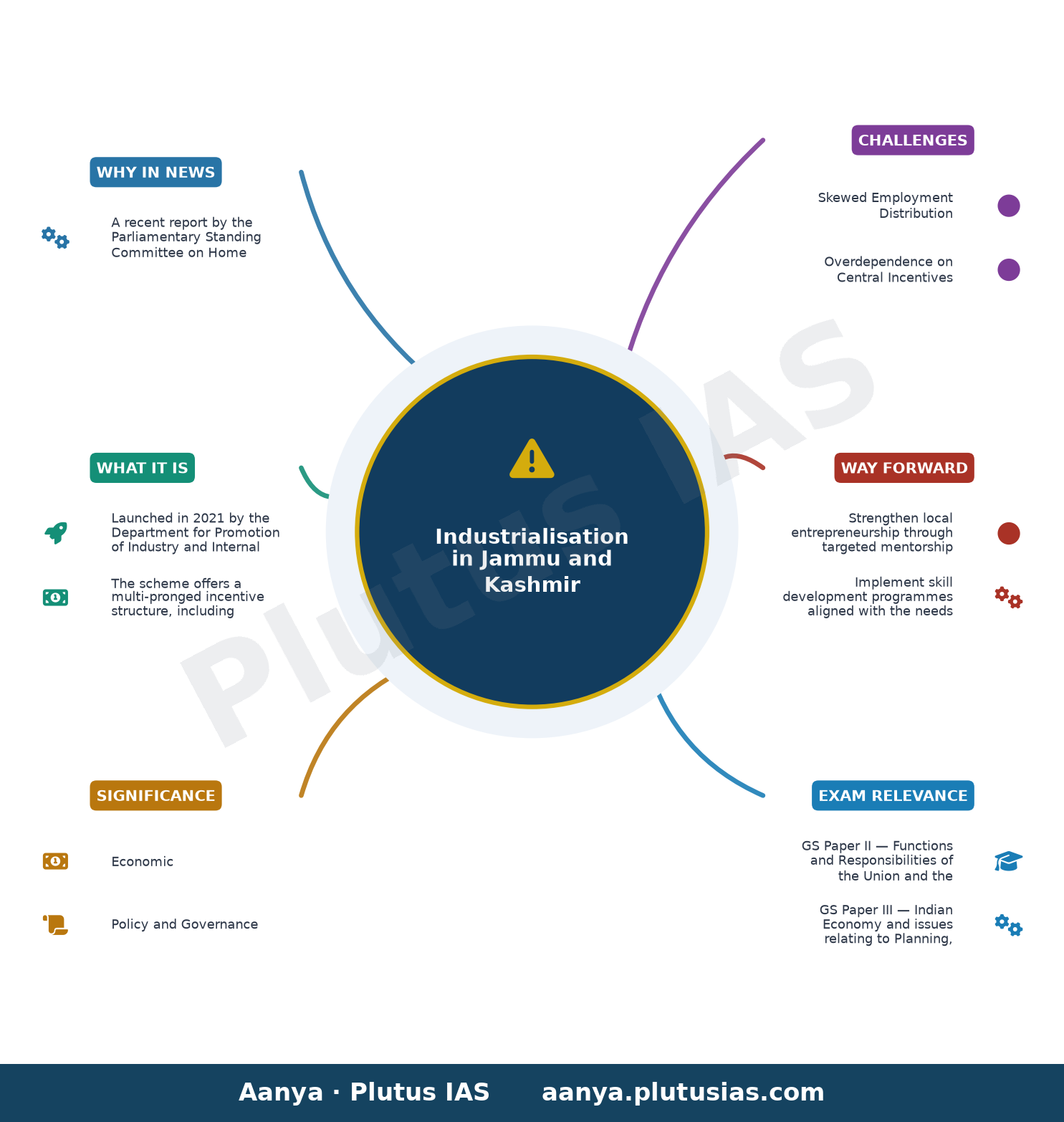
- GS Paper II — Functions and Responsibilities of the Union and the States, Issues and Challenges Pertaining to the Federal Structure | GS Paper III — Indian Economy and issues relating to Planning, Mobilisation of Resources, Growth, Development and Employment | GS Paper III — Effects of Liberalisation on the Economy, Changes in Industrial Policy and their Effects on Industrial Growth
- Prelims: Article 370 abrogation, Union Territory (UT) status, New Central Sector Scheme (NCSS-2021), Department for Promotion of Industry and Internal Trade (DPIIT), Total Fertility Rate (TFR), Parliamentary Standing Committee on Home Affairs, Investment Incentives, Employment Generation, Jammu and Kashmir Industrial Policy 2021-26
- Essay: The role of policy incentives in transforming regional economies, Local entrepreneurship as a driver of inclusive growth
Quick Revision: The New Central Sector Scheme (NCSS-2021) for Jammu and Kashmir, a ₹28,400-crore central sector scheme, has catalysed 90% of post-2019 industrial units in the UT, with 971 units registered and ₹814.68 crore disbursed, demonstrating the transformative potential of targeted policy incentives in post-special status regions.
Why is this in the news?
A recent report by the Parliamentary Standing Committee on Home Affairs, tabled in Parliament on August 8, 2026, highlights that 90% of industrial units established in Jammu and Kashmir (J&K) since 2019 were set up by local entrepreneurs. This development, occurring in the context of J&K’s transition from a state to a Union Territory (UT) following the abrogation of Article 370 in August 2019, underscores the impact of post-2019 industrial policies, particularly the New Central Sector Scheme (NCSS-2021), on fostering local and non-local investment, employment generation, and economic transformation in the region.
Background
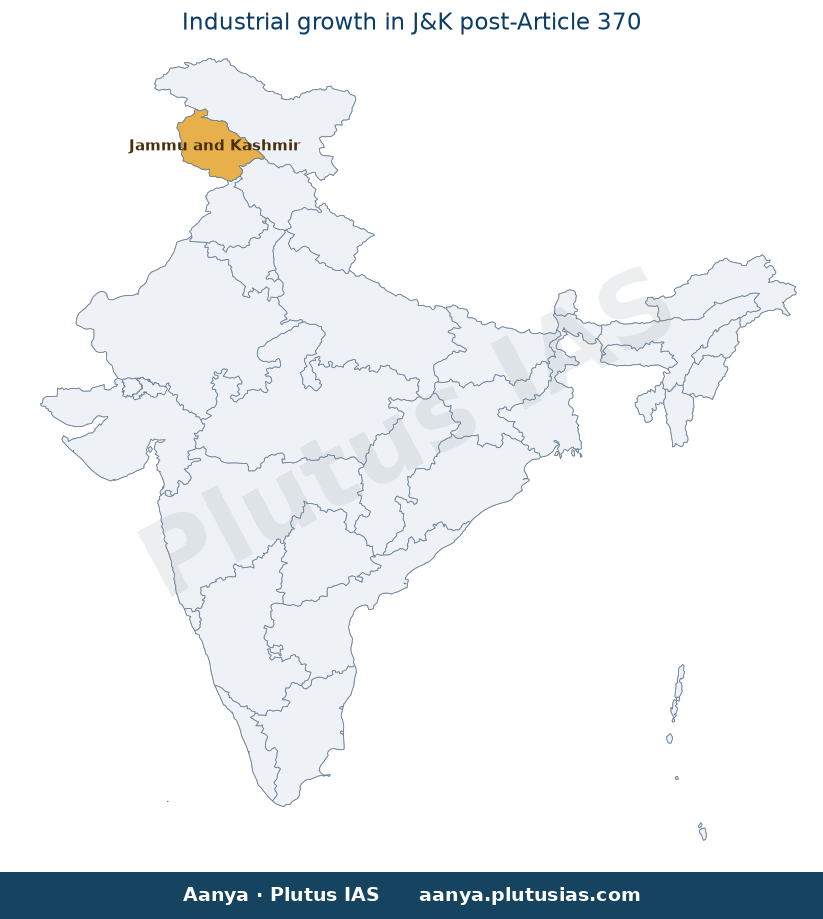
- The abrogation of Article 370 of the Constitution on August 5, 2019, revoked the special status of Jammu and Kashmir, converting it into a Union Territory (UT) with a bifurcated legislature and administration, thereby integrating it more closely with the Union Government’s policy framework.
- Post-abrogation, the Union Government introduced the New Central Sector Scheme (NCSS-2021) in 2021, a ₹28,400-crore incentive programme notified by the Department for Promotion of Industry and Internal Trade (DPIIT) to catalyse industrial development in J&K.
- The scheme aimed to attract investments, promote local entrepreneurship, and generate employment by providing financial incentives, including capital subsidies, interest subvention, and GST reimbursement, to eligible industrial units.
- Between 2019-20 and 2025-26, J&K witnessed the establishment of 2,279 industrial units, attracting investments worth ₹16,598.97 crore and generating 75,848 jobs, reflecting a significant shift in the region’s industrial landscape.
- The Parliamentary Standing Committee on Home Affairs, in its report, acknowledged the progress while emphasising the need for sustained policy support to maintain industrial growth momentum.
New Central Sector Scheme (NCSS-2021) for Jammu and Kashmir: Objectives, Components, and Impact
- Launched in 2021 by the Department for Promotion of Industry and Internal Trade (DPIIT), NCSS-2021 is a ₹28,400-crore central sector scheme designed to accelerate industrialisation in Jammu and Kashmir post-A370 abrogation.
- The scheme offers a multi-pronged incentive structure, including capital investment subsidy (up to 30% of the investment in plant and machinery for micro and small enterprises), interest subvention (5% per annum for 5 years on term loans), and GST reimbursement (100% for 10 years).
- NCSS-2021 targets both local and non-local entrepreneurs, with a focus on promoting self-employment, skill development, and employment generation in the UT.
- Under the scheme, 971 units were registered, with 754 units established by locals and 217 by non-locals, demonstrating balanced participation.
- Employment generation under NCSS-2021 shows a skew toward larger projects by non-local entrepreneurs, with 217 units proposing 31,268 jobs compared to 20,629 jobs proposed by 754 local units, highlighting the role of external capital in scaling operations.
- Financial disbursements under the scheme have been substantial, with ₹814.68 crore already disbursed against approved claims worth ₹951 crore, indicating effective utilisation of funds.
- The scheme aligns with the broader industrial policy of J&K, which seeks to diversify the economy beyond traditional sectors like agriculture and tourism by fostering manufacturing, IT, and allied industries.
- NCSS-2021 is complemented by state-level initiatives such as the J&K Industrial Policy 2021-26, which provides additional incentives like land allotment at concessional rates and single-window clearance for industrial approvals.
Key Features
| Feature | Significance |
|---|---|
| Proportion of local-owned industrial units (90%) | Demonstrates indigenous entrepreneurship and reduced dependence on external capital in J&K’s post-Article 370 industrialisation. |
| Total industrial units established (2,279) | Reflects the scale of industrial policy implementation and investor response in J&K between 2019-20 and 2025-26. |
| Investment attracted (₹16,598.97 crore) | Indicates the financial commitment to J&K’s industrial growth and the efficacy of central sector incentives. |
| Employment generated (75,848 jobs) | Highlights the socio-economic impact of industrialisation on local employment, particularly in a region with historical employment challenges. |
| New Central Sector Scheme-2021 (NCSS-2021) | A ₹28,400-crore incentive programme driving 42.6% of the industrial units established, with structured financial support for investors. |
Why it Matters
Economic
- Local ownership of 90% of industrial units suggests sustainable economic growth rooted in indigenous capabilities, reducing vulnerability to external economic shocks.
- The ₹16,598.97 crore investment and 75,848 jobs indicate a substantial expansion of the industrial base, aligning with the Union Territory’s developmental priorities.
- Employment generation addresses the persistent challenge of job scarcity in J&K, particularly among youth, while diversifying the economic structure beyond traditional sectors like tourism and agriculture.
Policy and Governance
- The abrogation of Article 370 and the subsequent constitutional transition to a Union Territory status appears to have facilitated a more streamlined industrial policy framework, as evidenced by the rapid establishment of units.
- The parliamentary panel’s emphasis on sustained policy support underscores the need for long-term stability in industrial incentives to prevent policy reversals and maintain investor confidence.
- The NCSS-2021 scheme demonstrates the Centre’s proactive role in incentivising industrial growth, with financial disbursements already reaching ₹814.68 crore, indicating effective implementation.
Demographic and Social
- A Total Fertility Rate (TFR) of 1.5 in J&K, below the national average, suggests demographic stabilisation, which may reduce pressure on employment and resource allocation in the long term.
- The high participation of local entrepreneurs implies greater social acceptance of industrialisation, potentially reducing resistance to economic reforms and fostering a culture of enterprise.
Challenges
1. Skewed Employment Distribution
- Non-local entrepreneurs established fewer units (223) but proposed significantly higher employment (31,268 jobs), indicating larger-scale investments that may not equally benefit local labour markets.
- The disparity in job creation suggests a need for targeted skill development programmes to ensure locals can fill high-value roles in larger enterprises.
UPSC Link: GS3: Employment and Skill Development
2. Overdependence on Central Incentives
- The NCSS-2021 scheme accounts for 42.6% of industrial units, raising concerns about long-term sustainability if central funding is reduced or withdrawn.
- Local industrialisation must transition from reliance on subsidies to self-sustaining growth models to ensure resilience against policy shifts.
UPSC Link: GS3: Industrial Policy and Subsidies
3. Regional Disparities in Industrialisation
- The report does not specify regional distribution within J&K, leaving open questions about whether industrial growth is concentrated in specific districts (e.g., Jammu vs. Kashmir), exacerbating intra-UT inequalities.
- Infrastructure gaps in remote areas may hinder equitable industrialisation, requiring targeted investments in connectivity and utilities.
UPSC Link: GS2: Regional Development and Inequality
4. Policy Continuity and Investor Confidence
- While current trends are positive, maintaining investor confidence requires consistent policy signals, particularly given J&K’s history of political volatility and its impact on business sentiment.
- The parliamentary panel’s call for sustained policy support highlights the need to avoid ad-hoc changes that could deter future investments.
UPSC Link: GS3: Investment Climate and Ease of Doing Business
5. Environmental and Regulatory Concerns
- Rapid industrialisation without robust environmental safeguards risks long-term ecological damage, particularly in ecologically sensitive regions like the Kashmir Valley.
- Streamlined regulatory processes must balance ease of doing business with stringent compliance to prevent environmental degradation and social conflicts.
UPSC Link: GS3: Environmental Impact Assessment
Challenges — UPSC Perspective
| Issue | Concern |
|---|---|
| Employment disparity between local and non-local units | Risk of local labour being sidelined in larger, non-local enterprises, exacerbating socio-economic inequalities. |
| Reliance on central subsidies (NCSS-2021) | Potential vulnerability to policy reversals or funding cuts, threatening long-term industrial sustainability. |
| Lack of regional industrial distribution data | Possible concentration of growth in select districts, widening intra-UT disparities in development. |
| Environmental degradation due to rapid industrialisation | Long-term ecological risks if industrial projects lack stringent environmental impact assessments. |
| Policy continuity and investor confidence | Need for stable, predictable policies to sustain industrial growth amid historical volatility in J&K. |
Government Initiatives — Must-Memorise for Prelims
- New Central Sector Scheme-2021 (NCSS-2021)
Way Forward
- Strengthen local entrepreneurship through targeted mentorship programmes, financial literacy initiatives, and access to credit for small and medium enterprises.
- Implement skill development programmes aligned with the needs of larger industrial units to ensure locals can compete for high-value jobs.
- Conduct a region-wise assessment of industrial growth to identify gaps and design district-specific policies for equitable development.
- Enhance environmental safeguards by mandating comprehensive Environmental Impact Assessments (EIAs) for all industrial projects, with strict monitoring mechanisms.
- Establish a dedicated investment facilitation cell within the J&K administration to provide end-to-end support to investors, reducing bureaucratic hurdles.
- Diversify industrial incentives beyond subsidies to include tax breaks, land leasing reforms, and infrastructure development to reduce dependence on central funding.
- Promote cluster-based industrialisation in identified growth hubs to leverage agglomeration economies and reduce regional disparities.
- Institutionalise periodic reviews of industrial policies with stakeholder consultations to ensure adaptability and responsiveness to ground realities.
UPSC Value Addition
Keywords for Mains Answer-Writing
Industrialisation in Jammu and Kashmir · Parliamentary Standing Committee on Home Affairs · New Central Sector Scheme-2021 (NCSS-2021) · Union Territory status of J&K post-Article 370 abrogation · Local entrepreneurship in industrial development · Investment and employment generation in J&K · Total Fertility Rate (TFR) in J&K · Policy incentives for industrial growth · Investor confidence in post-Article 370 J&K · Role of non-local entrepreneurs in industrialisation · Union Territory administration and economic development · Industrial growth and employment generation
Constitutional & Policy Linkages
- [‘Article 370 abrogation’, ‘Facilitated uniform industrial policy application in J&K.’]
- [‘Seventh Schedule’, ‘Distribution of legislative powers between Centre and UT.’]
Concept Flow
Abrogation of Article 370 (2019) → Transition to Union Territory status → Streamlined industrial policy framework → Launch of NCSS-2021 (₹28,400 crore) → Rapid establishment of industrial units (2,279) → 90% local ownership → Investment of ₹16,598.97 crore and 75,848 jobs → Socio-economic impact and policy sustainability challenges.
Prelims Practice Questions
Q1. Consider the following statements regarding industrial development in Jammu and Kashmir (J&K) as reported by the Parliamentary Standing Committee on Home Affairs:
1. Between 2019-20 and 2025-26, 2,279 industrial units were established in J&K.
2. Approximately 90% of these units were set up by non-local entrepreneurs.
3. The New Central Sector Scheme-2021 (NCSS-2021) is a ₹28,400-crore incentive programme for industrial development in J&K.
4. Under NCSS-2021, 3,338 incentive claims worth ₹951 crore had been approved.
How many of the above statements are correct?
- Only one
- Only two
- Only three
- All four
Answer: Only three — Statements 1, 3, and 4 are correct. Statement 2 is incorrect as approximately 90% of the units were set up by locals, not non-locals.
Q2. Assertion (A): The abrogation of Article 370 of the Constitution in 2019 led to a significant increase in industrial units established by non-local entrepreneurs in Jammu and Kashmir.
Reason (R): The New Central Sector Scheme-2021 (NCSS-2021) provided substantial incentives for industrial development, which attracted both local and non-local investors.
Options:
A. Both A and R are true, and R is the correct explanation of A.
B. Both A and R are true, but R is not the correct explanation of A.
C. A is true, but R is false.
D. A is false, but R is true.
Answer: ? — Assertion (A) is false because the report indicates that 90% of industrial units were set up by locals, not non-locals. Reason (R) is true as NCSS-2021 did provide incentives for industrial development.
Q3. Match the following columns related to industrial development in Jammu and Kashmir:
Column I (Data Points)
1. Total industrial units established (2019-20 to 2025-26)
2. Investment attracted by these units (in ₹ crore)
3. Jobs generated by these units
4. Total Fertility Rate (TFR) in J&K
Column II (Values)
A. 75,848
B. 1.5
C. 2,279
D. ₹16,598.97 crore
Options:
1-C, 2-D, 3-A, 4-B
1-D, 2-C, 3-B, 4-A
1-A, 2-B, 3-D, 4-C
1-B, 2-A, 3-C, 4-D
Answer: ? — The correct match is: 1-C (2,279 units), 2-D (₹16,598.97 crore), 3-A (75,848 jobs), 4-B (TFR of 1.5).
Mains Practice Question
✍ The abrogation of Article 370 and the conferment of Union Territory status on Jammu and Kashmir have been justified, inter alia, by the promise of accelerated industrialisation and economic development. Critically examine the extent to which this promise has materialised, with reference to the findings of the Parliamentary Standing Committee on Home Affairs and the New Central Sector Scheme-2021 (NCSS-2021). (15 Marks)
Approach: MODEL-ANSWER SKELETON:
1. **Context and Promise**: Briefly state the rationale behind the abrogation of Article 370 and the Union Territory status, highlighting the expected benefits of industrialisation and economic development.
2. **Data from the Report**:
– Total industrial units (2,279) and investment (₹16,598.97 crore) generated between 2019-20 and 2025-26.
– Employment generation (75,848 jobs).
– Local vs. non-local entrepreneurship (90% by locals).
– Role of NCSS-2021: ₹28,400 crore scheme, 971 units registered, 3,338 incentive claims worth ₹951 crore approved.
3. **Analysis of Outcomes**:
– **Industrial Growth**: Assess the scale of industrialisation and its distribution (local vs. non-local).
– **Employment Generation**: Evaluate the employment figures, including the larger scale of projects by non-locals.
– **Policy Impact**: Discuss the effectiveness of NCSS-2021 in incentivising industrial units and its role in attracting investment.
– **Demographic Dividend**: Reference the Total Fertility Rate (TFR) of 1.5 in J&K, indicating a demographic advantage.
4. **Critical Examination**:
– **Sustainability**: Examine whether the industrial growth is sustainable and inclusive, particularly for local entrepreneurs.
– **Challenges**: Highlight potential challenges such as infrastructure gaps, regulatory hurdles, or over-reliance on incentives.
– **Balanced View**: Acknowledge the positive trends (e.g., investor confidence, employment) while critiquing limitations (e.g., concentration of larger projects among non-locals).
5. **Conclusion**: Summarise the extent to which the promise of industrialisation has materialised, emphasising the need for sustained policy support and inclusive growth strategies.
Source: The Hindu
Generated by AanyaAi for educational purpose.

- महाराष्ट्र में त्योहार जुलूसों पर बॉम्बे हाईकोर्ट का बड़ा फैसला: पटाखे, लेजर और संगीत पर रोक - September 24, 2026
- Bombay HC Bans Firecrackers, Music in Maharashtra Processions: Key UPSC Analysis - September 24, 2026
- तमिलनाडु में महिला कर्मचारियों के लिए सवैतनिक माहवारी अवकाश नीति पर HC का आदेश - September 24, 2026

No Comments