


28 Jan “Prelims Bits: Wetland City Accreditation (WCA): Indore and Udaipur”
This article covers “Daily Current Affairs,” and the topic details related to “Prelims Bits: Wetland City Accreditation (WCA): Indore and Udaipur”
Syllabus mapping:
GS-1: Biodiversity and Biodiversity Conservation
For Prelims:
What is Wetland City Accreditation (WCA). Key facts about the Wetlands in the cities of Indore and Udaipur. Key biodiversity attractions like Indian River Tern etc.
Why in the news?
Prime Minister Narendra Modi recently praised Indore and Udaipur for their recognition under the Wetland City Accreditation (WCA) system. Indore, known for its consistent performance as India’s cleanest city in the Swachh Survekshan rankings, has significantly advanced urban development and smart city initiatives. Meanwhile, Udaipur has been recognized for its efforts in heritage conservation, sustainable tourism, and urban beautification. These cities continue to set governance, cleanliness, and innovation benchmarks, serving as role models for urban development across the country.
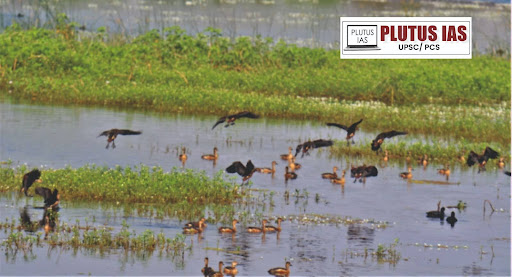
Wetland City Accreditation (WCA)
Origin of the WCA system:
Nature: Voluntary accreditation system recognizing cities that value and conserve wetlands.
Approval: Adopted at COP12 of Ramsar Convention (2015) in Uruguay.
Validity: 6 years, renewable if the city meets specific criteria.
Criteria for Recognition
Demonstrated conservation efforts for urban and peri-urban wetlands.
Integration of wetlands in urban planning and sustainable development.
Awareness campaigns to engage and educate citizens on wetland values.
Policies for wise use of wetland resources.
Monitoring and management to ensure wetland health.
Socio-economic benefits for local communities derived from wetlands.
Significance of WCA
Promotes conservation and wise use of urban/peri-urban wetlands.
Ensures sustainable socio-economic benefits for local populations.
Encourages positive relationships between cities and Wetlands of International Importance.
Supports the Amrit Dharohar Initiative of MoEF&CC.
Wetlands in Indore
Sirpur Lake: Key Facts
Basics:
Location: Situated on Indore-Dhar Road, Indore, Madhya Pradesh.
Ramsar Site Designation: Declared a Ramsar site under the Ramsar Convention on 07 January 2022.
IBA Status (Important Bird Area): Designated as one of 19 Important Bird Areas (IBAs) of Madhya Pradesh by BirdLife International in 2015.
Nature and Characteristics
Type: Human-made wetland stabilized and acquired near-natural characteristics over two centuries.
Commonly known as Pakshi Vihar (Bird Sanctuary).
Lake Features: Shallow, alkaline, and nutrient-rich. Maximum depth: 2 meters during the monsoon season.
Biodiversity:
Plant and Animal Life: 175 terrestrial plant species, 6 macrophytes, 30 fish species (natural and cultured), 8 reptiles and amphibian species.
Birdlife: The area supports 130 bird species (residents and migrants), including threatened species such as the common pochard (Aythya ferina), the Egyptian vulture (Neophron percnopterus), and the Indian river tern (Sterna aurantia).
Significance for Communities
Fisheries.
Medicinal plants.
Buffer against flooding.
Regulation of the local microclimate.
Offers benefits like spiritual enrichment, recreation, and education for local communities.
Indian River Tern: Key Facts
| Aspect | Details |
|---|---|
| Scientific Name | Sterna aurantia |
| Family | Laridae |
| Habitat | Inland rivers, freshwater lakes, tanks; rarely in tidal creeks or coasts. |
| Distribution | From Iran to Indian Subcontinent, Myanmar, and Thailand. |
| Size | Medium-sized, 38–43 cm long. |
| Physical Description | – Breeding Plumage: Dark grey upperparts, white underparts, black cap, yellow bill, red legs. – Non-Breeding Plumage: Greyish-white cap with black streaks, dark mask, dusky bill tip. – Juveniles: Brown head, grey upperparts with brown markings, white underparts, yellowish bill with dark tip. |
| Tail | Forked with long, flexible streamers. |
| Wings | Long and pointed. |
| Breeding Season | March to May. |
| Nesting | – Ground scrape on sandbanks, bare rock, or sand. – Lays 3 greenish-grey to buff eggs with brown blotches and streaks. |
| Feeding Habits | – Diet: Fish, crustaceans, tadpoles, aquatic insects. – Hunting: Plunge-dives into water. |
| Unique Traits | Exclusively found in freshwater habitats, unlike most Sterna terns. |
| Conservation Status | Population declining due to habitat pollution and degradation. |
Wetlands in Udaipur:
| Lake | Highlights | Ecological Importance | Cultural/Recreational Significance |
|---|---|---|---|
| Lake Pichola | – Known for stunning views, especially at sunset. | – Supports a diverse aquatic ecosystem. | – Home to iconic palaces like Jag Mandir and Lake Palace. |
| Lake Fateh Sagar | – Larger, man-made lake surrounded by Aravalli hills. – Contains Nehru Park and a solar observatory. |
– Major source of drinking water for Udaipur. | – Popular boating destination with panoramic views. |
| Lake Rang Sagar | – Calm waters with scenic sunrise and sunset views. | – Supports birdlife and aquatic species. | – A peaceful retreat surrounded by hills. |
| Lake Swaroop Sagar | – Smaller, tranquil lake often overlooked by tourists. | – Supports diverse flora and fauna. | – Offers insight into local life, surrounded by neighborhoods. |
| Lake Doodh Talai | – Primarily used as a water reservoir. | – Supports birdlife, including migratory species. | – Offers scenic greenery, a peaceful atmosphere, and recreational opportunities. |
Prelims Questions:
Q. With reference to the Indian River Tern, Consider the following statement:
1 . Indian River Tern is a type of fish
2. Indian River Tern almost found in the freshwater lakes
3. Indian River Tern is aligned with the summer season in India
4. Indian River Tern is under the critically endangered category of the IUCN.
How many of the above-given statements are correct?
(a). Only one
(b). Only two
(c). Only three
(d). All four
ANSWER: B

- United Nations in the 21st Century: Relevance, Crisis, and Way Forward - September 22, 2025
- Election Commission of India: Strengthening the Democratic Backbone - September 20, 2025
- India’s Renewable Energy Journey: Towards Energy Self-Reliance and Climate Leadership - September 19, 2025

No Comments