


22 Sep United Nations in the 21st Century: Relevance, Crisis, and Way Forward
This article covers “Daily Current Affairs” and Topic details “United Nations in the 21st Century: Relevance, Crisis, and Way Forward”
SYLLABUS MAPPING:
GS-2 – International Relations / Governance – Global Institutions, United Nations, International Cooperation
FOR PRELIMS
What are the six principal organs of the United Nations and their mandates?
FOR MAINS
Discuss the successes and challenges of the United Nations in the last 80 years.
Why in the News?
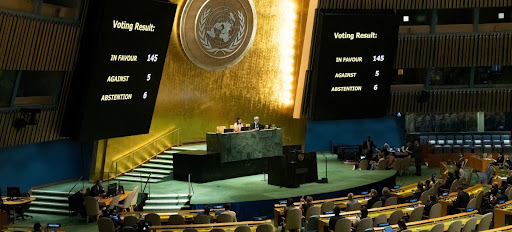
The United Nations General Assembly (UNGA), in its 80th session (September 2025), adopted a resolution allowing Palestinian President Mahmoud Abbas to address the high-level debate via pre-recorded video. This move came after the United States denied visas to Palestine’s delegation on national security grounds. The resolution was passed with 145 votes in favor, 5 against, and 6 abstentions, showcasing once again the UN’s role as a platform where global disputes and representation issues are contested and resolved.
What is the United Nations?
The United Nations was born in 1945, in the aftermath of World War II, with 51 founding members. Its Charter enshrines principles of sovereign equality, peaceful dispute settlement, non-use of force, and collective security. Today, with 193 member states, it is the largest and most universal intergovernmental organization in the world.
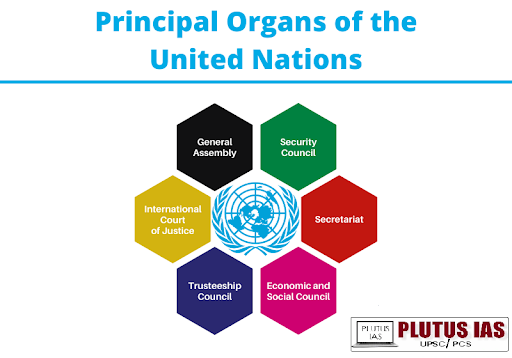
The UN operates through six principal organs, supported by specialized agencies like the World Health Organization (WHO), UNESCO, the International Monetary Fund (IMF), and the World Bank.
Six Principal Organs of the UN
| UN Organ | Mandate / Functions |
|---|---|
| General Assembly (UNGA) | World’s largest deliberative forum; one-country-one-vote principle; passes resolutions, approves budget, and elects members to other organs. |
| Security Council (UNSC) | Ensures global peace and security; 15 members (P5 with veto + 10 elected); can impose sanctions, authorize force, and establish peacekeeping missions. |
| Economic and Social Council (ECOSOC) | Coordinates socio-economic and developmental agendas; supervises agencies like WHO, ILO, FAO. |
| International Court of Justice (ICJ) | Settles disputes between states; advisory role on legal issues; based in The Hague. |
| Secretariat | Administrative arm led by the Secretary-General (currently António Guterres); implements decisions, manages peacekeeping, and produces reports. |
| Trusteeship Council | Created to oversee decolonization and trust territories; suspended operations in 1994 after Palau’s independence. |
Why the UNSC Matters
The UN Security Council is often referred to as the “nerve centre” of the UN system. Its importance lies in:
1. Legally binding powers under the UN Charter.
2. Authorizing interventions in conflicts (e.g., Korean War 1950, Gulf War 1991).
3. Peacekeeping operations (currently over 80,000 peacekeepers deployed in 12 active missions).
4. Nuclear non-proliferation: UNSC resolutions have shaped regimes like the Iran nuclear deal.
5. Global legitimacy: Even major powers seek UNSC backing for interventions, e.g., the US after 9/11.
Achievements of the UN in 80 Years
1. Conflict Prevention & Peacekeeping: Deployed over 70 peacekeeping missions; notable successes in Namibia, Cambodia, and Sierra Leone.
2. Decolonization: Enabled independence of 80+ countries in Asia and Africa.
3. Human Rights: Adoption of the Universal Declaration of Human Rights (1948); establishment of international criminal tribunals for Rwanda and former Yugoslavia.
4. Global Health: Eradication of smallpox; leadership during COVID-19, Ebola, and polio eradication campaigns.
5. Sustainable Development Goals (SDGs): Set a universal development agenda for 2015–2030.
6. Humanitarian Relief: The World Food Programme (WFP) feeds over 150 million people annually; UNHCR protects 43 million refugees.
Present Challenges for the UN
1. Geopolitical Paralysis: Rivalries (US–China, Russia–West) weaken collective decision-making.
2. Veto Deadlock: UNSC often paralysed (e.g., Russia vetoing resolutions on Ukraine).
3. Legitimacy Crisis: Rising voices from the Global South demand more representation.
4. Humanitarian Overstretch: Over 110 million displaced people worldwide strain UN agencies.
5. Funding Gaps: Only 10 countries contribute nearly 70% of the UN’s budget.
6. New Threats: Climate change, cybersecurity, artificial intelligence, and pandemics lack adequate frameworks
Way Forward
1. UNSC Expansion: Permanent seats must include countries like India, Brazil, South Africa, Japan, and an African Union nominee, reflecting multipolar realities.
2. Revitalizing UNGA: Strengthen its resolutions by linking them more effectively to global decision-making and accountability.
3. Financial Sustainability: Move away from dependency on a handful of donors; encourage equitable burden-sharing among all members.
4. Peacekeeping 2.0: Improve training, accountability, and integrate regional organizations (like the African Union) for joint missions.
5. New Mandates for New Challenges: Tackle cyber warfare, artificial intelligence ethics, climate migration, and outer-space governance.
6. Global South Inclusion: Ensure developing nations have greater say in agenda-setting, funding priorities, and leadership roles.
7. Reviving Multilateralism: Promote dialogue and collective problem-solving over unilateralism and bloc politics.
Conclusion
The United Nations, despite flaws, remains the world’s most legitimate multilateral forum. The Palestine episode in the 80th UNGA reaffirmed its role as a global stage for representation and dialogue. In the last 80 years, the UN has prevented global wars, advanced human rights, and coordinated humanitarian relief at unprecedented scales. Unless structural reforms are undertaken—especially in the UN Security Council—its relevance will continue to be questioned. As humanity faces climate emergencies, technological disruptions, and geopolitical fragmentation, the UN must reinvent itself for the 21st century.
Prelims question:
Q. With reference to the United Nations, consider the following statements:
1. The Trusteeship Council ceased to exist after Palau’s independence in 1994.
2. The International Court of Justice is headquartered in The Hague, Netherlands.
3. The UN Security Council is the only organ whose decisions are legally binding on member states.
How many of the above statements are correct?
(a) Only one
(b) Only two
(c) All three
(d) None
ANSWER: B
Mains Question:
Q. India has consistently advocated for reform of the UN system. Discuss India’s contributions to the UN and its case for permanent membership in the UNSC. (250 words)

- United Nations in the 21st Century: Relevance, Crisis, and Way Forward - September 22, 2025
- Election Commission of India: Strengthening the Democratic Backbone - September 20, 2025
- India’s Renewable Energy Journey: Towards Energy Self-Reliance and Climate Leadership - September 19, 2025

No Comments