


20 Sep Election Commission of India: Strengthening the Democratic Backbone
This article covers “Daily Current Affairs” and Topic details “Election Commission of India: Strengthening the Democratic Backbone”
SYLLABUS MAPPING:
GS-2 – Governance / Polity – Electoral Reforms, Election Commission of India
FOR PRELIMS
What are the constitutional provisions of the Election Commission of India?
FOR MAINS
Discuss the role of the Election Commission of India in regulating political parties?
Why in the News?
The Election Commission of India (ECI) has taken a strong step towards cleansing the electoral system. On 18 September 2025, it delisted 474 Registered Unrecognised Political Parties (RUPPs) for non-participation in elections for six consecutive years, in addition to 334 delisted earlier in August 2025. Thus, 808 RUPPs have been removed within two months. Proceedings have also begun against 359 RUPPs for failing to file mandatory financial reports. This is part of ECI’s sustained drive to enhance transparency, accountability, and integrity in electoral democracy.
Constitutional and Legal Framework
| Provision | Significance |
|---|---|
| Article 324 | Empowers the Election Commission of India (ECI) with superintendence, direction, and control over elections. |
| Article 325 | No person shall be ineligible for inclusion in electoral rolls on grounds of religion, race, caste, or sex. |
| Article 326 | Elections are based on universal adult suffrage. |
| Articles 327–329 | Enable Parliament and State Legislatures to regulate elections through law. |
| Section 29A, RPA 1951 | Governs registration of political parties. |
| Model Code of Conduct (MCC) | Set of guidelines for free and fair elections, though not legally binding. |
Structure of the Election Commission
- Composition: Chief Election Commissioner (CEC) + other Election Commissioners (currently 2).
- Appointment: Made by the President under Article 324.
- Tenure: 6 years or till age 65, whichever is earlier.
- Independence: CEC can only be removed by impeachment-like process (same as SC judges); other ECs can be removed on CEC’s recommendation.
Classification of Political Parties by ECI
| Category | Recognition Criteria | Privileges | Examples (as of 2023) |
|---|---|---|---|
| National Party | – 6% vote share in 4 or more states & 4 Lok Sabha seats OR– Recognised as state party in 4 states | Reserved symbol across India, free airtime, consultation in MCC | BJP, INC, CPI(M), BSP, AAP, TMC, NCP |
| State Party | – 6% vote share in the state & 2 assembly seats OR– 3% of assembly seats | Reserved symbol in that state, free airtime | DMK (TN), BJD (Odisha), JD(U) (Bihar), TRS/BRS (Telangana) |
| RUPPs | Registered but fail to meet recognition norms | Eligible to contest elections but no reserved symbol, no free airtime | Thousands of inactive/small parties |
Powers and Functions of the Election Commission of India
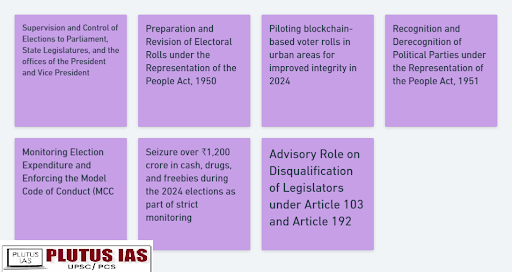
1. Conduct of Free and Fair Elections: The ECI oversees elections to Parliament, State Assemblies, and the offices of the President and Vice President. Its authority spans from scheduling to supervising polls and declaring results, ensuring smooth transitions of power.
2. Preparation and Revision of Electoral Rolls: It prepares, updates, and revises electoral rolls to guarantee universal adult suffrage under Article 326.
3. Recognition and Regulation of Political Parties: The ECI registers political parties under Section 29A of the RPA, 1951, and classifies them as national or state parties.
4. Monitoring Election Expenditure: The ECI sets expenditure limits for candidates and mandates transparent reporting of expenses. It uses mechanisms like flying squads, video monitoring, and digital tracking to curb black money in elections.
5. Electoral Awareness and Voter Education: Through programmes like SVEEP, it spreads awareness about voting rights, ethical participation, and informed decision-making.
Recent Initiatives of the Election Commission of India
1. Delisting of Inactive Political Parties: In 2025 alone, the ECI delisted 808 RUPPs that failed to contest elections or submit audited accounts. This step not only clears the clutter of non-serious parties but also curbs the misuse of registration benefits such as tax exemptions.
2. Introduction of e-EPIC (Electronic Electoral Photo ID Card): The e-EPIC is a portable digital voter identity card launched in 2021. Voters can download it on their smartphones, reducing dependency on physical cards and making the system more efficient.
3. VVPAT-Based Verification: To enhance voter confidence, the Commission introduced Voter Verifiable Paper Audit Trail (VVPAT) across all constituencies in 2019. It allows voters to verify their vote on a printed slip, bridging the trust gap between citizens and EVMs.
4. cVIGIL App: A mobile application enabling citizens to instantly report election malpractices like cash-for-votes, distribution of freebies, or hate speeches.
5. Accessibility Measures: The ECI has made polling stations accessible for persons with disabilities (PwDs) by providing wheelchairs, ramps, and Braille-enabled EVMs. Postal ballots have been extended to senior citizens (above 80 years) and PwDs.
Key Issues and Challenges
| Challenge | Illustration / Fact |
|---|---|
| Proliferation of RUPPs | Used for money laundering & tax evasion; many parties remain inactive. |
| Opaque Political Funding | Electoral Bonds (introduced 2017) criticised for anonymity of donors. |
| Perception of Bias | Opposition alleges leniency towards ruling party in enforcement of MCC violations. |
| Election Freebies & Populism | Supreme Court (2022) flagged risks to the fiscal health of states. |
| Digital Threats | Fake news, deepfakes, AI-manipulated content affecting voters’ perception. |
| Criminalisation of Politics | ADR data: 43% of MPs in Lok Sabha 2019 faced criminal cases. |
| Voter Apathy in Urban Areas | Mumbai turnout in LS 2019: ~55% vs national average of ~67%. |
Way Forward
1. Transparent Funding – Scrap anonymous Electoral Bonds; ensure full donor disclosure.
2. State Funding of Elections – Reduce black money influence.
3. Collegium-based Appointments – Strengthen independence post-SC 2023 ruling.
4. Digital Safeguards – AI-driven tools to counter fake news & deepfakes.
5. Penalties for Defaulting Parties – Stricter enforcement of audited accounts.
6. Regulation of Freebies – Clear framework to balance welfare with fiscal prudence.
7. Compulsory Inner-Party Democracy – Regular internal elections, transparent candidate selection.
8. Boost Urban & Youth Participation – Incentives, online voting pilots, campus campaigns.
Conclusion
The Election Commission of India has been the cornerstone of the electoral process, safeguarding the principles of free and fair elections for over seven decades. Its proactive steps—such as delisting inactive parties and enforcing financial transparency—show its commitment to cleaning up the political space.
However, persistent issues like the influence of money and muscle power, electoral malpractice, and political pressures highlight the need for greater autonomy, transparency, and reforms. Strengthening the ECI institutionally, embracing technology responsibly, and enhancing public trust will be critical to ensuring that India’s democracy remains vibrant, inclusive, and resilient in the years to come.
Prelims question:
Q. With reference to the Election Commission of India (ECI), consider the following statements:
1.The Election Commission of India is a multi-member body under Article 324 of the Constitution.
2.It registers political parties under Section 29A of the Representation of the People Act, 1951.
3. Its recommendations on disqualification of legislators are advisory and not binding on the President or Governor.
How many of the above statements are correct?
(a) Only one
(b) Only two
(c) All three
(d) None
ANSWER: B
Mains Question:
Q. “Discuss the role of the Election Commission of India in regulating political parties and ensuring transparency in the electoral process.” (250 words)

- United Nations in the 21st Century: Relevance, Crisis, and Way Forward - September 22, 2025
- Election Commission of India: Strengthening the Democratic Backbone - September 20, 2025
- India’s Renewable Energy Journey: Towards Energy Self-Reliance and Climate Leadership - September 19, 2025

No Comments