


15 Feb Saint Ravidas: The Mystic Poet-Saint of the Bhakti Movement
This article covers “Daily Current Affairs,” and the topic details related to Saint Ravidas: The Mystic Poet-Saint of the Bhakti Movement.
Syllabus mapping:
GS-1: Indian culture: Bhakti movement and its significance.
For Prelims:
Key literary work of the Saint Ravidas. Difference between Suguna and Nirguna Bhakti.
For Mains:
The Bhakti movement, its phases, important spiritual leaders, and their literary work.
Why in the News?
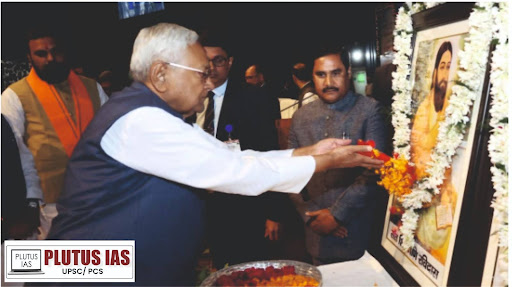
The birth anniversary of Bhagat Ravidas, a prominent poet-saint of the Bhakti movement, was celebrated with religious fervor. The Shiromani Gurdwara Parbandhak Committee (SGPC) organized special events to honour his contributions to spirituality and social reform. His teachings on equality, devotion, and social harmony continue to inspire millions across the Indian subcontinent.
Saint Ravidas
Ravidas, also known as Raidas, was a revered Indian mystic poet-saint of the Bhakti movement during the 15th to 16th century CE. Venerated as a guru in multiple regions, including Uttar Pradesh, Bihar, Rajasthan, Gujarat, Maharashtra, Madhya Pradesh, Punjab, and Haryana, he was a poet, social reformer, and spiritual figure. His teachings emphasised the removal of caste and gender divisions and promoted unity in spiritual pursuit.
Life and Teachings:
Ravidas was born in Sir Gobardhanpur, near Varanasi, in present-day Uttar Pradesh. His birthplace is now known as Shri Guru Ravidass Janam Asthan.
His mother was Mata Kalsi, and his father was Santokh Dass, belonging to a leather-working Chamar community.
Originally engaged in leatherwork, he later devoted himself to spiritual pursuits, spending time with Sufi saints, sadhus, and ascetics.
Married to Lona Devi, Ravidas had a son, Vijay Dass.
His teachings emphasized the idea of a formless divine (nirguna bhakti), rejected idol worship, and promoted equality.
Literary Works:
The Adi Granth and the Panchvani of the Hindu warrior-ascetic group Dadupanthi are the two oldest attested sources of Ravidas’s literary works.
The Adi Granth includes 41 of Ravidas’s poems, making him one of thirty-six contributors to this foremost canonical scripture of Sikhism.
His poetry addresses issues such as social justice, the nature of a just state, dispassion, and the true essence of a yogi.
Some poems attributed to Ravidas were likely composed by later poets as acts of reverence, reflecting the broader Bhakti tradition.
Philosophy of Saint Ravidas:
Ravidas’ hagiographies illustrate his struggle against rigid social structures and orthodox Brahminical traditions.
His teachings emphasise equality, unity, and devotion beyond caste and religious divisions.
His poetry and legends often depict a challenge to both Hindu and Islamic authorities of his time.
Many miracles are attributed to him, such as making a stone float on water and reversing the flow of the Ganges, symbolising divine intervention in his spiritual journey.
Scholars note that poetry attributed to Ravidas from the 17th to the 20th century carries a strong anti-Brahminical and anti-communal theme, reflecting the socio-political struggles of marginalised groups under Islamic and colonial rule.
Contribution to the Bhakti Movement:
Ravidas played a crucial role in shaping the Bhakti movement, emphasising devotion (bhakti) as the path to salvation.
He rejected caste-based discrimination and advocated for spiritual equality.
His teachings focused on a formless divine (nirguna bhakti), similar to other Bhakti saints like Kabir and Nanak.
He composed devotional hymns that spread the message of love, compassion, and unity.
His spiritual influence attracted followers across different social and religious backgrounds.
He emphasised ethical living and selfless service as the true essence of devotion.
His Concept of Begumpura (a city without sorrow) envisioned an ideal society free from social hierarchies and injustice.
Ravidas’ teachings were included in Sikh scripture, influencing Sikhism and other religious traditions.
Spiritual and Social Impact:
He was traditionally considered a disciple of Ramananda and a contemporary of Kabir.
Ravidas’ fame grew, and even Brahmins revered him for his spiritual wisdom.
He travelled extensively across India, visiting pilgrimage sites and spreading his teachings.
He played a crucial role in social reform, advocating for an egalitarian society free from caste-based discrimination.
The Ravidassia religious movement considers him a central figure, continuing his legacy.
The Concept of Begumpura:
The Concept of Begumpura was proposed by Sant Ravidas, a prominent Bhakti saint. Through his poetry, he envisioned Begumpura as a utopian city free from suffering, sorrow, and social discrimination. In his couplets, he described it as a land of equality and bliss, where no one experiences pain or injustice:
“Begampura sahar ko naao, dukhu-andoohu nahi tahi thaao”
(Translation: “Begumpura is the name of the city, where there is no suffering or sorrow.”) This idea reflected Ravidas’ vision of a casteless and oppression-free society, aligning with his broader teachings on social equality and spiritual liberation.
Legacy:
Ravidas is revered as a saint and a religious reformer who stood against social injustice.
The Ravidassia religion emerged as a distinct religious movement in the 21st century, focusing exclusively on the teachings of Ravidas.
Ravidassias give utmost respect to Guru Granth Sahib but consider Guru Ravidas as their supreme spiritual guide.
The Amritbani Guru Ravidass Ji, a holy scripture compiled by Ravidassia followers, contains 240 hymns based solely on Ravidas’ teachings.
The movement gained momentum after the 2009 attack on a Ravidassia temple in Vienna, leading to its formal separation from Sikhism.
Niranjan Dass is the head of Dera Sachkhand Ballan, an important spiritual center for Ravidassias.
The movement reflects the aspiration of marginalised communities, particularly the Chamars, to establish their independent religious identity.
Notable places of worship include Guru Ravidass temples in Bedford (UK), Nasinu (Fiji), Birmingham (UK), and Pittsburg (California, USA).
Kathryn Lum notes that Ravidassia followers emphasise self-identity and independence, aiming for social upliftment beyond Sikhism.
Download Plutus IAS Current Affairs (Eng) 15th Feb 2025
Conclusion:
Ravidas’ life and works significantly impacted the Bhakti movement, inspiring devotion beyond social barriers. His emphasis on equality, devotion, and inner spirituality continues to resonate in various religious traditions today. His poetry and teachings remain a guiding force for those seeking spiritual enlightenment and social harmony.
Comparison Between Saguna Bhakti and Nirguna Bhakti
| Features | Saguna Bhakti | Nirguna Bhakti |
|---|---|---|
| Origin | Emerged as a response to the need for personal devotion to deities with attributes | Developed as a movement emphasizing formless devotion and inner spirituality |
| Key Features | Worship of a deity with form (e.g., Vishnu, Shiva, Devi, Krishna, Rama) | Devotion to a formless, attributeless divine (Brahman) |
| Regions | More prevalent in North and South India (e.g., Tamil Nadu, Karnataka, Maharashtra) | Spread across North India, especially in Uttar Pradesh, Punjab, and Rajasthan |
| Spiritual Leaders | Prominent leaders include Ramanuja, Tulsidas, Mirabai, Surdas, and Chaitanya Mahaprabhu. | Leaders include Kabir, Ravidas, Nanak, Dadu Dayal, and Sant Eknath |
| Scriptural Basis | Relies on epics like Ramayana, Bhagavata Purana, and Puranic texts | Rooted in Upanishads, Sufi influences, and Sant poetry |
| Mode of Worship | Idol worship, temple rituals, bhajans, and kirtans | Meditation, naam-simran (chanting), inner realization, and simple devotion |
| View on Caste and Social Hierarchy | Some sects followed caste distinctions; however, Bhakti saints tried to soften rigid caste divisions. | Strongly opposed casteism, ritualism, and priestly authority |
| Philosophical Influence | Based on Advaita (non-dualism), Vishishtadvaita (qualified non-dualism), and Dvaita (dualism) philosophies | Strongly influenced by Nirguna Brahman concept from Vedanta and Sufism |
| Gender Inclusivity | Prominent female saints like Mirabai contributed, but temple access remained restricted for many lower castes and women. | More inclusive, with women and lower-caste individuals gaining recognition as spiritual seekers |
| Impact on Society | Strengthened traditional Hinduism, encouraged devotional practices, and popularized bhakti through temple culture | Advocated social reforms, caste, and religious harmony, and challenged rigid Brahmanical traditions |
| Concept of Liberation (Moksha) | Liberation through devotion (bhakti) and grace of the deity | Liberation through self-realization and merging with the formless divine |
Prelims Question:
Q. Which Bhakti saint proposed the Concept of “Begumpura”?
A) Kabir
B) Ravidas
C) Mirabai
D) Tulsidas
Answer: B) Ravidas
Mains question:
Q. Compare and Contrast the Saguna Bhakit and Nirguna Bhakti and their profound impact on medieval social life.
(Answer in 150 words)

- United Nations in the 21st Century: Relevance, Crisis, and Way Forward - September 22, 2025
- Election Commission of India: Strengthening the Democratic Backbone - September 20, 2025
- India’s Renewable Energy Journey: Towards Energy Self-Reliance and Climate Leadership - September 19, 2025

No Comments