


18 Sep Swasth Nari, Sashakt Bharat: Transforming Women’s Health for Viksit India
This article covers “Daily Current Affairs” and Topic details “Swasth Nari, Sashakt Bharat: Transforming Women’s Health for Viksit India”
SYLLABUS MAPPING:
GS-2 – Governance & Social Justice – Health, Women and Child Development, Government Schemes
FOR PRELIMS
What are the key objectives and components of the Swasth Nari Sashakt Parivar Abhiyaan (SNSPA)?
FOR MAINS
Examine the significance of the Swasth Nari Sashakt Parivar Abhiyaan in improving women’s health and family well-being in India. What challenges might hinder its effective implementation, and how can they be addressed?
Why in the News?
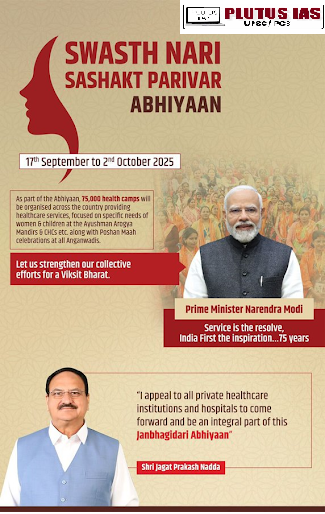
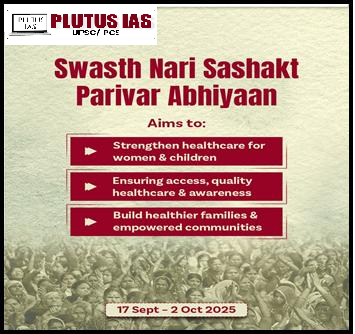
On September 17, 2025, Prime Minister Narendra Modi will inaugurate the Swasth Nari Sashakt Parivar Abhiyaan (SNSPA), a nation-wide women-centric health campaign. Running until October 2, 2025, the initiative is described as the largest ever women’s health outreach in India, with over 1 lakh health camps planned across Ayushman Arogya Mandirs and Community Health Centres.
- Aligns with the Prime Minister’s 75th birthday celebrations and vision of Jan Bhagidaari (people’s participation).
- Aims to integrate women’s health with family well-being, while linking to Mission Shakti and Poshan 2.0.
- Supported by SASHAKT portal for real-time monitoring, ensuring transparency and accountability.
Role of women in the family
| Dimension | Role | Example |
|---|---|---|
| Economic | 1. Contribute to household income through formal & informal work | Kudumbashree SHG women in Kerala running micro-enterprises |
| 2. Manage resources, savings, and family finances | Women’s cooperatives using microfinance for household resilience | |
| Social | 1. Ensure health & nutrition of children and elders | POSHAN Abhiyaan mothers tackling malnutrition |
| 2. Provide education, values, and discipline to children | Higher school enrolment in Kerala linked to literate mothers | |
| Cultural | 1. Preserve traditions, festivals, and rituals | Rajasthani women maintaining folk songs and customs |
| 2. Promote language, crafts, and arts | Assamese women sustaining weaving traditions | |
| Political | 1. Participate in decision-making via Panchayati Raj | Women sarpanches improving sanitation & water facilities |
| 2. Advocate for family welfare policies | Women MPs supporting maternal health & domestic violence laws | |
| Security | 1. Provide emotional and social stability in crises | Women supporting families during COVID-19 pandemic |
| 2. Ensure household & community safety | Women disaster groups in Odisha ensuring safety during cyclones |
Government policy and initiatives
| Domain | Initiatives / Mechanisms | Examples / Data / Policy Measures |
|---|---|---|
| Health | 1. POSHAN Abhiyaan (2018) – National Nutrition Mission to reduce stunting, undernutrition, anaemia among women & children | Target: reduce stunting to 25% by 2022; Institutional mechanism: MoWCD with convergence of health, sanitation, and women groups |
| 2. Pradhan Mantri Surakshit Matritva Abhiyan (PMSMA, 2016) – free antenatal care on 9th of every month for pregnant women | As of 2023, 3.6 crore women benefited; Institutional mechanism: MoHFW & NITI Aayog | |
| Education | 1. Beti Bachao Beti Padhao (2015) – awareness + education drive | Female Gross Enrolment Ratio in higher education rose to 28.5% (2021); Convergence: MoWCD + Education + Health ministries |
| 2. Samagra Shiksha Abhiyan (2018) – integrated scheme for school education ensuring girls’ retention | Incentives like free uniforms, bicycles for girls; Institutional mechanism: Department of School Education & Literacy | |
| Security | 1. Nirbhaya Fund (2013) – for women’s safety projects like safe transport, CCTVs, emergency response | Example: 112 Emergency Helpline launched under MHA; Institutional mechanism: Ministry of Home Affairs, MoWCD |
| 2. One Stop Centres (2015) – integrated support (legal, police, counselling, shelter) for women in distress | Over 1100 centres operational as of 2024; Policy measure under “Mission Shakti” | |
| Representation | 1. 33% Reservation in Panchayati Raj (1992, 73rd & 74th Amendments) | Over 14 lakh women representatives in Panchayats (43% of total seats) – largest in the world |
| 2. Women’s Reservation Bill (Nari Shakti Vandan Adhiniyam, 2023) – 33% reservation in Lok Sabha & State Assemblies | Constitutional amendment; To be implemented post-2026 delimitation | |
| Employment | 1. Stand-Up India Scheme (2016) – loans for women entrepreneurs | By 2023, over 1.5 lakh women entrepreneurs benefited; Institutional mechanism: SIDBI, banks |
| 2. Mahila E-Haat & Skill India initiatives – online marketplace & vocational training for women | Over 20 lakh women linked; Institutional mechanism: MoWCD & Ministry of Skill Development |
Additional Institutional Mechanisms
1. National Commission for Women (NCW, 1992) – statutory body for grievance redressal and policy advocacy.
2. Mission Shakti (2022) – umbrella scheme for women’s safety, security, empowerment (Samarthya & Sambal components).
3. Ministry of Women & Child Development (MoWCD) – nodal ministry for women-centric policies.
4. Janani Suraksha Yojana (JSY, 2005) – conditional cash transfer for institutional deliveries.
5. Labour Codes 2020 – provisions for maternity leave, crèche facilities, and equal wages.
Issues and Constraints Faced by Women
| Domain | Issues & Constraints | Examples / Data |
|---|---|---|
| Health | • Limited access to quality maternal healthcare in rural/tribal areas. • High levels of anaemia and malnutrition persist. | • NFHS-5 (2019-21): 57% of women aged 15–49 are anaemic. • In Bihar, UP, MP, institutional delivery gaps remain despite PMSMA. |
| Education | • Early marriage and dropouts reduce girls’ higher education prospects. • Gendered digital divide limits access to online education. | • AISHE 2022-23: Female Gross Enrolment Ratio in higher education = 27.9%, lower than men. • Rural girls’ dropout rate higher at secondary level due to safety & household responsibilities. |
| Employment / Economy | • Wage gap & concentration in informal/unpaid labour. • Care burden restricts participation in formal sector. | • PLFS 2023-24: Female LFPR = 31.7% vs men’s ~77%. • Women earn on avg. 30% less than men in formal jobs (ILO 2023). |
| Representation (Political / Decision-making) | • Under-representation in legislatures despite 33% reservation in local bodies. • Patriarchal norms & tokenism in leadership roles. | • 2024 Lok Sabha elections: Women MPs ~13.8% of House. • Many local women representatives face “proxy” control by male relatives. |
| Security | • Rising cyber-crimes, stalking, and harassment. • Underreporting due to stigma & fear of retaliation. | • NCRB 2023: 4.45 lakh crimes against women registered, 4% rise over 2022. • Cybercrime against women (morphing, blackmail) up 19% in 2023. |
Way Forward
| Domain | Way Forward (as per Committees / Experts) | Examples / Supporting Evidence |
|---|---|---|
| Health | • NITI Aayog (Strategy @75): Strengthen preventive care, universal screening for NCDs, expand digital health. • WHO Expert Papers: Integrate maternal health with mental health & nutrition. | • Tamil Nadu model: Maternity hospitals + nutrition counselling reduced MMR. • Ayushman Bharat Digital Mission (ABHA) expanding e-health services. |
| Education | • NEP 2020: Emphasize gender inclusion funds, STEM scholarships for girls, digital literacy. • Kothari Commission: Education as instrument for social equality – invest in girl’s secondary education. | • Kanyashree Prakalpa (West Bengal): Conditional cash transfers reduced girl child marriage & improved school retention. • Beti Bachao Beti Padhao: Raised awareness, female enrolment improving. |
| Employment / Economy | • ILO Expert Reports (2023): Expand childcare, enforce equal pay, formalize women’s informal work. • Economic Survey 2021-22: Promote women’s entrepreneurship through credit, skill training, market linkages. | • SHGs: Over 9 crore women under DAY-NRLM, improving credit access. • Kerala Kudumbashree model: Women-led cooperative enterprises successful. |
| Representation (Political / Decision-making) | • Law Commission (170th Report) & Parliamentary Standing Committees: Implement 33% women’s reservation in legislatures. • NCW: Capacity-building & training for women leaders to avoid tokenism. | • Panchayati Raj: 43% women in local bodies (2024), with many successful sarpanches in Rajasthan & Bihar. • Nari Shakti Vandan Adhiniyam (2023) ensures future representation in Parliament. |
| Security | • Justice Verma Committee (2013): Strengthen police reforms, fast-track courts, gender-sensitisation of judiciary. • UN Women 2022 paper: Focus on cyber safety, safe mobility, and workplace harassment mechanisms. | • One Stop Centres: 1100+ functional providing integrated legal/medical aid. • Safe City Project (Delhi, Mumbai, Hyderabad) under Nirbhaya Fund improving surveillance & women’s safety. |
Conclusion
As India marches towards Amrit Kaal with the vision of becoming a developed nation by 2047, empowering women is not just a social imperative but a civilisational necessity. From nurturing families to leading Panchayats, from contributing to the economy to serving in defence forces, Indian women have consistently proven to be the torchbearers of resilience, innovation, and compassion.
Prelims question:
Q. With reference to the Integrated Child Development Services (ICDS) Scheme, consider the following statements:
1. It provides supplementary nutrition, health check-ups, and pre-school education to
2. children below 6 years of age.
3. Anganwadi centres serve as the focal point for the delivery of ICDS services.
4. The scheme is implemented by the Ministry of Health and Family Welfare.
How many of the statements given above are correct?
(a) Only one
(b) Only two
(c) All three
(d) None
ANSWER: B
Mains Question:
Q. “In the era of globalization, the role of women in strengthening families has undergone a significant transformation.” Discuss the evolving economic, social, cultural, and emotional contributions of women in the family and their impact on society.
(250 words)

- United Nations in the 21st Century: Relevance, Crisis, and Way Forward - September 22, 2025
- Election Commission of India: Strengthening the Democratic Backbone - September 20, 2025
- India’s Renewable Energy Journey: Towards Energy Self-Reliance and Climate Leadership - September 19, 2025

No Comments