


19 Sep India’s Renewable Energy Journey: Towards Energy Self-Reliance and Climate Leadership
This article covers “Daily Current Affairs” and Topic details “India’s Renewable Energy Journey: Towards Energy Self-Reliance and Climate Leadership”
SYLLABUS MAPPING:
GS-3 – Science & Technology / Environment – Renewable Energy: Policies, Initiatives, and Challenges
FOR PRELIMS
What are the key practices promoted under sustainable agriculture in India?
FOR MAINS
What are the major renewable energy sources in India and their share in the national energy mix?
Why in the News?
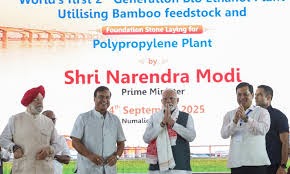
On 14th September 2025, Prime Minister Narendra Modi inaugurated the Assam Bioethanol Plant and laid the foundation stone for a Polypropylene Plant at Numaligarh Refinery Limited (NRL), Golaghat, Assam. These projects, worth over ₹18,000 crore, aim to strengthen India’s clean energy infrastructure, reduce dependence on fossil fuels, and create local employment opportunities.
The Bioethanol Plant is particularly significant as it uses bamboo as a raw material, benefiting tribal farmers of Assam. Alongside this, the Semiconductor Mission in Morigaon (₹27,000 crore investment) further highlights Assam’s rising role in India’s march towards self-reliance in energy and technology.
India’s Renewable Energy Basket
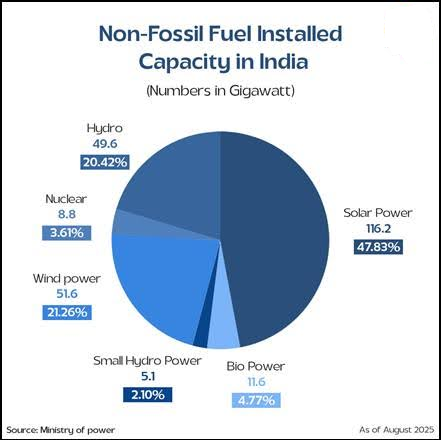
Installed Capacity (as of mid-2025)
| Source of Energy | Installed Capacity (approx.) | Share in India’s Renewable Mix | Key Features |
|---|---|---|---|
| Solar Power | ~116 GW | ~47% | Fastest-growing sector; Rajasthan, Gujarat, Karnataka leading; large solar parks + rooftop initiatives. |
| Wind Power | ~51 GW | ~21% | Concentrated in Tamil Nadu, Gujarat, Maharashtra; India is 4th globally in wind energy. |
| Hydropower (Large) | ~49 GW | ~20% | Provides base-load stability; Arunachal Pradesh, Himachal Pradesh, Uttarakhand key contributors. |
| Biomass & Waste-to-Energy | ~11 GW | ~5% | Includes bagasse cogeneration, rice husk plants, bamboo-based ethanol (Assam), urban waste-to-energy projects. |
| Small Hydro | ~5 GW | ~3% | Provides rural electrification; eco-friendly alternatives in hill states. |
The Domestic Policy Push
1. National Solar Mission (2010): Expanded solar power from <3 GW in 2014 to 82 GW in 2025. Rajasthan, Gujarat, and Karnataka are leading contributors.
2. National Wind-Solar Hybrid Policy (2018): Encourages projects combining wind and solar to ensure grid stability.
3.National Bio-Energy Mission: Focuses on biomass, bagasse cogeneration, and waste-to-energy plants.
4. Ethanol Blending Programme (EBP): Target of 20% ethanol blending by 2025, achieved partly through bamboo-based ethanol in Assam.
5. National Hydrogen Mission (2021): Target of 5 MMT green hydrogen per annum by 2030, with Gujarat and Rajasthan emerging as hydrogen hubs.
6. National Green Ammonia Mission (2023): To decarbonize fertilizer and chemical industries.
7. National Deepwater Exploration Mission (2025): “Samudra Manthan” initiative to explore offshore hydrocarbon reserves.
8. Production Linked Incentive (PLI) Scheme: For solar PV manufacturing and battery storage.
International Commitments & Global Role
1. Paris Agreement (2015): Reduce emissions intensity of GDP by 45% by 2030 (2005 baseline).
2. International Solar Alliance (ISA): India-led coalition of 120+ countries, headquartered in Gurugram.
3. Global Biofuel Alliance (2023): Joint effort by India, Brazil, and the USA.
4. Clean Energy Ministerial & Mission Innovation: India pushing global R&D partnerships.
5. G20 Presidency (2023): India placed clean energy transition as a priority agenda.
State-wise Leaders in Renewable Energy
| State | Leading Resource | Capacity Highlights |
|---|---|---|
| Rajasthan | Solar | >18 GW (largest in India) |
| Tamil Nadu | Wind | ~9 GW |
| Karnataka | Total RE mix | >16 GW across solar & wind |
| Maharashtra | Biomass & sugarcane bagasse | ~2 GW |
| Assam & NE states | Biomass & hydropower | Bamboo-based ethanol, small hydro projects |
Issues and Constraints
Economic
1. High upfront capital costs.
2. Financing gaps despite green bond market growth.
3. Distribution companies (DISCOMs) struggling with losses delay payments to RE developers.
Social
1. Land acquisition disputes for solar parks (e.g., Pavagada, Karnataka).
2. Concerns of displacement in hydropower projects.
3. Low awareness in rural areas about rooftop solar & biogas.
Environmental
1. Hydropower projects alter river ecosystems.
2. Disposal of solar PV panels poses future e-waste risks.
3. Biomass over-extraction risks local ecology.
Technological
1. Grid intermittency with solar & wind.
2. Lack of large-scale storage solutions.
3. Dependence on imported solar modules (despite PLI schemes).
Way Forward
1. Diversification & Decentralisation: Strengthen rooftop solar, small hydro, and local bioenergy to reduce transmission losses.
2. Green Finance & Innovation: Expand climate finance, sovereign green bonds, and tie-ups with multilateral banks.
3. Circular Economy: Build recycling capacity for solar PV, batteries, and e-waste.
4. Hydrogen & Ammonia: Position India as an export hub for green hydrogen-based fuels.
5. Rural Linkages: Encourage bamboo, jatropha, and agri-residue based projects for rural income.
6. Regional Partnerships: Link with ASEAN & BIMSTEC on energy corridors.
7. Skill Development: Train local youth in renewable tech maintenance and manufacturing.
Conclusion
India’s renewable energy journey is both an economic necessity and a civilizational responsibility. As the country enters its Amrit Kaal (2022–2047), clean energy becomes central to achieving the Panch Pran of national development. Renewable energy reduces dependence on fossil fuel imports, drives industrial growth, and integrates India’s traditional strengths—like bamboo-based ethanol in Assam—with modern innovations such as hydrogen and ammonia. It also reflects unity in diversity by linking solar-rich western states, wind corridors of the south, hydropower in the Himalayas, and bio-energy in the North-East into one national mission.
Prelims question:
Q. With reference to India’s renewable energy sector, consider the following statements:
1. India is a founding member of the International Solar Alliance (ISA).
2. The Global Biofuel Alliance was jointly launched by India, Brazil, and the USA.
3. The target of achieving 500 GW of non-fossil fuel capacity by 2030 was announced by India at COP26 in Glasgow.
How many of the above statements are correct?
(a) Only one
(b) Only two
(c) All three
(d) None
ANSWER: C
Mains Question:
Q. “Renewable energy is not only about climate action, but also about economic resilience and inclusive development.” Analyse this statement in the light of India’s Panch Pran and Amrit Kaal vision for a Viksit Bharat by 2047. (250 words)

- United Nations in the 21st Century: Relevance, Crisis, and Way Forward - September 22, 2025
- Election Commission of India: Strengthening the Democratic Backbone - September 20, 2025
- India’s Renewable Energy Journey: Towards Energy Self-Reliance and Climate Leadership - September 19, 2025

No Comments