


23 Sep E-Governance: Transforming Governance in the Digital Era
This article covers “Daily Current Affairs” and Topic details E-Governance: Transforming Governance in the Digital Era
SYLLABUS MAPPING
GS–2 – Governance – E-Governance: Applications, Models, Successes, Limitations, and Potential
FOR PRELIMS
What are the key objectives of the Digital India Mission?
FOR MAINS
Discuss the progress of e-governance initiatives in India and highlight the major challenges in their effective implementation.
Why in the News?
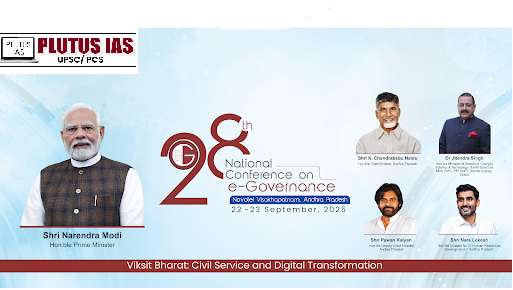
The 28th National Conference on e-Governance (NCeG) 2025 began on September 22, 2025, in Visakhapatnam, Andhra Pradesh, with the theme “Viksit Bharat: Civil Service and Digital Transformation.” The event, jointly organized by the Department of Administrative Reforms & Public Grievances (DARPG), the Ministry of Electronics & Information Technology (MeitY), and the Andhra Pradesh government, aims to showcase best practices, innovations, and strategies in e-governance. The conference will also confer National Awards for e-Governance 2025 across six categories to recognize exemplary initiatives at different governance levels.
What is E-Governance?
E-Governance means the use of Information and Communication Technology (ICT) in government functioning to improve service delivery, transparency, efficiency, and citizen participation.
It covers:
- G2C (Government to Citizen): e.g., UMANG App, DigiLocker.
- G2B (Government to Business): e.g., MCA21 Portal, GSTN.
- G2E (Government to Employee): e.g., e-Office.
- G2G (Government to Government): e.g., CPGRAMS grievance redressal.
The World Bank (2023) ranked India 10th globally in the UN e-Government Development Index (EGDI), showing significant progress in ICT adoption.
Government Progress in E-Governance
| Initiative | Objective | Achievements |
|---|---|---|
| Digital India Mission (2015) | Transform India into a digitally empowered society. | Over 35 crore Jan Dhan accounts linked with Aadhaar & mobiles. |
| Aadhaar | Unique biometric ID for authentication & DBT. | 1.35 billion Aadhaar cards issued; savings of ₹2.25 lakh crore by removing duplicates (UIDAI, 2024). |
| DigiLocker & UMANG | Secure cloud storage and single service access. | Over 21 crore registered DigiLocker users with 7.5 billion documents issued. |
| CoWIN & Aarogya Setu | Pandemic-related digital platforms. | 200+ crore vaccine doses administered through CoWIN. |
| GSTN (Goods & Services Tax Network) | Unified tax compliance and filing platform. | Over 1.4 crore businesses registered. |
| e-NAM (National Agricultural Market) | Online trading platform for farmers. | Connected 1,260+ mandis across 22 states/UTs. |
Model Initiatives and Success Stories
- Bhoomi Project (Karnataka): Computerization of land records—reduced middlemen and corruption.
- Passport Seva Project: Turnaround time reduced to just 3–7 days in many cities.
- e-Courts Mission Mode Project: Online access to 20 crore case records; 98% district courts computerised.
- Digital Andhra Pradesh: Use of Real-Time Governance Society (RTGS) and blockchain-based land records as a state model.
- Aadhaar Enabled Payment System (AePS): Enabled last-mile financial inclusion—over 500 crore transactions annually.
Limitations of E-Governance
1. Digital Divide: According to TRAI (2024), rural internet penetration is 44%, compared to 72% in urban areas.
2. Cybersecurity Risks: India witnessed over 13 lakh cybersecurity incidents in 2022 (CERT-In report).
3. Data Privacy Concerns: The lack of robust data protection laws (though the Digital Personal Data Protection Act, 2023 is a start).
4. Capacity & Awareness Gaps: Only 38% of rural households have digital literacy (NSSO data).
5. Infrastructure Constraints: Patchy electricity and low bandwidth in remote tribal and hilly regions.
6. Resistance to Change: Bureaucratic inertia and lack of interoperability across platforms.
Way Forward
1. Bridging Digital Divide: Expansion of BharatNet to provide optical fibre connectivity to all 2.5 lakh Gram Panchayats.
2. Cybersecurity & Data Protection: Strengthen CERT-In, implement DPDP Act effectively, and build resilient infrastructure.
3. Capacity Building: Training of over 20 lakh civil servants under Mission Karmayogi with digital skills.
4. Integration & Interoperability: Development of single-window citizen platforms across states.
5. Use of Emerging Technologies: AI for predictive governance, Blockchain for transparent land and supply chain records, IoT for smart agriculture.
6. Public-Private Partnerships (PPP): Encourage industry collaboration in areas like AI data centers and subsea cable infrastructure.
Conclusion
India’s e-governance journey has evolved from computerization of government offices in the 1990s to AI-driven policy-making today. Initiatives like Digital India, Aadhaar, and CoWIN have demonstrated the power of ICT in transforming governance.
While challenges remain—especially digital divide, cyber risks, and capacity gaps—platforms like the 28th National Conference on e-Governance highlight the government’s commitment to creating an inclusive, transparent, and digitally empowered India. If implemented with equity and resilience at the core, e-governance will be the key pillar of a Viksit Bharat by 2047.
Prelims Question
Q. With reference to E-Governance in India, consider the following statements:
1. The Digital India Mission was launched in 2015 to transform India into a digitally empowered society.
2. The Aadhaar-enabled Direct Benefit Transfer (DBT) system has been estimated to save the government over ₹2 lakh crore by eliminating leakages.
3. The e-NAM platform is exclusively designed for digital trading of fertilizers and seeds.
Which of the statements given above is/are correct?
(a) 1 and 2 only
(b) 2 only
(c) 1 and 3 only
(d) 1, 2 and 3
Answer: A
Mains Question
Q. E-Governance in India has improved transparency and service delivery, yet challenges like the digital divide and cybersecurity persist. Discuss.
(250 words)

- Elderly in India: Population, Challenges, and Government Initiatives - October 29, 2025
- Jal Jeevan Mission (JJM): Ensuring Tap Water to Every Rural Household - October 27, 2025
- National Blockchain Framework: Strengthening Governance through Blockchain Technology - October 25, 2025

No Comments