


27 Oct Jal Jeevan Mission (JJM): Ensuring Tap Water to Every Rural Household
This article covers “Daily Current Affairs” and Topic details “Jal Jeevan Mission (JJM): Ensuring Tap Water to Every Rural Household”
SYLLABUS MAPPING
GS–2 – Governance and Social Justice – Government policies and interventions for development in sectors relating to health, education, and social services.
FOR PRELIMS
Key facts about Jal Jeevan Mission – launch year, nodal ministry, targets.
FOR MAINS
Role of Jal Jeevan Mission in improving rural infrastructure, gender empowerment, and public health.
Why in the News?
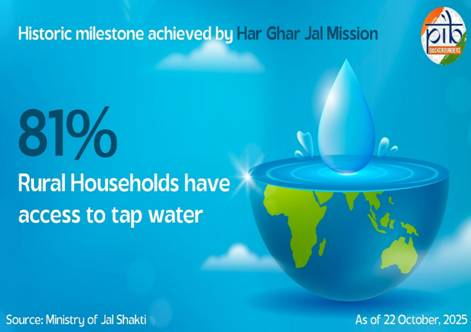
The Jal Jeevan Mission (JJM) has reached a significant milestone. As of October 2025, over 15.72 crore rural households now have access to safe tap water. This is an increase from just 3.23 crore in 2019. With a government investment of ₹2.08 lakh crore, the Mission represents one of the fastest infrastructure expansions in India’s rural development history.
About the Mission
Launched on 15 August 2019 by the Ministry of Jal Shakti, the Jal Jeevan Mission aims to provide a Functional Household Tap Connection (FHTC) to every rural household by 2024. The goal is to ensure safe and adequate drinking water regularly and for the long term. It uses a bottom-up, community-led approach, focusing on source sustainability, water quality monitoring, and digital governance.
Objectives of the Jal Jeevan Mission
– To ensure adequate, safe, and sustainable drinking water supply of 55 litres per person per day.
– To promote source sustainability through recharge and reuse.
– To engage local communities through Village Water & Sanitation Committees (VWSCs).
– To ensure regular water quality testing and promote public health awareness.
Progress under Jal Jeevan Mission (as of October 2025)
– 15.72 crore rural households now have access to tap water, achieving 81% coverage.
– 192 districts have reached full coverage; 116 have been certified by Gram Sabhas.
– 2.66 lakh villages reported coverage; 1.74 lakh have been certified.
– 11 States/UTs have achieved 100% coverage, including Goa, Telangana, Gujarat, Haryana, Punjab, and Mizoram.
– 9.23 lakh schools and 9.66 lakh Anganwadi centres now have a tap water supply.
Key Components of the Jal Jeevan Mission
| Component | Description |
|---|---|
| In-Village Piped Water Supply Infrastructure | Construction of water distribution networks within villages to ensure tap water connections to every household. |
| Sustainable Drinking Water Sources | Development and augmentation of reliable water sources to provide long-term sustainability to the system. |
| Bulk Water Transfer and Distribution | Creation of treatment plants, storage facilities, and distribution pipelines for efficient water delivery. |
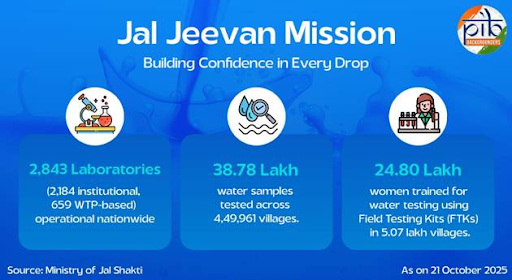
| Water Quality Monitoring | Use of Field Testing Kits (FTKs) and 2,843 water testing laboratories for ensuring potable water. |
| Retrofitting of Existing Schemes | Upgrading older schemes to provide Functional Household Tap Connections (FHTCs) at 55 lpcd. |
| Grey Water Management | Treatment and reuse of wastewater to promote water conservation and reduce wastage. |
| Community Capacity Building | Training communities and empowering women through participation in monitoring and management. |
| Contingency Planning | Provision for funds to address natural disasters or technical challenges affecting water supply. |
Digital Governance and Innovation
– The upgraded Rural Piped Water Supply Schemes (RPWSS) module serves as a digital registry, assigning unique IDs for transparency and traceability.
– Integrated with GIS mapping and PM Gati Shakti, it enables real-time dashboards and predictive analytics for effective monitoring.
– Tools like West Bengal’s “Jal Mitra App” promote transparency, functionality tracking, and community engagement.
Impact of Jal Jeevan Mission
1. Health and Hygiene:
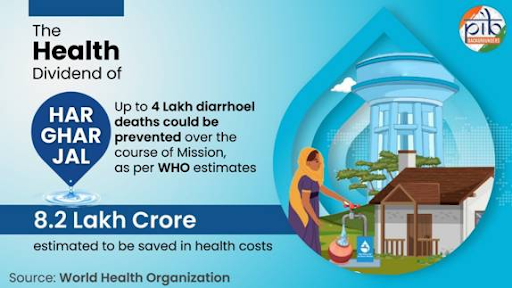
-WHO estimates JJM can avert 4 lakh diarrheal deaths and 14 million DALYs annually.
-Clean tap water access reduces child mortality by nearly 30% (Prof. Michael Kremer, Nobel Laureate).
2. Gender Empowerment:
-Time saved from fetching water: 5.5 crore hours per day, 75% of which benefits women.
-Over 9 crore women freed from water-fetching drudgery; 7.4% increase in female participation in agriculture.
3. Employment and Economic Impact:
-Potential to generate 3 crore person-years of employment (IIMB & ILO).
-25 lakh women trained in water testing, fostering skill development and local leadership.
Challenges
1. Source sustainability amid climate change and groundwater stress.
2. Maintenance and technical expertise in remote areas.
3. Behavioural changes for water conservation and waste management.
4. Ensuring financial viability of local water utilities.
Way Forward
1. Strengthen local water committees and community institutions.
2. Promote rainwater harvesting and aquifer recharge projects.
3. Deepen digital integration for transparency and accountability.
4. Foster public–private partnerships for innovation in water management.
Conclusion
The Jal Jeevan Mission is a landmark initiative transforming rural India by ensuring access to safe, sustainable drinking water. Beyond infrastructure, it empowers women, improves health outcomes, and strengthens rural livelihoods. With its focus on community participation, digital transparency, and sustainability, JJM exemplifies inclusive and effective governance, turning the vision of “Har Ghar Jal” into reality.
Prelims Question
Q. Which of the following statements about the Jal Jeevan Mission (JJM) is/are correct?
1. It was launched in 2019 under the Ministry of Jal Shakti.
2. It aims to provide Functional Household Tap Connection (FHTC) to every rural household.
3. It mandates a minimum service level of 55 litres per capita per day.
4. The mission includes greywater management and community participation as key components.
Select the correct answer using the code given below:
(a) 1 and 2 only
(b) 1, 2 and 3 only
(c) 1, 2 and 4 only
(d) 1, 2, 3 and 4
Answer: D
Mains Question
Q. Discuss the role of the Jal Jeevan Mission in improving rural infrastructure, health, and gender empowerment in India. Highlight the key challenges and suggest measures to ensure the mission’s long-term sustainability. (250 words)

- Elderly in India: Population, Challenges, and Government Initiatives - October 29, 2025
- Jal Jeevan Mission (JJM): Ensuring Tap Water to Every Rural Household - October 27, 2025
- National Blockchain Framework: Strengthening Governance through Blockchain Technology - October 25, 2025

No Comments