


25 Oct National Blockchain Framework: Strengthening Governance through Blockchain Technology
This article covers “Daily Current Affairs” and Topic details “National Blockchain Framework: Strengthening Governance through Blockchain Technology”
SYLLABUS MAPPING
GS–3 – Science and Technology – Developments and their Applications and Effects in Everyday Life
FOR PRELIMS
Basic features of blockchain technology and its applications in governance and financial systems.
FOR MAINS
Blockchain technology in India – regulatory framework, adoption challenges, capacity building, and the way forward for secure and transparent digital governance.
Why in the News?
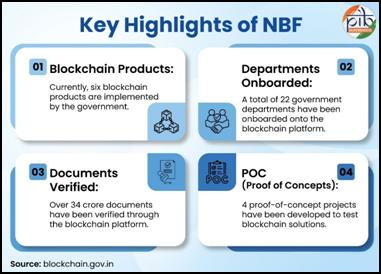
The National Blockchain Framework (NBF) was officially launched in September 2024 with a budget outlay of ₹64.76 crore by the Ministry of Electronics and Information Technology (MeitY). As of October 2025, over 34 crore documents have been verified on India’s blockchain platform — marking a major leap toward trust-based digital governance.
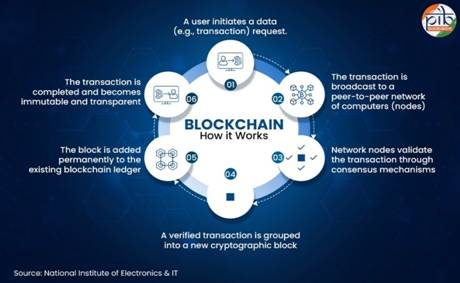
What is Blockchain Technology?
Blockchain is a distributed, secure, and immutable digital ledger that records transactions across a network of computers. Unlike traditional centralized databases, blockchain offers transparency, traceability, and tamper resistance, ensuring that once data is recorded, it cannot be altered.
Types of Blockchain Technology
| Type | Access Control | Use Case |
|---|---|---|
| Public Blockchain | Open to all; anyone can read or write data. | Bitcoin, Ethereum. |
| Private Blockchain | Restricted to authorized entities. | Government or enterprise systems. |
| Consortium Blockchain | Semi-decentralized; managed by a group of organizations. | Banking consortia, trade networks. |
| Hybrid Blockchain | Combines public transparency with private control. | National digital governance systems. |
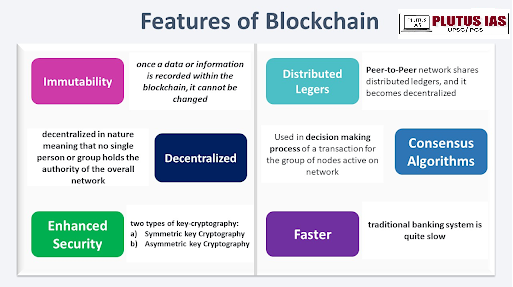
Features Of Blockchain Technology
What is the National Blockchain Framework (NBF)?
Launched in September 2024, the NBF provides a unified architecture for deploying blockchain-based governance solutions. It is hosted across NIC data centres in Bhubaneswar, Pune, and Hyderabad, ensuring scalability, fault tolerance, and data security.
Core Components:
1. Vishvasya Blockchain Stack – India’s indigenous Blockchain-as-a-Service (BaaS) platform.
2. NBFLite – A sandbox for startups, academia, and developers.
3. Praamaanik – A blockchain tool to verify the authenticity of mobile apps.
4. National Blockchain Portal – Centralized repository for blockchain policies, standards, and use cases.
Key Properties of NBF
| Property | Description |
|---|---|
| Permissioned Blockchain Layer | Only verified participants can validate transactions. |
| Distributed Infrastructure | Deployed across multiple NIC data centres for resilience. |
| Open APIs & Integration Services | Enables interoperability with e-Governance platforms. |
| Scalability & Fault Tolerance | Designed for large-scale government and enterprise use. |
Applications of NBF in Various Domains
| Domain / Chain | Objective | Impact / Example |
|---|---|---|
| Certificate & Document Chain | Secure issuance and retrieval of official documents. | 34 crore documents verified; includes CBSE certificates and caste/income proofs. |
| Logistics Chain | Trace movement of goods using tamper-proof ledgers. | Aushada, Karnataka’s medicine tracking system integrated with blockchain. |
| Judiciary Chain | Immutable and timestamped judicial records. | 665 judiciary documents verified. |
| Inter-Operable Criminal Justice System (ICJS) | Unified digital record of criminal cases. | 39,000+ ICJS documents verified. |
| Property Chain | Transparent property transactions and ownership records. | 34 crore+ property documents verified on blockchain. |
Regulatory Framework to Adopt Blockchain in India
1. Ministry of Electronics and Information Technology (MeitY):
– Formulated the National Strategy on Blockchain (2021) outlining short-term and long-term goals for blockchain integration across governance, finance, and logistics.
– Developed the National Blockchain Framework (NBF) to provide a unified architecture for government adoption.
2. National Informatics Centre (NIC):
– Established a Centre of Excellence (CoE) in Blockchain Technology to provide consultancy, Proof-of-Concept (PoC) support, and technical infrastructure for public sector blockchain projects.
– The CoE works on open-source platforms such as Hyperledger Fabric, Sawtooth, and Ethereum.
3. Telecom Regulatory Authority of India (TRAI):
– Integrated Distributed Ledger Technology (DLT) into the telecom ecosystem to regulate unsolicited commercial communication (spam).
– Over 1.13 lakh entities including Principal Entities (PEs) and Telemarketers (TMs) are registered, ensuring end-to-end SMS traceability.
4. Reserve Bank of India (RBI):
– Piloting the Digital Rupee (e₹) using blockchain for transparent, traceable, and real-time retail and wholesale payments.
– Encouraging blockchain-based fintech innovations to enhance financial inclusion.
5. National Securities Depository Limited (NSDL):
– Launched a DLT-based platform for Debenture Covenant Monitoring, creating an immutable ledger for asset charges and compliance.
– Strengthens investor confidence and transparency in capital markets.
Blockchain Adoption Challenges in India
1. Interoperability Issues: Multiple blockchain platforms operate in silos, lacking standard protocols for data sharing and interoperability.
2. Scalability Constraints: High computational demand and transaction load can cause network congestion and increased latency in large deployments.
3. Skill Deficit: A limited pool of trained blockchain developers, auditors, and regulators hampers widespread implementation.
4. Regulatory Ambiguity: Absence of a dedicated blockchain legislation or national data-sharing law complicates compliance and privacy enforcement.
5. Data Privacy and Cybersecurity: Balancing transparency with the confidentiality required for sensitive data (such as health or legal records) remains complex.
6. High Initial Costs: Infrastructure deployment, node setup, and maintenance costs can be significant, particularly for small government departments.
7. Resistance to Change: Bureaucratic inertia and lack of awareness about blockchain’s potential often slow down institutional adoption.
Way Forward
1. Standardization and Interoperability: Develop national blockchain standards and interoperability protocols across ministries and state governments.
2. Legal and Regulatory Clarity: Enact a dedicated Blockchain and Distributed Ledger Regulation Act ensuring legal recognition of blockchain-based records and smart contracts.
3. Public-Private Partnerships (PPP): Encourage collaboration between government, academia, and industry to accelerate solution development and deployment.
4. Integration with Emerging Technologies: Combine blockchain with AI, IoT, and Big Data for intelligent, data-driven governance.
5. Strengthening Data Protection Frameworks: Align blockchain initiatives with Digital Personal Data Protection Act (DPDPA) 2023 to safeguard citizen data.
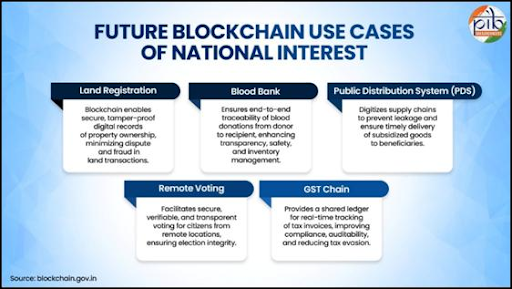
6. Expansion of Proof-of-Concept Projects: Scale blockchain pilots like Land Records Chain, GST Chain, Blood Bank Chain, and PDS Chain to national-level implementation.
7. Encouraging Indigenous R&D: Promote Indian-developed blockchain stacks and cryptographic algorithms under the Aatma nirbhar Bharat initiative.
8. International Collaboration: Engage in global blockchain forums and cross-border interoperability projects to position India as a leader in trusted digital ecosystems.
Conclusion
The National Blockchain Framework represents a pivotal step in India’s journey towards trusted digital governance. By integrating blockchain technology across governance, judiciary, supply chains, and financial systems, India is not only advancing Digital India and Aatmanirbhar Bharat, but also positioning itself as a global leader in secure, transparent, and citizen-centric technology ecosystems.
Prelims Question
Q. Consider the following statements:
Statement–I: Public blockchains are highly vulnerable to frauds and cyberattacks.
Statement–II: In a public blockchain all nodes can access records and verify transactions.
Which one of the following is correct with respect to the above statements?
(a) Both Statement I and Statement II are correct, and Statement II is the correct explanation for Statement I
(b) Both Statement I and Statement II are correct, but Statement II is not the correct explanation for Statement I
(c) Statement I is correct, but Statement II is incorrect
(d) Statement I is incorrect, but Statement II is correct
Answer: D
Mains Question
Q. Discuss how the National Blockchain Framework (NBF) can strengthen digital governance and enhance trust in public service delivery in India. (250 words)

- Elderly in India: Population, Challenges, and Government Initiatives - October 29, 2025
- Jal Jeevan Mission (JJM): Ensuring Tap Water to Every Rural Household - October 27, 2025
- National Blockchain Framework: Strengthening Governance through Blockchain Technology - October 25, 2025

No Comments