


24 Sep Seeds of the Future: Clean Plant Programme Driving Disease-Free Horticulture in India
This article covers “Daily Current Affairs” and Topic details “Seeds of the Future: Clean Plant Programme Driving Disease-Free Horticulture in India.”
SYLLABUS MAPPING
GS–3 – Economy / Agriculture / Science & Technology / Environment
FOR PRELIMS
What is the Clean Plant Programme (CPP) and its key objectives in providing disease-free planting material?
FOR MAINS
Analyse the role of the Clean Plant Programme (CPP) in enhancing productivity, income, and global competitiveness of Indian horticulture.
Why in the News?
The Union Cabinet on 9th August 2024 approved the Clean Plant Programme (CPP) with the objective of supplying farmers with disease-free planting material. The programme is designed to combat systemic pathogens, particularly viruses, that are responsible for significant yield and quality losses in horticultural crops. It will be implemented by the National Horticulture Board (NHB), while the Indian Council of Agricultural Research (ICAR) will provide technical support and capacity-building assistance. The initiative has a total outlay of ₹1,765.67 crore, which includes financial support through a $98 million loan sanctioned by the Asian Development Bank in December 2023.
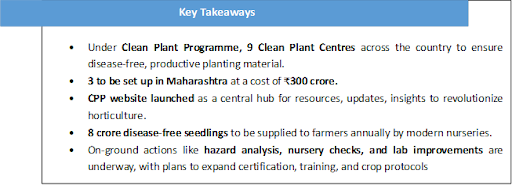
Clean Plant Programme (CPP)
1. Conceptualised by Ministry of Agriculture & Farmers Welfare in collaboration with the Asian Development Bank.
2. Aims to provide healthy, virus-free and disease-free planting material of key fruit crops.
3. Focuses on preventive crop health management by starting with clean, certified planting stock.
4. Seeks to enhance farmers’ productivity, income, and profitability.
5. Designed to boost India’s global competitiveness in horticulture by ensuring quality standards.
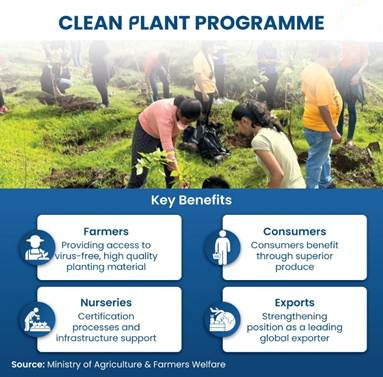
Key Benefits of Clean Plant Programme (CPP)
1. Boosts Farmers’ Income – Provides access to virus-free, high-quality planting material, leading to higher yields and better profitability.
2. Strengthens Nurseries – Introduces certification systems and infrastructure support to enable large-scale propagation of clean planting stock.
3. Improves Consumer Experience – Ensures superior quality fruits with better taste, appearance, and nutritional value.
4. Enhances Export Competitiveness – Positions India as a global leader in fruit exports through high-quality, disease-free produce.
5. Promotes Equity and Inclusivity – Makes clean planting material affordable for all farmers, engages women farmers, and develops region-specific solutions.
Importance of Indian Horticulture
| Category | Data | Example (Region) |
|---|---|---|
| Economy | Total horticulture output 367.72 million tonnes, up 3.66% vs last year. | Apple production in Himachal Pradesh |
| Farmers | Productivity: horticulture 12.5 t/ha vs food grains 2.23 t/ha. | Polyhouse floriculture in Pune |
| Government | Horticulture contributes 33% of Agriculture GVA using only 13% cropped area. | Clean Plant Programme in Telangana |
| Business / Private Sector | Rising exports of fruits, spices; investment in polyhouses & cold chains. | Mango processing units in Gujarat |
| Women Farmers | 76.9% rural women engaged in agriculture (2024). | Women managing mango orchards in West Bengal |
| Foreign Policy / Exports | India is world’s 2nd largest producer of fruits & vegetables. | Banana exports from Tamil Nadu to Middle East |
| Food Security / Nutrition | Vegetable production: 219.6 MT, higher than food grains. | Leafy vegetables in Uttarakhand |
| Ecology / Environment | Orchard plantations enhance carbon sequestration & climate resilience. | Citrus orchards in Madhya Pradesh (Central India) |
Government Policies and Initiatives
| Policy / Scheme | Key Area of Focus | Present Status (2025) | Success Stories |
|---|---|---|---|
| Mission for Integrated Development of Horticulture (MIDH) | Holistic growth: planting material, area expansion, post-harvest infrastructure | Implemented in all states; cluster-based approach strengthened | Kashmir saffron revitalization under MIDH boosted productivity and GI-tag exports |
| Horticulture Cluster Development Programme (CDP) | Market-led competitiveness of clusters | 55 clusters approved, focus on mango, banana, spices | Mango cluster in Uttar Pradesh improved exports to Middle East markets |
| Clean Plant Programme (CPP) | Virus-free, high-quality planting material | ₹1,765 crore approved; operational via ICAR & NHB | Banana plantations in Tamil Nadu and Maharashtra revived with clean planting stock |
| Operation Greens (TOP to TOTAL) | Price stabilization for Tomato, Onion, Potato; later expanded | Implemented in 22 states; subsidy support to FPOs | Tomato farmers in Andhra Pradesh received support during price crashes |
| Pradhan Mantri Krishi Sinchayee Yojana (PMKSY) | Micro-irrigation and efficient water use | 72 lakh ha covered under drip/sprinkler irrigation | Grape farmers in Maharashtra reduced water use by 40% while raising yields |
| Agri-Export Policy 2018 | Export promotion of fruits, vegetables, and spices | 46 product-district export hubs developed | Kerala spices export hub expanded black pepper exports globally |
| Digital Agriculture Mission (2021–26) | Digital solutions, AI, blockchain for traceability | Pilots in 7 states, focus on horticulture monitoring | Andhra Pradesh using blockchain for mango traceability to EU markets |
Key Challenges in the Horticulture Sector
1. Climate change impacts: Erratic monsoon, rising temperatures, droughts, and floods reduce yields.
Example: Heatwaves in 2022 reduced onion output in Maharashtra by 20%.
2. Post-harvest losses: Around 20–30% wastage of perishable produce due to poor storage and transport.
Example: Potato farmers in Uttar Pradesh face 25% loss due to inadequate cold chains.
3. Infrastructure gaps: Limited access to organized markets, poor logistics, and inadequate warehousing.
Example: Odisha’s vegetable farmers forced into distress sales due to lack of cold storage.
4. Quality planting material: Lack of disease-free seeds and planting material.
Example: Banana bunchy top virus in Tamil Nadu lowered yields drastically before clean planting initiatives.
5. Market volatility: High price fluctuations in crops like onion and tomato, impacting farmer income.
Example: Onion prices in Nashik (Maharashtra) crashed from ₹25/kg to ₹2/kg in 2023.
6. Global competition: Stiff competition in exports despite being the largest producer of spices and second in fruits/vegetables.
Example: Indian grapes rejected in EU markets due to pesticide residues, reducing export earnings.
7. Water stress: Over-extraction of groundwater for crops like banana and sugarcane affecting horticulture sustainability.
Example: Banana farming in Jalgaon (Maharashtra) consumes excessive groundwater.
Way Forward
| Way Forward / Solution | Committee / Commission | Example |
|---|---|---|
| Climate-resilient farming practices | MIDH General Council; ICAR Climate Research Panel | Chhattisgarh: Solar irrigation and diversified cropping |
| Expand cold chain & reduce losses | National Horticulture Board (NHB) Project Approval | Uttar Pradesh: Cold chain expansion curtailed potato loss |
| Build market & logistics infrastructure | NHB Managing Committee; APEDA | Odisha: Improved access to e-NAM, new rural storage |
| Ensure quality planting material | Clean Plant Programme Committee; ICAR Seed Board | Tamil Nadu: Clean Plant Programme for bananas controlled virus |
| Tackle market volatility | State Price Stabilization Fund; APEDA | Nashik: Onion price support via Farmer-Producer Companies |
| Boost export competitiveness | Export Promotion Council; APEDA; NHB Board | Grapes: Adoption of standards improved EU exports |
| Adopt sustainable water-efficient cropping | ICAR Horticulture Panel; National Water Mission | Jalgaon: Drip irrigation saves water in banana cultivation |
Conclusion
The Clean Plant Programme (CPP) strengthens India’s horticulture by providing disease-free planting material, boosting yields, farmer incomes, and export competitiveness. Along with policies like MIDH and PMKSY, it addresses challenges such as climate impacts, post-harvest losses, and market volatility. Emphasis on climate-resilient farming, cold chains, and digital traceability ensures sustainable growth. Together, these initiatives position India as a global horticultural leader while promoting farmer prosperity and food security.
Prelims Question
Q. Which of the following statements regarding the Mission for Integrated Development of Horticulture (MIDH) is/are correct?
1. MIDH is a Centrally Sponsored Scheme implemented for holistic development of horticulture in India.
2. Under MIDH, the Government of India contributes 90% of the total outlay in all States.
3. The scheme covers fruits, vegetables, root & tuber crops, spices, flowers, coconut, and bamboo.
Select the correct answer using the code below:
A) 1 and 3 only
B) 2 and 3 only
C) 1 and 2 only
D) 1, 2 and 3
Answer: A
Mains Question
Q. Explain the main objectives of the Mission for Integrated Development of Horticulture (MIDH) and how it supports the holistic growth of India’s horticulture sector.
(250 words)

- Elderly in India: Population, Challenges, and Government Initiatives - October 29, 2025
- Jal Jeevan Mission (JJM): Ensuring Tap Water to Every Rural Household - October 27, 2025
- National Blockchain Framework: Strengthening Governance through Blockchain Technology - October 25, 2025

No Comments