


27 Sep UPSC Mains 2025 GS Paper 1 Detailed Analysis: Syllabus Coverage, Difficulty & Strategy Insights
UPSC Mains 2025 GS Paper 1 Detailed Analysis: Syllabus Coverage, Difficulty & Strategy Insights
1. The Importance of GS Paper 1 in UPSC Mains
General Studies Paper 1 (GS1) holds a strategic edge in the UPSC Mains examination. While every GS paper is important, GS1 is often regarded as a “scoring paper” due to its static-heavy nature. Unlike GS2 and GS3, which rely heavily on dynamic current affairs, GS1 rewards a solid command over static subjects like history, geography, and society.
-Weightage in Mains Strategy (250 Marks): GS1 accounts for nearly 20% of the total GS marks. A good performance here provides a buffer against the unpredictability of GS2 and GS3, thereby stabilizing overall performance.
-Impact on Rank & Service Allocation: Consistently high scorers in GS1 often see this as a differentiating factor that pushes them into the final list or upgrades their service preferences.
-Link to Interview Call: Since the interview call is largely determined by your Mains score, papers like GS1—where preparation pays directly—become a decisive factor in crossing the cutoff.
2. Overview of GS Paper 1
a. Paper Pattern
-Duration & Marks: 3 hours | 250 marks
-Question Types: Combination of 10-markers (150 words) and 15-markers (250 words)
-Answer Writing Norms: Structured introduction–body–conclusion format is expected. Use headings, bullet points, diagrams/flowcharts, and maps for better presentation and score maximization.
b. Broad Thematic Areas Covered
The syllabus is diverse yet interlinked, covering four major subjects:
-Indian Heritage and Culture: Art forms, literature, and architecture from ancient to modern times.
-History: Modern Indian History (18th century onwards), the Freedom Struggle, and World History.
-Geography: World’s physical geography, natural resource distribution, and geophysical phenomena.
-Indian Society: Salient features of Indian society, role of women, population issues, social empowerment, and effects of globalization.
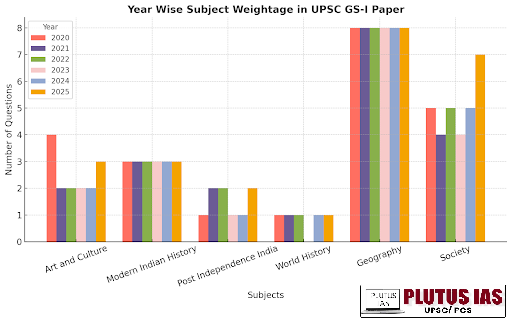
3. Trend Analysis (2020–2025)
Over the last five years, the GS1 paper has shown certain consistent patterns:
-Heritage & Culture: UPSC maintains its trend of 2–3 straightforward but conceptual questions every year.
-Modern History & Freedom Struggle: Continues to be moderately represented, but often requires analytical framing rather than factual recall.
-World History: Frequently under-represented, with only 1–2 questions in recent years.
-Geography: The dominant section, especially physical geography and environment-related themes, often linked with current events.
-Society: Steadily increasing in weightage, reflecting UPSC’s focus on contemporary social dynamics, gender, and empowerment.
Observation: UPSC has gradually reduced direct factual questions and now demands analytical, multidimensional answers that link static concepts with contemporary relevance.
4. Topic-Wise Analysis of GS1 Mains Paper 2025
| Subject Area | Questions Asked | Nature of Questions | Difficulty Level |
|---|---|---|---|
| Indian Heritage & Culture | 3 | Conceptual & factual blend | Moderate |
| History | 3 | Analytical, linkage-based | Moderate |
| Indian Society | 4 | Contemporary, issue-based | Moderate to High |
| Geography | 10 | Static + applied current relevance | Moderate |
Observation: Geography dominated this year’s paper, with questions requiring both core conceptual clarity and applied understanding linked to environment and resources. Society questions tested awareness of ongoing demographic and gender debates.
5. Question-Wise Analysis & Synopsis
10-Markers (150 words)
Q1. Discuss the salient features of the Harappan architecture.
Focus: Town planning, grid system, drainage, granaries, citadel, Great Bath.
Approach: Use examples (Mohenjo-Daro, Harappa, Dholavira). Diagram/map adds value.
Q2. Examine the main aspects of Akbar’s religious syncretism.
Focus: Sulh-i-kul, Din-i-Ilahi, Ibadat Khana debates, policy of tolerance.
Approach: Show inclusiveness, political motives, long-term impact.
Q3. ‘The sculptors filled the Chandella artform with resilient vigor and breadth of life.’ Elucidate.
Focus: Khajuraho temples, erotic sculptures, dynamism in form.
Approach: Highlight vigor, realism, symbolic spirituality.
Q4. How are climate change and the sea level rise affecting the very existence of many island nations? Discuss with examples.
Focus: Maldives, Tuvalu, Kiribati; sea-level rise, coastal erosion, salinity.
Approach: Add IPCC findings + Indian Ocean reference.
Q5. What are non-farm primary activities? How are these activities related to physiographic features in India? Discuss with suitable examples.
Focus: Fishing, forestry, mining, quarrying.
Approach: Link to physiographic features (Himalayas, coastal belts, mineral regions).
Q6. Explain briefly the ecological and economic benefits of solar energy generation in India with suitable examples.
Focus: Renewable, employment generation, energy security.
Approach: Economic + ecological benefits (reduced CO₂, rural employment, ISA role).
Q7. What are Tsunamis? How and where are they formed? What are their consequences? Explain with examples.
Focus: Undersea earthquakes, volcanic eruptions, landslides.
Approach: Diagram + Indian Ocean (2004 tsunami). Effects on coasts & livelihoods.
Q8. How does smart city in India, address the issues of urban poverty and distributive justice?
Focus: Affordable housing, infrastructure, livelihood creation, inclusivity.
Approach: Show gaps between vision and execution. Balanced answer needed.
Q9. The ethos of civil service in India stand for the combination of professionalism with nationalistic consciousness – Elucidate.
Focus: Neutrality, accountability, efficiency + patriotism, commitment to development.
Approach: Examples from freedom struggle & modern governance.
Q10. Do you think that globalization results in only an aggressive consumer culture? Justify your answer.
Focus: Debate: consumerism vs cultural integration.
Approach: Add Indian examples (mall culture, fast fashion, OTT).
15-Markers (250 words)
Q11. Mahatma Jotirao Phule’s writings and efforts of social reforms touched issues of almost all subaltern classes. Discuss.
Focus: Education of women, caste critique, Satyashodhak Samaj.
Approach: Link to subaltern classes – women, Shudras, Dalits, farmers.
Q12. Trace India’s consolidation process during the early phase of independence in terms of polity, economy, education and international relations.
Focus: Polity (integration of princely states), economy (planning), education (NIEPA, IITs), foreign policy (NAM).
Approach: Multi-dimensional answer.
Q13. The French Revolution has enduring relevance to the contemporary world. Explain.
Focus: Liberty, equality, fraternity, secularism, democracy.
Approach: Link to modern constitutions, rights discourse, social justice.
Q14. Give a geographical explanation of the distribution of off-shore oil reserves of the world. How are they different from the on-shore occurrences of oil reserves?
Focus: Offshore – continental shelf regions (North Sea, Mumbai High).
Approach: Compare geology, cost, technology, vulnerability. Use world map.
Q15. How can Artificial Intelligence (AI) and drones be effectively used along with GIS and RS techniques in locational and areal planning?
Focus: Urban planning, disaster management, agriculture, defense.
Approach: Innovative dimension + Indian case studies (SVAMITVA scheme).
Q16. Discuss how the changes in shape and sizes of continents and ocean basins of the planet take place due to tectonic movements of the crustal masses.
Focus: Plate tectonics, continental drift, sea-floor spreading.
Approach: Link with Himalayas, Rift Valleys, Pacific Ring of Fire. Diagram essential.
Q17. Discuss the distribution and density of population in the Ganga River Basin with special reference to land, soil and water resources.
Focus: High fertility, fertile alluvium, irrigation, dense settlements.
Approach: Use data + map of basin showing density zones.
Q18. How do you account for the growing fast food industries given that there are increased health concerns in modern society? Illustrate your answer with the Indian experience.
Focus: Urban lifestyle, rising incomes, processed foods.
Approach: Balance: economic growth vs obesity/diabetes. Cite Indian examples (McDonald’s, Swiggy/Zomato).
Q19. Achieving sustainable growth with emphasis on environmental protection could come into conflict with poor people’s needs in a country like India – Comment.
Focus: Development–environment trade-off.
Approach: Cite Paris Agreement, Indian challenges (coal vs renewable). Use a balanced view.
Q20. Does tribal development in India centre around two axes, those of displacement and of rehabilitation? Give your opinion.
Focus: Mining, dams, forest projects → displacement.
Approach: FRA, PESA, rehabilitation schemes. Suggest inclusive tribal development model.
6. Strategy Insights for the Upcoming Year
Based on the 2025 paper, here are key takeaways for aspirants preparing for 2026:
1. Focus on Geography as the Game-Changer:
–Strengthen maps, diagrams, and conceptual clarity on topics like ocean currents, monsoon variability, earthquakes, and climate change.
–Link static geography to current environmental issues.
2. Revise Heritage & Culture Smartly:
–Prepare short notes with flowcharts and examples.
–Use art & architecture illustrations wherever possible.
3. Don’t Ignore Society:
–Prepare on women’s empowerment, social justice, migration, urbanization, caste dynamics, and globalization.
–Enrich answers with data from Census, NFHS, SDGs, NITI Aayog reports.
4. History Preparation:
–Prioritize Modern Indian History (1757–1947) and Freedom Struggle themes.
–World History can be studied selectively, focusing on revolutions, world wars, and decolonization.
5. Answer Writing Practice:
–Practice timed mocks with strict word limits.
–Focus on structuring, balanced perspectives, and value-addition (maps, data, examples).
GS1 continues to be a stability provider in Mains. Aspirants who prepare with an integrated approach—linking static knowledge with contemporary issues—will consistently have an advantage.

- Elderly in India: Population, Challenges, and Government Initiatives - October 29, 2025
- Jal Jeevan Mission (JJM): Ensuring Tap Water to Every Rural Household - October 27, 2025
- National Blockchain Framework: Strengthening Governance through Blockchain Technology - October 25, 2025

No Comments