


27 Sep UPSC Mains 2025 GS Paper 4 Detailed Analysis: Syllabus Coverage, Difficulty & Strategy Insights
UPSC Mains 2025 GS Paper 4 Detailed Analysis: Syllabus Coverage, Difficulty & Strategy Insights
1. The Importance of GS Paper 4 in UPSC Mains
GS Paper 4, Ethics, Integrity, and Aptitude, is a unique and highly strategic paper in UPSC Mains. Unlike GS1, 2, or 3, this paper tests moral reasoning, ethical decision-making, emotional intelligence, and attitude, alongside knowledge of philosophical and administrative ethics.
-Weightage in Overall Mains Strategy (250 Marks): A well-prepared candidate can gain a substantial edge here because marks are often differentiated by quality of reasoning, clarity of ethical frameworks, and case study handling, rather than rote memorization.
-Impact on Rank: Aspirants who integrate classical ethical theories, constitutional values, and contemporary administrative examples generally secure higher marks. GS4 performance also indicates suitability for civil services, which closely aligns with themes explored in the Personality Test.
-Connection to Interview Call: Since GS4 assesses practical morality, integrity, and administrative decision-making, strong performance reflects positively in ethics-related questions in the UPSC interview, reinforcing the candidate’s credibility as a potential civil servant.
2. Overview of GS Paper 4
a. Paper Pattern
-Duration & Marks: 3 hours | 250 marks
-Question Types: 10-markers (150 words), 20-markers (Case Studies, 250 words)
-Answer Writing Norms: Answers must be analytical, structured, and value-driven, Use ethical theories, constitutional values, administrative examples, and real-life cases, Diagrams or frameworks (e.g., decision trees, stakeholder analysis) can enhance clarity.
b. Broad Thematic Areas Covered
-Ethics & Integrity: Core ethical concepts, honesty, accountability, moral reasoning, public service values
-Attitude & Aptitude: Emotional intelligence, empathy, moral courage, motivation, work culture
-Case Studies in Administration: Ethical dilemmas, conflict of interest, corruption, governance challenges
-Philosophical & Historical Perspectives: Teachings of thinkers (Gandhi, Vivekananda, Mahavir), constitutional morality
3. Trend Analysis (2020–2025)
-Ethics & Integrity: Core ethical reasoning dominates 4–6 questions yearly, often linked to governance or public administration.
-Attitude & Emotional Intelligence: Recurrent in questions evaluating human behaviour, motivation, and conflict resolution.
-Case Studies: Stable emphasis on administrative dilemmas, corruption, conflict of interest, resource management, and citizen welfare.
-Philosophical Teachings & Quotations: Usually 2–3 questions, integrating classical thought with contemporary challenges.
Observation: GS4 rewards applied ethical reasoning and structured case analysis rather than memorization. Candidates combining ethical frameworks with real-world examples tend to score significantly higher.
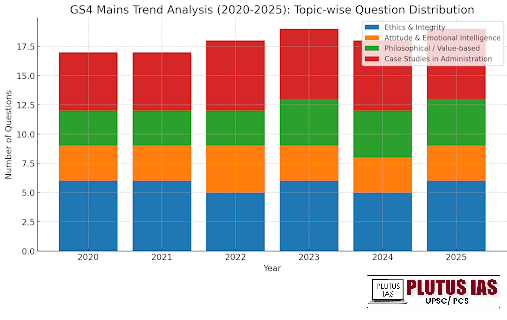
4. Topic-wise Analysis of GS4 Mains Paper 2025
| Topics Covered | No. of Questions | Breakdown / Comments |
|---|---|---|
| Ethics & Integrity | 6 | Q1(a), Q1(b), Q2(b), Q4(a), Q6(a), Q6(b) – Core ethical issues, constitutional morality, accountability, code of ethics, fund management, governance principles |
| Attitude & Emotional Intelligence | 3 | Q2(a), Q5(a), Q5(b) – Human attitudes, emotional intelligence, sense of duty, motivation, enabling growth |
| Philosophical / Value-based Questions | 4 | Q3(a), Q3(b), Q3(c), Q4(b) – Quotations from Thiruvalluvar, William James, Vivekananda; teachings of Mahavir; their relevance in modern administration |
| Case Studies in Administration | 6 | Q7, Q8, Q9, Q10, Q11, Q12 – Section B questions (20-markers) involving disaster management, welfare schemes, procurement dilemmas, conflict of interest, and border/security scenarios |
5. Complete Question-wise Analysis and Synopsis
SECTION A: 10 Marks Questions (150 words)
Q1(a). Social Media Ethical Dilemmas
Demand: Identify key ethical issues due to social media.
Approach: Discuss privacy, misinformation, cyberbullying, data misuse, echo chambers, mental health impact, surveillance vs freedom, corporate responsibility, accountability mechanisms.
Q1(b). Constitutional Morality for Public Servants
Demand: Significance of constitutional morality in governance.
Approach: Define constitutional morality, importance in rule-of-law adherence, examples of public accountability, promotion of fairness, anti-corruption, ethical policymaking.
Q2(a). Clausewitz and Contemporary Geopolitics
Demand: Critical analysis of war as “diplomacy by other means.”
Approach: Connect theory to modern conflicts (proxy wars, cyber warfare, hybrid conflicts), ethical implications, limits of military action in diplomacy.
Q2(b). Environmental Clearance Dilemmas
Demand: Ethical conflicts in border-area development projects.
Approach: Balancing national security, development needs vs environmental sustainability, stakeholder conflict, decision frameworks.
Q3(a). Thiruvalluvar Quote
Demand: Relevance of resilience and calm in adversity.
Approach: Apply to personal ethics, crisis management, public service decision-making.
Q3(b). William James Quote
Demand: Human agency in attitude change.
Approach: Stress ethical self-improvement, motivational leadership, shaping organisational culture.
Q3(c). Vivekananda Quote
Demand: Morality over mere legalism.
Approach: Connect ethics, integrity, and societal transformation, rule-of-law vs moral consciousness.
Q4(a). Reason and Critical Thinking in Welfare Schemes
Demand: Role of rational ethics in civil service.
Approach: Provide examples from welfare programs (MGNREGA, PM FME, health initiatives), importance of ethical frameworks and stakeholder analysis.
Q4(b). Teachings of Mahavir
Demand: Ethical and philosophical relevance today.
Approach: Ahimsa, truthfulness, non-possession, self-discipline; relevance to governance, environmental sustainability, conflict resolution.
Q5(a). Duty and Personal Fulfilment
Demand: Ethical perspective of duty in civil service.
Approach: Connect dharma-based ethics, responsibility, public service motivation, personal development.
Q5(b). Civil Servant as Enabler
Demand: Specific measures for holistic development.
Approach: Capacity-building, policy facilitation, social inclusion, skill development, participatory governance.
Q6(a). Value-based Work Culture
Demand: Measures for ethical organizational culture.
Approach: Code of ethics, internal audits, training, whistleblower protection, ethical leadership, accountability systems.
Q6(b). Ensuring Financial Accountability
Demand: Addressing fund misutilization for economic growth.
Approach: Transparent processes, e-governance, monitoring mechanisms, capacity building, citizen engagement, anti-corruption measures.
SECTION B: Case Studies (20 Marks, 250 words)
Q7. Vijay – Disaster Management and Personal Loss
Demand: Ethical dilemma between duty and personal grief.
Approach:
Options: Continue relief operations vs. attend personal matter.
Ethical dilemmas: Duty vs familial obligation, public expectation, personal grief.
Evaluation: Prioritise public duty with temporary delegation; personal travel after minimal disruption.
Recommendation: Adopt option that balances duty and grief; communicate transparently.
Q8. Deforestation vs Social Welfare
Demand: Balancing housing needs and ecological conservation.
Approach:
Ethical justification analysis, socio-environmental trade-offs, participatory decision-making, alternative solutions (vertical housing, eco-restoration, community consent).
Q9. Subash – Conflict of Interest & Political Pressure
Demand: Ethical dilemma in administration and personal integrity.
Approach: Identify conflicts: insider information to family, ministerial pressure, fairness, public trust. Options: refuse, recuse, follow transparency, document decisions. Recommend ethical adherence with transparency and reporting.
Q10. Rajesh – Procurement Dilemma
Demand: Ethical compliance vs superior’s expectations.
Approach: Identify legal and ethical issues: splitting orders, rule adherence, conflict of interest. Options: comply, refuse, report. Recommend ethical compliance and proper reporting, uphold accountability.
Q11. MGNREGA Mismanagement
Demand: Administrative and ethical measures.
Approach: Identify irregularities, implement audits, grievance redressal, transparent fund disbursement, capacity building, community monitoring.
Q12. Ashok – Border Crisis
Demand: Decision-making under extreme ethical and legal uncertainty.
Approach: Options: allow entry, selective entry, military containment. Evaluate based on human rights, security, rule-of-law. Recommend humanitarian priority with security protocols. Include border control measures for armed personnel.
6. Strategy Insights for the Upcoming Year
-Ethics & Integrity: Prepare core ethical theories, administrative codes, public service values, and constitutional morality. Integrate with real-life examples, government schemes, and contemporary case studies.
-Attitude & Emotional Intelligence: Emphasize empathy, ethical decision-making, conflict resolution, motivational strategies, and moral courage.
-Case Studies: Practice structured frameworks (stakeholders, options, ethical analysis, recommendation). UPSC rewards logical clarity, value-based reasoning, and balance between competing interests.
-Philosophical/Value-based Questions: Relate teachings of thinkers to contemporary governance and administrative dilemmas. Use concise quotes, explain relevance, and connect with public service ethics.
-Answer Writing Tips: Use headings/sub-headings for clarity (Options, Dilemmas, Evaluation, Recommendation), incorporate real-life administrative examples (MGNREGA, disaster management, smart city projects, fund allocation, environmental cases), analytical answers with stakeholder perspective outperform generic descriptive writing.
GS4 is a scoring and differentiating paper. Candidates who combine ethical theory, practical reasoning, and case study analysis outperform rote learners. Structured, concise, and ethical argumentation is the key to maximizing marks.

- Elderly in India: Population, Challenges, and Government Initiatives - October 29, 2025
- Jal Jeevan Mission (JJM): Ensuring Tap Water to Every Rural Household - October 27, 2025
- National Blockchain Framework: Strengthening Governance through Blockchain Technology - October 25, 2025

No Comments