


10 Oct India and UK Strengthen Defence and Trade Ties During PM Keir Starmer’s First India Visit”
This article covers “Daily Current Affairs” and Topic details “India and UK Strengthen Defence and Trade Ties During PM Keir Starmer’s First India Visit”
SYLLABUS MAPPING
GS–2 – International Relations – Bilateral, Regional, and Global Groupings and Agreements involving India and/or affecting India’s interests
FOR PRELIMS
Recent India–UK engagements under the Comprehensive Economic and Trade Agreement (CETA) and related defence, trade, and connectivity initiatives.
FOR MAINS
India–UK relations in the context of strategic, economic, and technological cooperation under the new trade and defence framework.
Why in the News?
The Prime Minister of the United Kingdom, Keir Starmer, undertook his first official visit to India after assuming office. During the visit, India and the U.K. strengthened their defense and trade partnerships by signing key agreements under the Comprehensive Economic Trade Agreement (CETA) and finalizing a £350 million missile supply contract from the U.K. to India. Mr. Starmer was accompanied by a high-level delegation of entrepreneurs, cultural representatives, and university leaders, highlighting the growing cooperation in economic, defence, education, and cultural sectors between the two nations.
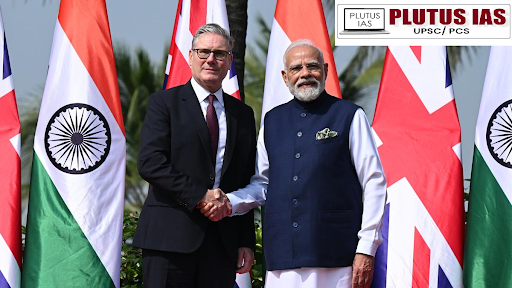
Key Highlights of the Visit
1. Largest UK Trade Mission to India:
– A 125-member delegation, including global companies like Rolls-Royce, British Airways, BT, Diageo, and London
– Stock Exchange Group, accompanied PM Starmer on a two-day visit to Mumbai.
2. Building on the UK–India Trade Deal (CETA):
– The July 2025 CETA, hailed as the best deal ever secured by any country with India, reduces India’s average tariffs on UK goods from 15% to 3% and simplifies customs procedures to promote faster trade.
3. Sectoral Gains:
– Whisky tariffs cut from 150% to 75% immediately, to further reduce to 40% within 10 years.
– Soft drinks, cosmetics, cars, and medical devices to see easier market access.
– SMEs gain from digital trade facilitation and dedicated support channels.
4. Economic Impact:
– Expected to raise UK GDP by £4.8 billion per year and UK exports to India by nearly 60%.
– Projected to add £2.2 billion to UK wages and create jobs through increased exports.
5. Defence and Connectivity:
– Alongside trade, a £350 million defence deal for missile supply was signed, complementing cooperation in maritime security and defence technology.
– British Airways also announced plans to launch a third daily flight between Delhi and London Heathrow by 2026, signaling deepening connectivity.
6. Leadership Remarks:
– PM Keir Starmer described the trade deal as “a launchpad for growth”, highlighting India’s role as a key partner in global economic expansion.
– UK Business and Trade Secretary Peter Kyle emphasized that the deal “places British businesses at the front of the queue to access India’s booming market.”
Significance of the UK for India
1. Strategic Partner: As a P5 and G7 member, the UK supports India’s global aspirations and partnership in international diplomacy.
2. Investment & Trade Hub: The UK is a major investor in India’s economy, particularly in financial services, green energy, and technology sectors.
3. Technology & Research Collaboration: India benefits from R&D partnerships in advanced technologies, pharmaceuticals, and higher education institutions.
4. Education & Workforce Opportunities: The UK remains a preferred destination for Indian students and skilled professionals.
5. Gateway to Europe and Global Finance: Despite Brexit, London continues to serve as a global financial hub and gateway for Indian businesses expanding into Europe.
Significance of India for the UK
1. Economic Growth Partner: India is among the world’s fastest-growing major economies, offering vast investment and trade opportunities.
2. Strategic Indo-Pacific Partner: India’s presence enhances the UK’s Indo-Pacific strategy, countering security challenges and ensuring maritime stability.
3. Technology & Innovation Hub: India’s expanding digital and startup ecosystem complements the UK’s innovation-driven economy.
4. Skilled Human Resource: Indian professionals play a key role in the UK’s IT, healthcare, and financial sectors, addressing workforce shortages.
5. Cultural & Diaspora Bridge: The Indian diaspora strengthens bilateral understanding and serves as a cultural bridge connecting both nations.
Way Forward
1. Fast-track the India–UK FTA to enhance trade, investment, and market access.
2. Expand cooperation in emerging technologies such as AI, space, quantum computing, and digital security.
3. Deepen defence partnerships through joint R&D, co-production, and military training programs.
4. Enhance climate collaboration via green hydrogen, renewable energy, and climate finance initiatives.
5. Ease visa and migration policies to promote greater mobility of students and professionals.
6. Address diaspora and political sensitivities (e.g., Khalistani extremism) through constructive engagement.
7. Align Indo-Pacific strategies to strengthen maritime and regional security cooperation.
Conclusion
PM Keir Starmer’s 2025 visit to India marks a new chapter in India–U.K. relations, transforming the partnership from negotiations to actionable cooperation under the Comprehensive Economic and Trade Agreement (CETA). With enhanced trade, defence, and technological engagement, the partnership aligns with the India–U.K. Roadmap 2030 vision. Both democracies now stand poised to build a modern, growth-driven, and strategic alliance, shaping a stronger global partnership anchored in mutual prosperity, innovation, and shared democratic values.
Prelims Question
Q. With reference to India-UK relations, consider the following statements:
1. India and the UK are negotiating a Free Trade Agreement (FTA) to enhance bilateral trade.
2. The UK-India Technology Security Initiative (TSI) focuses on emerging technologies like AI, semiconductors, and quantum computing.
3. The Young Professionals Scheme between India and the UK allows the free movement of workers without restrictions.
How many of the above-given statements are correct?
A. Only one
B. Only two
C. All three
D. None
Answer: A
Mains Question
Q. Examine the significance of India-UK bilateral relations in the context of trade, strategic partnerships, and technological cooperation. What are the key challenges, and how can both countries strengthen their engagement? (250 words)

- Elderly in India: Population, Challenges, and Government Initiatives - October 29, 2025
- Jal Jeevan Mission (JJM): Ensuring Tap Water to Every Rural Household - October 27, 2025
- National Blockchain Framework: Strengthening Governance through Blockchain Technology - October 25, 2025

No Comments