


24 Oct INDIA–ASEAN Bilateral Relations
This article covers “Daily Current Affairs” and Topic details “INDIA–ASEAN Bilateral Relations”
SYLLABUS MAPPING
GS–2 – International Relations – Bilateral, Regional, and Global Groupings and Agreements involving India and/or affecting India’s interests
FOR PRELIMS
Recent developments in India–ASEAN relations in the context of the 47th ASEAN Summit 2025 and India’s participation under the Act East Policy and Indo-Pacific framework.
FOR MAINS
India–ASEAN relations in the context of strategic, economic, and connectivity cooperation under the Act East Policy and Indo-Pacific vision.
Why in the News?
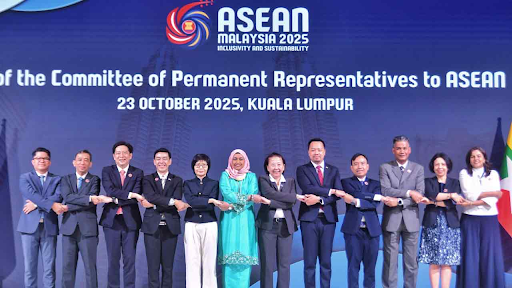
Prime Minister Narendra Modi will participate virtually in the upcoming 47th ASEAN Summit (October 2025), citing ongoing Deepavali celebrations for not travelling to Malaysia. External Affairs Minister S. Jaishankar will represent India at the East Asia Summit in Kuala Lumpur. The MEA reiterated that “ASEAN is a key pillar of India’s Act East Policy and Indo-Pacific vision.”
Evolution of India–ASEAN Relations
| Phase | Period | Highlights |
|---|---|---|
| Initial Engagement | 1967–1990s | Limited contact due to Cold War politics; India’s economic policies and ASEAN’s Western tilt kept ties lukewarm. |
| Look East Policy | 1992 onwards | India became a Sectoral Dialogue Partner (1992), Full Dialogue Partner (1995), and Summit-level Partner (2002). |
| Strategic Deepening | 2010–2017 | 2012: 20 years of Dialogue Partnership & 10 years of Summit-level partnership → ASEAN–India Strategic Partnership. |
| Act East Policy Era | 2014–present | Focus shifted from “Look” to “Act” East—emphasizing connectivity, commerce, culture, and capacity-building in the Indo-Pacific. |
Significance of ASEAN for India
1. Economic Gateway to East Asia:
– ASEAN is India’s 4th largest trading partner.
– India–ASEAN trade stood at USD 131.6 billion (2023–24), accounting for ~11% of India’s total trade.
– Investment flows: ASEAN accounts for nearly 18% of FDI inflows into India (2023).
2. Strategic & Geopolitical Importance:
– ASEAN lies at the heart of the Indo-Pacific, connecting Indian and Pacific Oceans—vital for India’s maritime strategy.
– Forums like East Asia Summit, ADMM+, and ASEAN Regional Forum (ARF) enable India’s strategic outreach.
– Shared goal of maintaining free, open, and rules-based maritime order vis-à-vis China’s assertiveness in the South China Sea.
3. Connectivity & Cultural Links: Projects:
– India–Myanmar–Thailand (IMT) Trilateral Highway (to be extended to Cambodia, Laos, Vietnam).
– Kaladan Multimodal Transit Transport Project connecting India’s northeast with Myanmar ports.
– Cultural diplomacy: Buddhism, Ramayana, and ancient maritime trade form strong civilizational ties.
4. People-to-People Contact:
– Tourism: Over 2 million people travel annually between India and ASEAN.
– Education & skill exchange through ASEAN–India Network of Think Tanks, ASEAN–India Students Exchange Programme, etc.
Issues and Challenges
1. Trade Imbalance – India faces a trade deficit of nearly USD 40 billion with ASEAN due to import-heavy trade, especially in electronics and machinery.
2. Connectivity Delays – Slow implementation of IMT Highway and Kaladan project due to funding, land acquisition, and insurgency issues in Myanmar.
3. Limited Integration in Supply Chains – India’s exit from RCEP (2020) limited its access to regional value chains. ASEAN’s deeper economic integration with China and Japan (ASEAN plus Three) marginalizes India’s role.
4. Maritime and Security Complexities – Divergent ASEAN responses to South China Sea tensions and China’s Belt and Road Initiative make it difficult for India to secure a unified ASEAN stance.
5. Political Transitions in the Region – Myanmar’s instability and differing political regimes within ASEAN hinder consistent engagement.
Way Forward
1. Recalibrate Trade Ties:
– Review ASEAN–India Free Trade Agreement (AIFTA) to address tariff barriers and boost export competitiveness.
– Encourage Indian MSMEs to integrate with ASEAN’s manufacturing networks.
2. Accelerate Connectivity Corridors
– Fast-track completion of IMT Highway and operationalize Kaladan project to link Northeast India with Southeast Asia.
– Expand digital connectivity via fintech, cybersecurity, and e-commerce partnerships.
3. Enhance Strategic Cooperation
– Strengthen joint maritime patrols, intelligence sharing, and blue economy initiatives under the ASEAN Outlook on Indo-Pacific (AOIP).
– Align India’s Indo-Pacific Oceans Initiative (IPOI) with AOIP to ensure synergy.
4. Boost Cultural and Academic Diplomacy
– Establish an ASEAN–India Cultural Corridor highlighting Buddhist heritage routes.
– Promote student exchanges and joint research on sustainable development and green technologies.
5. Collaborate on Global Challenges
– Climate action, pandemic preparedness, supply chain resilience, and AI ethics can become new pillars of cooperation.
Conclusion
India–ASEAN ties have evolved from economic pragmatism to strategic partnership—anchored in shared values of peace, prosperity, and inclusivity. As ASEAN celebrates over five decades of integration and India marks three decades of engagement, the relationship must move from “dialogue” to “delivery.”
By deepening connectivity, recalibrating trade, and aligning Indo-Pacific visions, India and ASEAN can together shape a multipolar, rule-based Asian order that ensures growth and stability for the entire region.
Prelims Question
Q. With reference to India–ASEAN relations, consider the following statements:
1. India became a full dialogue partner of ASEAN in 1995.
2. The India–Myanmar–Thailand Trilateral Highway aims to connect India’s Northeast with Singapore.
3. The ASEAN–India Free Trade Agreement (AIFTA) was signed in 2009.
Which of the statements given above are correct?
(a) 1 and 3 only
(b) 2 and 3 only
(c) 1 and 2 only
(d) 1, 2 and 3
Answer: A
Mains Question
Q. Discuss the evolution and significance of India–ASEAN relations in the context of India’s Act East Policy. (250 words)

- Elderly in India: Population, Challenges, and Government Initiatives - October 29, 2025
- Jal Jeevan Mission (JJM): Ensuring Tap Water to Every Rural Household - October 27, 2025
- National Blockchain Framework: Strengthening Governance through Blockchain Technology - October 25, 2025

No Comments