


29 Oct Elderly in India: Population, Challenges, and Government Initiatives
This article covers “Daily Current Affairs” and Topic details “Elderly in India: Population, Challenges, and Government Initiatives”
SYLLABUS MAPPING
GS–1 – Indian Society and Social Issues – Population and Associated Issues, Poverty and Developmental Issues.
FOR PRELIMS
Key facts about India’s elderly population – projected to reach 230 million by 2036 (15% of total population); nodal ministry – Ministry of Social Justice and Empowerment; key schemes
FOR MAINS
Demographic transition and ageing in India – social, economic, and policy implications; challenges
Why in the News?
India’s elderly population (aged 60 years and above) is projected to rise to 230 million by 2036, constituting nearly 15% of the total population. The Ministry of Social Justice and Empowerment (MoSJE) has released data and updates on policies and programmes for senior citizens, intensifying policy focus on the “silver economy” and geriatric care.
Background
India is undergoing a demographic transition — declining fertility and rising life expectancy — causing a rapid increase in the population aged 60+. From about 100 million in 2011 the elderly are projected to reach 230 million by 2036 and ~319 million by 2050 (LASI projections). Regional patterns vary — southern states and some hill states show earlier ageing; many northern/eastern states will age faster later.
Demographic Transition and Ageing in India
Fertility rate: 2.0 (NFHS-5, 2019–21) — approaching replacement level.
Life expectancy: 70.9 years (SRS 2023).
Elderly population: Expected to rise from 8.6% (2011) → 14.9% (2036).
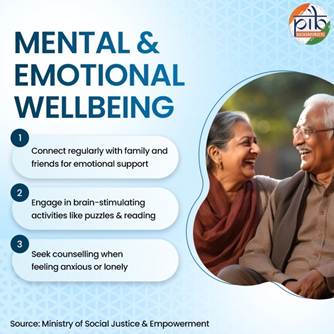
This transition, while a sign of social and health progress, brings challenges of dependency, healthcare, and social security.
Population and Demography Linkages
| Concept | Relevance to Elderly Population |
|---|---|
| Age Structure | The share of the working-age population (15–59 years) will decline post-2035, increasing dependency. |
| Dependency Ratio | 62 dependents per 100 working-age people — rising elderly dependency implies higher fiscal and caregiving burden. |
| Population Pyramid | India’s population pyramid is narrowing at the base and widening at the top — a “rectangularisation” typical of ageing societies. |
| Demographic Dividend Turning Point | India’s demographic dividend may peak by 2035, after which ageing pressure will intensify. |
Demographic Trends of Elderly in India
| Indicator | Key Findings |
|---|---|
| Elderly Population (60+ years) | Expected to reach 230 million by 2036 |
| Regional Pattern | Higher concentration in southern states like Kerala, Tamil Nadu, Himachal Pradesh, and Punjab |
| Kerala | Elderly share projected to rise from 13% (2011) to 23% (2036) |
| Uttar Pradesh | Elderly share projected to rise from 7% (2011) to 12% (2036) |
| Sex Ratio among Elderly | 1,065 females per 1,000 males |
| Dependency Ratio | 62 dependents per 100 working-age people |
| Projected Elderly by 2050 | 319 million (LASI Report 2021) |
Challenges Faced by the Elderly
| Domain | Key Issues |
|---|---|
| Health | Lack of geriatric care, rising NCDs, mental health (dementia), rural–urban access gap |
| Economic | Low pension coverage, medical expenditure burden, risky informal work |
| Social | Isolation, elder abuse, loss of traditional family support |
| Digital | Low digital literacy blocks access to e-services |
| Infrastructure | Non-age-friendly public spaces, inaccessible transport, inadequate long-term care facilities |
Importance of Addressing Elderly Needs
1. Human Dignity and Rights — Aging persons must be protected from neglect, abuse and poverty; ensuring their rights is a moral and constitutional duty (Dignity, welfare).
2. Demographic & Economic Implications — An increasing elderly share affects dependency ratios, savings, labour supply, pension liabilities and public finance; failure to plan can raise fiscal stress and reduce productive capacity.
3. Health-System Burden — A rise in chronic, geriatric and multi-morbidity cases increases pressure on primary, secondary and tertiary health care and calls for geriatric-specialised services and long-term care.
4. Social Stability & Family Structures — Shrinking joint-family support and increasing migration/nuclear families mean more elderly may face isolation or inadequate care — social policy must respond.
5. Gender Concerns — A larger proportion of elderly are women (widowhood, pension gaps, longer life expectancy) — gender-sensitive interventions are necessary.
6. Economic Opportunity (Silver Economy) — Elder-focused goods and services — healthcare, assistive devices, leisure, employment — can generate growth and employment if supported through policy and market nudges.
7. Intergenerational Equity — Policy choices must balance present generation needs with equitable sharing of resources across generations (pensions, health spending, taxation).
8. Disaster & Vulnerability Management — Elderly are especially vulnerable during disasters and public health emergencies; disaster planning must include their needs.
Major Government Initiatives
| Scheme / Initiative | Objective / Key Features |
|---|---|
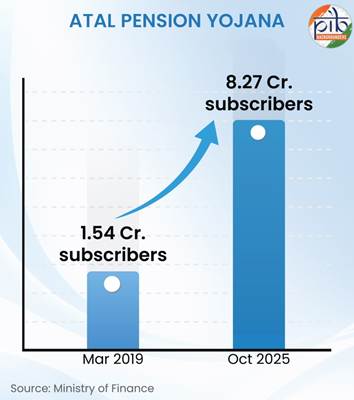
| Atal Pension Yojana (APY) | Provides ₹1,000–₹5,000 monthly pension for citizens aged 18–40; 8.27 crore subscribers (2025) |
| Atal Vayo Abhyuday Yojana (AVYAY) | Umbrella scheme for senior citizen empowerment and inclusion |
| Integrated Programme for Senior Citizens (IPSrC) | Funds NGOs and State agencies to run old-age homes; 696 homes functional (2025) |
| Rashtriya Vayoshri Yojana (RVY) | Provides free assistive devices (wheelchairs, hearing aids) to BPL elderly |
| Elderline (14567) | National Helpline for Senior Citizens addressing grievances and support services |
| SAGE Portal | Encourages start-ups to build products for the “silver economy” with govt equity up to ₹1 crore |
| SACRED Portal | Digital platform for re-employment opportunities for elderly citizens |
| Geriatric Caregivers Training | Empanels institutes for training caregivers; 36,785 trained in 2023–24 |
| Ayushman Bharat – PMJAY (Elderly Extension) | Provides ₹5 lakh annual health cover to all senior citizens aged 70+ |
| Indira Gandhi National Old Age Pension Scheme (IGNOAPS) | ₹200–₹500 monthly pension for BPL elderly; 2.21 crore beneficiaries |
| National Programme for Health Care of the Elderly (NPHCE) | Comprehensive geriatric care at district and sub-district levels |
| Senior Citizens Welfare Fund (SCWF) | Utilises unclaimed funds for welfare programmes for elderly |
| Retirement Homes Model Guidelines (2019) | Promotes age-friendly housing and community living |
Conclusion
India’s ageing population marks a major demographic shift, demanding a move from welfare-based to rights-based elderly care. Strengthening social security, healthcare, and community support while promoting the silver economy can turn this challenge into an opportunity. Ensuring dignity, inclusion, and active participation of senior citizens is key to building an equitable and compassionate society.
Prelims Question
Q. Consider the following pairs:
| Scheme | Implementing Ministry |
|---|---|
| 1. Atal Pension Yojana | Ministry of Finance |
| 2. Rashtriya Vayoshri Yojana | Ministry of Social Justice & Empowerment |
| 3. Indira Gandhi National Old Age Pension Scheme | Ministry of Rural Development |
Which of the above pairs are correctly matched?
(a) 1 and 2 only
(b) 2 and 3 only
(c) 1, 2 and 3
(d) 1 and 3 only
Answer: C
Mains Question
Q. Discuss the demographic and socio-economic implications of India’s ageing population and evaluate the effectiveness of government initiatives in ensuring dignity and welfare for senior citizens. (250 words)

- Elderly in India: Population, Challenges, and Government Initiatives - October 29, 2025
- Jal Jeevan Mission (JJM): Ensuring Tap Water to Every Rural Household - October 27, 2025
- National Blockchain Framework: Strengthening Governance through Blockchain Technology - October 25, 2025

No Comments