


19 Nov Minted Histories: How Delhi Sultanate Numismatics Redefines Medieval India
History often speaks through monuments, manuscripts, and chronicles, yet some of its clearest voices are found in the smallest and most overlooked artifacts: coins. As Edward Thomas once observed, “Coins are the most enduring witnesses to the reigns of kings, the economy of states, and the texture of everyday life,” and nowhere is this truer than in the numismatic legacy of the Delhi Sultanate. These small pieces of metal—gold, silver, copper, or billon—carry within them not just the weight of metal but the weight of power, ideology, and innovation.
The coins of the Delhi Sultanate reveal a world where sovereignty, legitimacy, and economic policy were expressed in inscriptions and images. Muhammad Ghori’s Lakshmi-bearing gold coins, struck after his victory in the Second Battle of Tarain (1192), symbolized a strategic negotiation with the local cultural and religious landscape. Centuries later, Alauddin Khalji boldly removed Caliphal references from his coins, proclaiming instead his own titles, such as Sikandar-us-Sani—“the second Alexander”—asserting imperial ambition through metal. Meanwhile, Muhammad bin Tughluq’s multi-mint operations and radical experiments with token currency reflected both administrative innovation and the perilous limits of monetary experimentation.
Numismatics does more than chronicle politics—it illuminates economy, aesthetics, and cultural adaptation. R.L. Gupta notes, “Coins often tell us what the chronicles would not: the subtle compromises, the pragmatism, and even the contradictions of rulers.” Coins bearing Nagari inscriptions alongside Arabic legends, for instance, reveal how Delhi Sultanate rulers negotiated authority and legitimacy with a diverse, multilingual population. They record not only the names and titles of kings but also the broader ideological and economic strategies that shaped their reigns.
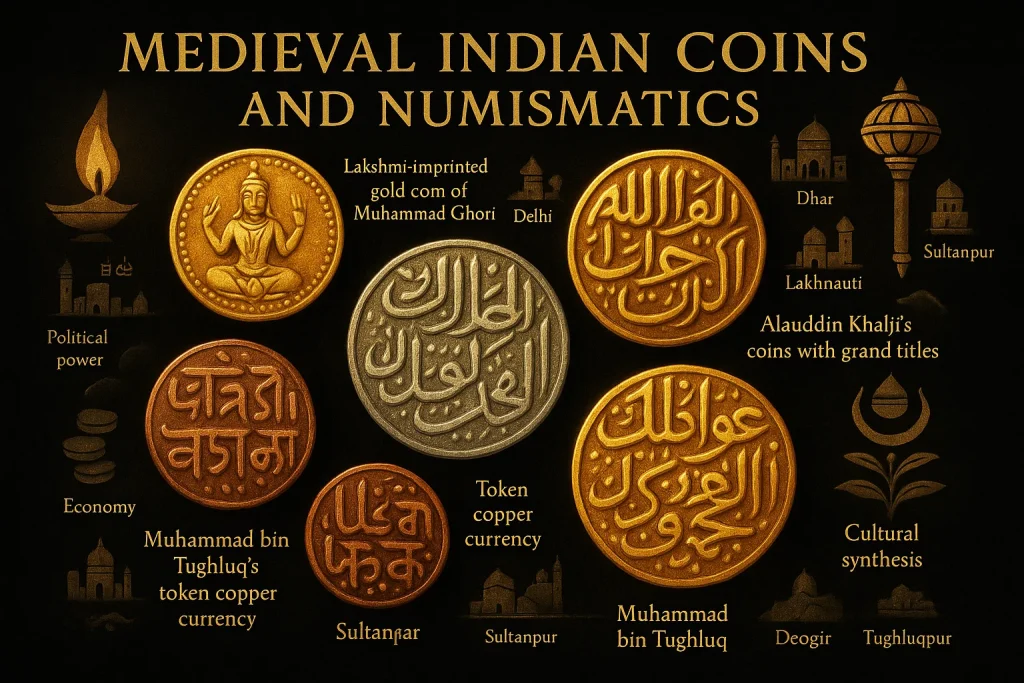
To study these coins is to study history in its most immediate form—a material testimony of ambition, adaptation, and rule. As historian R.S. Sharma reminds us, “The scarcity or abundance of coinage is never simply a question of economics; it is a mirror of political power, social change, and historical contingency.” By tracing the evolution of Delhi Sultanate coinage—from Ghori to Tughluq—one can reconstruct the contours of medieval Indian polity, economy, and society with a precision unmatched by chronicles or inscriptions alone.
This article explores how numismatics not only records history but actively reshapes our understanding of it, revealing an India where rulers, markets, religion, and artistry intersected on a coin—a tiny, yet powerful canvas of medieval life.
Coins as Historical Evidence
Medieval Indian dynasties actively minted coins, and these issues generally held intrinsic value because their worth was tied to the metal used—gold, silver, or copper. As state-controlled instruments, coins offer a continuous and virtually tamper-proof body of evidence, making them among the most reliable historical sources. The imprint of a ruler’s name, titles, symbols, and religious affiliations transforms a simple coin into a historical document that preserves the context of its own time.
In many cases—particularly for the early medieval period where literary sources are sparse—coins provide crucial supplementary evidence. They reveal the identity of rulers, dynastic affiliations, political authority, and even ideological inclinations. For the Chola period and other South Indian dynasties, numismatics adds significantly to what inscriptions and texts alone cannot supply.
Historiographical Debates on Medieval Coinage
The Numismatic Decline Debate
Historian R.S. Sharma argued that the period between the Gupta age and the establishment of Islamic rule witnessed a marked decline in coinage. According to him:
- Gold coins became scarce
- Silver issues declined
- Copper coins were rare
He interpreted this as a sign of the breakdown of monetized exchange and a shrinking commercial economy.
However, this conclusion remains debated. Some scholars suggest that the scarcity of precious-metal coins today may be due to the plundering of Indian treasures by invaders such as Mahmud Ghaznavi, leading to the disappearance of large quantities of gold and silver coinage. What survives archaeologically are mostly low-value base metal coins.
This underscores a methodological caution: the absence of coins in the archaeological record does not necessarily reflect a historical decline in minting or circulation.
Coins and Insights into Religious Policy
R.L. Gupta highlights intriguing evidence from the earliest Turkish invaders. Contrary to their reputation as iconoclasts:
- Mahmud Ghaznavi issued coins with the Kalima translated into Sanskrit and inscribed in Nāgarī script.
- Muhammad Ghori struck coins bearing the image of Goddess Lakshmi and inscriptions in Nāgarī.
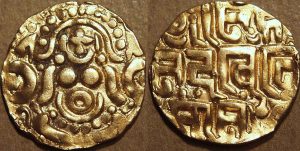
These numismatic findings suggest a more practical and accommodative approach than textual narratives often portray. Coins thus reveal political pragmatism and the need to communicate legitimacy to local populations.
Coins as Economic Evidence
Coins illuminate economic history as well. A notable example is the token currency experiment of Muhammad bin Tughluq, where brass and copper coins were issued in place of silver. Though the attempt failed due to counterfeiting, the coins serve as material evidence of an important fiscal policy initiative.
Aesthetic and Artistic Dimensions
Numismatics also reflects the artistic achievements of an era. The engraving of dies required exceptional craftsmanship, and the portraits or symbols on coins express prevailing artistic sensibilities.
Chola and Vijayanagara Coinage
- Chola coins often depicted royal portraits with impressive detail.
- South India saw a proliferation of silver issues during this period.
- With the rise of Vijayanagara (1336), a new phase began: Predominantly gold coins, Limited silver issues (notably under Harihara I and Devaraya II), Use of Nagari, Kannada, and Telugu scripts.
Transformation under Islamic Rule
With the establishment of the Delhi Sultanate, Indian coinage underwent a radical change:
Key Features
- Pictorial elements were replaced by Arabic and Persian inscriptions.
- Coins came to bear the ruler’s name, titles, mint, and Hijri date.
- The Kalima became a regular feature, symbolising religious and political legitimacy.
- Issuing coins on victories became a royal prerogative.
The practice emphasised sovereignty: a ruler’s legal authority rested partly on having his name recited in the khutba and stamped on coinage.
The numismatic history of the Delhi Sultanate reveals complex political strategies, administrative innovations, and changing assertions of sovereignty. After winning the Second Battle of Tarain (1192), Muhammad bin Sam (Muhammad Ghori) began issuing gold coins modelled on existing Indian currency. These coins bore the Nagari inscription “Śrī Muhammad bin Sām” and displayed the image of Goddess Lakshmi on the obverse. Such issues demonstrate his conscious attempt to appeal to the local population and continue earlier monetary traditions.
Although Qutbuddin Aibak established Delhi as the capital, no coins bearing his name have been discovered so far, suggesting either limited minting or subsequent loss.
Iltutmish: Assertion of Sovereignty through Coins
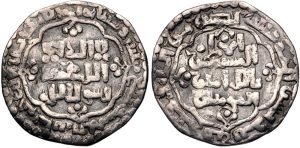
Iltutmish (1211–1236) was the first ruler of the Sultanate to consolidate and regularize the coinage system. His silver coins carry various legends, the most significant being those inscribed with the name of the Abbasid Caliph al-Mustansir. This inscription—sometimes accompanied by the Kalima—confirms the formal investiture he received in 1228, providing him symbolic legitimacy within the Islamic world.
Balban’s Coinage
Balban (1266–1287) continued issuing coins in Arabic but added a Nagari legend “Śrī Sūltān Ghiyāsuddīn” circumscribing his Arabic inscription. This bilingual formula reflects a deliberate outreach to the Indian populace. Copper coins of the period also carried legends on both sides, reflecting administrative consistency.
Alauddin Khalji: Wealth and Innovation
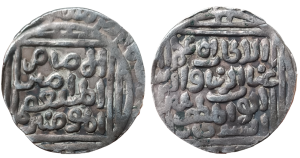
The vast wealth acquired through Alauddin’s Deccan and southern conquests facilitated an abundant release of gold and silver coins. He transformed existing conventions by removing references to the Caliph and instead assuming grand titles such as:
- Sikandar-us-Sānī (Second Alexander)
- Yamīn-ul-Khilāfat
His coins continued the long-standing standard of 170 grains, equal to one tola of gold. The uniformity of weight and content retained continuity with earlier issues, beginning from the time of Muhammad bin Sam.
Ghiyasuddin Tughluq and the Early Tughluq Coinage
Ghiyasuddin Tughluq (1320–1325) followed Khalji precedents but broadened metal usage by issuing coins in gold, silver, billon, and copper. His reign maintained monetary stability, but it was his son, Muhammad bin Tughluq, who introduced dramatic innovations in minting and monetary policy.
Muhammad bin Tughluq: The Most Experimental Numismatist
1. Expansion of the Mint Network
Muhammad bin Tughluq operated an unprecedented number of mints. Coins were struck at:
- Delhi
- Dhar
- Lakhnauti
- Satgaon
- Sultanpur
- Deogir
- Dar-ul-Islam (Ranthambhor)
- Mulk-i-Tilangana
- Tughluqpur (Tirhut)
This extensive mint system reflects his expansive administration and efforts at financial centralization.
2. Coins in Honour of His Father
Early in his reign, he issued coins bearing the name of Ghiyasuddin Tughluq along with the title al-shahid (martyr). Given that he ascended the throne after his father’s suspicious death, these coins were likely an attempt at political damage control rather than filial devotion.
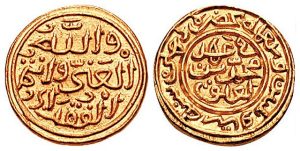
3. Revival of the Kalima
Muhammad bin Tughluq reintroduced the Kalima on coins—a feature discontinued after Iltutmish’s time—thus restoring a traditional Islamic symbol of sovereignty. This became standard on coins for many decades thereafter.
4. Experiments in Weight Standards
He altered the weight of gold and silver coins, issuing:
-
Gold dinars of 201.5 grains
-
Silver adlis of 144 grains
These deviations from the standard reflected attempts to adjust currency value to changing economic needs.
5. Token Currency Experiment (1329–30)
One of the most audacious initiatives was the introduction of token copper currency to replace silver and billon tankahs.
Inscriptions on the tokens included appeals such as:
-
“He who obeys the Sultan obeys the Compassionate (Allah).”
-
“I hope this stamped tankah will be accepted in transactions.”
However, the experiment failed catastrophically:
-
Copper tokens were easy to forge
-
Households began producing counterfeit currency
-
Market confidence collapsed
By 1331, Muhammad bin Tughluq withdrew the entire issue, suffering massive financial losses.
Later Rulers and the Continuity of Numismatics
Following Muhammad bin Tughluq, the later Tughluqs and subsequent rulers of the Delhi Sultanate continued to use coins as instruments of sovereignty, propaganda, and fiscal management, albeit with varying degrees of innovation and success. Firoz Shah Tughluq (1351–1388), for instance, reverted to a more conservative coinage system after the turbulent experiments of his predecessor. He emphasized stability, issuing gold, silver, and copper coins with standard weights and inscriptions, reinforcing both his legitimacy and the public’s confidence in the currency. His coinage reflected careful attention to economic pragmatism and administrative control, ensuring that minting operations across the Sultanate maintained uniformity.
The Sayyid and Lodi dynasties (1414–1526) further streamlined the Sultanate’s monetary system. Lodi coins, particularly those of Sikandar Lodi, bore inscriptions that combined Arabic calligraphy with occasionally symbolic motifs, demonstrating continuity with earlier traditions while adapting to evolving political contexts. These issues maintained weight and metal standards that facilitated trade and revenue collection, underlining the enduring role of coins in governance.
Even during periods of political instability or territorial fragmentation, coins remained a consistent marker of sovereignty and authority. They recorded the ruler’s name, titles, mint, and Hijri date, acting as portable declarations of power. Across centuries, from Muhammad Ghori’s pragmatic Lakshmi coins to the disciplined, standardized issues of the Lodis, the Sultanate’s coinage documents a historical continuum of governance, ideology, and economy.
Conclusion
The coins of the Delhi Sultanate are far more than instruments of trade; they are enduring witnesses to the ambitions, innovations, and complexities of medieval India. From Muhammad Ghori’s Lakshmi-imprinted gold coins to Alauddin Khalji’s assertion of sovereignty and Muhammad bin Tughluq’s experimental token currency, each issue reflects deliberate choices in politics, economy, and ideology. Numismatics allows historians to peer beyond textual narratives, uncovering the pragmatism, aesthetic sensibilities, and fiscal strategies of rulers who navigated a diverse and often turbulent landscape.
As R.L. Gupta aptly notes, “Coins speak when chronicles are silent, and reveal when inscriptions conceal.” By examining these small yet powerful objects, we gain insights into not only the administration and economy of the Delhi Sultanate but also the broader social and cultural currents of the period.
In essence, numismatics redefines our understanding of medieval India, transforming metal into memory, inscriptions into evidence, and coins into chronicles of power, faith, and innovation. The study of these minted histories reminds us that even the smallest artifacts can illuminate the grandest narratives.

- Alauddin Khalji’s Revolutionary Price Control Policy: How One Sultan Reinvented the Medieval Indian Economy - November 24, 2025
- From Chains to Crown: The Rise of the Mamluk Sovereigns in Delhi - November 20, 2025
- Reconstructing Medieval India: Chronicles, Narratives, and the People’s Perspective - November 19, 2025

No Comments