


19 Nov Reconstructing Medieval India: Chronicles, Narratives, and the People’s Perspective
Medieval India, especially after the establishment of the Delhi Sultanate, witnessed a remarkable surge in literary and textual records. This period stands out not only for its rich political and social developments but also for the way history was documented. One of the key reasons for this explosion of written material was the gradual availability of paper, which became cheaper and more accessible. Chroniclers eagerly used it to record the reigns of rulers, political intrigues, judicial proceedings, petitions, and revenue accounts. Even the teachings of saints and the trade activities of merchants found their way into these manuscripts.
However, collecting these manuscripts was not easy. Paper, though more common than before, remained expensive. Manuscripts were often the privilege of the wealthy, rulers, monasteries, temples, or state archives. They were painstakingly copied by hand, and over time, errors—both minor and major—crept into the texts. This makes studying medieval manuscripts both fascinating and challenging. Historians have to approach them with a critical eye, keeping in mind that these records were rarely objective and often reflected the biases of their authors.
Much of what we know about medieval India comes from a blend of Persian chronicles and the writings of foreign travellers. These visitors, often envoys, merchants, or curious wanderers, provide glimpses into the culture, politics, economy, and society of the time.
For instance, the Arab traveller Al-Masudi (957 CE) offered an extensive account of India, describing its social and cultural landscape. Al-Biruni (1024–1030 CE), who accompanied Mahmud of Ghazni on his campaigns, produced the monumental work Tahqiq-i-Hind, which analyzed India’s religions, sciences, and politics with a depth rarely seen in medieval writings.
A century later, the Moorish traveller Ibn Battuta (1333–1347 CE) journeyed through India during Muhammad bin Tughluq’s reign. His travelogue, the Rehla, vividly depicts the political life, geography, and social structures of the subcontinent. Meanwhile, Venetian merchant Nicolo Conti (1420–1421 CE) brought back fascinating insights from the Vijayanagar Empire, painting a picture of its wealth, architecture, and bustling trade networks.
Persian chronicler Abdur Razzaq (1443–1444 CE) spent time at the court of the Zamorin and recorded the grandeur and opulence of South Indian royalty. And in the early 16th century, the Portuguese traveller Domingos Paes (1520–1522 CE) visited the court of Krishnadeva Raya in Vijayanagar, offering an eye-witness account of one of India’s most powerful empires.
What makes these accounts truly remarkable is their blend of curiosity, observation, and storytelling. They allow us to step into the past and experience India as it was seen through foreign eyes—an intricate tapestry of kingdoms, cultures, and human ambitions. Yet, they also remind us to read history critically, for every traveller brought their own perspectives, prejudices, and interpretations along with their descriptions.
Medieval India, through these narratives, comes alive—not just as a series of dates and battles but as a vivid world of rulers, merchants, saints, and wanderers, each leaving a mark that echoes through the pages of history.
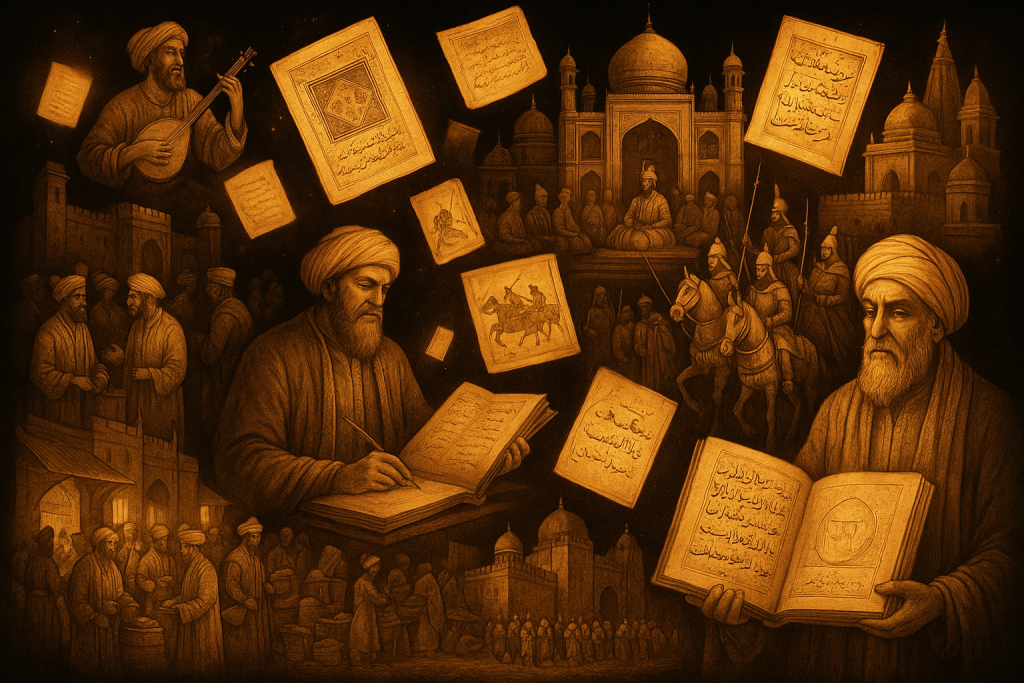
Understanding Medieval Indian History Through Persian Chronicles
When we look at medieval Indian history, it’s important to remember that not all accounts are impartial or “truthful” in the modern sense. Written histories from the past often carry the biases of their authors, reflecting personal viewpoints and the agendas of those who commissioned them. The so-called “authentic” histories, far from being purely factual, can sometimes dull our critical thinking if we accept them at face value. Every chronicler of the past decided what to include, what to omit, and for whom they were writing, shaping an “official” narrative that served political or cultural purposes.
Interestingly, the thirteenth and fourteenth centuries mark a turning point in the availability and diversity of historical sources. During the Delhi Sultanate, Persian texts became widely accessible, offering historians a rich literary record. Earlier historians of the seventh to twelfth centuries primarily relied on epigraphy, coins, and archaeology to reconstruct political and social history. These sources, though valuable, often provide a limited view and have even led to debates about concepts like “Indian feudalism” or “segmentary state” because scholars had to generalize from fragmentary evidence.
Persian chronicles, however, present a broader and more cohesive picture. As historian Sunil Kumar notes, the expansive canvas of these chronicles often overshadows the epigraphic, numismatic, architectural, and archaeological evidence, relegating them to a secondary, corroborative role. Works like the tawarikh of the Delhi Sultans allow us to understand the formation of state institutions, the conduct of kings and their subordinates, and the politics of the period with a narrative depth unmatched by other sources. Yet, it is essential to remember that almost all Persian texts of the time—except Isami’s Futuh al-Salatin—reflect the perspective of the Delhi Sultanate itself.
The Persian literary tradition that flourished in North India was heavily influenced by Iranian-Islamic stylistic conventions. Among its many genres, the tawarikh (chronicles) became particularly popular under the Sultanate. This rise of historical writing as a respected intellectual discipline was relatively new in India. While Sanskrit works like Kalhana’s Rajatarangini chronicled medieval Kashmir, they were exceptions. Muslim historians, by contrast, elevated history into a distinct branch of scholarship, driven by several factors: the Quran’s historical references, a deep cultural interest in genealogy, the compilation of Hadith traditions, and the intellectual engagement of Arab scholars with Byzantine and Sassanid civilizations.
The prosperity of early Caliphate states also fueled literary production, and the spread of paper—first manufactured in Baghdad in the late eighth century—made writing more accessible. Together, these developments set the stage for a remarkable flowering of historical consciousness in India, as Persian chronicles meticulously recorded not just events, but the subtleties of power, governance, and society under the Delhi Sultanate.
Al-Biruni’s Kitab al-Hind: A Scientific Window into Early India
One of the most remarkable historical works to come out of the medieval period is Al-Biruni’s Kitab al-Hind. Written during the early 11th century, it stands out as perhaps the earliest work that could be described as truly “scientific” in its approach to studying another society. Unlike many contemporaneous accounts, which were often second-hand, biased, or superficial, Al-Biruni approached India with intellectual curiosity and a keen desire to understand its culture, religion, and science on its own terms.
Al-Biruni was motivated not by conquest or politics but by knowledge. He wanted to understand why Indians thought the way they did, and to do this, he immersed himself in Indian learning. He studied Sanskrit, read religious and scientific texts, and engaged in discussions with Indian scholars, who welcomed him and shared their insights. His approach was rigorous and remarkably objective for the time—religious prejudices did not cloud his observations.
Kitab al-Hind draws extensively from classical Indian texts. Al-Biruni quotes mathematicians and astronomers like Brahmagupta, Belabhadra, and Varahamihira, and references scriptures such as the Bhagavad Gita, Vishnu Purana, and Vayu Purana. He also examines philosophical systems, including Kapila’s Sankhya and the works of Patanjali, often comparing Indian theories with those of Greece. Notably, he admits openly when he is unsure or lacks complete knowledge, which underscores the scholarly honesty that permeates his work.
But Al-Biruni’s observations went beyond philosophy and science. He recorded Indian customs, festivals, ceremonies, and daily life, offering one of the earliest comprehensive ethnographic accounts of the subcontinent. He analyzed the legal system, noting discrepancies between law books and actual practice, and studied the caste system, explaining that castes, or vamas, were essentially social “colours” rather than rigid divisions. He also measured weights, distances, and astronomical and mathematical data, providing a surprisingly detailed geographical and scientific record.
Interestingly, Al-Biruni did not shy away from critique. He described many contemporary Indian beliefs about history, geography, and science as “ridiculous” and lamented that Indians had lost the scientific skepticism of their ancestors. He felt that blind reliance on tradition and authority hindered genuine intellectual pursuit. Despite these critiques, his work remains invaluable, offering unparalleled insights into Indian society during the early years of the Turkish invasions.
In short, Kitab al-Hind is more than a historical account; it is a scholarly bridge between cultures, an ambitious attempt to understand India on its own terms, and a testament to the enduring power of curiosity and critical observation.
Juzjani and Barani: Chroniclers of the Delhi Sultanate
Medieval Delhi owes much of its historical record to chroniclers who meticulously documented the reigns of its early sultans. Among them, Minhaj-i-Siraj Juzjani and Ziauddin Barani stand out for their detailed narratives, though each approached history with distinct motivations and perspectives.
Juzjani and the Tabaqat-i Nasiri
Juzjani’s Tabaqat-i Nasiri offers a rare window into the Delhi Sultanate, particularly under Sultan Iltutmish. Unlike other chronicles, Juzjani didn’t follow a strict chronological or dynastic structure. Instead, he organized his history around groups of people with shared social or political affinities. His accounts become more detailed as he approaches his own time, naming the sons, nobles, qadis, wazirs, and other officials of Iltutmish—with particular prominence given to Balban.
Understanding Juzjani’s perspective is crucial. He was motivated in part by monetary rewards from Sultan Nasiruddin and Balban, yet this did not make him a professional historian. Intellectual and political concerns also shaped his work. Writing during a time when Islamic political fortunes were threatened by the Mongols, Juzjani sought to restore social confidence by glorifying Muslim rulers. For him, history was essentially the history of political authority, and anyone wielding power was inherently worthy of praise—even if they had seized the throne violently.
His reliance on other sources varied: for distant events, he often trusted existing written histories, while for contemporary events, he relied on hearsay. Juzjani’s religious education heavily influenced his work. Wars were described through the lens of religious loyalty, and his anti-Hindu bias is evident, particularly when Hindus did not challenge Turkish authority. Critics have labeled his history “boring” because it focuses almost entirely on kings and nobles, ignoring the lives of ordinary people. Yet, despite these limitations, the Tabaqat-i Nasiri remains an indispensable source for early Delhi Sultanate history.
Ziauddin Barani and the Tarikh-i Firuz Shahi
While Juzjani documented the earlier sultans, Ziauddin Barani picks up the narrative from Sultan Balban to the sixth year of Firuz Shah Tughluq’s reign. His Tarikh-i Firuz Shahi is a cornerstone for understanding this critical period, influencing later historians like Farishtah, Sirhindi, Abd al-Haqq Dihlawi, and Nizam al-Din Ahmad.
Barani’s work is distinctive not only for its historical detail but also for its socio-political analysis. His Fatawa-i Jahandari (Principles of Government) reflects his views on governance, society, and the role of religion in politics. Born in 1284 to a well-connected Sayyid family, Barani grew up close to royal power. His uncle, Ala-ul Mulk, was an adviser to Alauddin Khilji, which allowed Barani to witness the workings of the court firsthand. Trained under forty-six scholars, he later served as a nadim (court companion) to Muhammad bin Tughluq for seventeen years, placing him in close contact with nobles and rulers.
Barani’s narratives are colored by his background and personal experiences. His position as an alim shaped his religio-political outlook, reflecting the concerns of the ulema over the role of Muslim rulers in a predominantly Hindu society. Though he enjoyed influence during Alauddin Khilji’s reign, Barani’s fortunes declined under Firuz Shah Tughluq, and he even faced brief imprisonment. Nevertheless, his writings provide a rich, if partial, lens on the politics, society, and governance of the Delhi Sultanate.
The Later Years of Ziauddin Barani: History, Reflection, and Vision of Kingship
The final years of Ziauddin Barani’s life were marked by hardship and deprivation. Once a prominent court scholar, Barani suffered imprisonment, had his wealth confiscated, and died a pauper. Yet, even in these difficult circumstances, he turned to writing. In his last year, he produced works on Sufism, Islamic history, and governance, perhaps hoping to regain royal favor and alleviate his misery.
Barani’s literary output was also motivated by personal reflection. He viewed writing as a virtuous act—an attempt to atone for past failures, particularly his inability to confront Muhammad bin Tughluq over the ruler’s cruelty and irrational decisions. For Barani, history was not just a chronicle of events; it was a moral and educational tool. It recorded the deeds of kings, maliks, and other rulers, offering lessons for future leaders on governance, justice, and the consequences of actions. Importantly, he believed history could only be fully appreciated by the elite—the governing classes—who had the insight and authority to implement its lessons.
Completed in 1357–58, Barani’s Tarikh-i Firuz Shahi reflects a mature, highly structured approach to history. Unlike Juzjani’s Tabaqat-i Nasiri, which overlapped chronologically and regionally, Barani focused on the Delhi Sultanate alone, covering six sultans: Ghiyasuddin Balban, Kayqubad, Jalaluddin Firuz Khalji, Alauddin Khalji, Qutbuddin Mubarak Khalji, Ghiyasuddin Tughluq, and Muhammad bin Tughluq. Each chapter lists royal princes and key nobles, and when detailing Firuz Shah Tughluq’s reign, he divided the chapter into eleven muqaddimahs (sections), describing general characteristics of the rule. Although he planned to write 111 sections, he only completed the first eleven.
Barani’s works often convey his ideas indirectly, through dialogues among historical figures. In the Fatawa-i Jahandari (Principles of Government), for example, advice on statecraft is framed as lectures by Mahmud of Ghaznah to his sons. While historically dubious in some accounts, this work offers a clear insight into Barani’s vision of governance rather than a factual record of the Sultanate’s political theory.
Central to Barani’s philosophy was the notion that kingship was an Islamic institution. A ruler’s legitimacy depended on defending the faith, enforcing Shariah, and punishing wrongdoers. The state, he argued, must be guided by pious men, while philosophers and rationalists had no role in governance. A king needed to inspire fear and command authority, yet remain fair and just. A strong, vigilant army was essential, and rulers had a moral and religious duty to maintain social order and suppress immorality.
Barani’s reflections reveal a complex blend of morality, politics, and religious ideology. Even as he faced poverty and marginalization, he remained committed to documenting his vision of rulership and imparting lessons from history—a testament to the enduring power of historical writing in shaping both knowledge and ideals.
Barani, Muhammad bin Tughluq, and the Evolution of Sultanate Governance
Ziauddin Barani’s reflections on the Delhi Sultanate go beyond simple chronicling—they reveal a deeply partisan yet insightful vision of kingship. While he believed that Islamic principles (Shariah) were central to governance, Barani also acknowledged the necessity of secular laws, or Zawabit, to effectively manage the state.
He was highly critical of Muhammad bin Tughluq for elevating “low-born” individuals to high offices, viewing this as a disruption of social order. Philosophers and rationalists, who influenced the Sultan, were also targets of Barani’s disapproval. In his view, such intellectuals encouraged social mobility and unrest. To prevent this, Barani advised restricting access to education for the lower classes, maintaining fixed roles for each professional category, and supporting a feudal system reliant on land-based wealth. Merchants, he argued, should not prosper too much, as their success could destabilize the social hierarchy.
Unlike Juzjani, who primarily recorded events chronologically, Barani saw himself as an interpreter of history. He aimed to educate the ruling classes by analyzing the causes and consequences of policies. For example, he praised Balban while attributing the challenges faced by Balban’s successor to Balban’s own policies. Similarly, he defended Alauddin Khalji’s economic strategies as necessary for the empire’s security. Muhammad bin Tughluq’s reign, in Barani’s eyes, was a sequence of misadventures causing problems rather than solving them, and he openly admitted that he did not fully understand the Sultan’s policies.
Chronology in Tarikh-i Firuz Shahi is often inaccurate, with dates either missing or wrong. Nevertheless, Barani’s broader historical perspective was more analytical than Juzjani’s. He traced the evolution of policies across successive reigns, identifying patterns and lessons. Historians like Irfan Habib consider Barani’s substantive facts and analyses largely accurate, but his subjective and partisan lens requires careful use by modern scholars.
Shams-i-Siraj Afif and the Last Years of the Sultanate
Approximately half a century after Barani, Shams-i-Siraj Afif composed a Persian narrative continuation of the Sultanate chronicles. While Barani focused on consolidation and governance, Afif documented the decline of the Delhi Sultanate, culminating in Timur’s invasion.
Afif, born in 1356–57, hailed from a family of minor officials connected to the Tughluqs and held minor posts in the Diwan-i-Wizarat. Influenced by Sufism and devotional mysticism, his perspective differed significantly from Barani’s court-centered outlook. Only a portion of Afif’s work survives today. He wrote about Ghiyasuddin Tughluq and Muhammad bin Tughluq and seems to have composed a separate account of Delhi’s destruction at Timur’s hands. Afif also attempted to continue Barani’s unfinished sections on Firuz Shah Tughluq, reflecting the ongoing historiographical effort to document the Sultanate’s complex political landscape
Shams-i-Siraj Afif: Nostalgia and Popular History
Unlike Barani, Afif had no reason to flatter rulers—Firuz Shah Tughluq was already dead when he wrote. His narrative is shaped by nostalgia for a world destroyed by Timur, portraying Firuz Shah’s reign as peaceful and prosperous. Military shortcomings were reinterpreted as attempts to maintain peace, and corruption was seen as concern for the welfare of subjects. Afif’s style was simple, accessible, and often sprinkled with curious details—like bearded women, three-legged shops, or cows with horse-like hooves—which makes his work feel like early “popular history.”
Afif’s approach to non-Muslims also differed from his predecessors. He praised Firuz Shah for imposing the Jazia and punishing Brahmins, but he also noted that both Hindus and Muslims suffered equally under Timur, showing empathy across religious lines. Beyond politics, Afif gives us insights into urban planning, canals, gardens, mint operations, army logistics, festivals, and revenue collection, offering glimpses of social life rarely recorded by Juzjani or Barani.
Abdal Malik Isami: Critical Verse on Muhammad bin Tughluq
Another voice from the Sultanate era was Abdal Malik Isami, whose Futuh-us-Salatin presents a harsh critique of Muhammad bin Tughluq. Written in verse under the patronage of Bahman Shah—the founder of the Bahmani kingdom—Isami’s account reflects both literary flair and political hostility, emphasizing the Sultan’s failures and providing a counterpoint to more favorable narratives.
Amir Khusrau: Poetry, Culture, and Courtly Life
Amir Khusrau was not a historian in the conventional sense, but his poetic works offer a vivid portal into the social and cultural life of the Sultanate. Born in 1253, he served under six sultans, witnessing key political events and courtly affairs. Though history was not his primary focus, his masnavis—poetic narratives—captured events, personalities, and nuances of life that conventional chronicles often ignored.
His first historical masnavi, Qirn-us-Sadayn, describes interactions between Bughra Khan and his son Kaiqubad, providing details about Delhi, the imperial court, and the daily life of nobles. Other works, like Miftah-ul-Futuh, allowed him to subtly express contempt for enemies such as the Mongols while recording cultural and social developments. Unlike formal historians, Khusrau could introduce anecdotes and minute details that enrich our understanding of medieval India’s cultural fabric.
Amir Khusrau and the Literary Lens on the Delhi Sultanate
Amir Khusrau, born in 1253, occupies a unique place in the historiography of medieval India. Unlike court historians who aimed to chronicle events systematically, Khusrau approached history poetically, blending literary flourish with social observation. His works provide invaluable glimpses into the Delhi Sultanate that go beyond politics and courtly intrigues.
One of his earliest historical masnavis, written in 1291, details Jalaluddin Khilji’s military campaigns, including the rebellion of Malik Chajju, the Sultan’s advances into Ranthambhor, and the conquest of Jhayan. Khusrau’s Khaza’in-ul-Futuh, also known as Tarikh-i-Ala, is a flattering account of Alauddin Khilji’s first fifteen years. It is a rare contemporary source for Alauddin’s reign, covering his campaigns in Gujarat, Chittor, Malwa, and Warangal, as well as Malik Kafur’s Deccan expeditions. Rich in geographical and military detail, it also highlights Alauddin’s administrative reforms and architectural projects. Yet, as a work designed to praise the Sultan, it carefully avoids any controversial or embarrassing topics.
Khusrau’s Nuh Sipehr continues this literary trend with an account of Mubarak Shah Khilji’s reign, describing not only military victories and constructions but also the climate, local produce, languages, philosophy, and daily life. His final historical masnavi, the Tughluq Namah, recounts Ghiyasuddin Tughluq’s accession and the defeat of Khusrau Shah, casting the narrative in moralistic terms: Ghiyasuddin embodies good, while Khusrau Shah represents evil.
What makes Khusrau particularly valuable as a historical source is his attention to social and cultural details often neglected by other chroniclers. Embedded in his poetry are descriptions of weapons, military campaigns, cities, professions, games, music, and dance. While his work cannot be treated as objective history, it provides a unique perspective on the everyday lives of people, the social fabric, and the cultural milieu of the Delhi Sultanate.
Yahya bin Ahmad Sirhindi: Chronicling the Post-Timur Sultanate
For the period after Firuz Shah Tughluq, Yahya bin Ahmad Sirhindi’s Tarkikh-i-Mubarak Shahi is the only contemporary history, covering 1388–1434. Sirhindi relied on earlier works by Juzjani, Barani, and Khusrau until 1351, and thereafter on eyewitness accounts, hearsay, and his own observations. His focus was strictly political and military, with events narrated chronologically. Unlike Khusrau, he largely ignored social, economic, or cultural developments, including Alauddin Khalji’s economic policies, making his account more conventional but valuable for reconstructing the post-Timur political landscape.
Beyond the Chronicles: Rethinking History in the Sultanate Era
Modern historiography has moved beyond the old idea of Rankean positivism, which claimed that a historian’s only job is to ascertain “what really happened.” Today’s historians recognize that choosing which facts to highlight and how to interpret them is central to the craft. This approach allows researchers to reinterpret the same primary sources in fresh ways, and often overturn earlier narratives.
Take the Delhi Sultanate, for instance. For centuries, our understanding of the period relied heavily on the Persian tawarikh—official court chronicles recording statecraft, royal policies, and military campaigns. But modern historians like Richard Bulliet, Clifford Bosworth, Simon Digby, Bruce Lawrence, and Carl Ernst have expanded the lens. They examine Sufi malfuzat (discourses), tazkirat (biographies) of poets and religious scholars, and other cultural texts, providing insights into social life, spiritual currents, and cultural exchanges beyond the royal court.
The Role of Bardic Narratives
While Persian chronicles documented the rulers, oral traditions captured the people’s perspective. Across India, professional bards and genealogists preserved histories, often blending mythology with historical events. In Rajputana and Gujarat, bards—called Charans and Bhats—were attached to aristocratic families. These bards meticulously maintained genealogical records and vahi (ledger books) of their patrons, recording heroic deeds and family histories. Their work was hereditary, passed from father to son, and served as an enduring record of Rajput lineage.
Bards were not just passive scribes. Many accompanied their patrons on military campaigns, gaining first-hand knowledge of battles and valorous deeds. Their poetry captured social and cultural life, making it a vital source for understanding the era. In South India, hereditary bards performed similar functions, preserving the histories of local rulers and communities.
L.P. Tessitori’s 1914 “Bardic and Historical Survey of Rajputana,” sponsored by the Asiatic Society of Bengal, was a pioneering effort to document these oral traditions. According to Tessitori, the bardic repertoire consisted of two types of epics: one chronicling the deeds of legendary Rajput heroes, the other focusing on particular Rajput houses. The songs were composed in Dingala—a now extinct local dialect preserved through bardic poetry—and Pingala, a refined poetic language derived from Braja Bhasa.
Yet, bardic narratives come with limitations. The glorification of patrons often exaggerated achievements, and chronological accuracy was frequently compromised. A.K. Forbes noted that while bardic accounts reliably reflect social conditions, they distort timelines. Col. James Tod’s famous works on Rajasthan, for instance, relied heavily on these bardic compositions, creating a romanticized view of Rajput history rather than a critically analyzed one.
In essence, combining Persian chronicles, bardic narratives, and modern research allows historians to reconstruct a more nuanced picture of medieval India—one that balances the politics of rulers with the lived experiences, culture, and traditions of the people.
Khyat Literature and the Evolution of Historical Writing in Rajasthan
While bardic poetry provides rich cultural and social details, more structured and chronologically reliable historical accounts of Rajasthan emerged through Khyat literature. Unlike bardic compositions, Khyats were produced by trained officials rather than bards, making them more methodical and accurate. These chronicles, often composed under royal patronage, substantiated and complemented archival sources, providing historians with a firmer foundation for reconstructing the past.
According to L.P. Tessitori, the Khyat tradition became prominent toward the late sixteenth century, inspired in part by the court of Emperor Akbar, which encouraged Rajput princes to document their histories systematically. The authors—officials known as Pancholis and Mahajnas (or mutsaddis)—were well-versed in administration and trained in recording transactions with precision. Their accounts were objective, structured, and intelligible, contrasting sharply with the poetic and often exaggerated narratives of the Bhats and Charans.
Over time, however, these official chronicles lost their appeal to later generations of Rajput rulers in the eighteenth and nineteenth centuries. They preferred the grandeur and eloquence of bardic poetry, commissioning bards to recast historical records into more ornate and dramatic forms. Tessitori notes that historians like Col. James Tod relied primarily on these poetic renditions, largely disregarding the original Khyats.
Folklore as a Complementary Source
Folklore also offers valuable insights into community life, though it cannot substitute for archival sources. Oral narratives often blur the boundaries between history and myth, making chronological precision difficult. In Rajasthan, oral traditions frequently absorbed material from written chronicles, and vice versa, creating a rich but complex interplay between oral and textual history. While folklore provides cultural context and social perspectives, it rarely offers the authenticity or critical framework required for rigorous historical reconstruction.
Towards a People-Centric Historiography
The study of medieval Indian history has increasingly moved beyond state-centered chronicles. Modern historians question the objectivity of Persian narratives and official court histories, turning instead to a diverse range of sources, including archaeological evidence, inscriptions, and folk traditions. This broader approach allows for the reconstruction of a more inclusive and nuanced past, one that goes beyond the politics and self-interest of rulers to encompass the experiences of ordinary people.
Indeed, much of historical writing on medieval India has been shaped—consciously or unconsciously—by political agendas. Recognizing this, contemporary scholarship emphasizes the need to critically interrogate sources, understand their contexts, and incorporate multiple perspectives to produce a history that reflects the full complexity of society.
The study of medieval India demonstrates that history is not merely a record of kings, battles, and political events, but a complex tapestry woven from diverse sources and perspectives. Persian chronicles, foreign travellers’ accounts, bardic poetry, Khyat literature, and folklore together provide complementary insights into the social, cultural, economic, and political life of the subcontinent. While official records reveal the workings of power, oral and literary traditions highlight the experiences of ordinary people, regional elites, and cultural communities. Modern historiography emphasizes a critical, inclusive approach—questioning biases, analyzing context, and integrating multiple sources—to reconstruct a nuanced and vibrant picture of medieval India. This methodology reminds us that history is not static; it is continually reinterpreted, reflecting both the evidence available and the perspectives of those who engage with it.

- Alauddin Khalji’s Revolutionary Price Control Policy: How One Sultan Reinvented the Medieval Indian Economy - November 24, 2025
- From Chains to Crown: The Rise of the Mamluk Sovereigns in Delhi - November 20, 2025
- Reconstructing Medieval India: Chronicles, Narratives, and the People’s Perspective - November 19, 2025

No Comments