


20 Nov From Chains to Crown: The Rise of the Mamluk Sovereigns in Delhi
When Slaves Became Sovereigns: The Rise of the Mamluk Dynasty in Delhi
India’s history offers a fascinating glimpse into the complex institution of slavery, one that differs significantly from Western narratives. Unlike the plantation and industrial labor-driven slavery of Europe and America, slavery in India was multi-faceted, shaped by the subcontinent’s diverse cultural, religious, and political contexts. As historian Richard Eaton points out, each episode of slavery in South Asia “was shaped by a unique conjunction of contingent factors” and must be understood in its own specific setting.
One of the most striking examples of this unique dynamic is the Mamluk dynasty of Delhi, where slaves—primarily of Central Asian and African origin—rose to occupy the highest seats of power. This phenomenon highlights the remarkable social mobility embedded within the institution in medieval India. Slaves were not merely laborers or subordinates; under certain circumstances, they could ascend to rulership, governing vast populations and shaping the political landscape.
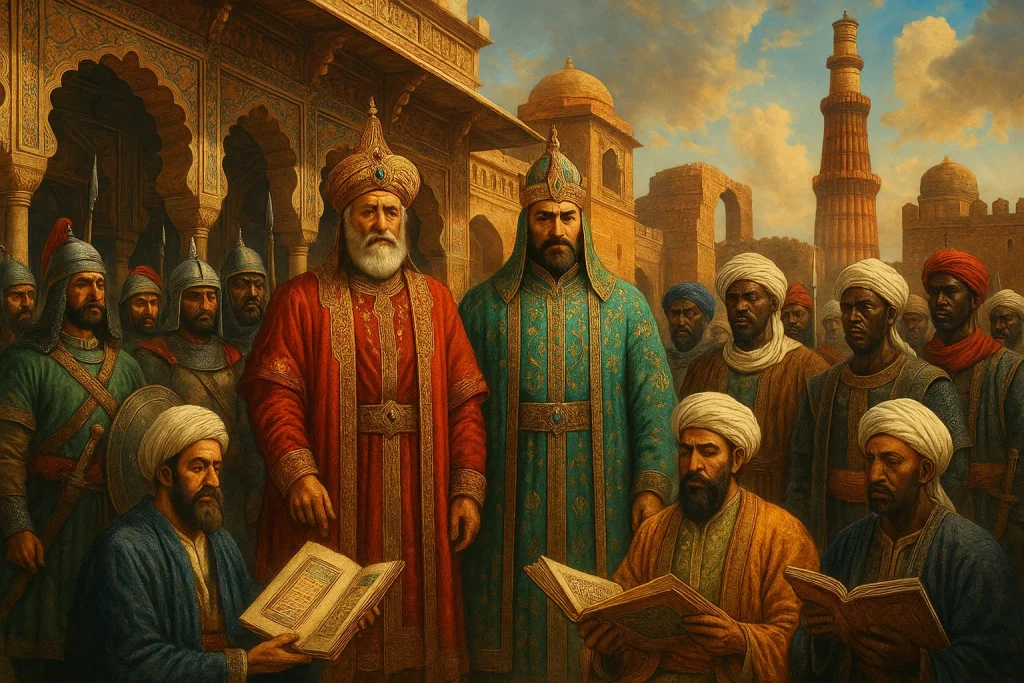
The emergence of such rulers was closely tied to the expansion of Muslim political authority in India from the 11th century onwards. As Islamic empires consolidated their power, slavery became intertwined with statecraft, military service, and administration. Skilled and loyal slaves often found themselves in positions of trust, gradually accumulating influence and eventually claiming sovereignty themselves. The Mamluk dynasty of Delhi stands as a prime illustration: a line of former slaves who established a formidable political entity, demonstrating that in some parts of medieval India, bondage could paradoxically be a stepping stone to supreme authority.
This historical episode challenges conventional perceptions of slavery, revealing a system where the boundaries between servitude and rulership were fluid, and where ambition, loyalty, and skill could propel the enslaved into the halls of power.
Slavery remains a pressing global issue, and recent findings by the International Labour Organisation (ILO) have highlighted India as having the largest number of people living under conditions of modern-day slavery. These circumstances include coercion in domestic work, construction, clandestine factories, agriculture, fishing, and even the sex industry—reminding us that slavery, in its various forms, continues to exist today.
Historically, however, the institution of slavery in India was markedly different from Western experiences. Unlike the plantation and industrial slavery that dominated Europe and the Americas, India’s system of bondage was multifaceted, shaped by diverse cultural, religious, and political influences. Historian Richard Eaton has noted that “each instance of slavery in South Asia was shaped by a unique conjunction of contingent factors; hence each, in order to be properly understood, must be placed in its own unique context.”
Among the most remarkable aspects of India’s history of slavery is the potential for social mobility inherent in the system. In certain contexts, slaves—particularly those from Central Asia and Africa—could rise to positions of immense power, sometimes even becoming rulers. This phenomenon was closely tied to Muslim political authority in India, which by the 11th century had consolidated over large regions of the subcontinent.
Unlike the typical perception of slavery as purely oppressive, in many Muslim dynasties, slaves were recruited for their elite skills, often taking on key military or administrative roles. These “elite slaves” were highly valued, sometimes trained and transported from abroad, and in India, they occasionally rose to sovereign status. African slaves such as Malik Ambar of Janjira, Barbak Shahzada in Bengal, and Sidi Masood of Adoni exemplify this rare trajectory—from bondage to rulership. India, in fact, stands out as one of the only regions where Africans achieved such positions of power.
In northern India, the rise of the Delhi Sultanate further illustrates this dynamic. The Mamluks—Turkish slaves whose name literally means “owned”—established control over significant portions of the subcontinent for nearly a century. While Mamluk rulers also appeared in Egypt and Eastern Iran, India’s case was unique: here, former slaves not only competed with free-born elites but also navigated a highly diverse social landscape, encompassing multiple racial, cultural, and religious groups.
The phenomenon of military slavery itself has deep roots in the Islamic world, dating back to the ninth century. As the Abbasid Caliphate began to fragment, emerging dynasties relied on Turkish slave corps to consolidate power, an innovation that ultimately shaped the trajectories of states from the Middle East to South Asia. In India, however, the system produced something exceptional: slaves transforming into rulers, leaving a legacy that continues to fascinate historians today.
Turkish Slaves and the Rise of Political Power in the Muslim World
The tradition of military slavery in the Islamic world dates back to the ninth century, during the decline of the Abbasid Caliphate in the Middle East. As the central authority weakened, new autonomous dynasties emerged in cities such as Baghdad and Samarra. To consolidate their tenuous rule, these dynasties began recruiting Turkish slave corps—elite soldiers who were both loyal and highly skilled.
Being a Mamluk, or slave soldier, was not considered derogatory. As historian Peter Jackson notes, “The Turks from the Eurasian steppe lands were highly prized by their masters, receiving instruction in Islam and rigorous training in martial arts, and were not employed in menial capacities.” Recruited slaves were often uprooted from their native religious and cultural traditions and trained in the Islamic faith. Remarkably, the institution of slavery itself was respected by the Turks, who seized the opportunities offered by their masters to advance socially and politically. Historian Sunil Kumar writes that “Unlike all other slaves, the Turkish bandagan prospered in their new homes, eventually becoming political grandees and governors.”
By the 11th century, Turkish slave regiments had become the core of many armies in the Eastern Islamic world. Beyond military command, these slaves frequently held ceremonial and administrative positions at court. Several went on to establish dynasties, including the Tulunids and Ikhshidids in Egypt and the Ghaznavids in Eastern Iran. In India, the Delhi Sultanate itself was founded by Qutubuddin Aibek, a former slave of the East Iranian ruler Muizzad-Din Muhammad Ghori.
Far from limiting advancement, slave status often enhanced prestige. Jackson highlights that “The Turkish people were highly regarded within the Muslim world for their courage, stamina, and military skill; Turkish ghulams further gained a reputation for steadfastness and orthodoxy in Islam.”
The Rise of the Delhi Sultanate: Qutb al-Din Aibak and the Turkic Legacy
Central Asia and India have shared interactions for over two millennia, shaping political, cultural, and military developments on both sides. The emergence of powerful nomadic Khans in Central Asia and their influence over neighboring regions created a persistent threat of invasion, which in turn played a critical role in the consolidation of the Delhi Sultanate at the dawn of the 13th century. The ruling elite of this new state was largely composed of Turkic military-feudal nobility, immigrants, and conquerors from Central Asia, Iran, and Afghanistan. Over the next three centuries, the Delhi Sultanate would become the largest political entity in North India, shaping the subcontinent’s history for generations. One of its earliest and most remarkable founders was Qutb al-Din Aibak, a man of humble origins who rose to unprecedented heights.
“A slave can become a ruler if his courage and talent outshine the stars of his masters.” – Bulat Sarsenbayev
Qutb al-Din Aibak’s story is as extraordinary as it is inspiring. Born a slave, he was purchased by a respected scholar and judge, who ensured that Aibak received an excellent education and mastered the art of warfare. After the death of his master, Aibak was sold again due to fears about his rising influence. Yet destiny had other plans. He was bought by Shihab ad-Din Muhammad Ghori, the last sultan of the Ghurid dynasty, who recognized his remarkable talent. Aibak quickly became Ghori’s chief commander and governor in Delhi.
Most medieval sources identify Qutb al-Din’s homeland as Turkestan, a region corresponding to parts of modern Kazakhstan. Historians generally agree that he belonged to the Kipchak tribe, although the term “Kipchak” also encompassed several other Turkic tribes inhabiting the vast steppe known as Desht-i Kipchak. As these tribes migrated westward, neighboring peoples continued to call the new settlers “Kipchaks,” linking identity with geography as much as lineage.
The death of Sultan Muhammad Ghori in June 1206 left a power vacuum. The Ghurid dynasty collapsed, and Qutb al-Din Aibak seized the moment, declaring himself the independent ruler of Delhi. His ascension marked the beginning of the Mamluk or Slave dynasty, which would dominate the city for almost a century.
Despite ruling for only four years, Aibak’s impact was immense. Known as “Lakh Bakhsh” for his generosity, he introduced substantial payments to the army, reduced taxes for the Muslim population, and reformed the administrative system—even in the face of aristocratic opposition. Under his reign, Persian (Farsi) became the official language, fostering a rich cultural and literary environment. Architectural achievements like Lal Kot, the Red Fortress of Delhi, and the iconic Qutub Minar remain enduring symbols of his vision.
The Qutub Minar, a 73-meter brick minaret, stands as a testament to medieval Indo-Islamic architecture and was once considered one of the wonders of the world. Today, it is India’s tallest brick minaret and a UNESCO World Heritage Site, reflecting the artistic and engineering brilliance of the Delhi Sultanate.
Tragically, in 1210, Qutb al-Din’s life ended suddenly when he fell from his horse while playing polo (chovgan). His only son, Aram-Shah, was ill-prepared to rule, leaving the nobility of Lahore to appoint him as sultan despite his incapacity. Yet the foundations laid by Aibak endured, securing the Sultanate’s future for decades and inspiring generations.
Iltutmish, Raziya, and the Rise of Early Delhi Sultanate Institutions
With the death of Qutbuddin Aibak, the responsibility of stabilising and expanding the young Delhi Sultanate fell on the shoulders of Iltutmish—a ruler whose administrative vision and political foresight shaped the foundation of Sultanate rule for decades to come. His reign marks the true consolidation of Turkish authority in north India.
Iltutmish: Architect of the Early Sultanate
Shamsuddin Iltutmish, the third ruler of the Mamluk dynasty, had been a highly esteemed military slave under Aibak. Not only was he considered extremely valuable, but he also enjoyed the monarch’s trust, who often referred to him as a son. However, following Aibak’s death, Iltutmish leveraged his position to challenge the emperor’s son, Aram Shah, and successfully claim the throne. He further consolidated his claim by marrying Aibak’s daughter.
This combination of usurpation and matrimonial alliance was considered scandalous by contemporary court chroniclers, who often framed the succession as a conflict between the son and the son-in-law, rather than acknowledging the extraordinary rise of a former slave to the empire’s highest office.
Iltutmish proved himself to be a capable and ambitious ruler. He expanded the Sultanate’s territory by annexing regions such as Bengal, Multan, the Siwalik hills, and Ranthambore. Beyond military achievements, he reformed the monetary system, commissioned mosques, dargahs, and khanqas, and strengthened the institutional presence of Islam across India, solidifying the Mamluk dynasty’s authority
The ‘Group of Forty’: Turkan-i-Chahalgani
To ensure stable administration, Iltutmish organised his most trusted Turkish nobles into an elite advisory body known as the Turkan-i-Chahalgani, or the “Group of Forty.”
- These nobles held important military and administrative positions.
- They acted as Iltutmish’s inner circle, shaping policies and advising the Sultan.
However, this group later grew too powerful. After Iltutmish’s death, they became kingmakers—choosing and removing Sultans at will—until Balban eventually crushed their power.
Securing Delhi’s Independence and Legitimacy
Iltutmish took several crucial steps to free Delhi from the political complications of Ghazni, Ghor, and Central Asia. He wisely focused on building a stable, independent power in India.
To secure his legitimacy, he obtained a formal Letter of Investiture from the Abbasid Caliph in AD 1229—a symbolic endorsement that enhanced the prestige of the Delhi Sultanate in the wider Islamic world.
Administrative Reforms: Iqtas, Currency, and the Army
Iltutmish’s reign marked major innovations in governance:
1. Development of the Iqta System
Iltutmish granted iqtas—land assignments instead of cash salaries—to his officers.
- The holders, known as iqtadars, collected revenue from their territories.
- They maintained armed forces, enforced law, and managed expenses from this revenue.
Recognising the economic importance of the Doab, Iltutmish strategically distributed many iqtas in this fertile region, strengthening the financial backbone of the Sultanate.
2. Introduction of Standard Coins
He introduced two important currency types:
- Silver Tanka
- Copper Jittal
These coins became the monetary foundation of the Delhi Sultanate for many years.
Raziya Sultan (AD 1236–1240): A Bold but Brief Reign
From the very beginning of her rule, Razia Sultan faced fierce opposition from the powerful Turkic nobles of the Delhi Sultanate. Unlike her predecessors, she had ascended the throne with the support of the general populace rather than the entrenched provincial governors of Turkic origin. The Turkic nobles were elite military and administrative officials, originally from Central Asia, who had held significant influence in the royal court and governed provinces. Prominent nobles during Razia’s time included Malik Izzuddin Muhammad Salari (Badaun), Malik Izzuddin Kabir Khan Ayaz (Multan), Malik Saifuddin Kuchi (Hansi), and Malik Alauddin Jani (Lahore). They opposed Razia because her rise challenged their authority as male-dominated military elites and threatened their control over iqta‘ lands, administrative privileges, and military command.
Among the opponents was also Nizamul Mulk Muhammad Junaidi, a ‘Tazik’ (non-Turkic) officer who had served as wazir since Iltutmish’s reign. Despite being non-Turkic, Junaidi opposed Razia because she bypassed traditional succession rules by taking the throne as a woman. His opposition also reflected loyalty to the previous sultan, Ruknuddin, and concern that Razia’s reforms would weaken his own power.
To counterbalance the power of the Turkic nobles, Razia attempted to create a new class of loyal, non-Turkic officers, including figures like Malik Jamaluddin Yaqut, whom she appointed Amir-i-Akhur (master of horses). This strategy, while innovative, further antagonized the traditional elite. When the rebel factions advanced from different directions, Razia sought support from Malik Nusratuddin Taisi, governor of Awadh, but he was captured while crossing the Ganges and died in captivity.
Undeterred, Razia personally led her army out of Delhi, establishing a camp on the banks of the Yamuna to confront the rebels. After initial skirmishes, two rebel leaders—Salari and Kabir Khan Ayaz—reconciled with Razia, secretly plotting to neutralize other dissenting nobles. Junaidi and other leaders discovered the plan and escaped, while Saifuddin Kuchi and his brother Fakhruddin were captured, imprisoned, and later executed. Alauddin Jani was killed at Nakawan village, and his head was sent to Delhi as a warning. Junaidi fled to the Sirmaur hills, where he later died.
Key Appointments and Administrative Measures
Upon securing the throne, Razia made several strategic appointments to consolidate her authority:
- Khwaja Muhazzabuddin became wazir, receiving the title Nizamul Mulk.
- Malik Qutubuddin Hasan Ghuri was appointed naib-i lashkar (commander-in-chief) after the death of Malik Saifuddin Aibek Bahtu.
- Key iqta‘ lands were redistributed: Lahore, formerly held by Alauddin Jani, was granted to Kabir Khan Ayaz, now a loyalist.
- Loyal officers were placed in imperial household positions, such as Malik-i Kabir Ikhtiyaruddin Aitigin (Amir-i Hajib) and Malik Jamaluddin Yaqut (Amir-i Akhur).
According to chronicler Minhaj, within a short time, nobles from Lakhnauti in the east to Debal in the west acknowledged her authority. Razia’s first military campaigns were aimed at consolidating non-rebellious territories. Qutubuddin Hasan Ghuri led the campaign against Ranthambore, successfully removing Turkic officers but failing to subdue the Chahamana rulers, who, allied with the Mewatis, conducted guerrilla raids across northeastern Rajasthan. A separate campaign to reassert control over Gwalior had to be abandoned.
Suppressing Rebellions and Diplomacy
Razia also faced religious unrest. In 1237, the Shia Qarmatians, led by Nuruddin Turk, attacked Delhi’s Jama Masjid, targeting Sunni worshippers. Razia acted decisively, and the rebellion was quelled by citizens loyal to the Sultanate.
In 1238, Malik Hasan Qarlugh, the former Khwarazmian governor of Ghazni, faced threats from the Mongols and sent his son to Delhi seeking military support. Razia received the envoy courteously, granted him revenues from Baran, but wisely refused to commit to an alliance against the Mongols, maintaining Delhi’s strategic autonomy.
Razia’s struggles illustrate the complex interplay of gender, ethnicity, and politics in medieval India. The Turkic nobles opposed her not only because she was a woman, but because her reforms and appointment of non-Turkic officers threatened their entrenched privileges. By personally leading her army and carefully redistributing power, Razia demonstrated political skill, military courage, and the ability to navigate a divided court. Her reign, though brief, remains historically significant for highlighting both the challenges and possibilities of female rule in a male-dominated society.
The Power of the ‘Forty’ and the Rise of Nasiruddin Mahmud (AD 1246–1266)
After Raziya, the Chahalgani nobles grew even more powerful. They installed rulers at will, including:
- Behram Shah (AD 1240–42)
- Masud Shah (AD 1242–46)
Neither could curb the nobility.
Balban’s Quiet Rise
Ghiyasuddin Balban, the ninth ruler of the Mamluk or Slave Dynasty, is often regarded as the most formidable of all the slave kings. He was formally known as Al-Sultan al-Azam Ghiyath al-Dunya Wal Din Abu’l Muzaffar Balban, was born in 1216 as Baha-ud-Din. He belonged to the Ilbari Turkic community, a group that had significant influence in Central Asia and the early Delhi Sultanate. During his early years,
Like his predecessors, Balban rose from servitude, usurping the throne of his former master after the latter’s death. According to the medieval political thinker Ziauddin Barani, Balban’s reign exemplified the principle that instilling fear of authority is the foundation of effective governance.
In 1232, Khawaja Jamal-ud-din brought Balban to Delhi along with a group of other slaves. These individuals were purchased by Sultan Iltutmish, one of the key rulers of the early Delhi Sultanate. Balban became part of the elite cadre of forty Turkic slaves who were central to Iltutmish’s administration, a group often entrusted with high responsibility and military duties. This early training and exposure to the workings of the state laid the foundation for Balban’s future rise to power.
In AD 1246, the influential noble Ulugh Khan—who would later become the famous Sultan Balban—elevated Nasiruddin Mahmud, a grandson of Iltutmish, to the throne.
Balban himself became the Naib, or deputy ruler, effectively controlling the state.
To strengthen his authority, he arranged a marriage between his daughter and Nasiruddin. Chroniclers like Ibn Battuta and Isami later suggested that Balban may have poisoned Nasiruddin in AD 1265, paving his own way to the throne.
Over time, Balban’s intelligence, discipline, and loyalty helped him ascend the political hierarchy of the Delhi Sultanate. Initially serving as a regent to the last Shamsi sultan, Mahmud, he gained valuable experience in governance and military campaigns. By the time of Mahmud’s death in 1266, Balban had positioned himself as the most powerful figure in Delhi, ultimately declaring himself sultan and shaping the foundation for a stable and prosperous rule.
Balban: The Architect of Sultanate Power (AD 1266–1287)
The struggle between the Sultan and the Turkish nobles, which had plagued the early Delhi Sultanate, found its resolution in the strong leadership of Balban (Ulugh Khan). Rising gradually through the ranks, he eventually consolidated all power and ascended the throne in AD 1266. His reign is remembered as a period of strict centralisation, autocracy, and the strengthening of the Sultanate’s institutions.
The era of Mamluk dominance in the Delhi Sultanate came to an end with the rise of the Khalji dynasty in 1290. As historian Sunil Kumar observes, “The rule of the Khaljis altered the social and ethnic composition of the military elites: the rulers and their nobility were no longer slaves.” Nevertheless, for nearly a century, the prosperity, administration, and military might of the Delhi Sultanate rested firmly in the hands of the Mamluk rulers, leaving a lasting legacy in Indian history.
Challenges at the Start of His Reign
Balban inherited a precarious position:
- Many Turkish nobles remained hostile.
- The Mongols threatened the north-west frontier.
- Provincial governors in distant regions sought independence.
- Local rulers and Rajput zamindars frequently rebelled.
- The Ganga-Yamuna Doab and Awadh suffered from lawlessness; roads were plagued by robbers, and regional forts defied Delhi’s authority.
- The Mewatis boldly attacked settlements near Delhi.
Faced with this chaotic situation, Balban adopted a stern and uncompromising policy to restore law, order, and the authority of the Sultan.
Autocratic Rule and the Theory of Kingship
Balban was a strict autocrat who refused to share power—even with his family. To curb the influence of the Turkish nobles (the Chahalgani), he:
- Appointed spies in every department to monitor the administration.
- Created a strong, centralised army to suppress rebellions and repel Mongol incursions.
- Reorganized the military under the Diwan-i-Arz and deployed forces strategically across the Sultanate.
Balban also developed a new theory of kingship, emphasizing the absolute authority of the Sultan over his nobles. He maintained a court of strict decorum, forbidding laughter and joking, giving up wine, and insisting on ceremonies such as sijada (prostration) and paibos (kissing of the Sultan’s feet) to impress subjects with the majesty of his authority.
The historian Barani records Balban’s harsh attitude: “Whenever I see a base born ignoble man, my eyes burn and I reach in anger for my sword.” Whether literal or symbolic, it reflected his contempt for disloyal nobles and non-Turkish officers.
Military Campaigns and Consolidation
Balban aggressively subdued rebellious regions:
- Mewat and Badayun: Rajput strongholds destroyed; rebels executed.
- Ajmer and Nagaur: Brought under firm Sultanate control.
- Attempts to capture Ranthambore and Gwalior failed.
In AD 1279, the governor of Bengal, Tughril Beg, rebelled, declared independence, and had the khutba read in his name. Balban swiftly sent forces to Bengal, eliminated Tughril, and installed his own son, Bughra Khan, as governor.
Through these measures, Balban secured authority over Delhi and its provinces, making the Sultanate both stable and formidable.
Balban’s Legacy
Balban’s reign strengthened the Delhi Sultanate in multiple ways:
- Centralised power in the Sultan’s hands
- Reformed the military and administrative system
- Asserted the Sultan’s supremacy over the nobility
- Maintained strict law and order, even in distant provinces
However, his policy of excluding non-Turks from positions of power caused resentment. Though he successfully consolidated the Sultanate, underlying tensions resurfaced after his death in AD 1287.
After Balban: End of the Slave Dynasty
After Balban’s death:
- His grandson Kaiquabad was initially placed on the throne.
- Soon replaced by his son Kaimurs, who ruled for just over three months.
Meanwhile, Firoz, the capable minister of war (Ariz-i-Mumalik), seized power in AD 1290 by murdering Kaimurs. Supported by Khalji nobles, Firoz established the Khalji dynasty, marking the end of the so-called Slave (Mamluk) Dynasty. Firoz ascended the throne under the title Jalaluddin Khalji, initiating a new era in the Delhi Sultanate

- Alauddin Khalji’s Revolutionary Price Control Policy: How One Sultan Reinvented the Medieval Indian Economy - November 24, 2025
- From Chains to Crown: The Rise of the Mamluk Sovereigns in Delhi - November 20, 2025
- Reconstructing Medieval India: Chronicles, Narratives, and the People’s Perspective - November 19, 2025

No Comments