


15 Dec 18th AIPP Conference Rekindles Push for Empowered Panchayats and Grassroots Democracy
This article covers “Daily Current Affairs” and From 18th AIPP Conference Rekindles Push for Empowered Panchayats and Grassroots Democracy
SYLLABUS MAPPING
GS – 2 – Polity and Governance – 18th AIPP Conference Rekindles Push for Empowered Panchayats and Grassroots Democracy
FOR PRELIMS
Mention the main objectives of the 73rd Constitutional Amendment Act.
FOR MAINS
How do Panchayati Raj Institutions promote decentralisation in India?
Why in the News?
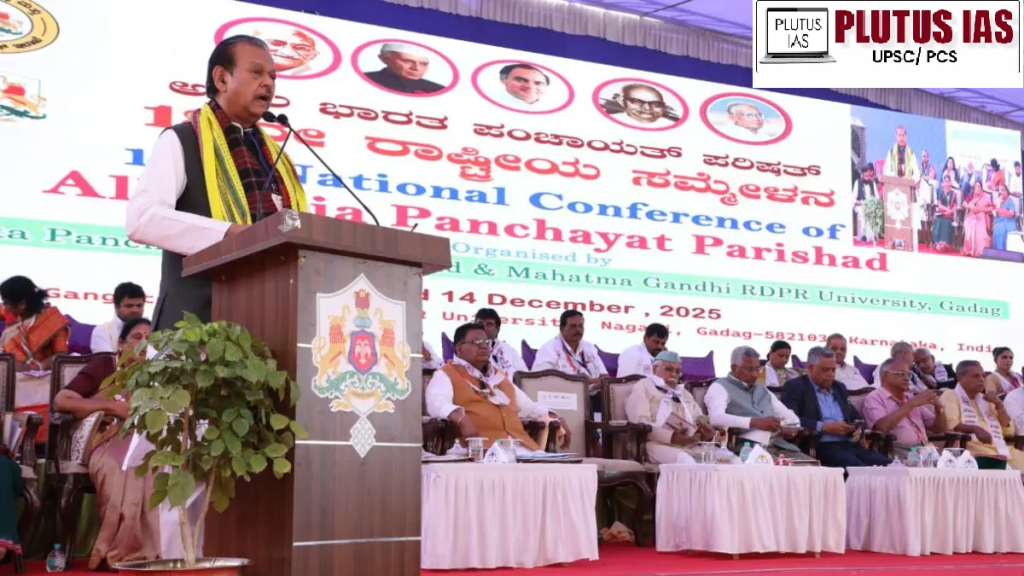
The 18th National Conference of the All India Panchayat Parishad renewed focus on strengthening Panchayati Raj Institutions in line with the 73rd Constitutional Amendment. The conference highlighted the need for self-reliant villages, deeper decentralisation, and empowered Gram Sabhas, while flagging gaps in devolution of functions, finances and functionaries (3Fs). It also underscored the role of PRIs in effective implementation of welfare schemes, rural development, and grassroots democracy, making it relevant in the current governance discourse.
Renewed National Attention on Panchayati Raj
The recent 18th National Conference of the All India Panchayat Parishad has brought Panchayati Raj Institutions (PRIs) back into the policy spotlight. The conference stressed that self-reliant villages are the foundation of Atmanirbhar Bharat, especially at a time when rural India faces challenges of livelihood insecurity, climate vulnerability, and uneven development. The deliberations highlighted that effective decentralisation is not just desirable but necessary for responsive governance and sustainable development.
Constitutional Mandate and Democratic Deepening
Constitutional Recognition of Local Self-Government: The 73rd Constitutional Amendment Act, 1992 marked a watershed in India’s democratic evolution by granting constitutional status to Panchayati Raj Institutions under Articles 243 to 243(O). It sought to institutionalise Panchayats as the third tier of governance, moving beyond mere administrative decentralisation to genuine political decentralisation. By clearly defining their tenure, structure, and powers, the Constitution aimed to ensure stability, continuity, and legitimacy of grassroots institutions.
Institutional Framework for Democratic Participation: The amendment mandated regular five-year elections supervised by independent State Election Commissions, ensuring democratic continuity at the local level. Provisions for reservation of seats for women (not less than one-third) and Scheduled Castes and Scheduled Tribes significantly broadened political participation, enabling inclusion of historically marginalised groups and fostering leadership from the grassroots.
Gram Sabha as the Foundation of Participatory Democracy: The constitutional recognition of the Gram Sabha as the basic unit of the Panchayati Raj system was a critical step towards direct democracy. Gram Sabhas were envisaged as forums for collective decision-making, approval of development plans, social audits, and accountability of elected representatives. In principle, this empowered citizens to shape local development priorities and monitor governance outcomes.
Vision of Self-Governance and Decentralised Planning: Through the Eleventh Schedule, the Constitution listed 29 subjects to be devolved to Panchayats, covering sectors such as agriculture, health, education, and rural development. This reflected the vision of localised planning and implementation, where development decisions are taken closest to the people, ensuring efficiency, responsiveness, and contextual relevance.
Constraints on Democratic Deepening: Despite this strong constitutional mandate, state-level dominance over administration and finances has constrained the autonomy of Panchayats. Partial devolution of powers, weak implementation of State Finance Commission recommendations, and continued control of line departments have reduced many PRIs to implementing agencies rather than institutions of self-governance. This gap between constitutional intent and operational reality has limited the depth of democratic decentralisation.
Need for Renewed Commitment to Constitutional Spirit: The limited autonomy of Panchayats underscores the need to move from formal constitutional compliance to substantive empowerment. Realising the democratic potential of the 73rd Amendment requires genuine transfer of authority, revitalisation of Gram Sabhas, and respect for local decision-making, thereby deepening democracy from the grassroots upwards.
Role of Panchayats in Rural Development and Self-Reliance
Grassroots Planning and Participatory Governance: Panchayats serve as the foundation of bottom-up development by institutionalising people’s participation through Gram Sabhas and Gram Panchayat Development Plans (GPDPs). These platforms enable identification of local needs, prioritisation of development works, and community ownership of outcomes. Such participatory planning ensures that rural development is demand-driven, context-specific, and socially inclusive.
Implementation of Rural Development Schemes: Panchayats play a pivotal role in implementing flagship schemes related to employment generation, housing, sanitation, drinking water, agriculture, and poverty alleviation. By acting as the last-mile delivery institutions, PRIs ensure better targeting, reduced leakages, and improved service delivery, thereby enhancing the effectiveness of public expenditure in rural areas.
Promotion of Local Livelihoods and Economic Self-Reliance: Through convergence of schemes and support to SHGs, FPOs, cooperatives, and rural enterprises, Panchayats promote livelihood diversification and local economic planning. Creation of durable assets under programmes like MGNREGA and emphasis on agriculture, allied activities, and micro-enterprises help strengthen income security and foster village-level self-reliance.
Sustainable Resource Management and Infrastructure Development: Panchayats contribute to sustainable development by managing land, water, forests, and common property resources. Initiatives such as watershed development, water conservation, rural roads, and sanitation infrastructure enhance productivity while ensuring ecological sustainability, which is crucial for long-term rural resilience.
Social Inclusion and Accountable Governance: By enabling representation of women, Scheduled Castes, and Scheduled Tribes, Panchayats promote social justice and inclusive growth. Mechanisms like social audits, transparency portals, and digital governance tools strengthen accountability and trust. When empowered with adequate functions, finances, and functionaries, Panchayats emerge as key drivers of inclusive rural development and grassroots self-reliance.
Way Forward: Strengthening Grassroots Governance
Ensuring Full Devolution of the 3Fs: A genuine system of local self-governance requires complete and uniform devolution of functions, finances, and functionaries to Panchayats in accordance with the 73rd Constitutional Amendment. States must transfer real decision-making authority over subjects in the Eleventh Schedule and align administrative control with elected local bodies to strengthen autonomy and accountability.
Revitalising Gram Sabhas and Participatory Democracy: Gram Sabhas should be strengthened as effective deliberative and oversight institutions rather than symbolic forums. Regular meetings, wider participation of women and marginalised groups, and empowerment in planning, social audits, and beneficiary selection can deepen grassroots democracy and ensure responsiveness to local needs.
Strengthening Fiscal Architecture and Finance Commissions: Timely constitution of State Finance Commissions and effective implementation of their recommendations are critical for fiscal sustainability of PRIs. Enhancing untied grants, expanding local revenue sources, and ensuring predictable fund flows will reduce Panchayats’ dependence on higher governments and improve development outcomes.
Capacity Building and Professional Support: Systematic training of elected representatives and officials under programmes like the Rashtriya Gram Swaraj Abhiyan (RGSA) must be complemented with access to technical expertise in planning, finance, and project management. Dedicated local cadres and institutional support systems can significantly enhance governance capacity.
Leveraging Digital Governance for Transparency and Efficiency: Digital initiatives such as e-Gram Swaraj, SVAMITVA, and GIS-based planning tools should be scaled up to improve financial management, asset ownership, and transparency. Technology-driven governance can reduce leakages, strengthen accountability, and empower Panchayats with data-driven decision-making.
Shifting from Control to Empowerment: Ultimately, strengthening Panchayati Raj demands a paradigm shift from top-down administrative control to genuine local empowerment. Recognising Panchayats as institutions of self-government rather than implementing agencies is essential to realise inclusive development, democratic decentralisation, and rural self-reliance.
Conclusion
Panchayati Raj Institutions are the bedrock of India’s democratic and developmental framework. The renewed focus on rural governance underscores that true decentralisation is key to inclusive growth, social justice, and democratic deepening. Strengthening PRIs is not merely an administrative reform but a constitutional and developmental imperative for India’s future.
Prelims question:
Q. With reference to Panchayati Raj Institutions in India, consider the following statements:
1. The 73rd Constitutional Amendment gave constitutional status to Panchayati Raj Institutions.
2. The Eleventh Schedule contains 29 subjects related to rural development.
3. State Finance Commissions are constituted under Article 280.
Which of the statements given above are correct?
A. 1 and 2 only
B. 2 and 3 only
C. 1 and 3 only
D. 1, 2 and 3
Answer: A
Mains Question
Q. Despite constitutional recognition, Panchayati Raj Institutions have not fully evolved as institutions of self-governance.” Examine the reasons and suggest measures to strengthen grassroots democracy. (250 words)

- PRAGATI: A Decade of Cooperative, Outcome-Driven Governance - January 15, 2026
- Iran’s Large-Scale Protests: Political Stability, Public Dissent and Regional Implications - January 14, 2026
- India–Oman CEPA: A Strategic Trade Pact for Jobs, Exports and Regional Integration - January 10, 2026

No Comments