


15 Jan PRAGATI: A Decade of Cooperative, Outcome-Driven Governance
This article covers “Daily Current Affairs” and From PRAGATI: A Decade of Cooperative, Outcome-Driven Governance
SYLLABUS MAPPING
GS- 3 – Infrastructure – PRAGATI: A Decade of Cooperative, Outcome-Driven Governance
FOR PRELIMS
How does PRAGATI help in improving coordination between the Centre and the States
FOR MAINS
Explain the role of PRAGATI in improving accountability in government administration.
Why in the News?
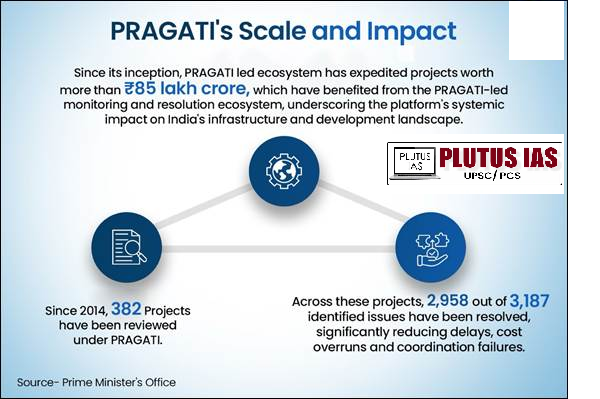
PRAGATI (Pro-Active Governance and Timely Implementation) completed a decade of operation in January 2026, with official data highlighting acceleration of projects worth over ₹85 lakh crore, resolution of 2,958 out of 3,187 issues, and institutionalisation of Prime Minister–led real-time Centre–State coordination, marking a major governance reform milestone.
PRAGATI as an Instrument of Governance Innovation
| Dimension | Key Features under PRAGATI | Governance Impact |
|---|---|---|
| Technology-Enabled Decision-Making | Digital dashboards, GIS-based project visualisation, secure video-conferencing, real-time data flow | Eliminates information asymmetry, enables evidence-based decisions, accelerates corrective action, reduces time and cost overruns |
| Shift from Process to Outcomes | Focus on deliverables, timelines, physical outputs (km of roads, MW commissioned) | Moves governance from rule-bound procedures to outcome-oriented administration aligned with New Public Management principles |
| Breaking Bureaucratic Silos | Joint participation of Union Secretaries, Chief Secretaries, and field officials | Improves vertical and horizontal coordination, reduces blame-shifting, enhances policy coherence across departments |
| Centralised Oversight with Distributed Execution | Strategic steering by PMO and Cabinet Secretariat; execution by Ministries and States | Ensures swift bottleneck resolution while preserving federal balance—example of cooperative federalism with accountability |
| Culture of Accountability | Fixed timelines, clear responsibility, digital tracking, repeated follow-ups | Creates reputational accountability, discourages inertia, strengthens transparency, responsiveness, and ethical governance |
Strengthening Cooperative Federalism
Centre–State Collaborative Platform : PRAGATI functions as a shared governance interface where Union Ministries and State governments deliberate simultaneously. By replacing fragmented correspondence with collective problem-solving, it operationalises cooperative federalism in practice rather than rhetoric. States are treated as partners in execution, not merely implementing agencies, reinforcing trust and institutional dialogue.
Real-Time Resolution of Federal Frictions : Many development delays stem from Centre–State jurisdictional overlaps—particularly in land acquisition, environmental clearances, and rehabilitation. PRAGATI enables consensus-driven escalation, where contentious issues are resolved through direct dialogue under Prime Ministerial oversight. This reduces intergovernmental friction, prevents litigation, and ensures time-bound conflict resolution.
Empowerment of State Administration : Direct interaction between Chief Secretaries and the Prime Minister bypasses multiple bureaucratic layers, amplifying state voices at the highest executive level. This elevates administrative morale, accelerates approvals, and reduces Centre–State mistrust. States gain greater ownership over implementation outcomes, strengthening executive federalism.
Shared Ownership of National Projects : PRAGATI reframes infrastructure and welfare initiatives as national developmental imperatives, dissolving artificial Centre–State binaries. Clear role allocation and joint monitoring create shared accountability for success or failure. This collective ownership aligns incentives across governments and discourages political blame-shifting, particularly in large, cross-jurisdictional projects.
Institutionalisation Beyond Personalities : Unlike ad-hoc review mechanisms dependent on individual leadership styles, PRAGATI has matured into a rule-based, technology-backed institutional platform. Standardised dashboards, fixed review cycles, and formalised follow-ups ensure continuity beyond political tenures. This institutionalisation safeguards governance innovation from leadership transitions and embeds cooperative federalism within administrative routines.
Impact on Infrastructure and Economic Growth
Reduction in Time and Cost Overruns : PRAGATI’s high-level, time-bound reviews have enabled decisive intervention in stalled mega projects such as the Bogibeel Bridge, Mumbai Trans Harbour Link (MTHL), and the Udhampur–Baramulla Rail Link. By swiftly resolving land, clearance, and funding bottlenecks, PRAGATI curtailed chronic delays and escalating costs, enhancing project viability and fiscal discipline.
Unlocking Long-Pending Projects : Several infrastructure projects, stalled for decades due to inter-ministerial and Centre–State deadlocks, were revived through continuous monitoring and escalation under PRAGATI. The platform transformed episodic reviews into sustained governance attention, ensuring that unresolved issues did not relapse into bureaucratic inertia, thereby converting sunk investments into productive assets.
Enhanced Capital Productivity : Timely completion of infrastructure projects accelerates revenue generation, employment creation, and multiplier effects. PRAGATI improves capital productivity by reducing gestation periods, ensuring that public funds begin yielding economic returns earlier. This strengthens macroeconomic efficiency by improving the incremental capital-output ratio (ICOR) of public investment.
Boost to Logistics and Connectivity : By fast-tracking roads, railways, ports, power, and energy corridors, PRAGATI has strengthened national supply chains and regional integration. Improved connectivity lowers logistics costs, enhances market access for producers, and integrates remote regions into the national economy, directly contributing to competitiveness and inclusive growth.
Support to National Initiatives : PRAGATI acts as a convergence platform for flagship infrastructure programmes such as PM GatiShakti, Bharatmala, Sagarmala, and the National Gas Grid. By aligning timelines, resolving inter-agency conflicts, and ensuring cross-sector coordination, PRAGATI maximises synergies across initiatives and prevents fragmented infrastructure development.
Social Sector and Citizen-Centric Governance
Expansion Beyond Infrastructure : While initially infrastructure-focused, PRAGATI has progressively expanded into social sector governance, monitoring projects such as AIIMS, medical colleges, health infrastructure, power availability, and critical welfare schemes. This evolution reflects recognition that human development outcomes are as vital as physical assets, aligning governance priorities with social well-being and inclusive growth.
Grievance Redressal Integration : Inspired by Gujarat’s SWAGAT model, PRAGATI integrates grievance redressal into its review architecture, enabling citizen concerns to be escalated through institutional channels. This bridges the gap between grassroots realities and apex decision-making, transforming grievance handling from a reactive process into a systemic accountability mechanism within governance.
Regional Equity : PRAGATI has given sustained focus to historically lagging and conflict-affected regions such as the North-East, Jammu & Kashmir, and parts of central India. By prioritising projects in these areas and resolving region-specific bottlenecks, it addresses structural neglect, promotes balanced regional development, and operationalises the constitutional vision of equitable federal growth.
Improved Public Service Delivery : Accelerated completion of hospitals, roads, power plants, and connectivity projects has tangible impacts on access, affordability, and quality of services. Reduced travel time to healthcare, reliable electricity, and better connectivity enhance everyday living standards, converting abstract policy commitments into visible welfare outcomes for citizens.
Trust in State Capacity : Consistent delivery under PRAGATI strengthens citizen confidence in the problem-solving ability of the State. When projects are completed on time and grievances addressed, governance acquires legitimacy beyond elections. This trust reinforces social contract, encourages citizen cooperation, and builds long-term institutional credibility essential for democratic stability.
Environmental and Sustainable Governance Dimensions
Integration with PM GatiShakti : PRAGATI complements PM GatiShakti’s GIS-based planning framework by integrating environmental layers such as forests, wildlife corridors, wetlands, and eco-sensitive zones at the project conceptualisation stage. This enables informed alignment decisions, reduces blind infrastructure expansion, and embeds environmental intelligence within core governance processes.
Prevention Over Post-Facto Clearance : Traditional project execution often treated environmental clearance as a late-stage procedural hurdle. PRAGATI shifts this approach towards anticipatory governance, identifying ecological sensitivities early. This prevents avoidable habitat damage, reduces litigation and activist resistance, and shortens approval timelines by replacing conflict with prior consensus.
Reduced Carbon Footprint : By relying on digital dashboards, virtual reviews, and video conferencing, PRAGATI significantly reduces the need for physical meetings and inter-city travel by officials. This lowers governance-related carbon emissions and demonstrates how digital governance itself can contribute to climate mitigation, setting an example of low-carbon public administration.
Balanced Development Approach : PRAGATI institutionalises a development–environment equilibrium, ensuring that economic growth does not override ecological safeguards. High-level oversight ensures that environmental compliance is not diluted, while timely decision-making prevents unnecessary project stalling. This reflects India’s commitment to sustainable development and intergenerational equity.
Institutional Learning : Repeated engagement with environmental constraints across projects fosters institutional memory and learning within ministries and state departments. Over time, officials internalise best practices in environmental compliance, shifting from reactive damage control to proactive sustainability planning. This marks a maturation of environmental governance capacity.
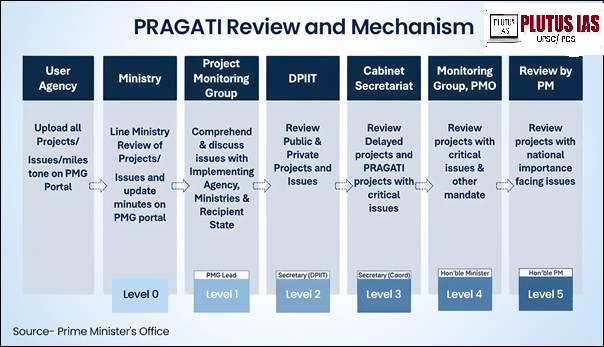
Global Recognition and Governance Benchmarking
Oxford Case Study Validation : PRAGATI has been documented as a governance innovation by Oxford Saïd Business School, which highlights its effectiveness in resolving infrastructure bottlenecks through technology-enabled, top-level coordination. This academic validation situates PRAGATI within global best practices in public administration and offers third-party credibility to India’s governance reforms.
Single Source of Truth : PRAGATI operates as a unified data and monitoring platform, consolidating inputs from multiple ministries, states, and implementing agencies. This eliminates duplication of reporting, reduces information asymmetry, and prevents inter-agency disputes arising from conflicting datasets, thereby improving decisional clarity and administrative coherence.
Replicable Model for Developing Economies : Many developing countries face chronic infrastructure delays due to fragmented authority and weak coordination. PRAGATI provides a scalable, adaptable template that can be customised to varying administrative capacities. Its emphasis on digital tools, accountability, and executive coordination makes it particularly relevant for nations pursuing infrastructure-led development.
Apolitical Administrative Focus : PRAGATI reviews projects based on objective progress indicators rather than political affiliation or geography. Uniform scrutiny across states strengthens administrative neutrality and reinforces the constitutional principle of non-partisan governance. This enhances institutional trust and reduces perceptions of politicised development.
Soft Power in Governance : Beyond economic outcomes, PRAGATI contributes to India’s soft power by projecting governance innovation as a pillar of its global leadership narrative. Alongside digital public goods like Aadhaar and UPI, PRAGATI showcases India’s capacity to deliver large-scale, technology-driven public administration reforms, enhancing its credibility in global governance forums.
Way Forward
Institutional Deepening: Embed PRAGATI principles within ministries beyond PM-led reviews.
AI and Predictive Analytics: Use AI to anticipate bottlenecks before escalation.
Capacity Building: Train district and state officials in outcome-based monitoring.
Transparency Expansion: Public dashboards for selected projects to enhance citizen oversight.
Replication at State Level: Encourage PRAGATI-like mechanisms within states and urban governance.
Conclusion
PRAGATI represents a paradigm shift in Indian governance—from fragmented, delay-prone administration to technology-enabled, cooperative, and outcome-driven delivery. By aligning leadership, institutions, and data on a single platform, it has demonstrated that governance reforms can be as transformative as economic reforms. As India aspires to become a $5 trillion economy, PRAGATI stands as a critical enabler of credible state capacity, cooperative federalism, and development with accountability.
Best ias coaching in delhi Best ias coaching in chandigarh
Prelims question:
Q. Consider the following statements regarding PRAGATI:
1. PRAGATI is a digital platform for monitoring infrastructure projects, government schemes and grievance redressal.
2. PRAGATI is chaired by the Prime Minister and involves Chief Secretaries of States and Secretaries of Union Ministries.
3. PRAGATI exclusively monitors projects of the Central Government and does not involve State Governments.
Which of the statements given above is/are correct?
(a) 1 and 2 only
(b) 2 and 3 only
(c) 1 only
(d) 1, 2 and 3
Answer: A
Q. “PRAGATI represents a shift from rule-based administration to outcome-based governance.” Critically examine the statement in the context of India’s governance reforms. (250 words)

- PRAGATI: A Decade of Cooperative, Outcome-Driven Governance - January 15, 2026
- Iran’s Large-Scale Protests: Political Stability, Public Dissent and Regional Implications - January 14, 2026
- India–Oman CEPA: A Strategic Trade Pact for Jobs, Exports and Regional Integration - January 10, 2026

No Comments