


14 Jan Iran’s Large-Scale Protests: Political Stability, Public Dissent and Regional Implications
This article covers “Daily Current Affairs” and From Iran’s Large-Scale Protests: Political Stability, Public Dissent and Regional Implications
SYLLABUS MAPPING
GS- 2 – International Relations – Iran’s Large-Scale Protests: Political Stability, Public Dissent and Regional Implications
FOR PRELIMS
Discuss the role of security forces in maintaining regime stability in Iran
FOR MAINS
How can political instability in Iran affect global oil markets
Why in News?
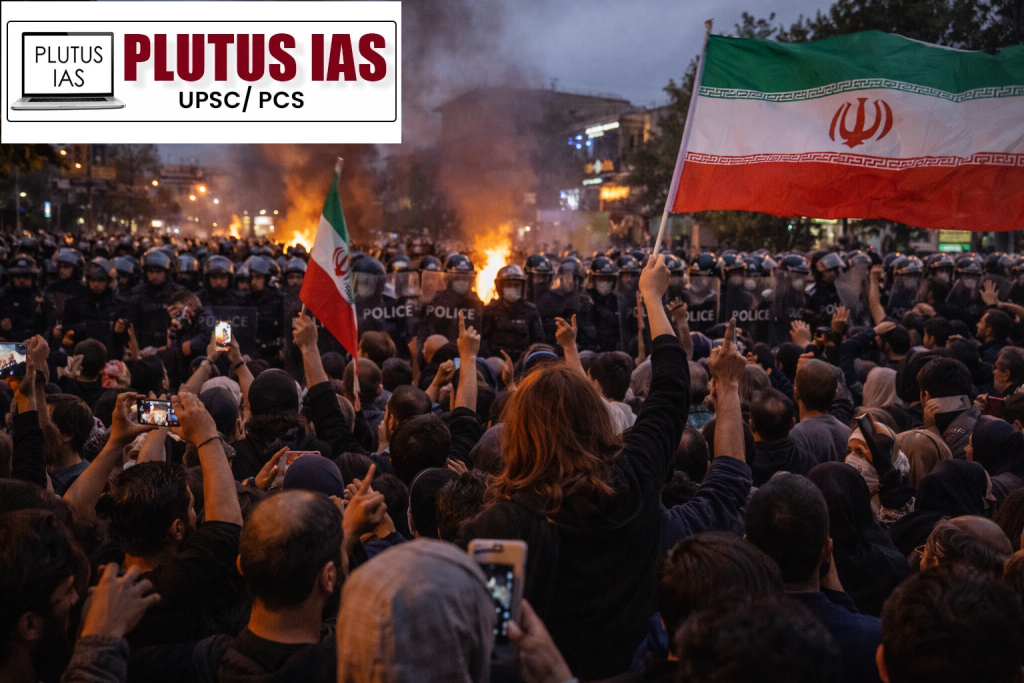
Iran is witnessing sustained nationwide protests triggered by economic distress, inflation, and governance failures. Despite weeks of unrest and harsh state repression, the clerical establishment remains intact, highlighting tensions between popular legitimacy, authoritarian resilience, and demands for political freedom.
Background and Immediate Triggers
| Dimension | Key Aspects | Explanation |
|---|---|---|
| Economic Crisis and Inflation | Inflation, currency depreciation, unemployment | Iran is facing severe inflation, weakening currency, and rising unemployment. Escalating prices of food, fuel, and medicines have sharply reduced living standards, converting economic stress into widespread public anger cutting across social classes. |
| Impact of International Sanctions | Oil exports, investment, financial isolation | US-led sanctions have restricted oil revenues, foreign investment, and global financial access. Citizens perceive that while sanctions worsen daily hardships for ordinary people, political elites remain largely insulated from their impact. |
| Youth Unemployment and Demographic Pressure | Educated but underemployed youth | Iran’s large youth population faces limited job opportunities. Educated yet underemployed youth increasingly see the political system as unresponsive to their aspirations, making them a driving force behind recurring protests. |
| Urban–Rural Spread of Discontent | Expansion beyond major cities | Unlike earlier protests confined to urban centres, current unrest has spread to smaller towns and peripheral regions, indicating deep-rooted structural dissatisfaction rather than elite-led or isolated urban movements. |
| Accumulated Governance Fatigue | Trust deficit and reform fatigue | Decades of unmet reform promises, corruption allegations, and restricted political participation have steadily eroded public trust in institutions, creating conditions for repeated cycles of mass protests. |
Nature and Character of the Protests
Leaderless and Decentralised Mobilisation : The protests in Iran are characterised by the absence of a central leadership, formal organisation, or identifiable command structure. Mobilisation occurs through spontaneous gatherings, local networks, and issue-based coordination. This decentralisation reduces the regime’s ability to neutralise the movement through targeted arrests or leadership decapitation. However, it simultaneously constrains the movement’s capacity for sustained negotiation, coherent strategy formulation, and articulation of unified political demands, increasing the risk of protest fatigue.
Shift from Economic to Political Slogans : While initial demonstrations were driven by economic distress such as inflation, unemployment, and declining purchasing power, protest slogans have progressively shifted towards questioning the legitimacy of clerical authority and governance structures. This transition reflects a deeper crisis of political legitimacy rather than dissatisfaction with specific policies. Economic grievances have thus acted as a trigger, but the underlying discontent is rooted in demands for accountability, representation, and systemic reform.
Role of Women and Students : Women and university students have emerged as the symbolic and operational vanguard of the protests. Women’s participation represents resistance against restrictive social norms and gender-based controls, while students bring organisational energy, ideological articulation, and sustained mobilisation capacity. Their involvement highlights the intersection of economic insecurity, generational alienation, and civil liberties, transforming the protests into a broader struggle for social autonomy and political dignity.
Digital Activism and State Response : Social media platforms play a central role in mobilising participants, disseminating real-time information, and shaping both domestic and international narratives. Digital spaces enable rapid coordination in the absence of formal leadership. In response, the state has imposed internet shutdowns and digital surveillance, reflecting its anxiety over uncontrolled information flows. While such measures temporarily disrupt coordination, they also deepen public resentment and reinforce perceptions of authoritarian overreach.
Non-violent Yet Persistent Resistance : Despite heavy repression, arrests, and occasional provocation, a significant proportion of protests remain non-violent, lending them moral legitimacy and broader societal support. Non-violent resistance also complicates the state’s justification for harsh crackdowns. However, prolonged repression without political accommodation risks radicalisation, erosion of faith in peaceful dissent, and long-term social fragmentation, potentially destabilising both state–society relations and internal cohesion.
State Response and Authoritarian Resilience
Heavy Security Crackdown : The Iranian regime has responded to protests through an extensive deployment of coercive apparatus, including the regular police, Basij militias, and the Islamic Revolutionary Guard Corps (IRGC). Tactics include mass arrests, street-level violence, surveillance, and intimidation. By prioritising immediate order over political dialogue, the state seeks to raise the cost of participation in protests and deter collective action, even at the expense of long-term legitimacy.
Judicial and Legal Intimidation : The judiciary has been instrumentalised as a tool of repression. Protesters are charged under broadly defined national security laws, enabling fast-track trials and disproportionate punishments. Such legal intimidation serves a dual purpose: punishing dissenters and signalling to the wider population that opposition carries severe personal risks, thereby fragmenting protest networks and discouraging sustained mobilisation.
Information Control and Media Censorship : The state exercises tight control over information flows through internet shutdowns, content filtering, and media censorship. By limiting digital connectivity, authorities disrupt protest coordination, weaken real-time mobilisation, and reduce international scrutiny. Simultaneously, state-controlled media frame protests as foreign-sponsored or anti-national, reinforcing regime narratives and legitimising repression in the eyes of loyal constituencies
Elite and Security Cohesion : A defining feature of Iran’s authoritarian resilience is the continued cohesion of political, clerical, and security elites. There have been no significant defections within the IRGC, judiciary, or senior clerical establishment. Control over economic resources, patronage networks, and ideological indoctrination ensures loyalty. As long as coercive institutions remain unified, mass protests alone are unlikely to translate into regime change.
Absence of Reform Signals : Despite recurring unrest, the leadership has shown minimal willingness to pursue substantive political reforms. Instead, it relies on a mix of repression, selective welfare measures, and nationalist or anti-Western rhetoric to sustain support among core constituencies. This strategy may ensure short-term stability but deepens structural grievances, making cycles of protest more frequent and intense over time.
Regional and Global Implications
Middle East Stability : Iran is a pivotal actor in West Asia, exercising influence through state and non-state actors in Iraq, Syria, Lebanon, and Yemen. Internal instability can divert Tehran’s attention and resources inward, potentially weakening its regional engagements. Alternatively, the regime may externalise internal pressures by intensifying proxy conflicts, thereby recalibrating regional power balances and increasing volatility in already fragile theatres.
Energy Markets and Oil Supply : Although sanctions have already constrained Iranian oil exports, sustained unrest raises concerns over production continuity, infrastructure security, and shipping routes such as the Strait of Hormuz. Even the perception of instability in a major hydrocarbon region contributes to price volatility in global energy markets, particularly at a time when geopolitical tensions and supply chain disruptions have reduced global energy buffers.
Human Rights and International Pressure : Although sanctions have already constrained Iranian oil exports, sustained unrest raises concerns over production continuity, infrastructure security, and shipping routes such as the Strait of Hormuz. Even the perception of instability in a major hydrocarbon region contributes to price volatility in global energy markets, particularly at a time when geopolitical tensions and supply chain disruptions have reduced global energy buffers.
Impact on Nuclear Diplomacy : Domestic unrest reduces Iran’s negotiating flexibility in nuclear talks, as concessions may be perceived internally as weakness. Regime survival becomes the overriding priority, encouraging hardline postures and resistance to compromise. Simultaneously, instability raises international concerns about nuclear governance, transparency, and crisis management, further entangling domestic politics with global non-proliferation efforts.
Lessons for Authoritarian States : Iran’s experience demonstrates that mass protests, even when widespread and morally legitimate, may not lead to regime change in the absence of elite fragmentation or security defections. It highlights how authoritarian regimes adapt through coercive institutional cohesion, digital repression, and narrative control. These lessons are being observed globally, influencing how other authoritarian and hybrid regimes prepare for and respond to popular mobilisation.
Why Protests Have Not Led to Regime Change
Strong Coercive Apparatus : The Islamic Revolutionary Guard Corps (IRGC) functions as the backbone of regime survival, exercising influence across security, politics, and large segments of the economy. Its control over strategic industries, intelligence networks, and paramilitary forces such as the Basij ensures rapid suppression of unrest. This institutional dominance prevents protests from escalating into a systemic challenge to state authority.
Fragmented Opposition : Iran’s opposition remains deeply fragmented, lacking a unified ideology, leadership, or credible alternative governance framework. Protest movements are largely issue-driven rather than programmatic, making coordination difficult. In the absence of a coherent political vision or transitional roadmap, resistance struggles to convert street mobilisation into sustained political transformation.
Absence of External Intervention : Unlike certain historical uprisings where external powers provided diplomatic, financial, or military backing, Iran’s protests lack direct foreign intervention aimed at regime change. Geopolitical caution, fears of regional instability, and Iran’s strategic importance discourage external actors from active involvement, thereby reducing pressure on ruling elites.
Ideological Control Mechanisms : The regime continues to employ religious legitimacy and nationalist rhetoric to mobilise a loyal support base, particularly in conservative and rural areas. State-controlled religious institutions and media frame protests as foreign-instigated or culturally subversive, reinforcing identity-based loyalty and weakening the reach of opposition narratives beyond urban centres.
Protest Fatigue and Economic Survival : Sustained participation in protests carries significant economic and personal costs for citizens, including job loss, surveillance, and legal consequences. For many, daily economic survival takes precedence over prolonged mobilisation. Over time, fatigue sets in, participation declines, and protests lose momentum, enabling the state to reassert control incrementally.
Way Forward
Internal Reforms: Gradual political and economic reforms addressing inflation, corruption, and employment could reduce unrest sustainably.
Dialogue and Inclusion: Opening limited channels for public participation may rebuild trust and legitimacy.
International Engagement: Balanced diplomacy to ease sanctions without compromising sovereignty could alleviate economic pressure.
Human Rights Safeguards: Reducing repression would prevent radicalisation and long-term instability.
Institutional Accountability: Strengthening transparency and governance can address root causes rather than symptoms of unrest.
Best ias coaching in delhi Best ias coaching in chandigarh
Conclusion
Iran’s ongoing protests reflect a deep structural crisis of governance, legitimacy, and economic management. While the regime remains resilient due to institutional cohesion, unresolved public grievances ensure recurring instability. Long-term stability depends not on repression, but on meaningful reform and responsive governance.
Prelims question:
Q. Which of the following factors have contributed to recent protests in Iran?
1. High inflation and rising cost of living
2. Youth unemployment
3. Expansion of oil exports after sanctions removal
Select the correct answer using the code below:
(a) 1 and 2 only
(b) 2 and 3 only
(c) 1 and 3 only
(d) 1, 2 and 3
Answer: A
Q. Discuss how institutional cohesion of coercive apparatus contributes to authoritarian resilience. Illustrate with reference to Iran.
(250 words)

- PRAGATI: A Decade of Cooperative, Outcome-Driven Governance - January 15, 2026
- Iran’s Large-Scale Protests: Political Stability, Public Dissent and Regional Implications - January 14, 2026
- India–Oman CEPA: A Strategic Trade Pact for Jobs, Exports and Regional Integration - January 10, 2026

No Comments