


17 Dec Breaking the Red Corridor: India’s March Towards a Naxal-Free Future (2014–2025)
This article covers “Daily Current Affairs” and From Breaking the Red Corridor: India’s March Towards a Naxal-Free Future (2014–2025)
SYLLABUS MAPPING
GS – 3 – Internal Security – Breaking the Red Corridor: India’s March Towards a Naxal-Free Future (2014–2025)
FOR PRELIMS
How has the Government of India reduced the influence of Naxalism since 2014
FOR MAINS
Explain the role of security forces in weakening the Red Corridor.
Why in the News?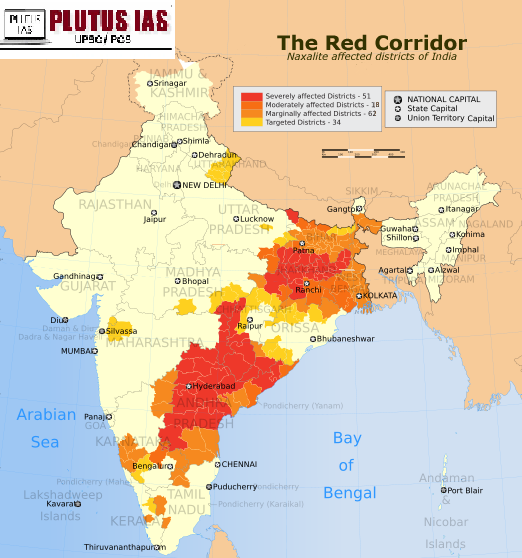
The issue is in the news due to recent official statements and data highlighting significant progress in curbing Left-Wing Extremism (LWE) in India over the last decade, with Naxal-affected districts declining sharply and violence reaching historic lows. Reports of mass surrenders of Naxal cadres, successful security operations in former strongholds like Bastar, and the government’s renewed push to transform “Red Corridors into growth corridors” have reinforced the narrative of a near-collapse of the insurgency. This convergence of security gains, development outreach and governance expansion has brought the vision of a Naxal-Free Bharat back into national focus.
Background: Decline of the Red Corridor
Origins and Spread of the Red Corridor: Left Wing Extremism (LWE), driven by Maoist ideology, took root in regions marked by chronic underdevelopment, land alienation, tribal marginalisation and weak state presence. Dense forests, difficult terrain and poor connectivity across central and eastern India enabled Naxal groups to expand their influence, eventually affecting 126 districts and forming the infamous Red Corridor.
Parallel Authority and Security Challenges: In the absence of effective governance, Naxal groups established parallel systems of taxation, justice and administration, intimidating civilians, targeting security forces and sabotaging infrastructure. Persistent violence disrupted development, deterred investment and posed a serious challenge to India’s internal security architecture.
Strategic Shift Since 2014: From 2014 onwards, the government adopted a clear, coordinated and multi-pronged strategy, combining intelligence-led security operations, enhanced inter-state coordination, modernisation of forces and targeted leadership decapitation with a renewed focus on development and governance.
Development and Governance Push: Alongside security measures, emphasis was placed on road and telecom connectivity, financial inclusion, education, healthcare and welfare delivery in LWE-affected areas. Surrender-cum-rehabilitation policies and community outreach weakened local support for extremism.
Outcome: Shrinking of the Red Corridor: These sustained efforts resulted in a dramatic decline of LWE influence. By 2025, the number of LWE-affected districts fell to 11, with only 3 classified as most-affected, signalling the near-collapse of the Red Corridor and restoration of state authority in once-insurgency-dominated regions.
Security Offensive and Operational Success
A decisive factor in weakening Left Wing Extremism has been the shift towards sustained, intelligence-led counter-insurgency operations combined with permanent area domination. Unlike earlier reactive approaches, security forces focused on denying Maoists safe havens by expanding their physical presence deep inside forested and hilly interiors. The number of fortified police stations rose sharply from 66 (pre-2014) to 586, complemented by 361 forward operating camps and 68 night-landing helipads, allowing rapid troop movement, casualty evacuation and round-the-clock operations. This persistent pressure dismantled Maoist logistics, recruitment and command structures, reflected in a 53% decline in violent incidents, 73% reduction in security force fatalities, and 70% fall in civilian deaths compared to the 2004–2014 period. In 2024–25 alone, coordinated operations by central and state forces neutralised over 600 Naxal cadres, including senior PLGA leaders. Crucially, long-standing Maoist bastions such as Abujhmad (Chhattisgarh) and Budha Pahad (Jharkhand)—which had remained outside effective state control for nearly three decades—were reclaimed, symbolising the collapse of insurgent territorial dominance and operational depth.
Major Real-Life Counter-Naxal Operations and Outcomes
| Operation / Area | Location | Key Forces Involved | Significance and Outcome |
|---|---|---|---|
| Operation Green Hunt (ongoing legacy) | Multiple LWE states | CRPF, CoBRA, State Police | Marked the shift towards coordinated central–state operations and intelligence sharing against Maoist networks. |
| Abujhmad Operations (2023–25) | Bastar region, Chhattisgarh | CRPF, CoBRA, Chhattisgarh Police | Penetration of a long-inaccessible Maoist core zone; destruction of training camps and leadership hideouts. |
| Budha Pahad Clearance Drive | Jharkhand | Jharkhand Police, CRPF | Ended nearly 30 years of Maoist dominance; restored civilian movement and administration. |
| CoBRA-led Deep Forest Operations | Sukma, Bijapur, Dantewada | CoBRA Battalions | Precision jungle warfare leading to elimination of senior PLGA commanders. |
| Area Domination through Forward Camps | Chhattisgarh, Odisha, Maharashtra | CRPF, State Police | Permanent security presence prevented Maoist regrouping and enabled development works. |
| Leadership Decapitation Drives (2024–25) | LWE core districts | Central & State Forces | Neutralisation of top Maoist leaders weakened PLGA’s command and morale. |
Financial Choking and Institutional Strengthening
Alongside kinetic operations, the Government systematically dismantled the financial and organisational networks of Naxals. A dedicated anti-Naxal vertical in the National Investigation Agency (NIA) accelerated prosecutions, while coordinated action by NIA, ED and states led to seizure and attachment of assets worth over ₹92 crore. Capacity-building of states through enhanced funding under SRE, SIS, SCA and ACALWEMS schemes strengthened local forces, intelligence units and infrastructure, ensuring that security gains became durable rather than episodic.
Development Saturation and Governance Outreach
Recognising that kinetic operations alone cannot dismantle insurgency, the Government complemented security measures with intensive development saturation in Left-Wing Extremism (LWE) affected regions. The construction of over 12,000 km of roads and installation of more than 8,500 mobile towers significantly enhanced physical connectivity, administrative reach, and real-time intelligence, reducing the isolation that sustained insurgent influence.
Financial inclusion deepened through the expansion of bank branches, ATMs, post offices and banking correspondents, integrating remote populations into the formal economy and eroding the parallel financial control exercised by Naxal networks. Simultaneously, targeted skill development initiatives—through ITIs and Skill Development Centres across 48 districts—created legitimate livelihood opportunities for local youth, directly disrupting extremist recruitment pipelines and strengthening state legitimacy at the grassroots.
Surrender and Rehabilitation
Effective Surrender–Rehabilitation Policy: An attractive surrender-cum-rehabilitation framework, combining financial incentives, stipends and assured livelihood support, significantly weakened Maoist cadre strength. Sharp Rise in Voluntary Surrenders: Nearly 2,000 Naxals surrendered in 2025 alone, indicating erosion of ideological commitment and growing confidence in state institutions.
Psychological and Organisational Impact: Large-scale surrenders disrupted leadership structures, demoralised remaining cadres and reduced recruitment potential.Integrated Counter-Insurgency Strategy: Calibrated security operations, financial choking of networks, governance outreach and rehabilitation worked in tandem to dismantle the insurgent ecosystem.
Transformation of the Threat Landscape: Naxalism has shifted from a geographically widespread insurgency to a residual, localised security challenge.
Road Ahead: Sustained vigilance, last-mile development and continued rehabilitation remain essential to prevent relapse.
Strategic Outcome: India is firmly on track to achieve its goal of a Naxal-free Bharat by March 2026, replacing decades of conflict with peace, development and inclusive governance.
Way Forward: Sustaining Gains Towards a Naxal-Free Bharat
Last-Mile Security Consolidation: While the Red Corridor has largely collapsed, residual pockets require focused intelligence-led operations and sustained area domination. Strengthening coordination among central forces, state police and local intelligence units is essential to prevent regrouping, splinter factions or cross-border movement across districts.
Development Saturation in Remaining Hotspots: The remaining affected districts must witness time-bound saturation of roads, telecom, health, education and livelihoods. Converting security gains into visible welfare delivery will ensure that liberated areas do not relapse into alienation or insurgent influence.
Deepening Tribal Inclusion and Rights Protection: Long-term peace demands empowerment of tribal communities through effective implementation of the Forest Rights Act, land rights security, participatory governance and culturally sensitive development models. Trust-building with local communities remains critical to deny ideological space to extremism.
Strengthening Rehabilitation and Post-Surrender Support: Rehabilitation should move beyond financial incentives to include psychological counselling, community acceptance, skill certification and long-term employment. Successful reintegration of surrendered cadres is key to discouraging fresh recruitment and ensuring social stability.
Preventing Urban and Ideological Revival: With rural strongholds weakened, focus must shift to urban networks, funding channels and digital propaganda. Continuous monitoring of information warfare, front organisations and legal ecosystems will prevent ideological regeneration in new forms.
Institutionalising Peace and Governance: To make gains irreversible, the state must institutionalise peace through responsive administration, grievance redressal mechanisms, local leadership development and youth engagement. Naxal eradication should culminate not just in security success, but in democratic deepening and inclusive growth.
Conclusion
India’s experience over the past decade demonstrates that Left Wing Extremism can be decisively rolled back through a balanced strategy of firm security action and inclusive development. With the Red Corridor reduced to a few residual pockets, the challenge ahead is no longer one of containment but of consolidation and prevention of relapse. Sustained vigilance, last-mile governance delivery, tribal empowerment and effective rehabilitation will be crucial to making these gains irreversible. If security success is matched with justice, opportunity and participation, India is well positioned to achieve the goal of a Naxal-free Bharat by March 2026, transforming former conflict zones into engines of peace and development.
Prelims question
Q. With reference to Left Wing Extremism (LWE) in India, consider the following statements:
1. The number of Naxal-affected districts has reduced significantly since 2014.
2. Fortified Police Stations have been constructed in LWE-affected areas as part of the security strategy.
3. The National Investigation Agency has a dedicated vertical to deal with Naxal-related cases.
4. Mobile connectivity expansion in LWE areas is unrelated to counter-insurgency strategy.
Which of the statements given above are correct?
A. 1, 2 and 3 only
B. 1 and 3 only
C. 2 and 4 only
D. 1, 2, 3 and 4
Answer: A
Mains Question
Q. “India’s approach to Left Wing Extremism has shifted from containment to decisive rollback.” Critically examine the factors behind the sharp decline of Naxalism since 2014 and discuss the challenges that remain for achieving a Naxal-free India. (250 words)

- PRAGATI: A Decade of Cooperative, Outcome-Driven Governance - January 15, 2026
- Iran’s Large-Scale Protests: Political Stability, Public Dissent and Regional Implications - January 14, 2026
- India–Oman CEPA: A Strategic Trade Pact for Jobs, Exports and Regional Integration - January 10, 2026

No Comments