


20 Dec US Military Action in Syria: Operation Hawkeye and Its Implications
This article covers “Daily Current Affairs” and From US Military Action in Syria: Operation Hawkeye and Its Implications
SYLLABUS MAPPING
GS-2 – International Relations – US Military Action in Syria: Operation Hawkeye and Its Implications
FOR PRELIMS
Briefly discuss how US military action in Syria affects regional stability in West Asia.
FOR MAINS
Explain why ISIS remains a security threat despite losing territorial control in Syria
Why in the News?
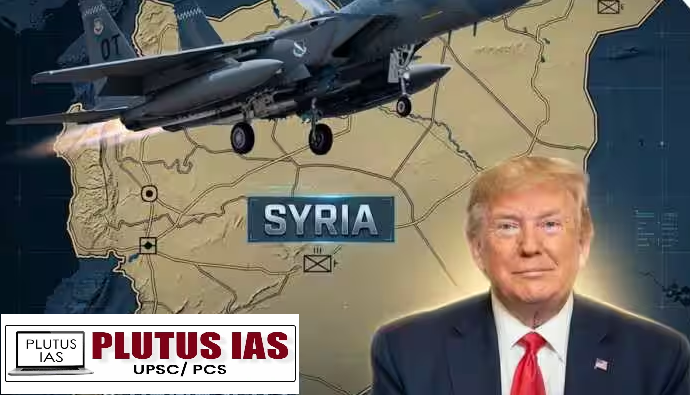
The United States recently launched Operation Hawkeye against Islamic State positions in Syria after intelligence assessments indicated attempts by the group to regroup. The operation has renewed international debate on counter-terrorism strategies, regional stability in West Asia and the legality of unilateral military interventions.
Background and Context
Evolution of the Syrian Conflict: The Syrian civil war, which began in 2011, created prolonged instability and governance vacuums that enabled extremist organisations such as ISIS to expand rapidly. Despite the military defeat of ISIS’s territorial caliphate, unresolved political tensions continue to fuel insecurity.
Decline and Transformation of ISIS: Following its territorial loss in 2019, ISIS adapted into a decentralised insurgent network operating through sleeper cells and sporadic attacks. This transformation has made detection and elimination more complex.
Regional Power Vacuum: The weakening of state authority in parts of Syria has allowed multiple external and regional powers to assert influence. This power contest has complicated peace efforts and prolonged instability.
Role of External Actors: Countries such as the United States, Russia, Iran and Turkey maintain varying degrees of involvement in Syria, often pursuing competing strategic interests that shape the conflict’s trajectory.
Strategic Objectives of Operation Hawkeye
| Strategic Objective | Explanation |
|---|---|
| Counter-Terrorism Goals | Operation Hawkeye aims to disrupt ISIS leadership, training bases, and logistical routes to prevent future attacks. It reflects a strategy of pre-emptive strikes against emerging terrorist threats. |
| Preventing ISIS Resurgence | The operation seeks to deny ISIS the space and resources required to reorganise and expand, highlighting the belief that sustained military pressure is essential to prevent revival. |
| Strategic Deterrence | Through targeted strikes, the US signals its willingness to act against non-state actors threatening regional security, while also reassuring regional allies of its commitment. |
| Assertion of US Influence | The operation reinforces continued US relevance in West Asia amid shifting regional alignments and the growing influence of rival powers. |
Implications for Regional Stability
Short-Term Security Impact: In the immediate term, the operation may weaken ISIS operational capacity and disrupt planned attacks. However, such gains are often temporary in the absence of political solutions.
Risk of Retaliation: Military actions increase the likelihood of retaliatory attacks by extremist groups, potentially destabilising neighbouring regions and escalating violence.
Impact on Regional Peace Efforts: Unilateral strikes complicate diplomatic negotiations aimed at conflict resolution and post-war reconstruction in Syria.
Spillover Effects: Prolonged instability contributes to refugee flows, arms proliferation and cross-border terrorism, affecting regional and global security.
International Law and Ethical Dimensions
Violation of Sovereignty: Military intervention without the consent of the Syrian government raises concerns regarding violation of state sovereignty under international law.
Legality under UN Charter: Such actions challenge the principles of non-intervention and collective security enshrined in the UN Charter, raising questions about global governance norms.
Civilian Safety Concerns: Airstrikes risk civilian casualties and damage to infrastructure, intensifying humanitarian crises in conflict-affected areas.
Ethical Dilemmas in Counter-Terrorism: The operation highlights the ethical tension between national security imperatives and the responsibility to protect civilian lives and human rights.
Way Forward
Strengthening Multilateral Cooperation: Counter-terrorism efforts should be anchored in multilateral frameworks to enhance legitimacy, accountability and effectiveness.
Political Resolution of the Syrian Conflict: Lasting peace requires inclusive political dialogue and reconciliation among Syrian stakeholders to address the root causes of instability.
Addressing Root Causes of Extremism: Socio-economic deprivation, political exclusion and governance failures must be addressed to prevent radicalisation and extremist recruitment.
Emphasis on International Norms: Respect for sovereignty, international law and humanitarian principles is essential for maintaining a rule-based global order.
Conclusion
Operation Hawkeye underscores the continuing threat of terrorism in conflict-ridden regions like Syria despite earlier military victories. While targeted strikes may deliver immediate tactical benefits, sustainable peace in West Asia depends on political reconciliation, multilateral engagement and adherence to international norms, making the issue highly significant for UPSC GS-II and GS-III analysis.
Q. “Despite the territorial defeat of ISIS, counter-terrorism operations continue in Syria.” In this context, critically examine the implications of Operation Hawkeye for regional stability and international law.

- PRAGATI: A Decade of Cooperative, Outcome-Driven Governance - January 15, 2026
- Iran’s Large-Scale Protests: Political Stability, Public Dissent and Regional Implications - January 14, 2026
- India–Oman CEPA: A Strategic Trade Pact for Jobs, Exports and Regional Integration - January 10, 2026

No Comments