


23 Dec Redefining the Aravallis: Development vs Ecology in India’s Oldest Mountain Range
This article covers “Daily Current Affairs” and From Redefining the Aravallis: Development vs Ecology in India’s Oldest Mountain Range
SYLLABUS MAPPING
GS-3 – Environment & Ecology – Redefining the Aravallis: Development vs Ecology in India’s Oldest Mountain Range
FOR PRELIMS
Discuss the role of the Aravalli hills in shaping the physical geography and environmental sustainability of the Delhi–NCR region.
FOR MAINS
Why are even low-lying hills and ridges of the Aravallis ecologically important
Why in the News?
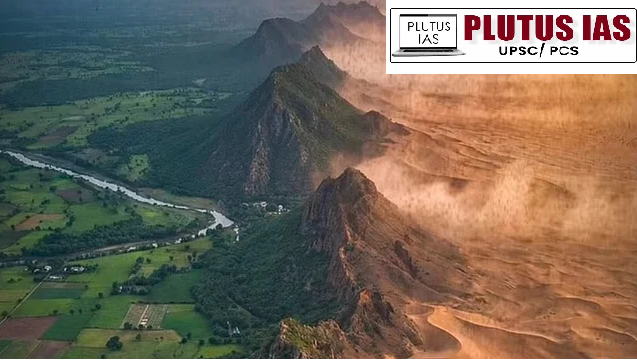
The Aravalli Hills have come into national focus following a recent legal and policy debate around their redefinition, particularly a height-based criterion (around 100 metres) used to determine what constitutes the Aravalli range for regulatory purposes. Environmental groups argue that this may dilute protection for large parts of the ancient hill system, while the government maintains that safeguards remain intact. The issue has triggered protests, political contestation, and concerns over mining, construction, and ecological degradation.
Ecological Significance of the Aravalli Range
| Dimension | Ecological Role | Key Data / Evidence | Relevance for India |
|---|---|---|---|
| Ancient Geological System | Among the oldest fold mountain systems globally, influencing landforms and soil profiles | Estimated age: 3.2–2.5 billion years (older than Himalayas) | Provides stable geological base, mineral-rich formations, and long-term ecological continuity |
| Barrier Against Desertification | Acts as a climatic and physical barrier against Thar Desert expansion | Arrests desert spread towards Delhi, Haryana, and western UP | Prevents land degradation, sustains agriculture and habitability in semi-arid regions |
| Groundwater Recharge | Facilitates infiltration through fractured quartzite rocks | Feeds major river basins like Sahibi, Luni, Banas; recharge zone for Delhi-NCR aquifers | Critical for water security in Rajasthan, Haryana, and NCR |
| Biodiversity Support | Hosts forests, wildlife corridors, and endemic flora-fauna | Part of Aravalli Biodiversity Park, habitat for 300+ bird species, leopards, hyenas | Maintains ecological connectivity between Western India and Gangetic plains |
| Forest Cover & Carbon Sink | Natural forests act as carbon sinks and climate buffers | Dry deciduous & thorn forests; sequestration capacity aiding India’s climate goals | Supports India’s Net-Zero 2070 and NDC commitments |
| Air Quality Regulation | Reduces dust storms and particulate matter transport | Natural dust barrier for Delhi-NCR, reduces PM10 influx from Thar | Improves urban air quality and public health |
| Climate Moderation | Moderates temperature extremes and heat waves | Lowers heat stress in western India; influences micro-climates | Important for climate resilience amid rising heatwaves |
| Soil Conservation | Prevents soil erosion and land degradation | Reduces wind erosion in arid Rajasthan | Sustains agriculture and prevents desertification |
| Waterbody Preservation | Origin of seasonal rivers and wetlands | Supports lakes like Badkhal, Surajkund, Siliserh | Enhances regional water ecology and livelihoods |
| Human–Nature Interface | Supports pastoralism and traditional livelihoods | Home to indigenous communities and agro-pastoral systems | Promotes sustainable living models and eco-restoration |
Legal and Policy Dimensions of the Aravalli Issue
Supreme Court Interventions: The Supreme Court has repeatedly intervened to protect the Aravalli range, particularly in cases concerning illegal mining and environmental degradation. Landmark judgments, such as M.C. Mehta vs Union of India, recognised the Aravallis as an ecologically sensitive zone critical for preventing desertification and maintaining groundwater regimes in north-west India. The Court imposed bans and restrictions on mining in notified forest areas and emphasised the application of sustainable development and intergenerational equity. These interventions underscore the judiciary’s role as a guardian of environmental commons in the absence of consistent executive action.
Height-Based Classification Debate: The proposal to classify the Aravallis based on a rigid height threshold has generated legal and ecological concerns. Critics argue that ecological systems do not function according to administrative or altitudinal boundaries; low-lying hillocks, valleys, and outcrops are integral to the continuity of the Aravalli landscape. Excluding areas solely because they fall below a specified elevation risks fragmenting habitats, disrupting wildlife corridors, and legitimising mining and construction in ecologically critical zones, thereby undermining the intent of conservation laws.
Environmental Jurisprudence Principles: Recent policy shifts have raised apprehensions about the dilution of core principles of Indian environmental jurisprudence. The precautionary principle, which mandates preventive action in the face of scientific uncertainty, may be compromised if protection is withdrawn without comprehensive ecological assessments. Similarly, the public trust doctrine, which holds the state as a trustee of natural resources for present and future generations, comes under strain when ecologically sensitive land is opened for commercial exploitation. Such dilution risks setting adverse precedents for environmental governance nationwide.
Multiplicity of Laws and Regulatory Overlap: The governance of the Aravallis is shaped by a complex web of legal instruments, including the Forest Conservation Act, Wildlife Protection Act, Environment (Protection) Act, mining regulations, and state-specific notifications. Overlapping jurisdictions and inconsistent definitions of “forest” and “protected land” create regulatory ambiguity. This multiplicity often leads to selective interpretation by authorities, litigation by affected stakeholders, and enforcement gaps that weaken environmental protection on the ground.
Governance Challenge: The core policy dilemma lies in reconciling legal clarity with ecological comprehensiveness. While governments seek clear, enforceable criteria to reduce disputes and facilitate development, ecological systems demand a landscape-level approach that transcends narrow legal classifications. Effective governance of the Aravallis requires harmonising laws, adopting science-based definitions, strengthening institutional coordination, and ensuring that conservation imperatives are not subordinated to short-term economic considerations.
Development, Mining and Economic Concerns
Mineral and Construction Demand: The region is rich in minerals and lies near fast-growing urban centres.A drone survey in Bhilwara, Rajasthan recently flagged massive illegal mining activities in the Aravalli hills well beyond authorised limits, showing the intense pressure on the landscape to feed construction demand.
Urban Expansion Pressure: Real estate and infrastructure projects exert continuous pressure on hill ecosystems.In rapid urban expansion zones like Gurugram and Faridabad, encroachment and construction continue unabated despite ecological safeguards. A specific area near Bandhwari village has seen illegal tree cutting, walls and land grabs — even though it’s a Natural Conservation Zone under Supreme Court orders.
Economic Justifications: Supporters argue that redefinition reduces uncertainty and facilitates planned development.Government and industry proponents have argued that redefining the Aravalli boundary (e.g., via height criteria) will clarify where economic activities like mining, infrastructure and real estate can occur — reducing legal conflicts and “uncertainty” for investors and builders. Recent public debates around the Supreme Court’s 2025 definition change reflect this economic rationale, though it’s also controversial.
Hidden Economic Costs: Ecological degradation leads to water scarcity, health costs, and disaster vulnerability. Accidental tragedies like the rain-filled mining crater in Sohna near Gurugram, where three youths drowned, underline the public safety and disaster risks from abandoned and unmanaged mining scars on the landscape.
Sustainability Trade-off: Short-term economic gains risk long-term environmental and social losses. Environmentalists highlight that desertification and land degradation (e.g., documented by ISRO for Haryana) are already underway because of mining and deforestation, with economic losses in farming productivity and water availability compounding long-term risks.
Federalism and Administrative Dimensions
Shared Jurisdiction: Environment is a concurrent subject, requiring coordination between Centre and states. Vellore Citizens’ Welfare Forum (1996) affirmed that environmental protection is a joint Centre–State responsibility.
Divergent State Priorities: States differ in land-use policies, mining interests, and conservation approaches. M.C. Mehta (Aravalli cases) showed how differing state mining policies harm shared ecosystems.
Centre–State Tensions: Uniform definitions may clash with region-specific ecological realities. T.N. Godavarman imposed a uniform forest definition, triggering Centre–State friction.
Role of Local Governments: Panchayats and urban local bodies often lack capacity in environmental decision-making. Punjab & Haryana High Court noted weak environmental capacity of Panchayats.
Need for Cooperative Federalism: Effective conservation demands harmonised and participatory governance. State of Meghalaya (2019) emphasised coordinated Centre–State–local action for sustainability.
Climate Change and Disaster Risk Perspective
Climate Buffer Function: The Aravallis mitigate heatwaves and regulate local climate patterns. Studies on Delhi-NCR show that intact Aravalli stretches around Gurugram and Faridabad help moderate extreme heat and act as a natural barrier against the westward spread of the Thar Desert.
Carbon Sink Potential: Forest cover in the hills contributes to carbon sequestration.ISRO and Forest Survey of India reports note that forested Aravalli patches in Rajasthan and Haryana contribute to carbon sequestration, supporting India’s land-based climate mitigation efforts.
Disaster Risk Amplification: Hill degradation increases flood risk, dust storms, and land degradation. Frequent flooding in Gurugram and dust storms affecting Delhi have been linked by environmental assessments to Aravalli degradation, mining scars, and loss of natural drainage.
National Climate Commitments: Weakening natural ecosystems undermines India’s climate adaptation goals. India’s Nationally Determined Contributions (NDCs) emphasise enhancing forest and tree cover, a goal weakened by continued degradation of ecosystems like the Aravallis.
Long-term Resilience: Protecting the Aravallis is central to regional climate resilience. Climate experts and policy reports identify Aravalli conservation as critical for long-term water security, heat resilience, and climate adaptation in north-western India.
Social Impact and Environmental Justice
Livelihood Dependence: Pastoralists, farmers and forest-dependent communities rely on the Aravallis.
Water and Resource Security: Ecological decline directly affects drinking water and agriculture.
Disproportionate Impact: Environmental damage affects marginalised communities the most.
Civil Society Engagement: Protests reflect demand for inclusive and transparent decision-making.
Inter-generational Equity: Conservation is essential to protect the rights of future generations.
Way Forward
1. Ecological-based Definition: Adopt a scientific, landscape-level definition that includes hills, ridges, slopes and associated ecosystems.
2. Strengthening Legal Safeguards: Harmonise Supreme Court directives, forest laws and state regulations to avoid loopholes.
3. Sustainable Development Zoning: Clearly demarcate no-go ecological zones while allowing regulated development elsewhere.
4. Community Participation: Involve local communities and experts in conservation planning and monitoring.
5. Long-term Climate Integration: Integrate Aravalli conservation into national climate adaptation and air-quality strategies.
Conclusion
The Aravalli controversy is not merely about a technical definition but about India’s broader development philosophy. Protecting one of the planet’s oldest mountain systems is integral to ecological security, climate resilience, and intergenerational equity. A balanced approach that prioritises scientific understanding, legal robustness, and sustainable development is essential to ensure that economic growth does not come at the cost of irreversible environmental loss.
Q. “The Aravalli range is not merely a geological structure but an ecological lifeline for north-western India.” Examine the statement with reference to desertification control, climate regulation and human settlements.

- PRAGATI: A Decade of Cooperative, Outcome-Driven Governance - January 15, 2026
- Iran’s Large-Scale Protests: Political Stability, Public Dissent and Regional Implications - January 14, 2026
- India–Oman CEPA: A Strategic Trade Pact for Jobs, Exports and Regional Integration - January 10, 2026

No Comments