


27 Dec Under Strain: Bangladesh’s Hindu Minority Amid Rising Violence, Political Flux and Regional Scrutiny
This article covers “Daily Current Affairs” and From Under Strain: Bangladesh’s Hindu Minority Amid Rising Violence, Political Flux and Regional Scrutiny
SYLLABUS MAPPING
GS- 1 & 2 – Indian Society & Indian Diaspora – Under Strain: Bangladesh’s Hindu Minority Amid Rising Violence, Political Flux and Regional Scrutiny
FOR PRELIMS
What are the main reasons for the decline of the Hindu population in Bangladesh
FOR MAINS
Why is protecting minority rights important for social harmony and regional stability
Why in the News?
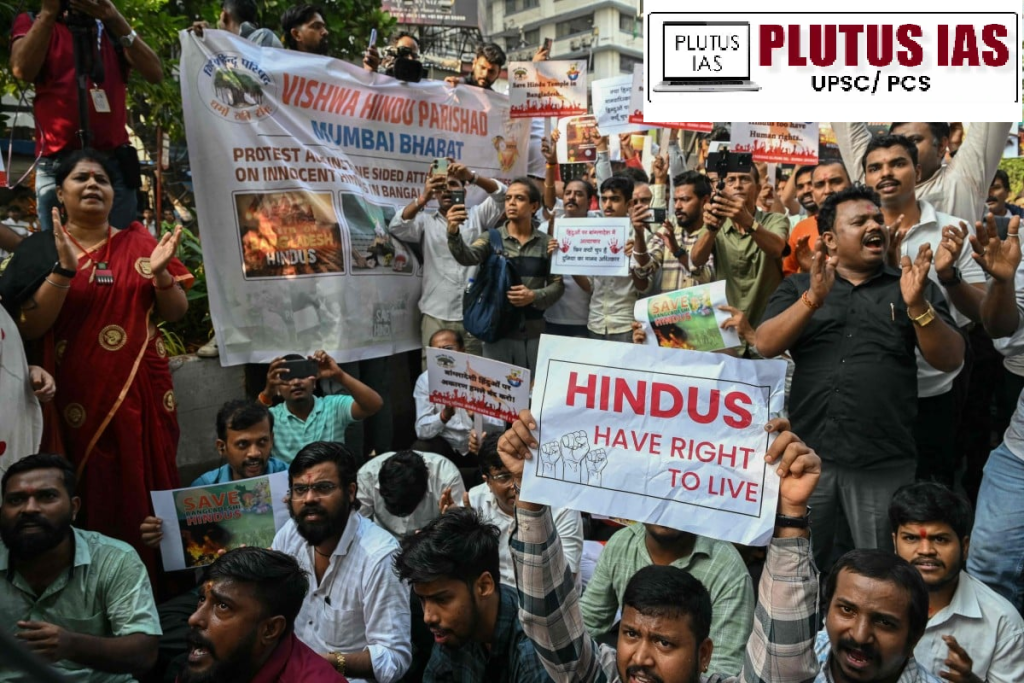
Hindus in Bangladesh are in news due to a recent spike in communal violence amid political instability following the 2024 transition of power. Reports of lynching, arson, and temple vandalism have triggered diplomatic concern from India and renewed international scrutiny over minority rights and security.
Hindus in Bangladesh
Hindus constitute the largest religious minority in Bangladesh, historically rooted in the region’s composite culture. According to the 2022 census, Hindus accounted for about 7.96% of the population, down from over 13% in the 1970s, reflecting long-term demographic shifts and migration patterns. Despite constitutional guarantees of secularism and equality, the community has faced periodic challenges ranging from social discrimination to violence. Recent developments indicate a worsening security environment, raising concerns domestically and internationally.
Historical and Demographic Context
Post-Partition & Post-1971 Patterns: After the Partition of India (1947) and later the Bangladesh Liberation War (1971), many Hindus migrated due to communal violences and socio-economic pressures.The decline in Hindu population share over decades reflects both outmigration and differential fertility rates
Legal and Constitutional Safeguards: Bangladesh’s Constitution proclaims equal rights, freedom of religion, and non-discrimination. However, implementation gaps continue to persist, especially in rural and politically unstable contexts.
Rising Incidents of Violence: Recent reporting highlights an alarming increase in attacks on Hindus and other minorities: allegations include mob lynching, arson of homes, threatening notes, and targeted killings. Independent monitoring and civil society data for 2025 show hundreds of communal incidents involving Hindus, including vandalism of temples and violent clashes linked to political upheaval and social tensions.
Political Instability and Minority Vulnerability
Leadership Transition and Governance Vacuum: The political transition after the end of Sheikh Hasina’s government in 2024 created periods of administrative uncertainty. Such transitions often weaken institutional authority, slow decision-making, and reduce the effectiveness of law enforcement. In this vacuum, minority communities, particularly Hindus, become easy targets due to their limited political leverage and numerical disadvantage.
Weakening of Law and Order Machinery: During phases of political flux, policing and local administration tend to become reactive rather than preventive. Reports suggest delayed police response, selective enforcement, and inadequate protection of minority localities. This emboldens perpetrators, fostering a perception that communal crimes may go unpunished, thereby increasing the frequency and intensity of attacks.
Politicisation of Religious Identity: Political actors and interest groups often instrumentalise religious identity to mobilise support or delegitimise opponents. In such narratives, minorities are portrayed as aligned with rival political forces or external actors. This politicisation deepens societal polarisation and normalises hostility against minority groups.
Culture of Impunity and Normalisation of Violence: Repeated incidents without swift accountability contribute to a culture of impunity. When investigations are delayed or diluted, communal violence risks becoming normalised. This erodes trust in state institutions among minorities and discourages victims from reporting crimes, further masking the true scale of insecurity.
Impact on Social Cohesion and Minority Confidence: Persistent instability and targeted violence weaken inter-community relations and undermine social cohesion. For Hindu minorities, this results in heightened fear, social withdrawal, and in some cases, renewed migration pressures. Over time, such insecurity challenges Bangladesh’s constitutional commitment to secularism and inclusive governance.
Regional and Diplomatic Implications: Minority vulnerability during political instability has spillover effects beyond national borders. It strains India–Bangladesh relations, invites international scrutiny, and raises concerns about regional stability. Thus, protecting minorities becomes not only a domestic governance issue but also a critical factor in sustaining Bangladesh’s international credibility.
Domestic and International Responses
| Stakeholder | Position / Response | Key Features | Implications |
|---|---|---|---|
| Bangladesh Government | Denial of systematic persecution | Incidents often described as isolated, politically motivated, or law-and-order problems rather than communal targeting | Limits acknowledgment of structural issues; risks underestimating minority insecurity |
| Law enforcement action | Arrests announced in select cases; deployment of police in sensitive areas | Inconsistent enforcement fuels perception of selective justice | |
| Official narrative | Emphasis on secular constitutional framework | Gap between constitutional ideals and ground realities | |
| Bangladesh Civil Society & Activists | Demand impartial investigations | Calls for independent probes, victim protection, and judicial accountability | Highlights credibility deficit in state responses |
| Documentation of incidents | Fact-finding reports, media outreach | Counters official minimisation of violence | |
| India (Government) | Diplomatic condemnation | MEA statements condemning violence against Hindus and minorities | Elevates minority protection to bilateral diplomatic agenda |
| Bilateral engagement | Issue raised in diplomatic channels with Dhaka | Signals India’s concern without direct intervention | |
| Normative stance | Emphasis on protection of minorities as essential to bilateral trust | Links human rights with regional cooperation | |
| Indian Political & Public Discourse | Parliamentary debates and media focus | Issue framed as humanitarian and civilisational concern | Shapes domestic opinion and foreign policy pressure |
| United States | Public statements urging protection | Calls for safeguarding religious freedom and minority rights | Reflects rights-based foreign policy approach |
| Human rights monitoring | Reference to minority issues in human rights reports | Increases international visibility and scrutiny | |
| International Human Rights Bodies | Advocacy and reporting | Monitoring communal violence and minority rights | Reinforces global norms on religious freedom |
| Global Media & Academia | Analytical critiques | Link political instability with minority vulnerability | Influences global perception of Bangladesh’s governance |
| Regional Stability Stakeholders | Concern over spillover effects | Fear of refugee flows and communal polarisation | Connects minority protection to regional security |
Socio-Economic Dimensions of Challenges Faced by Hindu Communities in Bangladesh
Land Dispossession and Property Insecurity: Land remains the most critical economic asset for rural Hindu households. Historical legacies such as the Vested Property Act and its uneven implementation have resulted in large-scale dispossession. Even today, bureaucratic delays, weak land records, and local power asymmetries enable encroachment and coercive transfers, eroding long-term economic security.
Livelihood Vulnerability and Occupational Shifts: Hindu communities are disproportionately represented in traditional occupations such as agriculture, fishing, pottery, and small-scale trading. Land loss and communal insecurity force many families to abandon these livelihoods, pushing them into informal, low-paying urban work. This transition often leads to job precarity and intergenerational poverty.
Economic Marginalization and Limited Access to Credit: Structural discrimination and lack of collateral restrict access to institutional credit for Hindu households. Dependence on informal moneylenders increases indebtedness, limiting entrepreneurship and upward mobility. Limited inclusion in government welfare schemes further compounds economic exclusion.
Social Exclusion and Reduced Political Voice: Socio-economic vulnerability intersects with minority status to reduce political representation at local levels. Fear of backlash and weak grievance redressal mechanisms discourage communities from asserting rights, perpetuating a cycle of marginalization and underdevelopment.
Migration and Demographic Impact: Persistent economic insecurity and social discrimination have driven gradual cross-border and internal migration. While migration acts as a coping mechanism, it results in demographic decline, fragmentation of communities, and loss of social capital in traditional settlements.
Intergenerational Impact on Education and Human Capital: Economic stress leads to higher dropout rates among children, especially in rural areas. Limited access to quality education reduces human capital formation, reinforcing socio-economic disadvantages across generations.
Policy Implications
| Stakeholder | Policy Area | Key Measures | Intended Outcomes |
|---|---|---|---|
| Bangladesh | Strengthening Rule of Law | Ensure swift investigation, prosecution, and accountability for communal crimes; provide impartial police protection to minorities | Restoration of trust in state institutions; deterrence against communal violence |
| Community Engagement | Promote interfaith dialogue, local peace committees, and community confidence-building initiatives | Social cohesion; reduction in communal mistrust and polarization | |
| Institutional Reform | Capacity building of police, judiciary, and local administration to handle hate crimes sensitively and impartially | Professionalized law enforcement; improved minority rights protection | |
| India & Neighbouring States | Diplomatic Engagement | Sustain bilateral dialogue with Bangladesh through official and track-II channels on minority protection | Regional stability; constructive resolution of minority concerns |
| Human Rights Advocacy | Support multilateral monitoring mechanisms; encourage civil society exchanges and people-to-people contacts | Norm diffusion; strengthening democratic and human rights practices | |
| International Community | Monitoring Mechanisms | Encourage independent reporting, fact-finding, and analysis by international human rights bodies | Evidence-based assessment; global accountability |
| Aid & Development Policies | Align development cooperation with human rights benchmarks while respecting national sovereignty | Inclusive development; incentives for rights-based governance |
Way Forward
Strengthening Rule of Law: Ensure swift investigation and strict punishment for communal crimes to end impunity.
Proactive Policing & Early Warning Mechanisms: Use intelligence-based policing and local monitoring to prevent mob violence and targeted attacks.
Protection of Religious, Cultural & Property Rights: Safeguard temples, cremation grounds, and land ownership through legal and administrative measures.
Political & Administrative Accountability: Act firmly against hate speech, communal mobilization, and political patronage of violence.
Community-Level Confidence Building: Promote interfaith dialogue, peace committees, and grassroots reconciliation to rebuild trust.
Diplomatic & International Engagement: Sustain constructive India–Bangladesh dialogue and allow independent human rights monitoring to ensure accountability.
Conclusion
The situation of Hindus in Bangladesh is complex, shaped by demographic changes, political instability, socio-economic disadvantage, and security challenges. Recent upsurges in violence and international diplomatic friction reflect broader regional concerns about minority rights and communal harmony.Addressing these issues demands multi-layered policy action, rooted in constitutional guarantees, international norms, and inclusive governance – essential not only for minority protection but for long-term stability and regional cooperation in South Asia.
Q. Discuss the historical and political factors responsible for the declining Hindu population in Bangladesh. How does this trend impact social cohesion and regional stability?

- PRAGATI: A Decade of Cooperative, Outcome-Driven Governance - January 15, 2026
- Iran’s Large-Scale Protests: Political Stability, Public Dissent and Regional Implications - January 14, 2026
- India–Oman CEPA: A Strategic Trade Pact for Jobs, Exports and Regional Integration - January 10, 2026

No Comments