


29 Dec ISRO Clears Critical Safety Milestone with Successful Drogue Parachute Test for Gaganyaan Mission
This article covers “Daily Current Affairs” and From ISRO Clears Critical Safety Milestone with Successful Drogue Parachute Test for Gaganyaan Mission
SYLLABUS MAPPING
GS- 3 – Science & Technology – ISRO Clears Critical Safety Milestone with Successful Drogue Parachute Test for Gaganyaan Mission
FOR PRELIMS
Why are parachute systems important in human spaceflight missions
FOR MAINS
Describe the role of drogue parachutes in the Gaganyaan mission.
Why in the News?
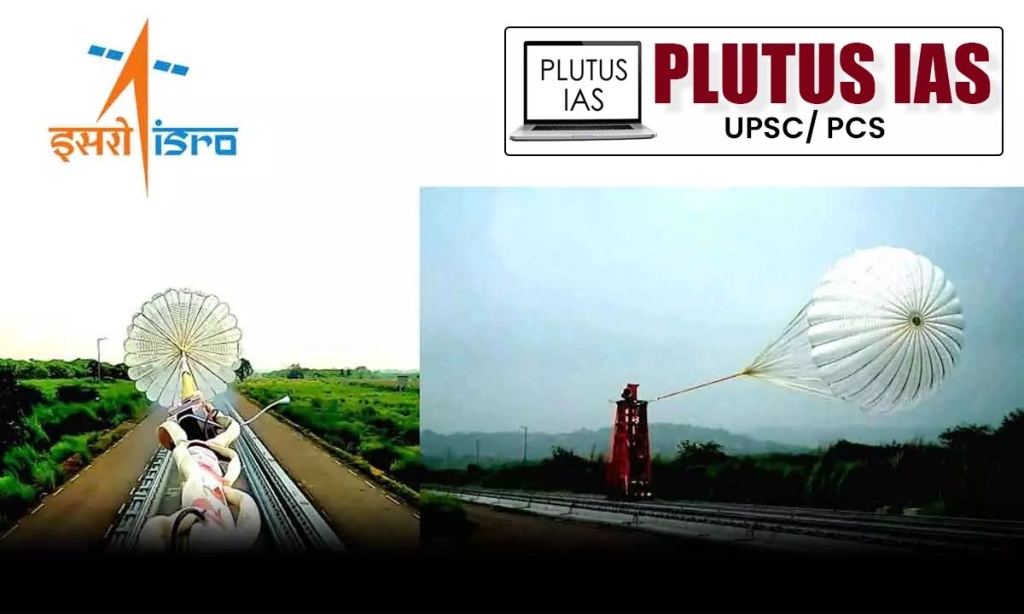
The Indian Space Research Organisation (ISRO) has successfully conducted drogue parachute tests for the Gaganyaan human spaceflight mission, validating a critical subsystem responsible for the safe atmospheric descent and recovery of the Crew Module. The test marks another milestone in India’s preparation for its first crewed space mission.
Gaganyaan Mission: India’s Human Spaceflight Ambition
Demonstration of Human-Rated Launch Capability: A core objective of Gaganyaan is to establish India’s ability to safely launch humans into space using indigenous systems. This involves human-rating of the LVM-3 launch vehicle, crew module, and life-support systems, ensuring high reliability, redundancy, and safety margins. Success would mark India’s transition from robotic missions to complex crewed spaceflight operations.
Development of Critical Life-Support and Crew Safety Systems: The mission seeks to master Environmental Control and Life Support Systems (ECLSS), crew escape mechanisms, and emergency response protocols. These technologies are vital for sustaining astronauts in microgravity and ensuring safe aborts during launch or re-entry. Such capabilities lay the foundation for future long-duration missions, including space stations.
Enhancement of Strategic Autonomy and National Security: Human spaceflight strengthens India’s strategic autonomy by reducing dependence on foreign launch systems for crewed missions. Dual-use technologies developed under Gaganyaan—such as advanced navigation, communication, and surveillance systems—also have spillover benefits for defence preparedness, situational awareness, and space-based intelligence infrastructure.
Catalyst for Advanced Aerospace Research and Industrial Ecosystem: Gaganyaan acts as a driver for innovation across India’s aerospace and manufacturing sectors. It promotes collaboration between ISRO, academia, startups, and private industry in areas like materials science, avionics, robotics, and biomedical research. This ecosystem-building supports India’s long-term goals in space exploration and high-technology self-reliance.
Parachute-Based Crew Module Recovery System: Architecture, Stages and Safety Role in Gaganyaan
| Aspect | Details |
|---|---|
| Purpose in Mission | The parachute-based recovery system forms the final and most critical safety layer of the Gaganyaan Crew Module Recovery System. It ensures safe deceleration of the crew module from supersonic re-entry speeds to splashdown-compatible velocities, directly safeguarding astronaut survival. |
| Overall Role in Crew Safety | By progressively reducing speed and stabilising orientation, the parachute system enables a controlled sea splashdown, preventing excessive impact forces and structural damage to the crew module. |
| Deployment Philosophy | The system follows a sequential, multi-stage deployment approach to manage extreme aerodynamic loads gradually rather than abruptly, enhancing reliability and safety. |
| Stages of Parachute Deployment | 1. Drogue Parachutes – Deployed first at high altitude and high speed for stabilisation.2. Pilot Parachutes – Assist in extracting the main parachutes.3. Main Parachutes – Provide maximum deceleration and controlled descent before splashdown. |
| Drogue Parachutes – Definition | Drogue parachutes are small, high-strength parachutes deployed during the early descent phase to stabilise the spacecraft, reduce dynamic pressure, and ensure correct orientation for subsequent parachute deployment. |
| Functional Importance of Drogue Parachutes | They prevent tumbling of the crew module, reduce aerodynamic stress, and create suitable conditions for safe deployment of larger main parachutes, acting as a bridge between re-entry and final descent phases. |
| Operational Environment | Drogue parachutes operate under extreme conditions—high-speed airflow, intense thermal loads, fluctuating pressure, and violent aerodynamic forces during atmospheric re-entry. |
| Design and Engineering Challenges | Materials must withstand high mechanical stress, thermal shock, and dynamic instability. Precision in timing, deployment angle, and structural integrity is essential, making extensive testing indispensable. |
| Significance for Mission Success | Any failure at the drogue stage can compromise the entire recovery sequence, highlighting why successful drogue parachute tests are a major milestone for India’s human spaceflight programme. |
Significance of the Recent Test
Validation of Indigenous Human-Rated Parachute Technology: The successful test establishes the reliability of fully indigenous parachute systems designed to meet stringent human-rating standards. This reinforces India’s Atmanirbhar Bharat push by reducing dependence on foreign aerospace technologies for critical crew safety systems.
Assurance of Crew Safety During Critical Mission Phases: Parachutes play a decisive role during the descent and landing phase, where margins for error are minimal. The test validates controlled deceleration and stability, directly enhancing astronaut survivability during atmospheric re-entry and splashdown.
Enhanced Readiness for Uncrewed Qualification Missions: The test demonstrates that the recovery subsystem is prepared for upcoming uncrewed missions. Such qualification flights are mandatory to certify system performance under real flight conditions before any human spaceflight attempt.
Strengthening Systems Integration and Redundancy: Successful deployment confirms seamless integration between drogue and main parachutes, sensors, and deployment mechanisms. It also validates redundancy features, ensuring fail-safe performance even in off-nominal conditions.
Boost to ISRO’s Human Spaceflight Confidence and Credibility: The achievement enhances institutional confidence in mission timelines and strengthens ISRO’s credibility in executing complex human spaceflight programs. It also positions India among a select group of nations with proven crew recovery capabilities.
Technological and Scientific Implications
Advancement in Indigenous Aerospace Engineering Capabilities: The test highlights India’s progress in advanced aerospace engineering, particularly in designing high-load parachute systems capable of operating under extreme thermal and aerodynamic conditions. It reflects growing competence in precision engineering for human spaceflight.
Innovation in High-Performance Materials and Textiles: Development of parachutes requires specialised fabrics with high strength-to-weight ratios, thermal resistance, and durability. The success demonstrates indigenous capability in advanced textile engineering, benefitting both space and strategic sectors.
Improved Aerodynamic Modelling and Simulation Expertise: Accurate prediction of parachute behaviour during high-speed descent relies on complex computational modelling. The test validates India’s advancements in aerodynamic simulations, wind tunnel testing, and real-time performance analysis.
Development of Reliable Real-Time Deployment and Control Systems: The successful sequencing of drogue and main parachutes confirms robustness in sensor-driven deployment mechanisms. This strengthens expertise in autonomous control systems and real-time decision-making technologies critical for crewed missions.
Spin-off Applications Across Strategic and Civil Domains: Technologies developed can be adapted for defence aircraft recovery systems, reusable launch vehicles, space tourism modules, planetary landers, and emergency evacuation systems, generating broader scientific and economic benefits beyond the Gaganyaan mission.
Gaganyaan in the Global Spaceflight Context
India’s Entry into the Exclusive Human Spaceflight Club: With the Gaganyaan mission, India positions itself among a select group of nations—such as the US, Russia, and China—that possess independent human spaceflight capability. This achievement marks a transition from satellite-launch proficiency to human-rated launch, orbital, and recovery systems.
Strategic Autonomy in Crewed Space Missions: An indigenous human spaceflight program reduces dependence on foreign launch vehicles, crew capsules, and recovery infrastructure. This autonomy is strategically significant, particularly in an era where space access is increasingly linked to national security and geopolitical influence.
Strengthening India’s Role in Global Space Governance: Human spaceflight capability enhances India’s voice in shaping norms related to space safety, crew rescue, orbital debris mitigation, and responsible use of outer space. It strengthens India’s standing in multilateral forums such as the UN Committee on the Peaceful Uses of Outer Space (UNCOPUOS).
Balanced Model of International Collaboration: While core mission systems remain indigenous, Gaganyaan benefits from international cooperation in astronaut training, crew health monitoring, life-support technologies, and safety protocols. This reflects a balanced approach—leveraging global expertise without compromising sovereign control.
Enabling Future Multinational and Commercial Missions: A successful Gaganyaan program lays the foundation for India’s participation in future multinational space stations, joint deep-space missions, and commercial human spaceflight initiatives. It positions India as a reliable partner in the evolving global space economy.
Way Forward
Integrated System-Level Testing: Conduct combined trials of parachute systems with the Crew Module and Crew Escape System to validate coordinated performance under real mission conditions.
Uncrewed Orbital Qualification Missions: Complete multiple uncrewed orbital flights to test end-to-end mission safety, including launch, on-orbit operations, re-entry, and recovery.
Strengthening Human-Rating Certification Frameworks: Adopt rigorous human-rating standards aligned with global best practices to ensure maximum crew safety and mission reliability.
Investment in Advanced Materials and Manufacturing: Develop next-generation high-performance materials to enhance parachute durability, thermal resistance, and load-bearing capacity.
Enhancing Redundancy and Fail-Safe Mechanisms: Improve system redundancy across deployment, sensing, and control components to mitigate risks from single-point failures.
Upgrading Recovery and Post-Landing Logistics: Strengthen naval, aerial, and ground recovery infrastructure for swift crew retrieval and post-mission safety assurance.
Conclusion
The successful drogue parachute test is a crucial step in ensuring astronaut safety and mission reliability under the Gaganyaan programme. It reflects ISRO’s systematic, safety-first approach and India’s growing maturity in human spaceflight technologies. As India moves closer to its first crewed mission, such milestones reaffirm the country’s commitment to safe, indigenous, and globally competitive space exploration.
Q.“The successful testing of drogue parachutes marks a critical milestone in India’s human spaceflight programme.” Examine the significance of the recent parachute tests conducted by ISRO for the Gaganyaan mission.

- PRAGATI: A Decade of Cooperative, Outcome-Driven Governance - January 15, 2026
- Iran’s Large-Scale Protests: Political Stability, Public Dissent and Regional Implications - January 14, 2026
- India–Oman CEPA: A Strategic Trade Pact for Jobs, Exports and Regional Integration - January 10, 2026

No Comments