


18 May Repatriations of Chola-Era Leiden Copper Plates
This article covers “Daily Current Affairs”
SYLLABUS MAPPING : GS Paper 1 : Art and Culture , Ancient & Medieval History
FOR PRELIMS : Anaimangalam Copper Plates , Chola Dynasty , Indian Artifacts abroad
FOR MAINS : “The return of the Leiden Plates marks India’s evolving use of cultural diplomacy as a soft power tool — but the persistence of the Kohinoor, Amaravati Marbles, and hundreds of other treasures in British and European museums reveals the structural limits of a purely diplomatic approach to cultural repatriation.” Critically evaluate India’s repatriation strategy, the international legal framework, and the reforms needed to make heritage recovery more systematic and effective. (15 M)
Why in News?
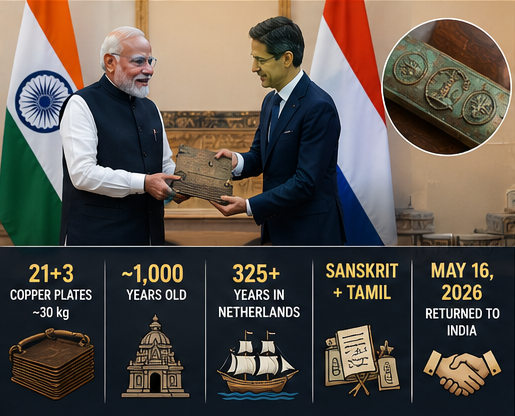
During Prime Minister Narendra Modi’s visit to the Netherlands on May 16, 2026, the Dutch government formally returned the Anaimangalam Copper Plates — popularly known in Europe as the Leiden Copper Plates — to India in a ceremony at The Hague attended by PM Modi and his Dutch counterpart Rob Jetten. The plates, which had been in Dutch custody for over 325 years and in Leiden University’s collections since 1862, are 21 large and 3 smaller copper sheets weighing approximately 30 kilograms, bound by a circular copper ring bearing the royal seal of Rajendra Chola I. They are among the most important surviving records of the Chola period — a thousand-year-old administrative archive recording a royal land grant to support a Buddhist monastery built by a Malay king at Nagapattinam. Their return is being called a watershed event in India’s repatriation of colonial-era heritage — and Indian archaeologists are demanding it must now accelerate efforts to recover the Kohinoor diamond, the Amaravati Marbles, Tipu Sultan’s Tiger, and thousands of other treasures still held abroad.
What Are the Anaimangalam Copper Plates? — Historical Profile
The Physical Object
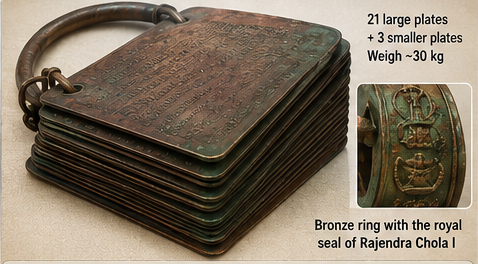
The Anaimangalam Copper Plates are a royal charter issued by Rajaraja Chola I (985–1014 CE) and later engraved onto copper by his son Emperor Rajendra Chola I to ensure the permanence of his father’s verbal grant. The collection consists of 21 large copper plates and 3 smaller plates, weighing approximately 30 kilograms in total, held together by a massive bronze ring bearing the royal seal of Rajendra Chola I. The inscriptions are bilingual — 5 plates in Sanskrit (recording the Chola genealogy, invoking divine legitimacy from Vishnu) and 16 plates in Tamil (recording the specifics of the land grant).
What Do the Plates Record?
The plates record Rajaraja Chola I’s grant of land revenue and taxes from villages near Anaimangalam (in present-day Nagapattinam district, Tamil Nadu) to support the Chulamanivarma Vihara — a Buddhist monastery at the port of Nagapattinam. This monastery had been built by Sri Mara Vijayotunga Varman, ruler of the Srivijaya kingdom of present-day Malaysia/Indonesia, with Rajaraja Chola I’s permission. The grant was specifically confirmed by Rajendra Chola I (regnal years 1070–1120 CE), who also made an additional grant of 4,500 kalam of paddy land — on top of his grandfather’s earlier grant of 8,943 kalam.
The bronze ring that holds the plates together bears the royal insignia of the Chola dynasty — a unique set of symbols that identified Chola sovereignty across their empire:
Chola royal emblem
Symbol of Pandyas (defeated)
Symbol of Cheras (defeated)
Two chamaras
Royal lamps
Auspicious symbol
The inclusion of the two fish (Pandya symbol) and the bow (Chera symbol) signified that the Cholas had defeated both rival dynasties — a political statement embedded in a religious land grant document.
Historical Significance — Five Reasons These Plates Matter
| Significance | What the plates reveal |
|---|---|
| Chola administrative sophistication | Copper plates were legal, political, and sacred records. By engraving grants on copper, the Chola court created a 1,000-year administrative archive — more durable than palm-leaf manuscripts or oral traditions; evidence of a sophisticated revenue-recording bureaucracy. |
| India–Southeast Asia connections | The Buddhist monastery was built by the Srivijayan king — evidence of Indian Ocean trade, Buddhist diplomatic ties, and cultural exchange between the Cholas and the maritime kingdoms of Southeast Asia (present-day Malaysia and Indonesia). |
| Royal Buddhist patronage | Despite being a Shaivite dynasty, the Cholas patronised a Buddhist monastery built by a Malay king — demonstrating a cosmopolitan, pragmatic model of kingship that crossed religious and cultural boundaries. |
| Bilingual epigraphic record | The five Sanskrit plates (genealogy) and sixteen Tamil plates (grant details) are among the most important surviving bilingual royal inscriptions of medieval South India — primary evidence for Chola history, genealogy, and administrative practice. |
| Indian Ocean world history | The plates link Tamil political power, Indian Ocean trade, Nagapattinam’s cosmopolitanism, Buddhist patronage, and Southeast Asian diplomacy — placing the Coromandel Coast at the centre, not the periphery, of medieval world history. |
Journey to the Netherlands — How They Left India
The Chola Dynasty — Quick Reference
Origin: One of the longest-ruling dynasties; referenced as early as 3rd century BCE in Ashoka’s edicts as “Choda”
Imperial Cholas: 848–1279 CE; Vijayalaya captured Thanjavur ~850 CE
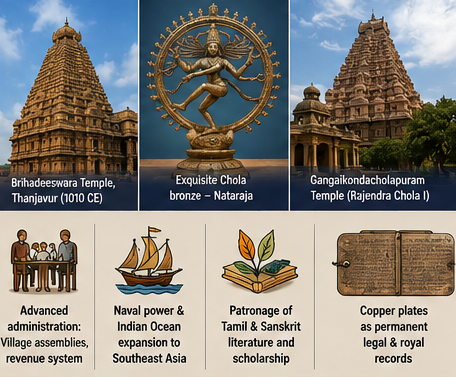
Rajaraja Chola I (985–1014 CE): Built the Brihadeeswara (Brihadeeshwara) Temple at Thanjavur (UNESCO World Heritage Site); reformed administration; expanded to Sri Lanka and Maldives
Rajendra Chola I (1014–1044 CE): Led naval expeditions to Southeast Asia (Srivijaya, Malay Peninsula); titled himself “Gangaikonda Cholan” after reaching the Ganges
Architecture: Brihadeeswara Temple, Thanjavur (UNESCO); Gangaikondacholapuram temple; elaborate gopurams
Bronze casting: Chola bronzes (Nataraja, Ardhanarishvara) are among the finest metal sculptures in world art history
Administration: Village assemblies (ur, sabha, nagaram); revenue surveys; land grants recorded in copper plates
Literature: Patronised Tamil literature and scholarship; inscriptions in Tamil and Sanskrit
Legal and Policy Framework for Repatriation
- Antiquities and Art Treasures Act, 1972 (amended 1976): Strictly bans export of any archaeological object; imposes custodial ownership of all antiquities by the state; has enabled multiple repatriation demands by establishing provenance documentation
- UNESCO Convention on the Means of Prohibiting and Preventing the Illicit Import, Export and Transfer of Ownership of Cultural Property (1970): India is a signatory; provides the international legal basis for repatriation of post-1970 thefts; older colonial-era items require separate bilateral diplomacy
- UNIDROIT Convention on Stolen or Illegally Exported Cultural Objects (1995): Strengthens legal tools for recovery of cultural property; India has not yet ratified this convention — a gap that archaeologists have urged should be addressed
- UNESCO 2003 Declaration on Intentional Destruction of Cultural Heritage: Provides normative framework for protecting heritage sites like the demolished Chudamani Vihara
- India’s diplomatic push (2012–2026): India’s repatriation drive intensified after 2012; 297 artefacts have been repatriated since 2014 from USA (245), UK (23), Australia (2), Belgium (15), and now Netherlands; ASI (Archaeological Survey of India) maintains a watchlist of items sought
Most Important Indian Artefacts Still Held Abroad
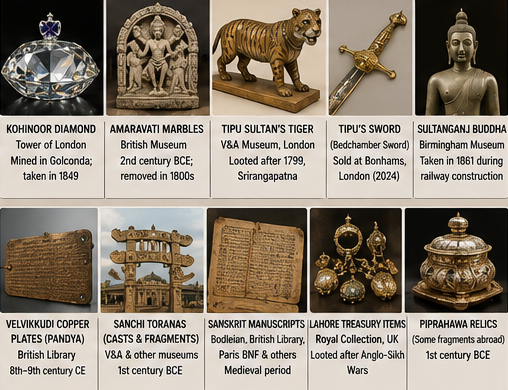
Archaeologists are right to call the return of the Leiden plates a “watershed” — but it is a small victory in the context of the enormous scale of cultural property that remains in foreign institutions. Here are the most significant items:
| Artefact | Where held | Period / Origin | How it left India | Status |
|---|---|---|---|---|
| Kohinoor Diamond | Tower of London / British Crown Jewels | Ancient; mined in Golconda (Andhra Pradesh) | Treaty of Lahore (1849) — signed by 10-year-old Maharaja Duleep Singh under British coercion; “gifted” to Queen Victoria | Not returned; UK insists it was lawfully acquired |
| Amaravati Marbles | British Museum | 2nd century BCE; Andhra Pradesh | 120+ marble sculptures and inscriptions from the Amaravati Stupa removed by Colonel Colin Mackenzie in the 1800s | Not returned; UK’s British Museum Act 1963 legally prevents deaccessioning |
| Tipu Sultan’s Tiger (automaton) | Victoria and Albert Museum | 18th century; Mysore | Looted after the fall of Srirangapatna in 1799; Tipu Sultan’s palace systematically plundered by British East India Company forces | Not returned; V&A refuses repatriation |
| Tipu Sultan’s Bedchamber Sword | Private ownership (sold at Bonhams, London, May 2024 for £14 million) | 18th century; Mysore | Looted from Srirangapatna, 1799 | Sold at auction to unknown buyer; India protested but could not prevent sale |
| Sultanganj Buddha | Birmingham Museum and Art Gallery | 7th century CE; Bihar | Discovered in 1861 during railway construction; taken by colonial railway engineer E.B. Harris | Not returned; India has formally requested return |
| Velvikkudi Copper Plates (Pandya) | British Library / multiple UK institutions | 8th–9th century CE | Colonial-era removal; archaeologist V. Vedachalam has called for repatriation after the Leiden plates success | Repatriation demand pending |
| Sanchi Toranas (Gateway casts) | Victoria and Albert Museum; originals in Sanchi Stupa | 1st century BCE; Madhya Pradesh | Full-scale casts taken; portions of original Sanchi sculptures held in foreign collections | Fragments in V&A and Paris museums |
| Sanskrit manuscripts (thousands) | Bodleian Library; British Library; Paris BNF | Medieval period | Systematically removed by Orientalist scholars, colonial officials, and missionaries | Large collection; partial digitisation but not physical repatriation |
| Koh-i-Noor replicas & other Lahore treasury items | Victoria & Albert Museum; Royal Collection | 19th century; Punjab | Sikh treasury looted after Anglo-Sikh Wars and Treaty of Lahore | Not returned; UK position: no compulsion under domestic law |
| Piprahawa Buddha relics (partial) | Returned! But some fragments still abroad | 1st century BCE; Uttar Pradesh | Excavated in 1898 by William Claxton Peppe; relics distributed internationally | Core collection returned to India from Thailand in 2025; some fragments still in foreign private collections |
| Sivapuram Nataraja ✓ RETURNED | Returned from USA (Norton Simon Museum) to Tamil Nadu | Chola period; Tamil Nadu | Stolen from Thanjavur in 1956 | Returned in 1986 after a 10-year loan to Norton Simon Museum |
| Anaimangalam Copper Plates ✓ RETURNED | Returned from Netherlands (Leiden University) | Chola period; Tamil Nadu | Dutch colonial removal around 1700 | Returned on May 16, 2026 — current news |
Practice Questions
1. The copper plates were issued during the reign of Rajaraja Chola I (985–1014 CE) and later engraved by his son Rajendra Chola I, recording a land grant to support the Chulamanivarma Vihara — a Buddhist monastery at Nagapattinam built by the ruler of the Srivijaya kingdom.
2. The plates consist of 21 large and 3 smaller copper sheets held together by a bronze ring bearing the royal insignia of the Chola dynasty, including a tiger, two fish, and a bow — the fish symbolising the Cholas themselves and the bow representing their military conquests.
3. The Chulamanivarma Vihara, whose land grants are recorded in these plates, was demolished by Jesuit priests in 1867 with the permission of the colonial Government of Madras, making the copper plates the primary surviving documentary evidence of this lost monument.
4. The plates were returned to India under the UNESCO 1970 Convention, which mandates the return of all cultural property removed after 1900 from their countries of origin.
Which of the statements given above are correct?
Statement 1 is CORRECT. The Anaimangalam Copper Plates record a grant made by Rajaraja Chola I (985–1014 CE) — specifically, his grant of land revenue from villages near Anaimangalam to support the Chulamanivarma Vihara at Nagapattinam. The vihara was originally built by Sri Mara Vijayotunga Varman, the ruler of the Srivijaya kingdom of present-day Malaysia/Indonesia. Although the grant was made during Rajaraja I’s reign, it was his son Rajendra Chola I who had the grant engraved permanently onto copper plates — ensuring it would outlast palm-leaf records and oral traditions. This detail of the engraving being done by the son, not the grantor himself, is a significant and frequently tested factual point.
Statement 2 is INCORRECT. The identification of symbols is incorrect. On the Chola royal insignia, the tiger is the Chola’s own royal emblem. The two fish symbolise the Pandya dynasty (which the Cholas defeated) — not the Cholas themselves. The bow represents the Chera dynasty (which the Cholas also defeated). The inclusion of the Pandya fish and the Chera bow on the Chola royal seal was a deliberate political statement — signalling that the Cholas had conquered both rival dynasties. This is an important distinction: the emblems of defeated enemies are incorporated into the victor’s seal as trophies of conquest.
Statement 3 is CORRECT. The tower of the Chulamanivarma Vihara (also called the Buddha Vihara or Chola Vihara near Nagapattinam) was indeed demolished by Jesuit priests in 1867, with the express permission of the colonial Government of Madras. This destruction of the physical monument makes the copper plates — which describe the vihara in detail and record the grants made for its support — the primary and practically only surviving documentary evidence of this once-significant Buddhist monument that linked South Indian Chola kingship with Southeast Asian Buddhist traditions.
Statement 4 is INCORRECT. The UNESCO 1970 Convention does NOT mandate the return of all cultural property removed after 1900. Its scope is limited to cultural property that was illicitly exported or transferred after its adoption in 1970 — it does not have retroactive effect covering the entire 20th century. The Anaimangalam Copper Plates were not returned under the UNESCO 1970 Convention (they left India around 1700, far before the convention’s scope). They were returned primarily through bilateral diplomacy between India and the Netherlands, enabled by the Netherlands’ own 2022 national policy on returning colonial-era artefacts, provenance studies by the ICCCO, and Leiden University’s review — with UNESCO’s Intergovernmental Committee lending normative support.
Mains Questions

- India’s Youth Unemployment and Education Crisis - August 5, 2026
- India’s Sports Infrastructure and the 2036 Olympics Ambition - August 5, 2026
- Critical Minerals: The Foundation of Strategic Power - August 4, 2026

No Comments