


16 May Ensure Living Wages for Workers, Not Label Them Terrorists”: Supreme Court
This article covers “Daily Current Affairs”
SYLLABUS MAPPING : GS Paper 2 , 3 : Polity , Governance and Economy
FOR PRELIMS : Living Wage, Supreme Court Judgements , NSA ACT
FOR MAINS : “Directive Principles of State Policy are not empty platitudes — they represent the Constitution’s socio-economic vision, and the Supreme Court has consistently held that the State cannot simultaneously ignore its DPSP obligations and use coercive law enforcement against those who suffer from that neglect.” In light of Article 43, Article 43A, and the Supreme Court’s evolving jurisprudence on DPSPs, critically evaluate the constitutional relationship between Fundamental Rights and Directive Principles in the context of labour justice. (15 M)
Why in News?
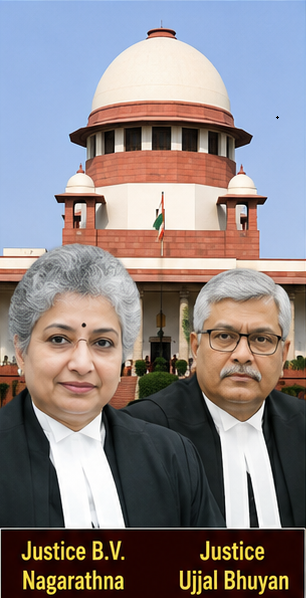
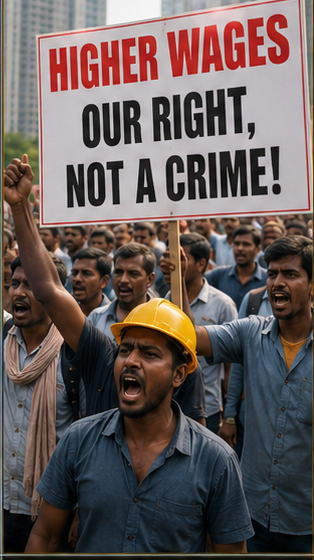
On Friday, May 15, 2026, a Supreme Court bench comprising Justice B.V. Nagarathna and Justice Ujjal Bhuyan issued a sharp judicial rebuke to the Uttar Pradesh Government for invoking the National Security Act (NSA), 1980 against workers and activists who had protested for higher wages in Noida in April 2026. The Court directed the production of arrested persons — Aditya Anand and Rupesh Roy — before the court on May 18, 2026 at 2 PM, after family members alleged custodial torture. The bench also stopped them from being moved out of judicial custody into police remand. The Court pointedly reminded the UP government of Article 43 of the Constitution — a Directive Principle that mandates the State to ensure workers receive a “living wage, conditions of work ensuring a decent standard of life, and full enjoyment of leisure and social and cultural opportunities.” Justice Nagarathna’s oral remark crystallised the constitutional moment: “They were asking for higher wages. Don’t think they are terrorists. They are merely demanding basic rights like minimum wages.”
Background — The 2026 Noida Workers’ Protest
The Constitutional Framework — Articles 43 and Labour Rights
The Living Wage — Article 43 (DPSP)
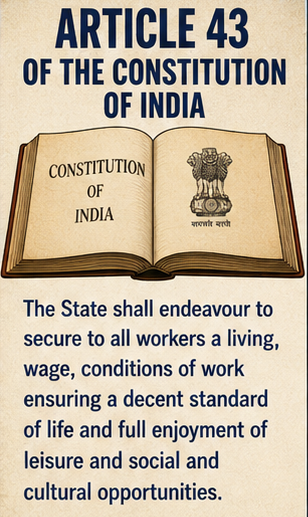
Article 43 falls under Part IV of the Constitution — Directive Principles of State Policy (DPSP). It is a non-justiciable directive — meaning it cannot be directly enforced in court as a matter of right — but it is constitutionally binding on the State as a duty of governance, and courts have repeatedly interpreted it as a guiding principle for labour legislation and State action.
“The State shall endeavour to secure, by suitable legislation or economic organisation or any other legitimate way, to all workers — agricultural, industrial, or otherwise — work, a living wage, conditions of work ensuring a decent standard of life and full enjoyment of leisure, and social and cultural opportunities, and, in particular, the State shall endeavour to promote cottage industries on an individual or co-operative basis in rural areas.”
The key phrase — “living wage” — is constitutionally distinct from “minimum wage.” The Supreme Court has repeatedly distinguished between the two:
The lowest legally permissible wage — set to prevent absolute deprivation; must be paid regardless of the employer’s capacity to pay; governs bare subsistence (food, clothing, shelter only). Set under the Minimum Wages Act, 1948 (now replaced by the Code on Wages, 2019). States set their own minimum wages above the central floor wage.
A higher standard than minimum wage — one that allows a worker to maintain a decent standard of living: basic needs + some discretionary spending; social participation; savings for emergencies. Article 43 aspires to this higher standard. The Supreme Court in Workmen v. Reptakos Brett (1992) identified five components of a living wage: food, clothing, shelter, children’s education, and medical costs.
Inserted by the 42nd Constitutional Amendment, 1976: “The State shall take steps, by suitable legislation or in any other way, to secure the participation of workers in the management of undertakings, establishments or other organisations engaged in any industry.”
This Directive — often overlooked — goes beyond wages to mandate worker participation in industrial governance, reflecting the Constitution’s vision of economic democracy, not merely economic subsistence.
What is the National Security Act (NSA), 1980?
The National Security Act (NSA), 1980 is a preventive detention law that allows the government to detain a person without trial for up to 12 months if it is satisfied that the person is likely to act in a manner prejudicial to national security, public order, or the maintenance of essential services. It is invoked by the executive — not by a court — and the detainee has no right to be represented by a lawyer before the detention is reviewed by an Advisory Board.
| Feature | NSA 1980 Provision | Constitutional Concern |
|---|---|---|
| Detention without trial | Up to 12 months (Section 13); initial order for 3 months, extendable | Violates the presumption of innocence; no judicial conviction needed |
| Ground for detention | Security of India; maintenance of public order; maintenance of essential services | Broadly worded — potential for misuse against legitimate protest |
| Right to legal representation | No right to be represented by a lawyer before the Advisory Board | Violates natural justice principles under Article 22(5) |
| Advisory Board review | Within 7 weeks of detention; 3-member board headed by a High Court judge | Board reviews in camera; procedural safeguard but not equivalent to judicial trial |
| Grounds of detention | Must be communicated to the detainee “as soon as may be” (Section 8) | In Noida case: lawyers alleged grounds were not provided — violation of Section 8 |
| Habeas corpus challenge | Detainee can challenge detention in High Court or Supreme Court under Article 226/32 | Principal judicial safeguard against NSA misuse — used in this case |
| Overlap with CrPC provisions | NSA bypasses normal criminal procedure; no bail, no charge sheet required within 90 days | Structurally bypasses safeguards in Chapter V CrPC / BNSS 2023 |
- NSA was designed for genuine threats to national security — espionage, terrorism, foreign agents — not for workers demanding wage increases or labour activists organising protests
- The Court’s observation that “subscribing to a leftist ideology doesn’t make someone a criminal” directly addresses the UP government’s attempt to frame the arrested persons as “agent provocateurs” — a framing that would satisfy the NSA’s “national security” threshold
- The FIRs registered without preliminary enquiry, as alleged, would constitute a violation of procedural safeguards under the Code of Criminal Procedure (CrPC) / Bharatiya Nagarik Suraksha Sanhita (BNSS), 2023
- The allegation of custodial torture — if proved — would violate Article 21 (right to life and personal dignity), Article 20(3) (no self-incrimination), and India’s obligations under the UN Convention Against Torture (which India has signed but not ratified)
- The Court’s production order is an exercise of its inherent power under Article 32 (right to constitutional remedies) — the most direct safeguard against unlawful detention
Labour Law Framework — Minimum Wages to Codes
| Law / Provision | Key Features | Current Status |
|---|---|---|
| Minimum Wages Act, 1948 | Mandates scheduled employers to pay minimum wages; different rates for skilled/unskilled/semi-skilled workers; state and central governments set separate rates | Subsumed into Code on Wages, 2019; not yet fully enforced in all states |
| Code on Wages, 2019 | Consolidates 4 labour laws (Minimum Wages Act, Payment of Wages Act, Equal Remuneration Act, Payment of Bonus Act); introduces national floor wage concept | Central government has notified rules; most states yet to notify state rules |
| National Floor Wage | Central government sets a floor below which no state minimum wage can be set; currently ₹178/day (revised periodically) | Not legally binding — only recommendatory at present; states set their own rates above this |
| UP Minimum Wage (pre-protest) | UP’s minimum wage for unskilled workers in factories was approximately ₹10,000–12,000/month | UP government hiked wages by 20–21% after Noida protests — effective April 18, 2026 |
| Living Wage (Constitutional standard) | Article 43 standard; includes food, clothing, shelter, education, medical costs (Reptakos Brett components) | Not legally enforceable as a right; aspirational DPSP; no national living wage law exists |
| Industrial Disputes Act, 1947 | Governs strikes, lockouts, layoffs, retrenchment; provides for conciliation and arbitration; workers’ right to strike protected (subject to procedural requirements) | Subsumed into Industrial Relations Code, 2020; not yet fully implemented in all states |
Landmark Judgments on Living Wage and Labour Rights
The Supreme Court first laid down the principle that the minimum wage is not the same as a living wage. It described the ideal wage structure as having three levels: (1) Minimum wage (subsistence); (2) Fair wage (between minimum and living); (3) Living wage (highest — enables a decent life). Article 43 aspires to the third level.
The Supreme Court identified five components of a living wage that must be considered in wage fixation: (1) Food, clothing, and shelter; (2) Children’s education; (3) Medical requirements; (4) Minimum recreation; (5) Provision for old age, marriage, and other contingencies. These five components are the constitutional benchmark against which any minimum wage revision must be measured.
The Supreme Court held that the grounds of detention under NSA must be communicated to the detainee as specifically and particularly as possible, and that vague grounds are constitutionally impermissible. The Court also held that the right of the detainee to make an effective representation to the Advisory Board is constitutionally guaranteed under Article 22(5), and the denial of legal representation undermines this right.
The Supreme Court issued guidelines requiring police officers to conduct a careful assessment before arresting a person in cases where the offence is punishable with fewer than 7 years’ imprisonment. Magistrates must apply their mind independently before granting remand. These guidelines are frequently cited in cases where FIRs are registered and arrests made without preliminary enquiry — as alleged in the Noida workers’ case.
Freedom of Expression, Protest, and Ideological Labelling
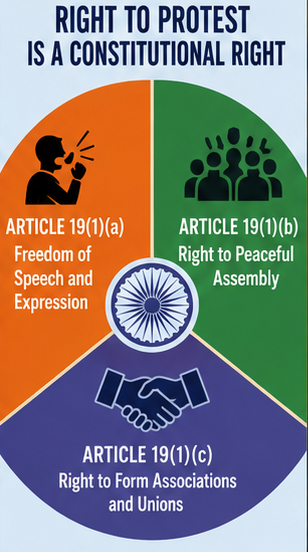
The Supreme Court’s observation that “subscribing to a leftist ideology doesn’t make someone a criminal” addresses a deeply significant constitutional principle. Article 19(1)(a) guarantees freedom of speech and expression; Article 19(1)(b) guarantees the right to peaceful assembly; Article 19(1)(c) guarantees the right to form associations and unions. These rights collectively protect the right to organise labour protests, form trade unions, and advocate for wage increases — even if the organisers hold minority political ideologies.
- Article 19(1)(a): Freedom of speech and expression — includes the right to publish labour journalism (Mazdoor Bigul) and to advocate for workers’ rights publicly
- Article 19(1)(b): Right to assemble peaceably and without arms — the Noida protests, in their peaceful phase, were constitutionally protected; violence (if any) by some protestors does not make the entire movement illegal or terrorist
- Article 19(1)(c): Right to form associations and unions — Mazdoor Bigul Dasta is a workers’ organisation whose members have a constitutional right to organise, regardless of their political ideology
- The “agent provocateur” label: UP government’s characterisation of arrested persons as “agent provocateurs” and “left-wing sympathisers” conflates political ideology with criminal intent — a conflation the Supreme Court explicitly rejected
- Reasonable restrictions under Article 19(2) do apply — public order, incitement to violence — but these must be narrowly and specifically proved for each individual, not applied as a blanket label to an entire protest movement
Practice Questions
1. Article 43, which is a Directive Principle of State Policy, mandates the State to secure a “living wage” for all workers — which is constitutionally distinct from, and higher than, the “minimum wage” that prevents mere subsistence-level deprivation.
2. In Workmen v. Reptakos Brett & Co. (1992), the Supreme Court identified five components of a living wage: food, clothing, and shelter; children’s education; medical requirements; minimum recreation; and provision for old age and contingencies.
3. The National Security Act (NSA), 1980 allows the government to detain a person for up to 12 months without trial, and the detainee has the right to be represented by a lawyer of their choice before the Advisory Board constituted to review the detention.
4. Article 19(1)(c) of the Constitution, which guarantees the right to form associations or unions, protects the right of workers to form trade unions and labour organisations, and this right cannot be restricted on grounds of the political ideology of the organisation’s members.
Which of the statements given above are correct?
Statement 1 is CORRECT. Article 43 is placed in Part IV (Directive Principles of State Policy) of the Constitution — not in the Fundamental Rights chapter. The Supreme Court has consistently held that the “living wage” contemplated by Article 43 is a higher standard than the “minimum wage” under the Minimum Wages Act, 1948 (now Code on Wages, 2019). The minimum wage prevents subsistence-level deprivation; the living wage enables a decent standard of life including social and cultural participation. The Supreme Court bench in the Noida workers’ case explicitly invoked this distinction to remind UP of its constitutional duty.
Statement 2 is CORRECT. In Workmen of Reptakos Brett & Co. Ltd. v. Management (1992), the Supreme Court elaborated on the concept of a living wage by identifying five components that must be taken into account in wage fixation: (1) food, clothing, and shelter needs of an average worker’s family; (2) children’s education; (3) medical requirements; (4) provision for minimum recreation; and (5) provision for old age, marriage, and other contingencies. These five components represent the constitutional benchmark of Article 43 and have been repeatedly cited in wage determination cases since 1992.
Statement 3 is INCORRECT. This is a critical distinction. Under the NSA 1980, while a detained person has the right under Article 22(5) to make a representation to the Advisory Board, they do NOT have the right to be represented by a lawyer of their choice before the Advisory Board. This is one of the most criticised aspects of preventive detention legislation — the Advisory Board review happens in camera, and the detainee must personally (without legal counsel) make their representation. The Supreme Court in A.K. Roy v. Union of India (1982) noted this limitation and called for reform, but it remains the law. This is precisely why habeas corpus petitions before High Courts and the Supreme Court (Articles 226 and 32) are the principal practical remedy for persons detained under NSA.
Statement 4 is CORRECT. Article 19(1)(c) guarantees the right to form associations or unions — which the Supreme Court has interpreted to include trade unions and workers’ organisations. This right is subject only to the reasonable restrictions under Article 19(4): sovereignty and integrity of India, public order, and morality. Political ideology of the union — including “leftist” ideology — is not a valid ground for restriction under Article 19(4). The Supreme Court’s observation in the Noida workers’ case that “subscribing to a leftist ideology doesn’t make someone a criminal” is a direct application of this constitutional principle.
Mains Questions

- India’s Youth Unemployment and Education Crisis - August 5, 2026
- India’s Sports Infrastructure and the 2036 Olympics Ambition - August 5, 2026
- Critical Minerals: The Foundation of Strategic Power - August 4, 2026

No Comments