


18 Jul Vikram-1 Success: India’s Private Space Sector & Global Power
Subject Relevance — Where This Topic Fits
- GS Paper II — Government Policies and Interventions, Science and Technology | GS Paper III — Science and Technology (Space Technology), Indian Economy (Industrial Policy, Infrastructure), Security (Space Security)
- Prelims: Vikram-1, Skyroot Aerospace, IN-SPACe, LEO, Private Space Sector, Space Reforms 2020, SPS-01, Orbital Launch Vehicle, Satis Dhawan Space Centre, Space Economy
- Essay: The Privatisation of Space: Opportunities and Challenges for India’s Technological Ascendancy, From Public Monopoly to Private Prowess: India’s Journey in Space Exploration and its Global Implications
Quick Revision: Vikram-1’s orbital success by Skyroot Aerospace signifies India’s private sector entering the global space launch market, validating space reforms and strengthening India’s position as a major space power.
Why is this in the news?
Dr. Jitendra Singh, Union Minister, lauded the successful orbital launch of ‘Vikram-1’, India’s first privately developed orbital launch vehicle by Skyroot Aerospace from Satish Dhawan Space Centre, Sriharikota. This landmark achievement, which successfully deployed experimental payloads into Low Earth Orbit (LEO), signifies India’s emergence as a major global space power and validates the transformative space sector reforms initiated by Prime Minister Narendra Modi in 2020, fostering private participation and innovation.
Background
- Historically, India’s space sector was primarily dominated by the Indian Space Research Organisation (ISRO), a government entity responsible for all space-related activities.
- In June 2020, the Union Cabinet approved far-reaching reforms to open up the space sector to private players, aiming to boost innovation, create jobs, and enhance India’s share in the global space economy.
- The establishment of the Indian National Space Promotion and Authorisation Centre (IN-SPACe) was a crucial step, acting as a single-window agency to promote, handhold, and authorise private sector activities in space.
- Skyroot Aerospace, a Hyderabad-based private space startup, emerged as a key beneficiary of these reforms, developing the ‘Vikram’ series of launch vehicles.
- Prior to Vikram-1, Skyroot Aerospace had successfully launched ‘Vikram-S’ (Sub-orbital) in November 2022, marking India’s first private rocket launch, demonstrating sub-orbital flight capabilities.
- The global space economy is projected to grow significantly, with commercial applications like satellite internet, Earth observation, and space tourism driving demand for launch services and satellite manufacturing.
What is Vikram-1?
- Vikram-1 is India’s first privately developed orbital launch vehicle, designed and built by Skyroot Aerospace.
- It is a multi-stage rocket capable of placing payloads into Low Earth Orbit (LEO).
- The vehicle is named after Dr. Vikram Sarabhai, the father of India’s space program, signifying a tribute to his pioneering vision.
- Unlike many initial orbital launches globally, Vikram-1 carried experimental payloads, including customer payloads from Indian and international partners, demonstrating its commercial viability and technological maturity.
- Its successful launch marks Skyroot Aerospace as the first Indian private company to achieve orbital launch capability from Indian soil.
- The mission’s success validates the efficacy of India’s public-private partnership model in the space sector, involving ISRO, IN-SPACe, and private startups.
- It aims to offer cost-effective and reliable launch services for small satellites, catering to the burgeoning global demand in this segment.
Key Features
| Feature | Significance |
|---|---|
| First Private Orbital Launch | Marks a paradigm shift from government monopoly to private sector participation in orbital space launches, fostering innovation and competition. |
| Experimental Payloads | Demonstrates technological maturity and commercial readiness by carrying actual payloads, unlike dummy payloads often used in maiden launches. |
| Low Earth Orbit (LEO) Capability | Enables deployment of small satellites for Earth observation, communication, and scientific research, a rapidly growing segment of the space market. |
| Public-Private Partnership (PPP) | Highlights the successful collaboration between ISRO, IN-SPACe, and private entities, leveraging national infrastructure and private innovation. |
| Indigenous Development | Showcases India’s self-reliance (Atmanirbhar Bharat) in advanced space technology, from design to manufacturing and launch. |
| Commercial Market Positioning | Strengthens India’s position in the global commercial launch market, offering competitive services for international clients. |
Why it Matters
Strategic Significance
- Enhances India’s strategic autonomy in space, reducing reliance on foreign launch capabilities for critical missions.
- Diversifies India’s space capabilities, allowing ISRO to focus on more complex, deep-space missions while private players handle commercial launches.
- Contributes to national security by fostering a robust domestic space industrial base, crucial for defence and intelligence applications.
Economic Significance
- Positions India as a significant player in the multi-billion dollar global space economy, attracting foreign investment and generating revenue.
- Fosters a vibrant space startup ecosystem, creating high-tech jobs and promoting entrepreneurship in advanced technology sectors.
- Offers cost-effective launch solutions, making space access more affordable for various applications, including remote sensing and telecommunications.
- Boosts ‘Make in India’ and ‘Atmanirbhar Bharat’ initiatives by promoting indigenous manufacturing and technological self-reliance.
Technological Significance
- Accelerates technological innovation and development within India, pushing the boundaries of rocket propulsion, materials science, and avionics.
- Facilitates rapid prototyping and deployment of new space technologies, reducing development cycles and increasing responsiveness to market demands.
- Demonstrates India’s capability to build and launch advanced orbital vehicles entirely within the private sector, showcasing engineering prowess.
Global Positioning
- Elevates India’s global standing as a leading space power, capable of not only government-led missions but also a thriving private space industry.
- Strengthens India’s diplomatic influence and partnerships in space, through collaborations and commercial ventures with international entities.
- Contributes to global space sustainability by potentially offering more efficient and environmentally conscious launch options in the long run.
Challenges
1. Regulatory Framework Evolution
- Ensuring a dynamic and adaptive regulatory environment that keeps pace with rapid technological advancements and private sector needs.
- Balancing ease of doing business for startups with national security concerns and international space treaties.
UPSC Link: GS Paper II — Government Policies
2. Funding and Investment
- Securing sustained long-term funding and venture capital for capital-intensive space ventures, especially for early-stage startups.
- Developing robust financial mechanisms and incentives to attract both domestic and international investors.
UPSC Link: GS Paper III — Indian Economy
3. Infrastructure Access and Utilisation
- Ensuring equitable and efficient access for private players to existing ISRO infrastructure (launch pads, testing facilities).
- Developing new, dedicated private infrastructure to support the growing demand without overburdening existing national assets.
UPSC Link: GS Paper III — Infrastructure
4. Talent Pool and Skill Development
- Addressing the demand for highly specialized talent in space engineering, rocketry, and satellite technology.
- Bridging the gap between academic curricula and industry requirements to produce a future-ready workforce.
UPSC Link: GS Paper III — Human Resource Development
5. Global Competition and Market Share
- Competing effectively with established global players and emerging private space companies from other nations.
- Capturing a significant share of the commercial launch and satellite services market amidst intense international competition.
UPSC Link: GS Paper III — Economy, International Relations
6. Space Debris Management
- Mitigating the increasing risk of space debris from a growing number of launches and satellite deployments.
- Adhering to international guidelines for space debris mitigation and ensuring responsible space operations.
UPSC Link: GS Paper III — Environment, Science & Tech
Challenges — UPSC Perspective
| Issue | Concern |
|---|---|
| Regulatory Ambiguity | Lack of comprehensive space law for private sector, potential for bureaucratic hurdles. |
| Capital Intensity | High investment required for R&D, manufacturing, and launch infrastructure, posing financial strain on startups. |
| Technology Transfer | Balancing ISRO’s proprietary knowledge with the need to support private sector growth without compromising national interests. |
| Market Access | Navigating complex international procurement processes and securing global clientele for launch services. |
| Cybersecurity Threats | Protecting sensitive space assets and data from cyberattacks, especially with increased private involvement. |
| Insurance and Liability | Developing robust frameworks for insurance and liability in case of launch failures or damage caused by private space activities. |
Government Initiatives — Must-Memorise for Prelims
- Space Sector Reforms 2020
- Indian National Space Promotion and Authorisation Centre (IN-SPACe)
- NewSpace India Limited (NSIL)
- Atmanirbhar Bharat Abhiyan
- Startup India Initiative
- Pradhan Mantri Kaushal Vikas Yojana (PMKVY) – for skill development
- National Policy on Space-based Applications (NPSA)
- Draft Space Activities Bill
- Technology Development Fund (TDF)
- Mission Karmayogi (for capacity building of civil servants in new domains)
Way Forward
- Develop a comprehensive and progressive National Space Policy and Space Activities Bill to provide a clear legal and regulatory framework for private sector operations.
- Strengthen IN-SPACe’s capabilities as a true single-window agency, ensuring efficient approvals, technical guidance, and infrastructure access for private players.
- Promote greater industry-academia collaboration to foster research, innovation, and skill development in cutting-edge space technologies.
- Incentivise private investment through tax breaks, grants, and easier access to capital, including dedicated space-focused venture funds.
- Encourage ISRO to act as an anchor customer for private sector services, providing initial market stability and validating private capabilities.
- Invest in developing shared testing facilities and launch infrastructure that can be accessed by multiple private entities, reducing individual capital expenditure.
- Actively participate in international forums to shape global space governance, promote responsible space practices, and secure India’s interests.
- Focus on niche areas like satellite manufacturing, space tourism, and in-orbit servicing to diversify India’s private space economy beyond launch services.
UPSC Value Addition
Keywords for Mains Answer-Writing
Space Sector Reforms · Private Participation · Global Space Economy · Atmanirbhar Bharat · Technological Sovereignty · Public-Private Partnership · Orbital Launch Capability · Space Startup Ecosystem · Strategic Autonomy · Commercialisation of Space · Space Governance · Innovation-led Growth
Constitutional & Policy Linkages
- Article 51 (Promotion of international peace and security) – Space cooperation
- Seventh Schedule (Union List, Entry 12: Atomic energy and space research) – Central government’s domain
- Space Activities Bill (Draft) – Regulatory framework for space activities
- National Space Policy (Proposed) – Guiding principles for space sector
- Companies Act, 2013 – Governing private entities like Skyroot Aerospace
Concept Flow
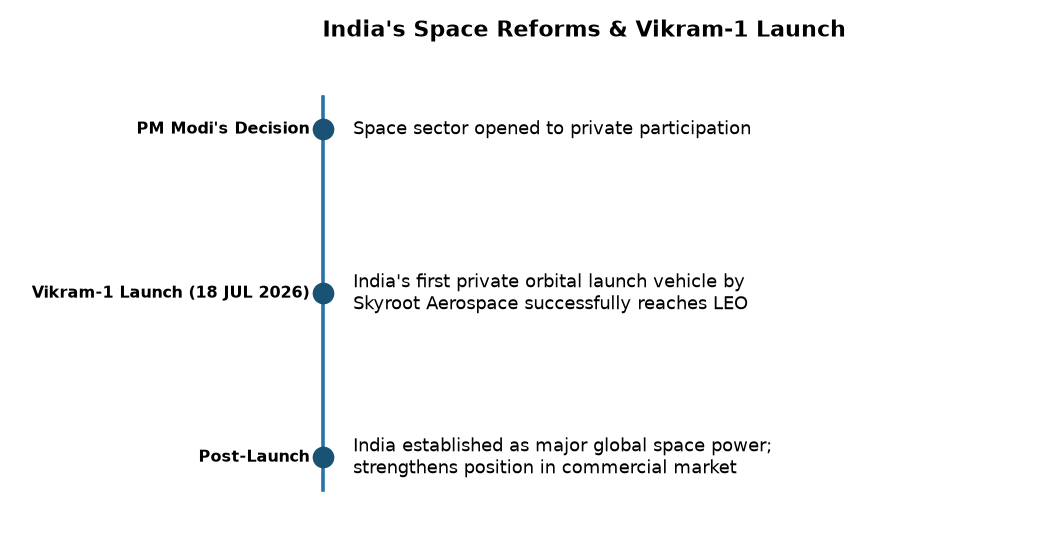
PM Modi’s Space Reforms (2020) → Establishment of IN-SPACe → Increased Private Sector Participation → Skyroot Aerospace’s Vikram-1 Development → Successful Orbital Launch (LEO) → India’s Emergence as Global Space Power → Boost to Space Economy & Atmanirbhar Bharat
Prelims Practice Questions
Q1. Consider the following statements regarding ‘Vikram-1’ mission:
1. It is India’s first privately developed orbital launch vehicle.
2. It was launched by NewSpace India Limited (NSIL).
3. It successfully placed experimental payloads into Geosynchronous Transfer Orbit (GTO).
Which of the statements given above is/are correct?
- A. 1 only
- B. 1 and 2 only
- C. 2 and 3 only
- D. 1, 2 and 3
Answer: A. 1 only — Statement 1 is correct: Vikram-1 is indeed India’s first privately developed orbital launch vehicle by Skyroot Aerospace. Statement 2 is incorrect: It was launched by Skyroot Aerospace, not NSIL. NSIL is a public sector undertaking under DoS, primarily for commercialisation. Statement 3 is incorrect: Vikram-1 placed payloads into Low Earth Orbit (LEO), not GTO.
Q2. Which of the following bodies acts as a single-window agency for promoting and authorising private sector activities in the Indian space sector?
- A. Indian Space Research Organisation (ISRO)
- B. Department of Space (DoS)
- C. Indian National Space Promotion and Authorisation Centre (IN-SPACe)
- D. NewSpace India Limited (NSIL)
Answer: C. Indian National Space Promotion and Authorisation Centre (IN-SPACe) — IN-SPACe (Indian National Space Promotion and Authorisation Centre) was established as an independent nodal agency under the Department of Space to allow and regulate private companies to use ISRO’s facilities and also to carry out their own space activities. ISRO is the primary space agency, DoS is the administrative department, and NSIL is the commercial arm of ISRO.
Mains Practice Question
✍ The successful launch of Vikram-1 marks a pivotal moment in India’s space journey, validating the transformative potential of space sector reforms. Critically analyse the strategic, economic, and technological implications of increased private sector participation in India’s space program. What challenges must be addressed to sustain this momentum and position India as a dominant global space power?
Approach: Begin by briefly introducing the Vikram-1 launch and the context of space sector reforms. In the main body, systematically discuss the strategic implications (e.g., national security, autonomy), economic implications (e.g., job creation, global market share, ‘Atmanirbhar Bharat’), and technological implications (e.g., innovation, faster development cycles). Subsequently, identify and elaborate on the key challenges, such as regulatory frameworks, funding, infrastructure access, global competition, and talent development. Conclude with a forward-looking perspective, suggesting actionable ‘way forward’ measures to consolidate India’s position in the global space arena.
Source: PIB (Press Information Bureau)
Generated by AanyaAi for educational purpose.

- Kerala HC Refuses Stay on Waqf Board Reconstitution: Key Facts - October 23, 2026
- तेलंगाना पेंशनरों के PAN और आधार विवरण होंगे सत्यापित, जानिए पूरा मामला - October 23, 2026
- Marathwada Turns Hotter; Konkan Wetter in 70 Years: IMD-IITM Study - October 23, 2026

No Comments