


24 Jul TV Rating Policy 2026: Enhancing Transparency & Accountability
Subject Relevance — Where This Topic Fits
- GS Paper II — Government Policies and Interventions for Development in various sectors and Issues arising out of their Design and Implementation | GS Paper III — Indian Economy and issues relating to Planning, Mobilization of Resources, Growth, Development and Employment
- Prelims: Television Rating Policy 2026, Audience Measurement, Ministry of Information and Broadcasting, BARC, Net Worth Requirement, Technology-Neutral Measurement, Cross-Holding Restrictions
- Essay: The Role of Regulation in Fostering Fair Competition and Transparency in Media, Technological Advancements and their Impact on Media Consumption and Measurement
Quick Revision: The Television Rating Policy, 2026, aims to enhance transparency and accountability in India’s TV audience measurement by reducing entry barriers, expanding sample sizes, mandating technology-neutral measurement, and implementing robust audit and penalty mechanisms.
Why is this in the news?
The Ministry of Information and Broadcasting has introduced the Television Rating Policy, 2026, superseding the previous guidelines from January 16, 2014. This new policy aims to enhance transparency, independence, and accountability within India’s television audience measurement system by establishing comprehensive guidelines for the registration, operation, audit, and monitoring of TV rating agencies. The policy introduces significant reforms, including reduced net worth requirements, an expanded sample size for metered households, and provisions for independent audits and penalties for non-compliance, thereby ensuring a more robust and reliable framework for viewership data.
Background
- Television audience measurement (TAM) is a critical component of the broadcasting industry, influencing advertising revenue, content creation, and policy decisions.
- The previous guidelines, issued on January 16, 2014, governed the functioning of TV rating agencies, but concerns regarding transparency, methodology, and potential conflicts of interest have periodically arisen.
- The dynamic media landscape, characterized by the proliferation of connected TVs and Over-The-Top (OTT) platforms, necessitated a policy framework capable of accommodating technological advancements and ensuring accurate, platform-agnostic measurement.
- The government’s objective has consistently been to foster a fair and transparent ecosystem for media measurement, safeguarding consumer interests and promoting healthy competition among broadcasters.
- The policy’s introduction follows extensive deliberations and addresses various stakeholder concerns, aiming to create a more equitable and credible system for television ratings.
What is the Television Rating Policy, 2026?
- The Television Rating Policy, 2026, is a comprehensive set of guidelines issued by the Ministry of Information and Broadcasting to regulate television rating services in India.
- It replaces the existing guidelines for TV rating agencies dated January 16, 2014, with an aim to ensure transparency, independence, and accountability in audience measurement.
- Key reforms include reducing the net worth requirement for rating agencies from ₹20 crore to ₹5 crore, facilitating broader participation in the sector.
- The policy mandates technology-neutral audience measurement, encompassing connected TVs and OTT platforms, to reflect the evolving media consumption patterns accurately.
- It significantly increases the sample size of metered households from 50,000 to 80,000, enhancing the statistical reliability and representativeness of viewership data.
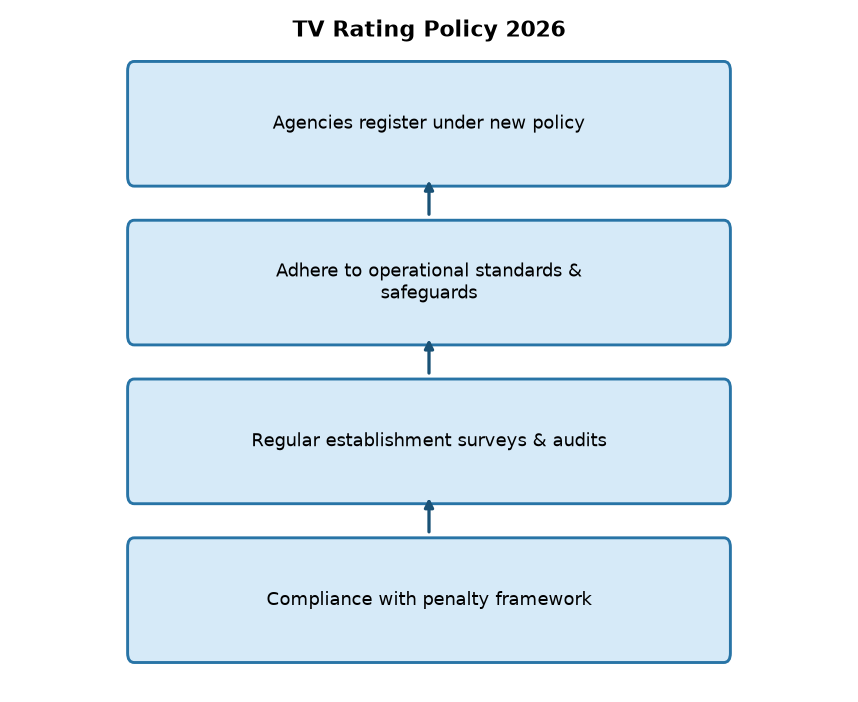
- Periodic establishment surveys, to be conducted every three years, are introduced to update the demographic and socio-economic profiles of the sample households.
- The policy explicitly excludes ‘landing pages’ from viewership data calculation, addressing a long-standing concern regarding artificial inflation of ratings.
- It mandates annual independent audits of rating agencies to verify compliance with methodological standards and operational protocols.
- Provisions for a graded penalty structure are included to deter non-compliance and ensure adherence to the policy’s stipulations.
- Recommended safeguards include prohibiting cross-holding, requiring at least 33% independent directors on agency boards, and restricting consultancy activities that could lead to conflicts of interest.
Key Features
| Feature | Significance |
|---|---|
| Reduced Net Worth Requirement | Decreased from INR 20 crore to INR 5 crore, fostering greater participation and competition among potential rating agencies. |
| Technology-Neutral Measurement | Encompasses Connected TV and OTT platforms, ensuring comprehensive and future-proof viewership data collection across diverse media consumption channels. |
| Increased Sample Size | Expanded from 50,000 to 80,000 metered households, enhancing the statistical robustness and representativeness of viewership data. |
| Periodic Establishment Surveys | Mandated every three years to update the demographic and socio-economic profile of the sample panel, ensuring accuracy and relevance of the data. |
| Exclusion of Landing Pages | Prohibits the inclusion of ‘landing page’ viewership in data calculation, preventing artificial inflation of channel ratings. |
| Independent Annual Audit | Mandatory external audits ensure the integrity, transparency, and reliability of the rating agencies’ operations and data. |
Why it Matters
Governance and Transparency
- Establishes clear guidelines for the registration, operation, audit, and monitoring of TV rating agencies, promoting accountability.
- Introduces measures such as independent audits and prohibition of cross-holdings to enhance the credibility and impartiality of viewership data.
- Replaces the 2014 guidelines, reflecting an updated regulatory framework aligned with contemporary media consumption patterns and technological advancements.
Economic Impact
- Reduces the financial barrier for entry (net worth requirement), potentially fostering a more competitive market for TV rating services.
- Ensures more accurate and reliable viewership data, which is crucial for advertisers in making informed investment decisions, thereby optimising advertising expenditure.
- Supports the growth of the broadcasting sector by providing a robust measurement system that reflects genuine audience engagement, attracting further investment.
Technological Adaptability
- Embraces technology-neutral measurement, including Connected TV and OTT platforms, acknowledging the evolving landscape of media consumption.
- Addresses the challenges posed by digital transformation in broadcasting, ensuring that the rating system remains relevant and comprehensive across various platforms.
Consumer Protection and Fair Practices
- Prevents manipulation of viewership data by excluding ‘landing page’ views, ensuring that ratings genuinely reflect audience preference.
- Implements a graded penalty structure for non-compliance, deterring malpractices and upholding ethical standards in the industry.
- Requires at least 33% independent directors on agency boards and prohibits conflict-of-interest activities, safeguarding the independence of rating operations.
Challenges
1. Data Accuracy and Representativeness
- Ensuring that the increased sample size of 80,000 metered households accurately represents India’s diverse socio-economic and geographical demographics.
- Maintaining the integrity of data collection in a technologically evolving environment, particularly with the proliferation of diverse viewing platforms.
UPSC Link: GS-II: Government Policies and Interventions
2. Regulatory Oversight and Enforcement
- Effective implementation and enforcement of the graded penalty structure to deter non-compliance and maintain industry standards.
- The capacity of regulatory bodies to conduct thorough independent audits annually and ensure adherence to all policy provisions.
UPSC Link: GS-II: Statutory, Regulatory and Quasi-Judicial Bodies
3. Technological Integration and Neutrality
- Developing and deploying robust, technology-neutral measurement systems that can accurately capture viewership across traditional TV, Connected TV, and OTT platforms.
- Addressing potential biases or limitations inherent in different measurement technologies and ensuring their seamless integration.
UPSC Link: GS-III: Science and Technology Developments and their Applications
4. Preventing Conflict of Interest
- Strictly enforcing the prohibition on cross-holdings and consultancy activities that could create conflicts of interest for rating agencies.
- Ensuring the genuine independence of the required 33% independent directors on agency boards, beyond mere compliance.
UPSC Link: GS-IV: Ethics and Human Interface
5. Market Entry and Competition
- While the net worth requirement is reduced, ensuring that the overall regulatory burden does not inadvertently stifle the entry of new, innovative players.
- Monitoring the market to prevent monopolistic tendencies or unfair practices despite the policy allowing multiple registered agencies.
UPSC Link: GS-III: Indian Economy and Issues Relating to Planning, Mobilization of Resources, Growth, Development and Employment
Challenges — UPSC Perspective
| Issue | Concern |
|---|---|
| Data Manipulation | Potential for agencies to exploit loopholes or engage in practices that artificially inflate ratings, despite new safeguards. |
| Technological Disparity | Challenges in accurately measuring viewership across a fragmented media landscape, including rural-urban digital divides and varying internet penetration. |
| Auditing Efficacy | Ensuring the independence and thoroughness of annual audits to genuinely uncover and address non-compliance issues. |
| Resource Allocation | Adequate allocation of resources for expanding the sample size to 80,000 households and conducting periodic establishment surveys effectively. |
| Industry Acceptance | Achieving broad acceptance and trust in the new policy’s framework and data outputs from all stakeholders, including broadcasters, advertisers, and agencies. |
| Global Standards Alignment | Continuously evolving the policy to align with international best practices in media measurement, ensuring global comparability and credibility. |
Way Forward
- Establish a robust, independent oversight body with sufficient powers to monitor compliance and enforce penalties effectively.
- Invest in advanced, AI-driven data analytics and measurement technologies to enhance accuracy and real-time insights across all platforms.
- Conduct regular stakeholder consultations to address emerging challenges and incorporate feedback for continuous policy refinement.
- Launch public awareness campaigns to educate consumers and industry about the importance of transparent TV rating systems.
- Promote research and development in media measurement methodologies to stay ahead of technological advancements and evolving viewer habits.
- Develop a comprehensive grievance redressal mechanism for broadcasters and advertisers to report discrepancies and seek resolution.
- Explore partnerships with academic institutions for independent validation and auditing of rating methodologies and data integrity.
UPSC Value Addition
Keywords for Mains Answer-Writing
Television Rating Policy 2026 · TV viewership measurement · Ministry of Information and Broadcasting · Transparency in media ratings · Broadcast Audience Research Council (BARC) · Regulatory framework for TV ratings · Conflict of interest in media · Technological neutrality in viewership data · Audience measurement methodology · Media ethics and accountability
Constitutional & Policy Linkages
- Article 19(1)(a): Freedom of Speech and Expression
- Article 19(1)(g): Right to Practice any Profession
Concept Flow
Need for transparent TV rating system → Ministry of I&B issues TV Rating Policy 2026 → Policy introduces reforms (e.g., reduced net worth, increased sample size) → Enhanced transparency, independence, and accountability in TV viewership measurement → More reliable data for advertisers and broadcasters → Fairer competition and informed decision-making in the media industry
Prelims Practice Questions
Q1. Consider the following statements regarding the Television Rating Policy, 2026:
1. It replaces the existing guidelines for TV rating agencies issued in 2014.
2. The policy mandates a reduction in the net worth requirement for rating agencies from ₹20 crore to ₹5 crore.
3. It prohibits cross-holding and requires at least 33% independent directors on the agency’s board.
Which of the statements given above are correct?
- 1 and 2 only
- 2 and 3 only
- 1 and 3 only
- 1, 2 and 3
Answer: 1, 2 and 3 — Statement 1 is correct: The Television Rating Policy, 2026, supersedes the guidelines issued on January 16, 2014. Statement 2 is correct: The policy reduces the net worth requirement for agencies from ₹20 crore to ₹5 crore. Statement 3 is correct: The policy includes provisions for prohibiting cross-holding and mandating at least 33% independent directors on the boards of rating agencies to ensure independence and transparency.
Q2. Which of the following measures are introduced by the Television Rating Policy, 2026, to enhance the reliability of TV viewership data?
1. Increase in the sample size of metered households.
2. Inclusion of landing pages in viewership data calculation.
3. Introduction of periodic Establishment Surveys.
4. Mandating annual independent audits.
Select the correct answer using the code given below:
- 1, 2 and 3 only
- 1, 3 and 4 only
- 2, 3 and 4 only
- 1, 2, 3 and 4
Answer: 1, 3 and 4 only — Statement 1 is correct: The policy increases the number of metered households from 50,000 to 80,000. Statement 2 is incorrect: The policy explicitly excludes landing pages from viewership data calculation. Statement 3 is correct: Periodic Establishment Surveys are to be conducted every three years. Statement 4 is correct: The policy mandates annual independent audits to ensure data integrity.
Mains Practice Question
✍ The Television Rating Policy, 2026, aims to strengthen transparency, independence, and accountability in India’s TV viewership measurement system. Critically analyse the key provisions of this policy and discuss their potential impact on the Indian broadcasting sector and media ethics. (250 words)
Approach: Begin by briefly introducing the context and the need for the new policy. Detail the key provisions, such as changes in net worth, sample size, technology neutrality, exclusion of landing pages, independent audits, and governance safeguards (cross-holding, independent directors). Critically analyse the potential positive impacts on transparency, fairness, and competition within the broadcasting sector. Discuss how these measures address previous concerns regarding data manipulation and conflicts of interest. Conclude by assessing the overall significance of the policy in fostering a more robust and ethical media environment in India.
Source: PIB (Press Information Bureau)
Generated by AanyaAi for educational purpose.


No Comments